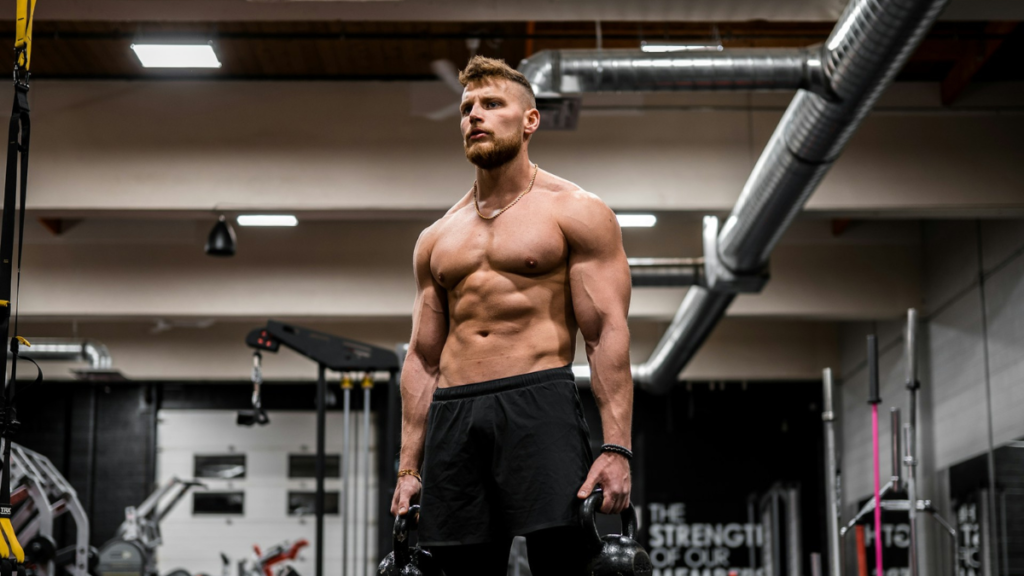
The floor press is one of the best chest exercises you can do without a bench. It trains the chest, triceps, and front shoulders with a stable setup, a simple movement pattern, and little equipment. You only need a pair of dumbbells, kettlebells, or a barbell with a safe way to get into position.
A bench press is an excellent chest building exercise, but you do not need a bench to make progress. The floor press lets you load a horizontal pressing pattern while the floor provides a firm and predictable base. This makes it a practical option for home training, crowded gyms, beginners, and lifters who want to train pressing strength without setting up a bench.



The floor press does have a shorter range of motion than the bench press because your upper arms stop when they contact the floor. That is not automatically good or bad. A full range of motion is usually useful for muscle development, but the floor press can still be an effective chest and triceps exercise when it is trained with enough effort and progressive overload.
The floor press is especially valuable when you want a straightforward press that is easy to control. You can focus on building strength through the chest and triceps without worrying about balance on a bench or excessive movement at the bottom of the repetition.
Why the Floor Press Works for Chest Training
The chest is primarily made up of the pectoralis major, a large muscle that helps move the upper arm across the body and forward from the shoulder. During pressing exercises, the chest works with the triceps and front shoulders to move the weight away from the torso.
The floor press trains this pushing pattern while you lie flat on the ground. Your torso is supported, your legs can stay still, and the floor limits how far your upper arms travel below your body. This gives the exercise a stable foundation that can make it easier to learn than some other pressing variations.
Research on resistance training shows that muscle growth is supported by progressive overload, sufficient effort, and enough weekly training volume. The floor press can meet all three requirements. You can add weight, perform more repetitions, add sets, slow the lowering phase, or use a more challenging variation.
The exercise is not a direct replacement for every benefit of the bench press. Because the floor stops the upper arms, the chest does not work through the same stretched position that it would during a deeper bench press. However, the floor press still provides meaningful resistance for the chest and triceps through the available range of motion.
For people who train at home or do not have access to a bench, that makes it an extremely useful option.
How to Perform the Floor Press
The floor press can be performed with dumbbells, kettlebells, or a barbell. Dumbbells are usually the simplest choice for beginners because you can bring them into position more easily and lower them safely to the side after your set.
Lie on your back with your knees bent and your feet flat on the floor. Hold the weights above your chest with your arms extended. Your wrists should be stacked over your elbows, and your shoulder blades should rest firmly against the floor.
Lower the weights slowly until the backs of your upper arms contact the floor. Pause briefly without relaxing completely. Then press the weights upward until your elbows are straight. Keep the movement controlled and avoid bouncing your arms off the floor. Your elbows should not flare directly out to the sides. Instead, keep them angled slightly toward your torso. This often creates a more comfortable pressing path for the shoulders and allows the chest and triceps to contribute effectively.
The floor press should feel stable and deliberate. You do not need to rush the movement. A controlled lowering phase improves your ability to maintain position and creates more time under tension for the target muscles.
Dumbbell Floor Press
The dumbbell floor press allows each arm to work independently. This can help you notice side to side differences in control and strength. It also lets you use a neutral grip, where your palms face each other, if that feels more comfortable for your shoulders.
Start with dumbbells on the floor beside your torso. Roll slightly to one side, grip the weights, and use both hands to guide them into the starting position. Once the dumbbells are above your chest, perform your repetitions with control.
3 Best Standing Core Exercises for Beginners that Want a Stronger Six Pack
At the end of the set, lower the dumbbells back toward your chest, then guide them safely to the floor. Do not drop them from the top position.
Barbell Floor Press
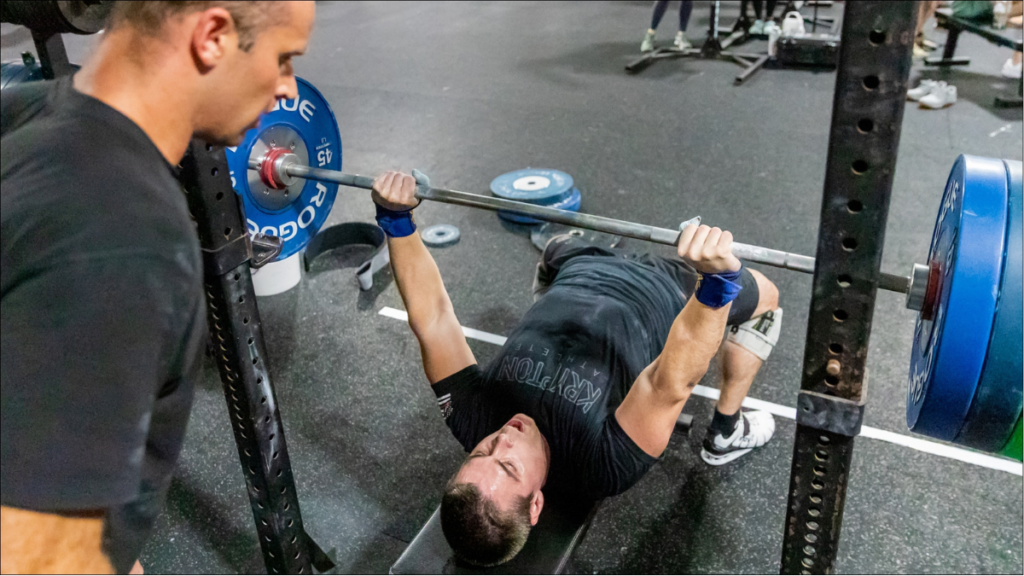
The barbell floor press allows you to use heavier loads, but it requires more attention to setup and safety. Ideally, begin from a rack with safety arms positioned appropriately. If you do not have a secure rack and know how to use it safely, dumbbells or kettlebells are a better choice.
Once the bar is over your chest, lower it under control until your upper arms touch the floor. Press it upward in a smooth path. Keep your wrists straight and your elbows controlled throughout the repetition.
The barbell version can be particularly useful for building pressing strength because the load is easy to progress in small increments. However, the stability and simplicity of dumbbells make them the better starting choice for many people.
The Floor Press and Shoulder Comfort
The floor press is often described as shoulder friendly because the floor limits the bottom portion of the movement. This may be useful for some lifters because it reduces how far the upper arm moves behind the body. However, this does not mean the exercise is automatically safe or pain free for everyone.
Shoulder discomfort has many possible causes, and no single pressing variation works for every person. If you can perform the floor press with a comfortable range of motion and controlled technique, it may be a useful alternative to deeper pressing exercises. If it causes sharp pain, persistent discomfort, tingling, or a feeling of instability, stop and seek individual guidance from a qualified health professional.
Research on shoulder mechanics supports the importance of load management, progressive strengthening, and appropriate exercise selection. The best chest exercise is the one you can perform consistently, progress safely, and recover from well.
The floor press provides a practical starting point because the stable floor setup makes it easier to control the lower portion of each repetition. For many beginners, this can reduce uncertainty and help them learn a strong pressing pattern before moving to a bench press.
How to Build Chest Muscle With the Floor Press
To build muscle, the floor press must become progressively more challenging over time. Start with a load that you can control for six to twelve repetitions. The final few repetitions should feel difficult, but your form should remain consistent.
Research shows that both lighter and heavier loads can support muscle growth when sets are performed with sufficient effort. This means you do not need extremely heavy weights to grow your chest. Moderate dumbbells, kettlebells, or a barbell can work well if you gradually increase the training demand.
Perform the floor press two or three times each week. Beginners can start with two or three working sets per session. More experienced lifters may need additional weekly pressing volume, but only if they can recover well and maintain high quality technique.
A simple progression is to add repetitions until you reach the top of your target range. For example, begin with three sets of eight repetitions. Over several sessions, work toward three sets of twelve repetitions. Once you can complete all three sets with good form, increase the weight slightly and return to eight repetitions.
Use a Controlled Lowering Phase
The lowering phase of the floor press is important. Lower the weights for about two or three seconds instead of letting them fall quickly toward the floor. This helps you maintain a strong position and increases the amount of controlled work completed by the chest and triceps.
Pause briefly when your upper arms touch the floor. Do not let your shoulders relax completely at the bottom. Keep tension through your arms and upper back, then press the weights upward smoothly.
Train Both Chest and Upper Back
A strong chest is useful, but pressing should be balanced with pulling exercises. Rows, pullups, inverted rows, and other upper back movements train the muscles that help control the shoulder blades.
Research supports training all major muscle groups rather than focusing on a single exercise pattern. For practical programming, perform at least as much pulling work as pressing work, and consider adding more pulling volume if your training includes a great deal of chest and shoulder work.
Common Floor Press Mistakes
One common mistake is lowering the upper arms to the floor and completely relaxing. This turns each repetition into a stop and restart. A short pause is fine, but maintain enough tension to press smoothly from the bottom position.
Another mistake is allowing the wrists to bend backward under the load. Keep your knuckles pointed toward the ceiling and stack the weight over your forearms. This creates a stronger and more comfortable pressing position.
Some lifters also use an excessively wide elbow position. Flaring the elbows directly out to the sides can make the shoulders feel less stable. Keep the elbows slightly closer to the torso and allow the weights to travel in a natural path.
Finally, do not select weights that force you to lose control. Heavy training can be productive, but only when you can lower and press the load safely. Use dumbbells, a spotter, or proper rack safety equipment when appropriate.
Who Should Use the Floor Press?
The floor press is useful for beginners learning how to press, home lifters without a bench, athletes who want extra triceps strength, and experienced lifters who want a stable pressing variation. It can also work well in a program that includes pushups, overhead presses, rows, and pullups.
If your main goal is maximum chest development, include a variety of pressing and fly movements over time when they are available and comfortable. The floor press can be one central movement, but variety can help you train the chest through different angles and ranges of motion.
If you only have access to basic equipment, the floor press is still enough to make meaningful progress. Train it consistently, make the sets challenging, and pair it with sufficient pulling work.
Final Thoughts
The floor press is the best chest exercise you can do without a bench because it is stable, effective, scalable, and easy to perform at home or in the gym. It trains the chest, triceps, and front shoulders while limiting the bottom range of motion with the floor.
It is not identical to the bench press, and it does not need to be. The floor press provides a practical way to build pressing strength and chest muscle when you do not have a bench or prefer a more controlled setup. Focus on steady progression, controlled repetitions, and balanced upper body training.
Table 1: Key takeaways
| Topic | Main point | Practical application |
|---|---|---|
| Exercise purpose | The floor press trains the chest, triceps, and front shoulders | Use it as your main horizontal pressing exercise when no bench is available |
| Range of motion | The floor limits how far the upper arms travel below the torso | Maintain tension when your upper arms touch the floor |
| Muscle gain | Progressive overload and challenging sets drive improvement | Use two or three sets of six to twelve repetitions |
| Equipment choice | Dumbbells, kettlebells, and barbells can all work | Beginners should usually begin with dumbbells or kettlebells |
| Shoulder comfort | The limited range may suit some lifters | Stop if you experience sharp pain or worsening symptoms |
References
- American College of Sports Medicine (2009) ‘American College of Sports Medicine position stand: Progression models in resistance training for healthy adults’, Medicine and Science in Sports and Exercise, 41(3), pp. 687 to 708.
- Cools, A.M., Struyf, F., De Mey, K., Maenhout, A., Castelein, B. and Cagnie, B. (2014) ‘Rehabilitation of scapular dyskinesis: From the office worker to the elite overhead athlete’, British Journal of Sports Medicine, 48(8), pp. 692 to 697.
- Schoenfeld, B.J., Grgic, J., Ogborn, D. and Krieger, J.W. (2017) ‘Strength and hypertrophy adaptations between low versus high load resistance training: A systematic review and meta analysis’, Journal of Strength and Conditioning Research, 31(12), pp. 3508 to 3523.
- Schoenfeld, B.J., Ogborn, D. and Krieger, J.W. (2017) ‘Dose response relationship between weekly resistance training volume and increases in muscle mass: A systematic review and meta analysis’, Journal of Sports Sciences, 35(11), pp. 1073 to 1082.
- Trebs, A.A., Brandenburg, J.P. and Pitney, W.A. (2010) ‘An electromyography analysis of three muscles surrounding the shoulder joint during the performance of a chest press exercise at several angles’, Journal of Strength and Conditioning Research, 24(7), pp. 1925 to 1930.
- Welsch, E.A., Bird, M. and Mayhew, J.L. (2005) ‘Electromyographic activity of the pectoralis major and anterior deltoid muscles during three upper body lifts’, Journal of Strength and Conditioning Research, 19(2), pp. 449 to 452.