

Starting a back workout can feel confusing when the gym is full of unfamiliar machines, cables, and free weights. A good beginner routine does not need a long list of movements. It needs exercises you can learn, repeat, and gradually make more challenging.
These three exercises cover two useful pulling patterns. The lat pulldown trains a vertical pull, while the seated cable row and chest supported row train horizontal pulls. All three are common beginner options, and expert consensus on exercise selection includes pulldowns and both types of rows as suitable choices for people new to resistance training. Research also shows that resistance training can improve strength and muscle size, with a range of training approaches producing benefits.


The best exercise is one you can perform with control and without pain. Start with a manageable weight, learn the movement, and give yourself time to improve. The goal is not to lift as much as possible on your first day. It is to build a routine you can keep doing.
What Beginners Should Know About Back Training
Your back includes several muscles that help move your arms and shoulder blades, as well as muscles that support and move your trunk. Pulling exercises involve different combinations of these muscles. For example, the latissimus dorsi, often called the lats, contributes to movements that bring the upper arm down and back. Rowing exercises involve the lats too, along with muscles around the shoulder blades.
No single exercise trains every back muscle in exactly the same way. That is one reason a routine with both a vertical pull and a horizontal pull is a useful starting point. The three exercises below give you straightforward ways to practice these patterns, while machines and cables make it easier to adjust resistance in small steps.
Beginners do not need to test their maximum strength to choose a starting weight. Choose a resistance that lets you complete each repetition with steady control and good technique. The American College of Sports Medicine’s guidance for novice resistance training recommends loads that allow roughly 8 to 12 repetitions. That is a helpful starting range, although your comfort, training history, and goals should guide the details.
1. Lat Pulldown
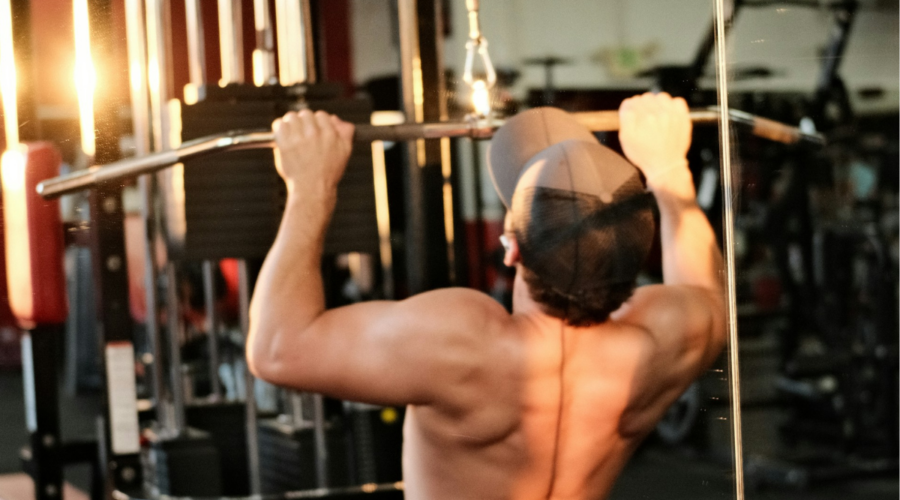
The lat pulldown is a practical way to learn a vertical pulling movement before trying an unassisted pullup. You sit at the machine and pull a bar down toward your upper chest while the machine provides adjustable resistance. The movement trains the lats and also involves the arms and muscles around the shoulder blades.
How to Do a Lat Pulldown
Adjust the thigh pad so it holds your legs comfortably in place without pressing painfully into them. Sit facing the machine and take an overhand grip on the bar, with your hands a little wider than shoulder width. If the bar or grip feels uncomfortable, ask a trainer to help you find a comfortable setup.
Sit tall, brace your torso gently, and begin with your arms extended overhead. Pull the bar down toward the upper part of your chest, keeping your elbows pointed down. Pause briefly when the bar reaches a comfortable position, then let it rise under control until your arms are extended again. Keep the movement smooth rather than leaning back to swing the weight down.
A common mistake is pulling the bar behind the neck. There is no need to do that to train your back, and reaching behind your head may feel uncomfortable for some people. Pull the bar in front of you toward your upper chest instead. Another common mistake is using momentum by rocking the torso back and forth. If you have to swing to complete a repetition, reduce the weight.
Why It Works for Beginners
The lat pulldown lets you practice a vertical pull with a stable seated position and adjustable resistance. A small laboratory study comparing common back exercises found that the lat pulldown recruited the lats, while also involving the biceps and other muscles. That kind of short term muscle activity research cannot prove that one exercise will produce the most growth over time, but it helps explain why the pulldown is a relevant back exercise.
Start with two or three sets of 8 to 12 controlled repetitions. Rest long enough between sets to feel ready to perform the next one with similar technique. If you cannot bring the bar down without leaning far back, or if you feel pain, lower the weight and reassess your setup.
2. Seated Cable Row
The seated cable row is a horizontal pulling exercise that trains the back while letting you sit with your feet supported. It uses a cable stack and a handle, often a narrow neutral grip handle. This makes the exercise simple to adjust and gives you a clear path to follow as you pull.
How to Do a Seated Cable Row
Sit on the bench with your feet against the footplates and your knees slightly bent. Hold the handle with both hands and sit tall, with your arms extended in front of you. Keep your shoulders relaxed rather than pulling them up toward your ears.
Pull the handle toward your lower ribs or upper abdomen by bending your elbows and drawing them back. Keep your torso steady as the handle approaches you. Pause briefly, then extend your arms slowly to return to the starting position. Let your shoulder blades move naturally as you reach forward, while keeping control of the cable.
Avoid rounding your back to reach farther forward or leaning back to pull the handle. The movement should come mainly from your arms and shoulders, while your trunk stays steady. If you find yourself rocking with each repetition, reduce the load until you can complete the set without swinging.
Why It Works for Beginners
The seated cable row is a useful way to practice pulling toward your body. In a small study that measured muscle activity during several back exercises, the seated row involved the lats and also recruited muscles around the shoulder blades. The study compared activity during specific exercise conditions, so it does not establish that the seated row is better than every other rowing option for long term strength or muscle growth.
A neutral grip, where your palms face one another, is a comfortable starting choice for many people. Keep the range of motion within a comfortable limit. You do not need to pull the handle as far as possible if doing so makes your shoulders roll forward or your lower back round. Try two or three sets of 8 to 12 repetitions, using a weight you can control on both the pull and the return.
3. Chest Supported Row
The chest supported row is another horizontal pull, performed on a machine or with your chest resting against an angled bench. The support helps keep your torso in place, which can make it easier to focus on the pulling action. Expert consensus on exercises for novice lifters includes chest supported rows among suitable options.
How to Do a Chest Supported Row
Set the seat or bench so that the handles are within comfortable reach when your arms are extended. Place your chest against the pad and keep your feet firmly on the floor or the machine’s supports. Hold the handles and begin with your arms extended, allowing your shoulder blades to move forward naturally without lifting your chest from the pad.
Pull the handles toward your sides by bending your elbows. Keep your chest in contact with the pad and avoid shrugging your shoulders. Pause briefly when your elbows reach a comfortable position beside your torso, then extend your arms slowly to return to the start. Move only as far as you can while staying comfortably supported.
Do not jerk the handles or lift your chest to help finish a repetition. If the handles pull your shoulders into an uncomfortable position at the start, adjust the seat or use a different handle if the machine allows it. Ask a trainer to check the setup if you are unsure how to adjust the machine.
Why It Works for Beginners
Like the seated cable row, the chest supported row trains a horizontal pull. Its chest pad gives you a stable point of contact, which can help you practice the movement without needing to hold your torso in position throughout the set. That does not make it automatically better than a cable row. Both are reasonable choices, and you can use the one that feels more comfortable and is easier to set up at your gym.
The chest supported row also gives you a simple way to keep the movement consistent from repetition to repetition. Start with two or three sets of 8 to 12 repetitions. Use a resistance that lets you pause briefly at the end of the pull and return the handles under control.
How to Put These Exercises Into a Beginner Workout
You do not need to perform all three exercises in every workout. For a simple back session, choose one pulldown and one row. If you want to practice both rowing variations, use the chest supported row in one session and the seated cable row in another. This approach gives you practice with the main pulling patterns without adding exercises just to make the workout longer.
For each exercise, begin with a light warmup set if it helps you get comfortable with the machine and movement. Then perform two or three working sets in a range of about 8 to 12 repetitions. Finish a set when you feel you could complete only a few more repetitions with good technique. You do not need to keep going until you cannot move the weight at all.
As the exercise becomes easier, add a small amount of weight when you can complete the top of your repetition range while maintaining good control. The ACSM’s progression guidance supports increasing resistance when a person can perform more repetitions than the target range. Small increases are easier to manage than large jumps, especially while you are still learning the exercise.

Give yourself time between sessions to recover, and avoid making major changes to several parts of your routine at once. A systematic review and meta analysis of resistance training studies found that many different combinations of load, sets, and weekly frequency can improve strength and muscle size. Consistency and a plan you can sustain matter more than finding one perfect exercise variation.
Stop if an exercise causes sharp pain, numbness, or a feeling that something is wrong. Adjust the machine or exercise, reduce the weight, or ask a qualified trainer for help. If you have an injury or a health condition that affects exercise, seek guidance from an appropriate health professional before starting a new routine.
Key Takeaways
| Focus | What to Remember |
|---|---|
| Vertical pull | The lat pulldown is a beginner friendly way to practice pulling from overhead. |
| Horizontal pull | Seated cable rows and chest supported rows train pulling toward your body. |
| Starting volume | Begin with two or three sets of about 8 to 12 controlled repetitions. |
| Technique | Use a manageable weight, keep the movement smooth, and avoid swinging. |
| Progress | Add resistance gradually when you can complete your repetitions with steady form. |
References
- American College of Sports Medicine (2009) ‘Progression models in resistance training for healthy adults’, Medicine & Science in Sports & Exercise, 41(3), pp. 687–708.
- Currier, B.S. et al. (2023) ‘Resistance training prescription for muscle strength and hypertrophy in healthy adults: a systematic review and Bayesian network meta-analysis’, British Journal of Sports Medicine, 57(18), pp. 1211–1220.
- Kompf, J.M., Rhodes, R.E. and Lee, S. (2025) ‘Selecting resistance training exercises for novices: a Delphi study with expert consensus’, American Journal of Lifestyle Medicine, 19(3), pp. 437–449.
- Lehman, G.J., Buchan, D.D., Lundy, A., Myers, N. and Nalborczyk, A. (2004) ‘Variations in muscle activation levels during traditional latissimus dorsi weight training exercises: an experimental study’, Dynamic Medicine, 3, article 4.