

For most beginners, the standard dumbbell shoulder press is the better place to start. It uses a direct pressing pattern that is straightforward to learn, easy to repeat, and simple to progress over time. The Arnold press is a useful variation, and one small study found greater electrical activity in parts of the deltoid during the Arnold press. That finding does not prove that it builds more muscle over the long term.
The best choice is the version you can perform with a comfortable range of motion, steady control, and a load you can increase gradually. If both feel good, start with the standard shoulder press as your main lift, then try the Arnold press later as an alternative. Neither movement alone builds every part of the shoulder equally, so shoulder training should also include movements that challenge the side and rear deltoids.


What is the difference between the two presses?
A standard dumbbell shoulder press begins with the weights near shoulder level and the palms facing mostly forward or slightly toward one another. You press the dumbbells overhead, then lower them under control along the same general path. The exact position can vary with your equipment and mobility, but the exercise does not require you to rotate your hands through a large arc.
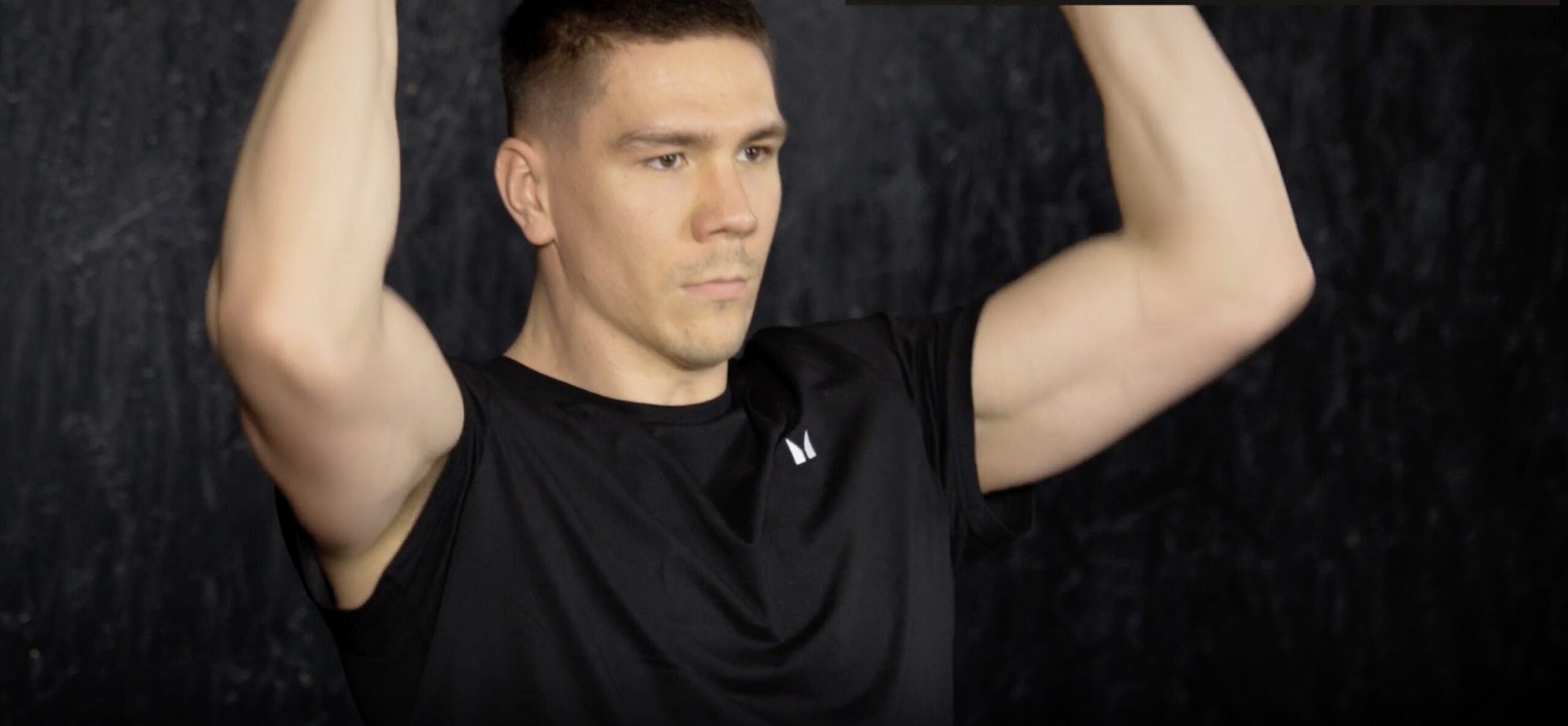
The Arnold press begins with the dumbbells in front of the upper chest, palms facing the body, and elbows bent in front of you. As you press upward, you rotate the hands so the palms face forward near the top. You reverse that rotation as you lower the weights. That turning action changes the path of the dumbbells and adds a coordination demand to the movement.

Both are compound exercises. The deltoids help raise the upper arms, while the triceps help straighten the elbows. The front portion of the deltoid is heavily involved in pressing in front of the body. The side portion contributes to raising the arm out to the side, but a press should not be treated as a complete substitute for side raises. The rear portion helps move the arm backward and is not the main target of either press. A balanced shoulder program therefore usually pairs a press with movements for the side and rear deltoids.
What the science says about muscle growth
The most direct comparison located for these exercises was a small electromyography study involving ten young men with at least a year of weight training experience. Participants performed five repetitions of each dumbbell press while researchers measured electrical activity in the front and side portions of the deltoid. The Arnold press produced higher readings in both measured portions during that test.
This result is interesting, but it cannot tell us which exercise builds more shoulder muscle. Electromyography measures electrical signals during a task. It does not directly measure how much muscle a person gains after months of training. The study was also small, included experienced young men rather than beginners, and examined only two portions of the deltoid. It did not compare long term changes in muscle size, strength, comfort, or injury rates. So it is not sound to declare the Arnold press the winner based on this result alone.
Broader resistance training research points to a more useful principle for beginners: choose a movement that can be trained consistently and progressively. An American College of Sports Medicine overview of systematic reviews found that hypertrophy is influenced by training variables such as weekly volume, while many other factors, including load and training frequency, do not consistently change muscle growth when training is otherwise appropriately programmed. A separate meta analysis found similar muscle growth across a range of loads when training volume was matched, although heavier loads produced greater gains in maximal strength.
In practical terms, a beginner does not need to chase the exercise with the highest single session muscle activity reading. A manageable press, performed with good control and gradually increased repetitions or weight, can contribute to growth. The Arnold press may suit some people better, but there is not enough long term comparison research to say that it is inherently superior for shoulder size.
Why the standard shoulder press is a strong beginner choice
The standard press has fewer moving parts to coordinate. You can focus on keeping your torso stable, pressing smoothly, and controlling the lowering phase without also timing a rotation. That makes it easier to learn what a repeatable repetition feels like and to notice when your technique changes as the set gets harder.
It is also straightforward to track. If you complete your planned sets with solid form, you can add a repetition or use a slightly heavier pair of dumbbells in a later session. This kind of gradual progression gives a beginner a clear training target. The 2026 ACSM position stand emphasizes progressive resistance training and supports a range of effective approaches rather than one uniquely best exercise prescription.
A seated version with back support can help beginners limit unnecessary torso movement while they learn the pattern. Standing presses are also an option, but they ask you to stabilize your trunk and legs as you lift. Neither setup is universally best. Choose the version that lets you press without leaning back excessively or turning the movement into a push from your legs.
To perform a repetition, sit or stand tall with the dumbbells near shoulder height. Keep your ribs stacked over your pelvis and your wrists roughly over your elbows. Press the weights overhead along a path that feels natural, without forcing your elbows into an uncomfortable position. Finish with the weights over your shoulders, then lower them under control. Use a range of motion you can manage comfortably and consistently.
When the Arnold press may be useful
The Arnold press can be a reasonable option if you can rotate your arms comfortably and can control the dumbbells through the whole repetition. The lower starting position gives the movement a different path and may make the set feel more challenging across a longer portion of the repetition for some lifters. That is a practical observation about how the exercise feels, not proof that it produces more growth.
Some beginners enjoy the rotation and find it helps them stay focused on the exercise. Others find that the turning motion makes it harder to keep the wrists, elbows, and dumbbells controlled. If you are still learning how to brace and press, the additional coordination can distract from the basics. Start very light if you test it, and stop the set if you feel sharp pain or cannot keep the motion smooth.
Shoulder comfort is individual. Research on shoulder pressing shows that changes in range of motion can change muscle activity, but those acute findings do not establish that one range is safest for everyone. Do not force a deep starting position or a large rotation just to copy a demonstration. Use a comfortable range, and consider asking a qualified clinician or coach for help if you have persistent pain or a relevant injury history.
How beginners can program either exercise
A simple starting point is to perform the shoulder press once or twice per week as part of a balanced resistance training plan. Begin with two or three working sets of about eight to twelve controlled repetitions, using a load that leaves you able to maintain technique. This is a practical range rather than a special muscle building zone. Current evidence indicates that muscle can grow across a wide range of loads when sets are sufficiently challenging and the training is progressed.
Keep one or two good repetitions in reserve at first, meaning you finish each set when you think you could still complete one or two more clean repetitions. Beginners do not need to take every press set to the point where another repetition is impossible. A systematic review found no clear requirement to reach momentary failure for muscle growth, and repeatedly pushing a technical lift to failure can make it harder to maintain clean repetitions.
When you can complete the top end of your repetition range for every set with stable form, increase the weight by the smallest practical amount and build the repetitions again. If the next dumbbells are much heavier, add repetitions gradually before moving up. Record the load and repetitions so you can see whether your training is progressing.
Do not rely on pressing alone to develop the whole shoulder. A beginner could pair a shoulder press with a lateral raise for the side deltoids and a rear deltoid exercise, such as a reverse fly or cable rear delt fly. These choices address functions and regions that an overhead press does not emphasize as directly. Keep total training volume appropriate to your experience and recovery, rather than adding extra sets every week simply because the shoulders are a smaller muscle group.
Which one should you choose?
Choose the standard dumbbell shoulder press if you want the simplest option to learn, track, and progressively load. It is the best default recommendation for a beginner because it teaches a basic overhead pressing pattern without the Arnold press rotation. Choose the Arnold press if the movement feels comfortable, you can control the rotation, and you enjoy it enough to train it consistently.
You can also use both across different training blocks, or use one as your main press and the other occasionally as a variation. Keep the rest of your program consistent long enough to evaluate your performance. Switching exercises every workout makes it harder to judge whether you are adding repetitions, improving control, or tolerating more load.
The science does not establish a universal winner for shoulder growth. The one direct EMG comparison favors the Arnold press for short term activation in two deltoid regions, but it does not establish greater long term hypertrophy. For most beginners, the standard shoulder press is the sensible starting point. Train it with controlled technique, progress it gradually, and include side and rear deltoid work for more complete shoulder development.
Key takeaways
| Topic | Key takeaway |
|---|---|
| Best beginner default | Start with the standard dumbbell shoulder press because it is simpler to learn and track. |
| Arnold press | It adds a rotation and may feel harder, but research has not shown that it builds more muscle over time. |
| Direct comparison evidence | A small EMG study found higher front and side deltoid activity during the Arnold press, but it did not measure muscle growth. |
| Training approach | Use a controllable load, repeat clean repetitions, and gradually add repetitions or weight. |
| Complete shoulder training | Add side and rear deltoid exercises because neither press fully covers every shoulder region. |
References
- American College of Sports Medicine (2026) ‘Resistance training prescription for muscle function, hypertrophy, and physical performance in healthy adults: An overview of reviews’, Medicine & Science in Sports & Exercise, 58(4), pp. 851–872. doi: 10.1249/MSS.0000000000003897.
- Carvalho, L.H.F., Moriggi Junior, R., Barreira, J., Schoenfeld, B.J., Orazem, J. and Barroso, R. (2022) ‘Muscle hypertrophy and strength gains after resistance training with different volume-matched loads: A systematic review and meta-analysis’, Applied Physiology, Nutrition, and Metabolism, 47(4), pp. 357–368. doi: 10.1139/apnm-2021-0515.
- Currier, B.S., et al. (2023) ‘Influence of resistance training proximity-to-failure on skeletal muscle hypertrophy: A systematic review with meta-analysis’, Sports Medicine, 53(3), pp. 649–665. doi: 10.1007/s40279-022-01784-y.
- Paoli, A., Marcolin, G. and Petrone, N. (2010) ‘Influence of different ranges of motion on selective recruitment of shoulder muscles in the sitting military press: An electromyographic study’, Journal of Strength and Conditioning Research, 24(6), pp. 1578–1583. doi: 10.1519/JSC.0b013e3181d756ea.
- Raizada, S. and Bagchi, A. (2017) ‘Comparison among the EMG activity of the anterior deltoid and medial deltoid during two variations of dumbbell shoulder press exercise’, Indian Journal of Public Health Research & Development, 8(4), pp. 653–656. doi: 10.5958/0976-5506.2017.00411.9.