

A bigger biceps peak can make your arms look more defined, but no single curl can guarantee a dramatic peak. The shape of your biceps depends partly on your individual muscle and tendon structure. Training can increase the size of the muscle, though, and a well chosen mix of barbell curls can help you build stronger, fuller arms.
The biceps brachii has two heads that work together to bend the elbow and turn the palm upward. Both heads contribute during a standard curl, so it is misleading to promise that a particular grip or exercise will isolate one head and make only the peak grow. Variations in arm position and resistance can change how an exercise feels and where it is hardest, but the evidence does not identify one barbell curl as a guaranteed peak builder.


The three exercises below give you different ways to train the elbow flexors with a barbell. Use controlled repetitions, work through a comfortable range of motion, and increase your training challenge gradually. The goal is to build the biceps over time, rather than chase a burn or force heavy repetitions with your back.
What Builds a Bigger Biceps Peak?
The biceps peak is the visible contour of the muscle when it contracts. More muscle size can make that contour more prominent, but exercise selection cannot change your basic anatomy. Your two biceps heads both contribute to the muscle’s appearance, alongside other muscles in the upper arm, including the brachialis.
A curl trains the elbow flexors by making them bend your arm against resistance. The biceps also helps turn your palm upward, which is why a palms up grip is a practical choice when your main goal is to train the biceps brachii. That does not mean the other elbow flexors switch off. They assist with the movement too.

Research on curl variations gives useful guidance, but it has limits. Some studies measure muscle activity during a single workout, while others track muscle growth over several weeks. A higher muscle activity reading during one exercise does not prove that the exercise will produce more long term growth. There is also limited research directly comparing different barbell curl variations for biceps peak development.
The practical takeaway is to choose exercises you can perform consistently and progress with good control. A standing curl lets you use a simple, familiar movement. A preacher curl changes your arm position and makes the lower part of the curl more challenging with a barbell. A drag curl adds another standing variation, but claims that it selectively builds the long head should be treated cautiously because direct long term research on the exercise is limited.
1. Standing Barbell Curl
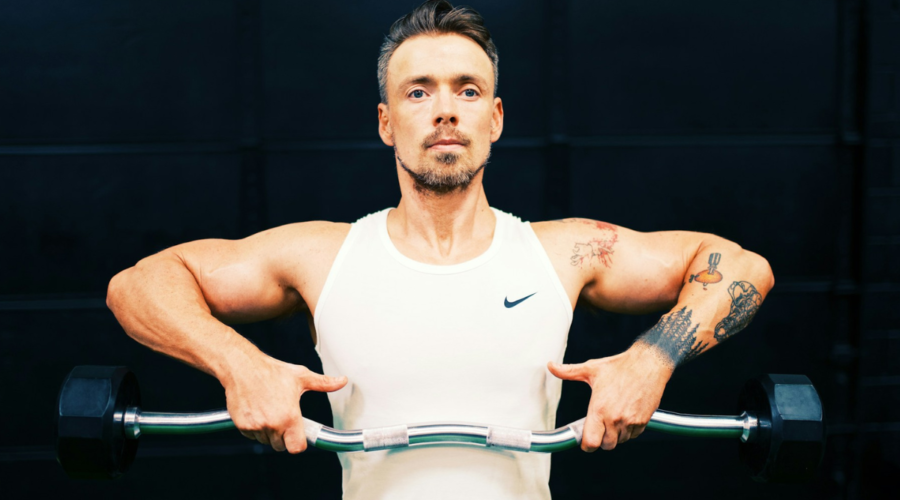
The standing barbell curl is a straightforward way to train the biceps with a supinated grip, meaning your palms face forward as you lift. It is easy to load in small increments, which makes it useful for tracking progress. A study comparing straight bar curls with EZ bar and dumbbell curls found differences in muscle activity, but it did not test long term muscle growth. The bar that feels most comfortable on your wrists is a sensible place to start.
How to do it
Stand with your feet about hip width apart and hold a barbell with your palms facing forward. Keep your hands around shoulder width, or adjust slightly if a narrower or wider position feels more comfortable. Let your arms hang by your sides, keep your ribs stacked over your pelvis, and brace your midsection.
Bend your elbows to curl the bar toward your upper abdomen or chest. Keep your upper arms close to your sides and avoid swinging your torso to get the bar moving. Lower the bar under control until your elbows are nearly straight, then begin the next repetition without relaxing your posture.
Use a weight that allows you to keep the same body position throughout the set. If you have to lean back or throw your hips forward to lift the bar, reduce the load. A controlled set with a repeatable range of motion is easier to progress than a heavier set built on momentum.
What makes it useful
A standing barbell curl is a good main exercise because it is simple to learn and easy to measure. You can record the weight and repetitions, then aim to add a repetition or a small amount of load when your form stays consistent. The exercise trains elbow flexion with the palms turned upward, a position that suits biceps training.
Do not treat a close grip or wide grip as a reliable way to isolate a particular biceps head. Grip width can change comfort and the path of the bar, but it does not switch one head off. Choose a grip that lets your wrists and elbows feel comfortable while you curl smoothly.
2. Barbell Preacher Curl
The barbell preacher curl supports your upper arms on an angled pad, reducing the chance that you will use a large torso swing. It also changes how the barbell challenges the elbow flexors during the curl. In a training study comparing barbell and cable preacher curls, muscle growth was similar between the two versions, even though the most difficult part of the repetition differed.
How to do it
Adjust the preacher bench so your upper arms rest securely on the pad without your shoulders rounding forward. Hold a barbell with your palms facing up and position your upper arms against the support. Begin with your elbows slightly bent rather than forcing them into a hard lockout.
Curl the bar toward your shoulders while keeping your upper arms in contact with the pad. Pause briefly near the top without lifting your elbows from the support. Lower the bar slowly until your arms are close to straight, stopping if you feel discomfort around the elbow or front of the shoulder.
A lighter weight is often appropriate at first because the bench limits how much you can use your body to help lift the bar. Move through a range that feels controlled and comfortable. Avoid bouncing out of the bottom position, where the barbell preacher curl can feel particularly challenging.
What makes it useful
The pad gives you feedback when you start to shift your upper arms or use momentum. That can make it easier to focus on elbow flexion. With a barbell, the resistance is greatest when the bar has a longer horizontal distance from your elbows, which tends to make the lower part of the repetition demanding.
That lower range is not a magic growth zone, and the available research does not show that barbell preacher curls create a bigger peak than standing curls. Instead, treat the preacher curl as a useful variation that changes the challenge and can complement your standing work. If the bench or bar bothers your joints, stop and choose a more comfortable curl setup.
3. Barbell Drag Curl
The barbell drag curl is a standing variation in which the bar travels close to your torso as your elbows move behind you. This changes the arm position compared with a standard curl. The biceps crosses the shoulder joint as well as the elbow, so moving the upper arm behind the torso changes its length at the shoulder. However, there is not strong long term evidence proving that drag curls selectively grow the biceps peak or one head.
How to do it
Stand tall with a barbell held in front of your thighs and your palms facing forward. Keep your chest steady and begin curling the bar while letting your elbows move slightly behind your body. Keep the bar close to your torso as it travels upward, rather than sweeping it forward in a wide arc.
Stop when you can no longer curl the bar higher without shrugging or changing your posture. Lower it slowly along the same close path. The movement may feel shorter than a standard curl, so use a manageable weight and avoid forcing extra range by leaning back.
What makes it useful
The drag curl offers a different way to perform a standing barbell curl, with the elbows moving behind the torso rather than staying fixed at your sides. It can be a useful option if you want another curl variation and can perform it comfortably. Its distinct feel should not be mistaken for proof that it will build a higher peak than other curls.
3 Best Exercises for Beginners to Get Jacked Arms Quickly
If the movement causes shoulder discomfort, leave it out. A standard standing curl or preacher curl can provide plenty of direct biceps work without needing to force a variation that does not suit your joints.
How to Program These Exercises
You do not need to perform all three exercises in every workout. For example, choose two of them and perform a few challenging sets of each, once or twice a week as part of your broader training plan. Start with a manageable amount of work and adjust based on your recovery and progress. Research supports the value of sufficient weekly training volume for muscle growth, but more work is not automatically better if your technique or recovery suffers.
For each exercise, a moderate repetition range can help you balance control and effort. Select a load that lets you finish your set with good technique while making the final repetitions challenging. You do not need to reach absolute failure on every set. A systematic review found only a small advantage for training to failure over stopping short, so consistent hard sets with sound form are a reasonable approach.

Rest long enough between sets to perform the next set with control. Keep a record of the exercise, weight, repetitions, and how the set felt. When you can complete the top of your chosen repetition range without swinging or shortening the movement, add a small amount of weight or perform another repetition next time.
Give the plan time to work. Changes in arm size come from repeated training, recovery, and adequate nutrition, not from a single workout or a special curl variation. If your biceps are not progressing, first check whether you are training consistently, using enough challenging sets, and gradually increasing the work you can do with good technique.
Key Takeaways
| Topic | Key takeaway |
|---|---|
| Biceps peak | Training can increase muscle size, but curls cannot guarantee a particular peak shape. |
| Standing barbell curl | A simple palms up curl that is easy to track and progressively load. |
| Barbell preacher curl | Supports the upper arms and makes the lower portion of the curl challenging. |
| Barbell drag curl | A standing variation with the elbows moving behind the torso, though claims of selective peak growth are unproven. |
| Progress | Use controlled repetitions, choose comfortable exercises, and gradually increase your training challenge. |
References
- Aguiar, A.F. et al. (2020) ‘Placing greater torque at shorter or longer muscle lengths? Effects of cable vs. barbell preacher curl training on muscular strength and hypertrophy in young adults’, International Journal of Environmental Research and Public Health, 17(16), 5859.
- Bernárdez-Vázquez, R., Raya-González, J., Castillo, D. and Beato, M. (2022) ‘Resistance training variables for optimization of muscle hypertrophy: An umbrella review’, Frontiers in Sports and Active Living, 4, 949021.
- Marcolin, G. et al. (2018) ‘Differences in electromyographic activity of biceps brachii and brachioradialis while performing three variants of curl’, PeerJ, 6, e5165.
- Refalo, M.C., Helms, E.R., Trexler, E.T., Hamilton, D.L. and Fyfe, J.J. (2023) ‘Influence of resistance training proximity-to-failure on skeletal muscle hypertrophy: A systematic review with meta-analysis’, Sports Medicine, 53(3), pp. 649–665.