

Kettlebells can help beginners build muscle when the exercises are challenging, performed with good control, and progressed over time. The most useful starting point is to train several movement patterns: a squat or lunge, a hip hinge, and an upper body push or pull. Together, these patterns give you a practical way to work major muscle groups with a small amount of equipment.
Research on resistance training shows that different training plans can increase muscle size, and that doing multiple sets can be useful for hypertrophy. Kettlebell research also suggests that this kind of training can improve fitness and strength, although studies that measure muscle growth directly are more limited than the broader research on resistance training. The exercises below are good starting options, but they are not magic shortcuts. Muscle growth depends on consistent training and a gradual increase in the challenge.


1. Squat and Lunge Exercises
Squats and lunges train the muscles of the legs and hips. The goblet squat is a beginner friendly way to start because you hold one kettlebell close to your chest while you squat. This position gives you a simple way to add resistance while practicing the movement. A reverse lunge is another option, with the kettlebell held at the chest or by your sides.
How to do a goblet squat
Hold the kettlebell by its handles or horns close to your chest, with your elbows angled down. Stand with your feet around shoulder width apart and your toes turned slightly outward if that feels natural. Brace your midsection, then bend your knees and hips to lower yourself as far as you can while keeping your heels on the floor and your torso steady. Push through your feet to stand.
Choose a depth that lets you maintain control. You do not need to force a deep squat if your current mobility or comfort does not allow it. Start with a light kettlebell and practice smooth repetitions before adding weight. When the set feels too easy and your form stays consistent, increase the resistance if you have a suitable heavier kettlebell.
How to add a reverse lunge
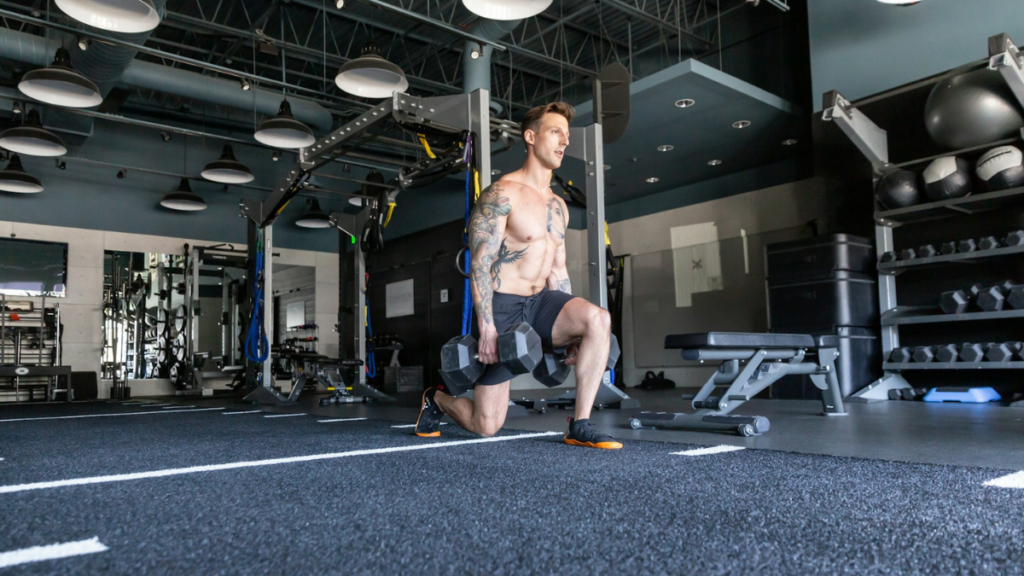
Stand tall with the kettlebell held at your chest or in each hand if you have two kettlebells. Step one foot backward and lower your body until both knees bend comfortably. Push through the front foot to return to standing, then repeat on the other side. Begin with body weight if you are still learning to balance, and add the kettlebell once you can control the step and return.
Squats and lunges give beginners a straightforward way to train the lower body through repeated bending and straightening of the hips and knees. If your goal is muscle growth, use a weight that makes the final repetitions challenging while still allowing you to move cleanly. Avoid turning every set into a balance test by choosing a load that you can control.
2. Hip Hinge Exercises
Hip hinge exercises train the muscles at the back of the body, including the glutes and hamstrings. Start with the kettlebell deadlift, which lets you practice hinging with the kettlebell resting on the floor. Once the movement is familiar, you can learn the kettlebell swing with coaching or careful practice. The swing is fast and ballistic, so it calls for more coordination than a deadlift.
How to do a kettlebell deadlift
Place the kettlebell on the floor between your feet. Stand with your feet about hip width apart, then bend at the hips and knees to reach the handle. Keep your back in a comfortable neutral position, brace your torso, and hold the handle firmly. Push the floor away as you stand, bringing your hips forward without leaning backward at the top. Lower the kettlebell to the floor with control.
The deadlift is a useful starting point because you can pause between repetitions and reset your position. Keep the kettlebell close to your body, and stop the set if you cannot maintain a steady posture. Beginners should master the hinge before moving on to swings, because a swing relies on the hips moving back and forward quickly.
When to try kettlebell swings
A kettlebell swing is not a squat with the bell lifted by the arms. It is a hip hinge in which the hips drive the kettlebell forward, while the arms guide it. In research, swings have produced substantial muscle activity in the glutes and lower back, but those findings describe short term muscle activation, not guaranteed muscle growth. They also underline why sound technique matters.
If you are new to swings, learn them with an experienced coach if possible. Begin with a light bell and a small number of controlled repetitions. Stop before your form deteriorates, and do not swing a load that pulls you off balance. For muscle gain, a controlled deadlift may be a more suitable starting exercise than adding high repetition swings before your hinge technique is reliable.
3. Press and Row Exercises
A balanced beginner routine should also train the upper body. A one arm kettlebell press is a pushing exercise that works the shoulders and arms, while a one arm row trains the back and arms. These movements are easier to adjust than complex kettlebell combinations, and you can perform them one side at a time.
How to do a one arm press
Hold a kettlebell at shoulder height with your wrist straight and your elbow beneath or slightly in front of the bell. Stand with your feet steady and your torso braced. Press the kettlebell overhead without leaning your lower back backward, then lower it to the starting position with control. If you cannot press without arching or twisting, use a lighter kettlebell or practice the movement without weight.
How to do a one arm row
Place one hand on a sturdy bench or chair for support, with your feet set firmly on the floor. Hold the kettlebell in the other hand and let your arm hang beneath your shoulder. Pull the kettlebell toward your lower ribs, keeping your torso steady, then lower it until your arm is extended again. Complete the repetitions on one side before switching.
Use a load that allows you to move the bell through a comfortable range without swinging your body. Presses and rows help include both pushing and pulling in your training. They also provide a way to work the upper body without relying on swings, which primarily train a hip hinge pattern.
How to Train for Muscle Growth
Beginners can start with two or three training sessions per week, with at least a day between sessions that train the same muscles. In each session, choose one squat or lunge, one hinge, and one press and row variation. Perform two or three sets of each exercise. For controlled movements such as goblet squats, deadlifts, presses, and rows, a set of about eight to twelve repetitions is a practical starting point. For a lunge, count repetitions on each side.
3 Best Barbell Exercises for a Jacked and Strong Chest
The right weight is one that makes the end of a set challenging without making you lose control. You do not have to reach the point where another repetition is impossible on every set. Research comparing training to failure with stopping short has not shown that failure is required for strength or muscle growth in the studied groups. Beginners can stop when they think they could complete one or two more good repetitions.
Keep a simple record of your kettlebell weight, sets, and repetitions. When you can complete all planned repetitions with steady technique, you can increase the load slightly, add a repetition, or add a set. Progress gradually, because adding difficulty faster than your technique and recovery can handle makes training harder to sustain.
Muscle growth also depends on recovery and nutrition. Resistance training provides the stimulus, but the results build over repeated sessions, not from one workout. Give yourself enough time to recover between hard sessions, eat adequate food, and include a source of protein in your meals. These basics matter more than constantly changing exercises or chasing fatigue.
Key Takeaways
| Training choice | Beginner approach |
|---|---|
| Squat or lunge | Start with goblet squats or reverse lunges and use a load you can control. |
| Hip hinge | Learn kettlebell deadlifts before practicing swings. |
| Upper body | Include a one arm press and a supported one arm row. |
| Sets and repetitions | Begin with two or three sets and about eight to twelve controlled repetitions for most movements. |
| Progress | Add a little weight, a repetition, or a set when your technique remains consistent. |
| Effort | Finish most sets with one or two good repetitions still possible. |
References
- Currier, B.S. et al. (2023) ‘Resistance training prescription for muscle strength and hypertrophy in healthy adults: a systematic review and Bayesian network meta-analysis’, British Journal of Sports Medicine, 57(18), pp. 1211–1220.
- Grgic, J. et al. (2022) ‘Effects of resistance training performed to repetition failure or non-failure on muscular strength and hypertrophy: a systematic review and meta-analysis’, Journal of Sport and Health Science, 11(2), pp. 202–211.
- Lake, J.P. and Lauder, M.A. (2012) ‘Mechanical demands of kettlebell swing exercise’, Journal of Strength and Conditioning Research, 26(12), pp. 3209–3216.
- McGill, S.M. and Marshall, L.W. (2012) ‘Kettlebell swing, snatch, and bottoms-up carry: back and hip muscle activation, motion, and low back loads’, Journal of Strength and Conditioning Research, 26(1), pp. 16–27.
- Otto, W.H. et al. (2012) ‘The effects of weightlifting vs. kettlebell training on strength, power, and body composition’, Journal of Strength and Conditioning Research, 26(5), pp. 1199–1202.
- Ratamess, N.A. et al. (2009) ‘Progression models in resistance training for healthy adults’, Medicine & Science in Sports & Exercise, 41(3), pp. 687–708.