

Building a bigger chest is one of the most common goals in strength training, but many lifters struggle to develop the upper portion of the chest. You can bench press heavy for years and still end up with a chest that lacks fullness near the collarbones. That missing upper chest thickness is often what separates an average physique from a truly impressive one.
The good news is that you do not need complicated machines or advanced training methods to fix the problem. Dumbbells are one of the best tools for upper chest development because they allow a greater range of motion, improve muscle activation, and help train each side independently.


Research supports this approach. Studies on muscle activation and hypertrophy consistently show that incline pressing movements can increase recruitment of the clavicular head of the pectoralis major, which is the upper chest region. Dumbbells also create more freedom of movement than barbells, making them highly effective for muscle growth.
Why the Upper Chest Matters
The chest is mainly made up of the pectoralis major, which has two primary regions:
- The clavicular head, often called the upper chest
- The sternocostal head, often called the middle and lower chest
Although the muscle works as a whole, different movement angles can emphasize different fibers. Incline pressing exercises target the clavicular fibers more effectively than flat pressing movements.
A well developed upper chest improves both aesthetics and performance. Visually, it creates more fullness near the collarbones and gives the chest a more complete appearance. Functionally, the upper chest contributes to shoulder flexion and pressing strength.
One of the biggest mistakes lifters make is relying almost entirely on flat bench pressing. Flat pressing is excellent for overall chest development, but it often fails to provide enough focused stimulation for the upper chest. This is where dumbbell training becomes especially useful.
Why Dumbbells Are So Effective for Upper Chest Growth
Dumbbells offer several advantages for hypertrophy training.
Greater Range of Motion
A barbell limits how far the elbows can travel because the bar touches the chest. Dumbbells allow a deeper stretch at the bottom of pressing movements. Research suggests that training muscles at longer lengths may improve hypertrophy by increasing mechanical tension and muscle damage.
Improved Muscle Balance
Each arm works independently with dumbbells. This reduces compensation from the dominant side and helps build more symmetrical muscle development.
Better Stabilization
Dumbbells require greater stabilization than barbells. This increases recruitment of supporting musculature and improves movement control.
More Natural Joint Positioning
Many lifters find dumbbells more comfortable on the shoulders because the wrists and elbows can move naturally instead of being fixed in one position.
The Science of Muscle Growth
Before looking at the exercises, it helps to understand what actually drives hypertrophy. Research identifies three major mechanisms:
- Mechanical tension
- Metabolic stress
- Muscle damage
Mechanical tension is considered the most important factor. This refers to the force generated within muscle fibers during resistance training. To maximize upper chest growth, your training should include:
- Progressive overload
- Full range of motion
- Adequate training volume
- Proper recovery
- Effective exercise selection
Studies also show that hypertrophy can occur across a wide range of repetitions as long as sets are performed reasonably close to failure. Now let’s examine the three best upper chest dumbbell exercises.
1. Incline Dumbbell Press
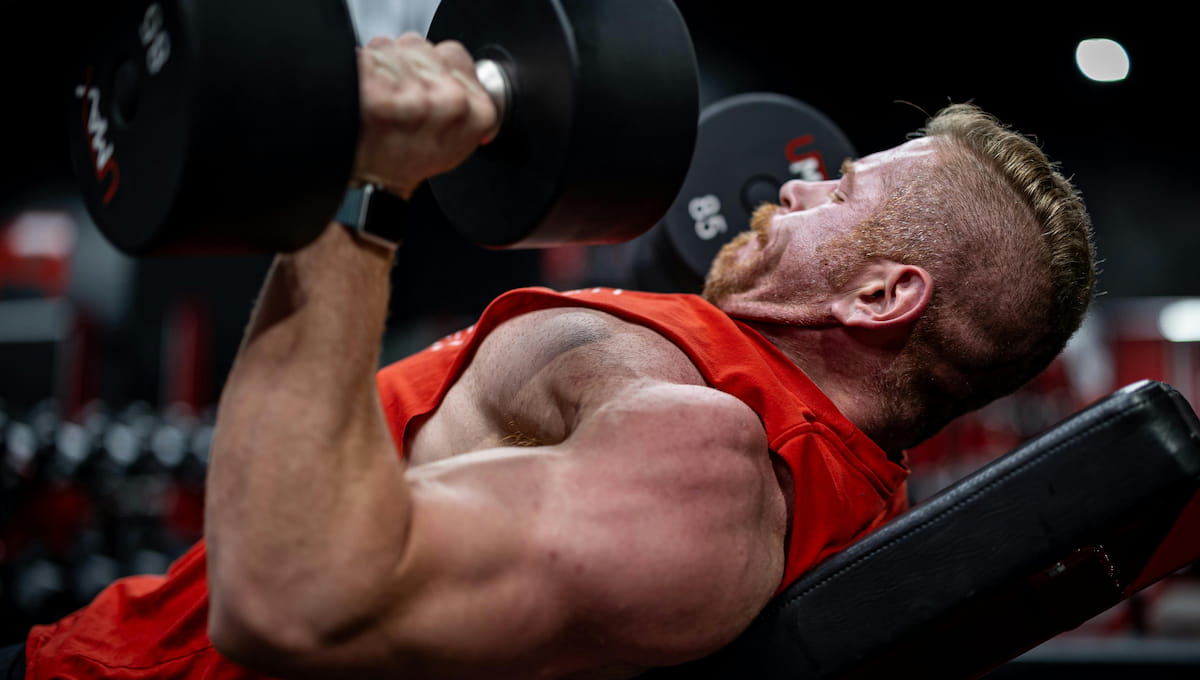
The incline dumbbell press is the king of upper chest exercises. If your goal is to build upper chest size, this movement should be the foundation of your training program.
Why the Incline Dumbbell Press Works
Changing the bench angle shifts more tension toward the clavicular fibers of the chest. Research examining muscle activation during different bench press angles consistently shows higher upper chest activation during incline pressing compared to flat pressing. Dumbbells improve the movement even further because they allow:
- Greater stretch at the bottom
- Independent arm movement
- More natural shoulder mechanics
- Increased stabilization demands
An incline angle between 30 and 45 degrees appears to work best for emphasizing the upper chest without turning the exercise into more of a shoulder press.
How to Perform the Incline Dumbbell Press
- Set an adjustable bench to roughly 30 to 45 degrees.
- Sit down with a dumbbell in each hand.
- Lie back while bringing the dumbbells into position above the chest.
- Plant your feet firmly on the floor.
- Retract your shoulder blades and keep the chest lifted.
- Lower the dumbbells slowly until your elbows move slightly below the torso.
- Press the weights upward in a controlled line.
- Stop just short of lockout to maintain tension.
Key Technique Tips
- Lower the weights slowly
- Keep the chest high throughout the movement
- Avoid excessive elbow flare
- Use a full range of motion
- Focus on driving through the upper chest
Common Mistakes
Bench Angle Too High
Many lifters set the bench too steeply, which shifts more tension onto the front deltoids.
Partial Repetitions
Shortening the range of motion reduces stretch and mechanical tension.
Using Momentum
Dropping the weights too quickly reduces muscular control and decreases effectiveness.
Best Rep Range
The incline dumbbell press works well across several rep ranges:
- 6 to 8 reps for strength focused hypertrophy
- 8 to 12 reps for balanced muscle growth
- 12 to 15 reps for metabolic stress
Most lifters should spend the majority of their training in the 6 to 12 rep range.
Programming Recommendations
- Perform 3 to 5 hard sets
- Train 1 to 2 times per week
- Stay within 0 to 3 reps of failure
- Increase weight gradually over time
2. Incline Dumbbell Fly
The incline dumbbell fly is one of the best exercises for stretching and isolating the upper chest.
While pressing movements are excellent for overall hypertrophy, fly variations place more emphasis on horizontal adduction and loaded stretch.
How to Perform the Incline Dumbbell Fly
- Set the bench to roughly 30 degrees.
- Hold the dumbbells above the chest with palms facing each other.
- Keep a slight bend in the elbows.
- Slowly lower the weights outward in a wide arc.
- Descend until you feel a deep stretch across the chest.
- Bring the weights back together while squeezing the chest.
- Maintain control throughout the set.
Key Technique Tips
- Keep a soft bend in the elbows
- Lower the weights slowly
- Focus on chest contraction
- Avoid overstretching
- Use controlled tempo
Common Mistakes
Going Too Heavy
Heavy dumbbells often compromise form and increase joint stress.
Turning the Movement Into a Press
Excessive elbow bend changes the mechanics of the exercise.
Rushing Repetitions
Fast reps reduce tension and decrease the hypertrophy stimulus.
Best Rep Range
The incline dumbbell fly responds especially well to moderate and higher repetitions:
- 10 to 15 reps
- 12 to 20 reps
This exercise is more about tension and control than maximal loading.
Programming Recommendations
- Perform after compound pressing
- Use 2 to 4 sets
- Rest 60 to 90 seconds between sets
- Prioritize quality over weight
3. Incline Dumbbell Hex Press
The incline dumbbell hex press is one of the most underrated chest exercises for hypertrophy. In this variation, the dumbbells stay pressed together throughout the movement, creating constant inward tension.
Why the Incline Dumbbell Hex Press Works
The pectoralis major plays a major role in bringing the arms toward the center of the body. By actively squeezing the dumbbells together, the hex press increases chest activation and internal tension. The incline position further biases the upper chest fibers. This combination creates a powerful contraction and significant metabolic stress.
How to Perform the Incline Dumbbell Hex Press
- Set the bench to around 30 degrees.
- Hold two dumbbells together above the chest.
- Press the dumbbells firmly into each other.
- Lower them slowly toward the upper chest.
- Maintain inward pressure throughout the movement.
- Press back upward while continuing to squeeze.
Key Technique Tips
- Keep constant pressure between the dumbbells
- Use controlled repetitions
- Focus on chest contraction
- Keep the elbows slightly tucked
Common Mistakes
Losing the Squeeze
The inward pressure is what makes this exercise effective.
Using Excessive Weight
Too much load reduces control and decreases chest tension.
Rushing the Set
The hex press works best with slow and deliberate movement.
Best Rep Range
This exercise works extremely well in moderate and higher repetition ranges:
- 8 to 12 reps
- 12 to 15 reps
- 15 to 20 reps
Programming Recommendations
- Use near the end of the workout
- Perform 2 to 4 sets
- Keep rest periods relatively short
- Focus on muscular fatigue and contraction
Sample Upper Chest Workout
Here is an effective upper chest focused dumbbell workout:
Workout Example
- Incline Dumbbell Press: 4 sets of 6 to 10 reps
- Incline Dumbbell Fly: 3 sets of 10 to 15 reps
- Incline Dumbbell Hex Press: 3 sets of 12 to 15 reps
This combination provides:
- Heavy mechanical tension
- Loaded stretch
- Metabolic stress
- High muscle activation
Together, these create a powerful hypertrophy stimulus.
Weekly Training Volume
Research suggests that around 10 to 20 hard sets per muscle group per week is effective for hypertrophy. For upper chest development, this can include:
- Incline pressing variations
- Incline fly variations
- Additional chest pressing work
Beginners often grow well with lower volume, while advanced lifters may require more total work.

Progressive Overload
Progressive overload is essential for continued muscle growth.
Without gradually increasing training demands, hypertrophy eventually stalls.
You can apply progressive overload by:
- Increasing weight
- Performing more repetitions
- Improving technique
- Adding sets
- Increasing range of motion
- Slowing tempo
Consistency matters more than perfection. Small improvements repeated over time produce significant results.
Training Close to Failure
Research consistently shows that training close to muscular failure recruits more motor units and increases hypertrophic stimulus. This does not mean every set must be taken to complete failure. Most working sets should finish with zero to three repetitions left in reserve. This balances stimulus with recovery.
Final Thoughts
The upper chest is one of the most important areas for building a balanced and athletic physique. Dumbbells are especially effective because they allow greater range of motion, improve stabilization, and increase muscular tension.
The incline dumbbell press remains the best overall exercise for upper chest hypertrophy because it combines heavy loading with strong clavicular activation. The incline dumbbell fly provides deep stretch and isolation work.
The incline dumbbell hex press creates constant tension and a powerful contraction. Combined with progressive overload, intelligent programming, proper nutrition, and consistent recovery, these exercises can significantly improve upper chest size and shape over time.
References
- Barnett, C., Kippers, V. and Turner, P. (1995) ‘Effects of variations of the bench press exercise on the EMG activity of five shoulder muscles’, Journal of Strength and Conditioning Research, 9(4), pp. 222 to 227.
- Schoenfeld, B.J. (2010) ‘The mechanisms of muscle hypertrophy and their application to resistance training’, Journal of Strength and Conditioning Research, 24(10), pp. 2857 to 2872.
- Schoenfeld, B.J., Ogborn, D. and Krieger, J.W. (2017) ‘Dose response relationship between weekly resistance training volume and increases in muscle mass: A systematic review and meta analysis’, Journal of Sports Sciences, 35(11), pp. 1073 to 1082.