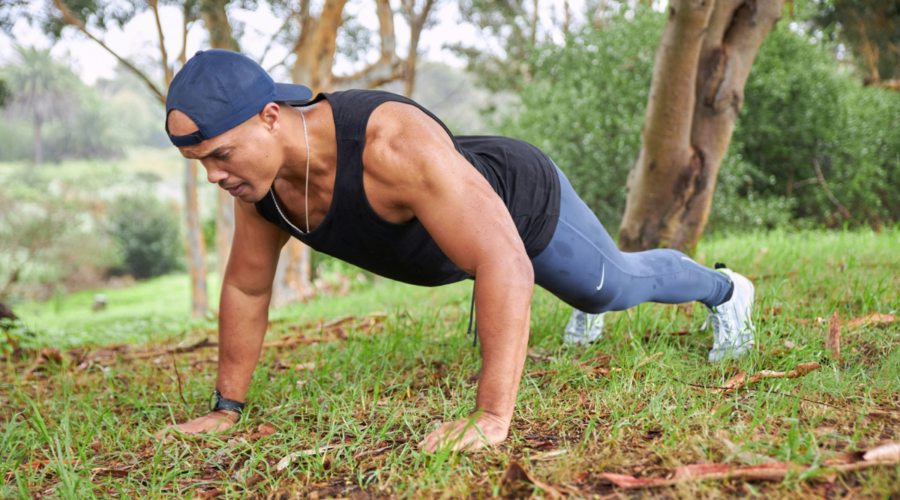


The plank looks simple, but it asks a lot of your body. It requires your trunk, shoulders, hips, and breathing mechanics to work together while you resist movement. That makes it a useful exercise for assessing and training the ability to keep your spine and pelvis controlled when your body is under low level, sustained load.
For adults over 30, the aim is not to chase an internet record or make your lower back shake through a five minute hold. The more useful goal is to demonstrate clean control at a few sensible milestones, then build strength that carries over to lifting, running, sport, and everyday life. A well performed plank is a test of quality as much as duration.



The three benchmarks below are practical targets for generally healthy adults. They are not medical diagnostic tests, and they do not replace an assessment from a qualified clinician if you have ongoing back, shoulder, hip, or pelvic pain. They do, however, give you a clear way to judge your current trunk endurance and improve it without turning the exercise into a contest.
Why the Plank Matters After 30
Your trunk is not designed only to bend and straighten. Its major job during many tasks is to transmit force between the upper and lower body while limiting unwanted movement at the spine. When you carry a heavy bag, push a sled, run, press a weight overhead, or pick something up from the floor, your abdominal wall, spinal muscles, and hip muscles must create enough stiffness to keep the movement efficient and controlled.
Research on trunk muscle endurance has repeatedly linked better endurance capacity with lower back health in broad populations, although it does not prove that a longer plank alone prevents pain. Low back pain has many causes, including sleep, stress, previous injury, work demands, training load, and general health. Still, developing enough trunk endurance to hold neutral positions comfortably is a sensible part of a well rounded training plan.
The plank is especially useful because it trains anti extension. In other words, you resist the tendency for the lower back to arch as gravity pulls your hips down. When performed properly, it challenges the rectus abdominis, obliques, transverse abdominis, spinal erectors, shoulder stabilizers, and glutes together. That whole body demand is why a short, strict hold can be more valuable than a long hold with poor form.
First, Define a Good Plank
Before timing yourself, earn the position. Place your elbows under your shoulders and keep your forearms parallel or with your hands lightly clasped. Step your feet back so your body makes a long, straight line from head to heels. Squeeze your glutes, gently tighten your thighs, and pull your ribs down toward your pelvis without holding your breath.
Think about pushing the floor away with your forearms. Your shoulder blades should be active and stable rather than collapsed between your shoulders. Look at the floor slightly in front of your hands to keep your neck relaxed. Breathe steadily through the entire set. If you cannot breathe normally, you are likely bracing harder than necessary or holding a position that is too demanding.
The set ends when your lower back arches, your hips rise well above shoulder level, your shoulders sink, or you need to repeatedly change position to stay there. These are not failures of character. They are useful information. Stopping at the first obvious form loss gives you a more reliable benchmark and protects the purpose of the exercise.
Benchmark 1: A Clean 30 Second Forearm Plank
The first target is a continuous 30 second hold with no visible loss of position. This is the entry benchmark that most healthy adults over 30 should work toward. It is long enough to expose poor trunk control, but short enough that a beginner can practice it frequently without excessive fatigue.
A 30 second plank shows that you can create and maintain basic full body tension. It is particularly meaningful if you are returning to training after a break, spend most of the day sitting, or are beginning a strength program. Do not dismiss it because the number sounds modest. A genuinely strict 30 seconds, with normal breathing and no sagging through the lower back, is a better starting point than a loose 90 second hold.

If you cannot yet reach this benchmark, reduce the lever rather than forcing bad reps. Perform the exercise from your knees while maintaining a straight line from head to knees, or elevate your forearms on a bench. Build up to several holds of 10 to 20 seconds, resting long enough to make every hold look the same. Gradually lower the incline or increase the work interval as control improves.
Benchmark 2: A Strict 60 Second Forearm Plank
The second target is 60 seconds of clean, controlled work. For most active adults, this is a strong general benchmark. It requires enough endurance from the trunk and shoulder stabilizers to reveal whether you can keep breathing and maintain alignment after the first burst of effort has passed.
Reaching one minute does not mean your core training is complete. It means you have a useful base of isometric endurance. From there, the best next step is often to make the exercise more challenging rather than simply extending the timer. Strength and conditioning research supports using a variety of trunk exercises rather than relying on one movement alone. Side planks, carries, dead bugs, bird dogs, controlled rollouts, and anti rotation presses expose the trunk to different demands.
3 Best Beginner Exercises for Wider and More Muscular Pecs
If your goal is better gym performance, a one minute strict plank should be accompanied by control during loaded movements. You should be able to keep your ribs and pelvis organized during a squat, deadlift, press, row, and loaded carry. The plank gives you a simple check, but it is only one piece of a broader strength foundation.
To progress from 30 seconds to 60 seconds, use total quality time. Three 25 second holds with good form are often more productive than one all out attempt that turns messy. Add five seconds to each hold every week when you can maintain the same position from the first second to the last. Keep the effort challenging but leave enough in reserve to avoid turning each session into a maximum test.
Benchmark 3: A Controlled 90 Second Forearm Plank
The third target is a 90 second forearm plank performed with the same form you used at 30 seconds. This is an ambitious yet realistic benchmark for a healthy, trained adult over 30. It demonstrates that your trunk endurance is not merely enough for a brief test, but robust enough to maintain control for a sustained effort.
There is an important caveat. A 90 second hold is a benchmark, not a requirement for everyone and not a guarantee of a pain free back. Taller people, people with larger body mass, and people with particular shoulder histories may find a front plank disproportionately demanding. Training age and technique also matter. Use the target to guide your own progress, not to rank yourself against strangers.
Once you own 90 seconds, longer and longer front planks offer diminishing returns for many people. Research and clinical recommendations on spinal stability commonly favor brief, repeated bouts of high quality endurance work over exhaustive holds. At this point, progress by adding movement, load, or asymmetry while preserving alignment. A long lever plank, shoulder tap plank, body saw, weighted plank, or suitcase carry can create a new challenge without requiring several minutes on the floor.
Choose one variation at a time and use conservative progressions. A small external load placed securely across the upper back can make the front plank harder, but it is not appropriate if it causes pain, changes your alignment, or makes you hold your breath. For most people, carries and side plank variations are a more practical next stage because they develop bracing under real movement and uneven loading.
How Often Should You Train Planks?
Two to four sessions per week is enough for most people. The plank is low impact, but that does not mean it needs to be trained to failure every day. Place it after your main strength work or use it as part of a short warm up on nonconsecutive days. Keep the volume manageable so that your form remains precise.

A simple approach is to perform two or three sets at roughly 60 to 80 percent of your current best strict hold. If your best is 45 seconds, use sets of about 25 to 35 seconds. Rest for at least as long as you worked. When all sets look controlled and you finish with normal breathing, increase the duration slightly at the next session.
This approach also helps you avoid a common mistake: allowing fatigue to decide your technique. The value of a plank comes from resisting movement. If your lower back takes over, your hips sag, and you are simply enduring discomfort, you are no longer practicing the skill you set out to improve.
What Your Result Can and Cannot Tell You
Plank performance is a useful snapshot of isometric trunk endurance. It can tell you whether your current ability is improving, whether a particular training phase has left you fatigued, and whether you can maintain a basic braced position. It can also help you identify where to start.
It cannot diagnose injuries, measure every quality of athleticism, or tell you exactly how much back pain risk you have. A person can have a long plank time and still need more hip strength, better movement skill, aerobic fitness, or recovery. Another person may be strong and athletic but have a shorter plank time because their training is focused elsewhere.
Use these benchmarks as a clear standard, then keep the bigger picture in view. Aim for 30 seconds to establish control, 60 seconds to build a dependable base, and 90 seconds to demonstrate strong endurance. Most importantly, make every second look the same.
References
- Axler, C.T. and McGill, S.M. (1997) ‘Low back loads over a variety of abdominal exercises: Searching for the safest abdominal challenge’, Medicine and Science in Sports and Exercise, 29(6), pp. 804 to 811.
- McGill, S.M. (2010) ‘Core training: Evidence translating to better performance and injury prevention’, Strength and Conditioning Journal, 32(3), pp. 33 to 46.
- McGill, S.M., Childs, A. and Liebenson, C. (1999) ‘Endurance times for low back stabilization exercises: Clinical targets for testing and training from a normal database’, Archives of Physical Medicine and Rehabilitation, 80(8), pp. 941 to 944.
- McGill, S.M., Grenier, S., Kavcic, N. and Cholewicki, J. (2003) ‘Coordination of muscle activity to assure stability of the lumbar spine’, Journal of Electromyography and Kinesiology, 13(4), pp. 353 to 359.
- Norris, C.M. (1999) ‘Functional load abdominal training: Part 1’, Journal of Bodywork and Movement Therapies, 3(3), pp. 150 to 158.
- Owen, P.J., Miller, C.T., Mundell, N.L., Verswijveren, S.J.J.M., Tagliaferri, S.D., Brisby, H., Bowe, S.J. and Belavy, D.L. (2020) ‘Which specific modes of exercise training are most effective for treating low back pain? Network meta analysis’, British Journal of Sports Medicine, 54(21), pp. 1279 to 1287.
Key Takeaways
| Benchmark | What it shows | Practical next step |
|---|---|---|
| 30 seconds | Basic trunk control with sound alignment and normal breathing | Build several short strict holds if needed |
| 60 seconds | A dependable base of trunk and shoulder endurance | Add varied trunk exercises and loaded movement control |
| 90 seconds | Strong sustained control for a trained adult | Progress difficulty with carries, asymmetry, or controlled movement |