Training smarter does not mean training less. It means understanding what actually drives adaptation and using that knowledge to guide decisions. Two of the most important variables in any training program are volume and intensity.
They are often misunderstood, misused, or treated as interchangeable. They are not.


For CrossFit athletes, strength athletes, and general fitness enthusiasts alike, confusion around volume and intensity leads to stalled progress, unnecessary fatigue, and higher injury risk. This article explains what volume and intensity really are, how they interact, and how science shows they should be manipulated for better performance.
Everything here is grounded in peer-reviewed research. The goal is clarity, not dogma.
What Volume and Intensity Actually Mean
Training Volume Defined
Training volume refers to the total amount of work performed. In resistance training, volume is most commonly quantified as:
Total volume = sets × repetitions × load
For example, five sets of five reps at 100 kg equals 2,500 kg of volume.

In endurance and mixed-modal training, volume is often measured as total time, distance, or number of repetitions performed within a session or week.
Research consistently shows that training volume is a primary driver of adaptation, especially for muscle hypertrophy and aerobic development. Higher volumes generally produce greater adaptations, up to a point, provided recovery is adequate (Schoenfeld et al., 2017).
Training Intensity Defined
Intensity describes how hard the work is relative to maximum capacity.
In resistance training, intensity is usually expressed as a percentage of one-repetition maximum (1RM). Lifting at 85 percent of 1RM is more intense than lifting at 65 percent.
In conditioning, intensity refers to physiological effort, often measured using heart rate, oxygen consumption, lactate concentration, or perceived exertion.
High intensity places greater stress on the nervous system and connective tissues, while lower intensity primarily stresses metabolic systems.
Why Volume and Intensity Are Not Opposites
A common mistake is to think volume and intensity exist on a single spectrum. In reality, they are independent variables.
You can have:
- High volume and high intensity (very demanding and rarely sustainable)
- High volume and low intensity
- Low volume and high intensity
- Low volume and low intensity (usually ineffective)
Studies in strength and endurance sports show that the balance between volume and intensity determines the type of adaptation that occurs (Zatsiorsky and Kraemer, 2006).
Volume vs. Intensity for Strength Development
Heavy Loads Drive Maximal Strength
Maximal strength gains are highly specific to lifting heavy loads. Research shows that intensities above 80 percent of 1RM are most effective for improving maximal force production (ACSM, 2009).
High-intensity training improves:
- Motor unit recruitment
- Rate coding
- Intermuscular coordination
These neural adaptations are essential for maximal strength and are not fully developed with lighter loads alone (Haff and Nimphius, 2012).
Volume Still Matters for Strength
While intensity determines how heavy the weight is, volume determines how much practice the nervous system gets under load.
Meta-analyses show that multiple sets produce greater strength gains than single sets, even when intensity is controlled (Krieger, 2010).
However, excessive volume at high intensity leads to accumulated fatigue and diminished returns. Strength athletes who attempt to push both variables too high simultaneously often experience performance plateaus or regression (Fry et al., 1994).
Practical Implication for Strength
For strength:
- Intensity should be high enough to challenge the nervous system
- Volume should be sufficient to reinforce the movement pattern
- Weekly volume must be carefully managed to avoid overreaching
Volume vs. Intensity for Muscle Hypertrophy
Volume Is the Primary Driver of Muscle Growth
Muscle hypertrophy is strongly correlated with total training volume.
A large body of research shows a dose-response relationship between volume and hypertrophy, with higher volumes leading to greater muscle growth up to an individual threshold (Schoenfeld et al., 2017).
Multiple meta-analyses confirm that:
- Multiple sets outperform single sets
- Training each muscle group with higher weekly volume produces more growth (Schoenfeld et al., 2019)
Intensity Is More Flexible for Hypertrophy
Hypertrophy can occur across a wide range of intensities, provided sets are taken close to muscular failure.
Studies comparing heavy and light loads show similar hypertrophy when total volume and effort are equated (Morton et al., 2016).

This means muscle growth does not require heavy weights, but heavy weights can still be useful for efficiency and strength carryover.
Fatigue Management and Volume Thresholds
While volume drives hypertrophy, excessive volume increases muscle damage and systemic fatigue.
Research suggests there is an upper limit beyond which additional volume provides little benefit and may impair recovery (Haun et al., 2018).
This upper limit varies based on training history, nutrition, sleep, and stress.
Practical Implication for Hypertrophy
For hypertrophy:
- Prioritize sufficient weekly volume per muscle group
- Use a mix of intensities
- Avoid excessive volume that compromises recovery
Volume vs. Intensity for Conditioning and Endurance
High Volume Builds the Aerobic Base
Endurance research consistently shows that large volumes of low-to-moderate intensity work improve mitochondrial density, capillarization, and aerobic efficiency (Seiler, 2010).
Elite endurance athletes spend the majority of training time at relatively low intensities, despite racing at high intensity.
This phenomenon is known as polarized training.
High Intensity Improves Performance Ceiling
High-intensity training improves:
- VO2max
- Lactate threshold
- Anaerobic capacity
Studies comparing training models show that a small amount of high-intensity work combined with a large base of low-intensity volume produces superior results compared to moderate-intensity training alone (Seiler and Tønnessen, 2009).
The Cost of Excessive Intensity
High-intensity conditioning is metabolically and neurologically expensive.
Excessive high-intensity training increases injury risk, suppresses immune function, and elevates markers of overtraining (Meeusen et al., 2013).
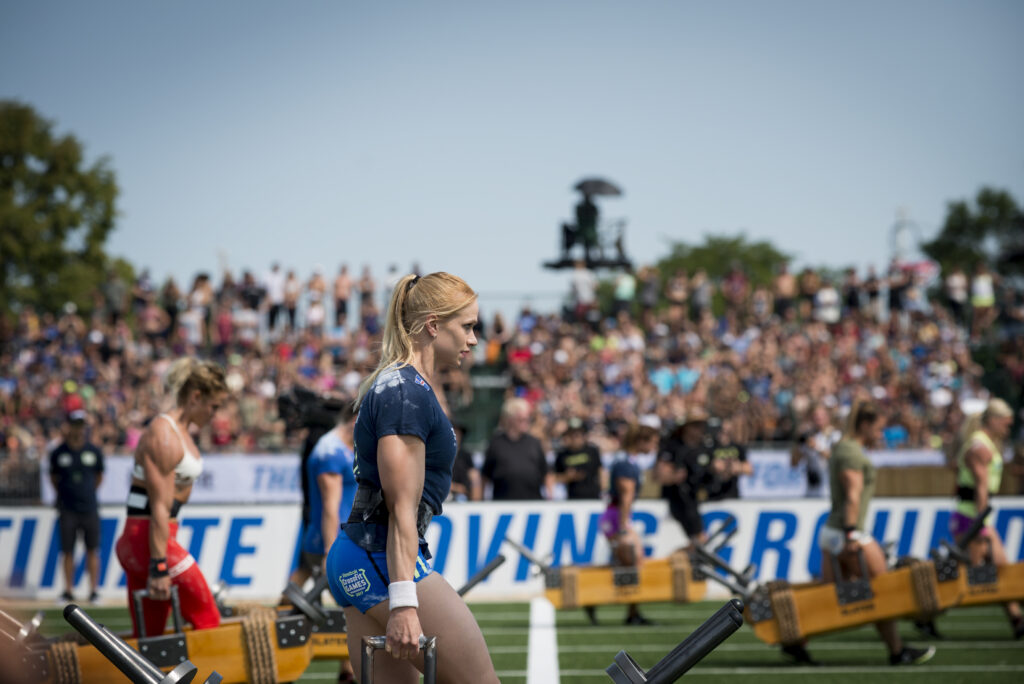
This is especially relevant in CrossFit, where intensity is often emphasized at the expense of volume management.
Practical Implication for Conditioning
For conditioning:
- Use volume to build capacity
- Use intensity strategically
- Avoid turning every session into a maximal effort
Volume, Intensity, and Recovery
Fatigue Is Not the Enemy, But Accumulation Is
Training adaptations occur during recovery, not during the session itself.
Both volume and intensity contribute to fatigue, but they do so differently.
High volume produces:
- Muscular fatigue
- Metabolic stress
- Structural damage
High intensity produces:
- Neural fatigue
- Joint stress
- Central nervous system strain
Research shows that high-intensity work requires longer recovery than low-intensity work with similar volume (Pareja-Blanco et al., 2017).
Managing Weekly Load
The concept of training impulse highlights that total stress is the combined effect of volume and intensity (Banister et al., 1975).
Athletes who fail to manage weekly load are more likely to experience non-functional overreaching or overtraining syndrome (Meeusen et al., 2013).
Monitoring trends in performance, motivation, and sleep is more reliable than focusing on any single variable.
Injury Risk and Training Variables
Volume and Overuse Injuries
Overuse injuries are strongly associated with excessive volume and insufficient recovery.
Epidemiological studies show that rapid increases in training volume significantly increase injury risk, particularly in endurance and mixed-modal sports (Gabbett, 2016).
Intensity and Acute Injury Risk
High intensity increases acute injury risk due to higher forces and faster movement velocities.
However, progressive exposure to intensity improves tissue tolerance and reduces long-term risk when properly managed (Haff and Triplett, 2016).
Practical Implication for Injury Prevention
Injury risk increases when:
- Volume increases too quickly
- Intensity is high without adequate technical proficiency
- Recovery is insufficient
Balancing volume and intensity is essential for long-term training sustainability.
Applying Volume and Intensity to CrossFit Training
The Problem With “Always High Intensity”
CrossFit methodology emphasizes intensity, but intensity without structure leads to stagnation.
Research on concurrent training shows that excessive high-intensity work can interfere with strength and hypertrophy adaptations (Wilson et al., 2012).
Athletes who treat every session as a competition often underperform those who periodize effort.
Smarter Programming Principles
Science supports:
- Varying intensity across the week
- Accumulating volume at manageable intensities
- Reserving maximal efforts for specific sessions
This approach improves performance while reducing burnout and injury risk.
Weekly Structure Example

A balanced week might include:
- High-volume, low-intensity aerobic work
- Moderate-volume strength training
- Limited high-intensity conditioning sessions
This mirrors the distribution seen in successful endurance and strength programs.
Common Myths About Volume and Intensity
Myth: More Intensity Always Means Better Results
Evidence shows diminishing returns when intensity is excessive and poorly distributed (Foster, 1998).
Myth: High Volume Means Junk Training
Volume only becomes junk when it exceeds recovery capacity or lacks purpose.
Well-planned volume is the foundation of long-term progress.
Myth: You Must Choose Between Volume and Intensity
The most effective programs use both, but not maximally at the same time.
How to Adjust Volume and Intensity Over Time
Progressive Overload Done Right
Progressive overload can be achieved by:
- Increasing volume
- Increasing intensity
- Improving efficiency at the same workload
Research shows that alternating periods of higher volume and higher intensity produces superior adaptations compared to linear increases in both (Stone et al., 2007).
Autoregulation and Individual Differences
Not all athletes respond the same way to volume and intensity.
Autoregulation strategies, such as rate of perceived exertion or velocity-based training, help tailor training stress to the individual (Helms et al., 2018).
Final Thoughts
Volume builds capacity. Intensity sharpens performance.
Training smarter means knowing when to emphasize each variable and when to hold back. The evidence is clear: sustainable progress comes from managing volume and intensity, not chasing exhaustion.
Athletes who understand this train longer, perform better, and get injured less.
Bibliography
- American College of Sports Medicine (2009). Progression models in resistance training for healthy adults. Medicine & Science in Sports & Exercise, 41(3), pp. 687–708.
- Banister, E.W., Calvert, T.W., Savage, M.V. and Bach, T. (1975). A systems model of training for athletic performance. Australian Journal of Sports Medicine, 7(3), pp. 57–61.
- Foster, C. (1998). Monitoring training in athletes with reference to overtraining syndrome. Medicine & Science in Sports & Exercise, 30(7), pp. 1164–1168.
- Fry, A.C., Kraemer, W.J. and Ramsey, L.T. (1994). Pitfalls of heavy resistance training. Strength and Conditioning Journal, 16(2), pp. 3–12.
- Gabbett, T.J. (2016). The training–injury prevention paradox. British Journal of Sports Medicine, 50(5), pp. 273–280.
- Haff, G.G. and Nimphius, S. (2012). Training principles for power. Strength and Conditioning Journal, 34(6), pp. 2–12.
- Haff, G.G. and Triplett, N.T. (2016). Essentials of Strength Training and Conditioning. 4th ed. Champaign: Human Kinetics.
- Haun, C.T., et al. (2018). A critical evaluation of the biological construct skeletal muscle hypertrophy. Sports Medicine, 49(3), pp. 1–13.
- Helms, E.R., et al. (2018). RPE-based load progression in powerlifting. Sports, 6(4), pp. 1–16.