

Calisthenics looks simple on the surface. No barbells. No machines. Just you, your bodyweight, and gravity. That simplicity is exactly why so many people are drawn to it.
But simple does not mean easy, and it definitely does not mean risk-free.


Calisthenics places unique demands on the body. It requires high levels of joint control, relative strength (strength compared to body mass), connective tissue resilience, and movement awareness. When these factors are ignored, progress slows and injury risk increases. When they are respected, calisthenics can be one of the most effective and sustainable ways to build strength, muscle, coordination, and long-term physical capacity.
This article breaks down three critical, science-backed considerations you should think through before starting calisthenics training. These are not opinions or trends. Each point is grounded in biomechanics, physiology, and peer-reviewed research.
Whether you are a complete beginner or transitioning from gym-based resistance training, understanding these principles will save you time, frustration, and unnecessary pain.
1. Your Joints and Tendons Adapt More Slowly Than Your Muscles
One of the biggest mistakes people make when starting calisthenics is assuming that if their muscles feel ready, their body is ready.
That assumption is wrong.
Muscle Strength Improves Faster Than Connective Tissue Strength
Muscle tissue adapts relatively quickly to training. Neural adaptations alone can significantly increase strength within the first few weeks of a new program. Research shows that early strength gains are largely driven by improved motor unit recruitment and coordination rather than muscle hypertrophy.

Tendons, ligaments, joint capsules, and cartilage adapt much more slowly.
Tendons respond to mechanical loading by increasing collagen synthesis and stiffness, which improves their ability to transmit force. However, these changes occur over months, not weeks. Studies examining tendon adaptation show meaningful structural changes typically require at least 8 to 12 weeks of consistent, progressive loading.
This creates a dangerous mismatch early in calisthenics training. Your muscles may quickly become strong enough to perform harder movements, while your connective tissues are not yet prepared to tolerate the stress.
Why Calisthenics Is Especially Demanding on Joints
Calisthenics places large loads across relatively small joint surfaces. Movements such as push-ups, dips, pull-ups, handstands, and levers require significant joint stabilization at the shoulders, elbows, wrists, hips, knees, and ankles.
Unlike machine-based training, calisthenics does not constrain movement paths. That freedom increases muscular engagement but also demands higher levels of joint control and passive tissue resilience.
For example:
• The elbow joint experiences high repetitive loading during pull-ups, chin-ups, and dips
• The wrist must tolerate extreme extension angles during push-ups and handstands
• The shoulder complex must stabilize the body through large ranges of motion under load
Research on overuse injuries consistently shows that tendinopathies often arise when load is increased too rapidly without sufficient recovery time. This is particularly relevant for bodyweight training, where people often train movements daily because they feel “light” compared to external weights.
Tendons Prefer Gradual, Consistent Loading
Tendons adapt best to slow, progressive increases in load and volume. Sudden spikes in intensity or frequency increase injury risk.
Evidence from sports medicine literature suggests that:
• Tendons respond positively to moderate-to-high mechanical tension
• Excessive frequency without recovery impairs collagen remodeling
• Isometric and slow eccentric loading can improve tendon stiffness and pain tolerance
This means jumping straight into high-volume calisthenics programs or advanced skills is a poor strategy, even if you feel strong.

Practical Implications Before You Start
Before beginning calisthenics training, you should accept the following:
• Early progress should feel almost boring
• Lower volume and slower progress reduce long-term injury risk
• Joint discomfort is not a normal sign of adaptation
Pain in tendons or joints is not something to “push through.” Research consistently shows that pain alters movement patterns and increases injury risk over time.
If you are coming from weight training, this can be frustrating. You may feel capable of doing more, but your connective tissues are still adapting to a completely different loading pattern.
Patience here pays off later.
2. Relative Strength and Body Mass Matter More Than You Think
Calisthenics is not just about strength. It is about strength relative to bodyweight.
This is a fundamental difference from many traditional resistance training approaches.
What Relative Strength Actually Means
Relative strength is your ability to produce force in relation to your body mass. In calisthenics, you are the load. Every movement requires you to lift, push, pull, or stabilize your own body.
This means two people with the same absolute strength may perform very differently if their body mass differs.
For example:
• Pull-ups require sufficient force production to overcome total body weight
• Push-ups and dips scale directly with body mass distribution
• Static holds demand continuous force output relative to total mass
Research comparing athletes across sports consistently shows that bodyweight-dependent disciplines favor high relative strength rather than maximal absolute strength.
Body Composition Influences Calisthenics Performance
Body composition plays a major role in calisthenics progression. Higher fat mass increases the load without contributing to force production.
Studies on strength-to-weight ratios show that excess non-functional mass reduces performance in bodyweight tasks such as jumping, sprinting, and pulling movements.
This does not mean calisthenics is only for lean people. It does mean that expectations and progressions must be realistic.
Someone with a higher body mass may need:
• More regression exercises
• Slower progression timelines
• Greater focus on supportive strength work
Ignoring this reality often leads to frustration and overuse injuries.
Why Beginners Struggle With Pulling Movements
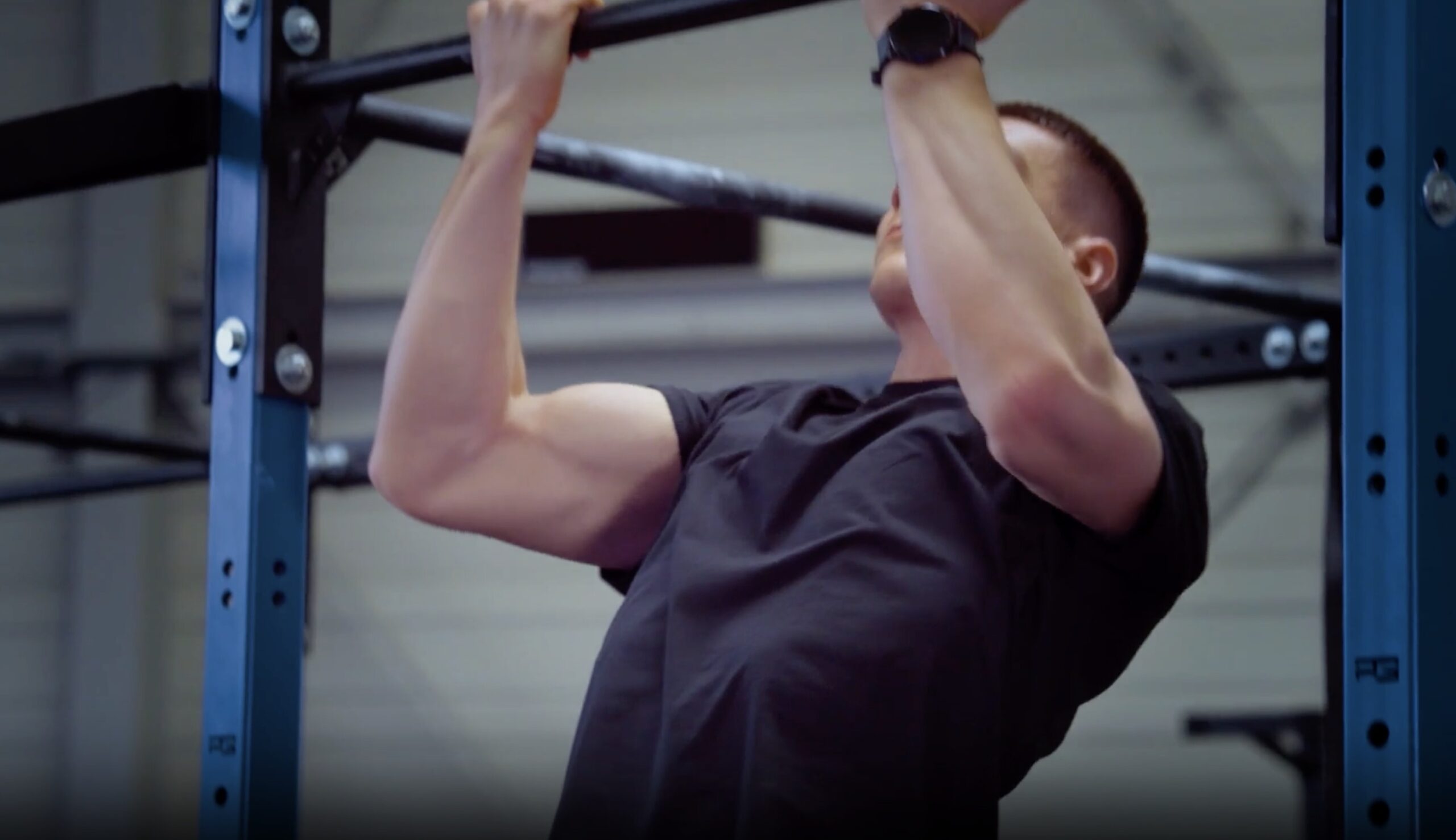
Pull-ups and chin-ups are often the biggest barrier for beginners. This is not a lack of effort. It is basic physics.
Pulling movements require a high level of relative upper-body strength. Research shows that untrained individuals often lack sufficient latissimus dorsi, scapular stabilizer, and elbow flexor strength to overcome body mass.
Electromyography studies demonstrate that pull-ups place high activation demands on:
• Latissimus dorsi
• Biceps brachii
• Lower trapezius
• Rhomboids
If these muscles are underdeveloped relative to body mass, failure is inevitable regardless of motivation.
Strength Training Still Matters
Calisthenics does not eliminate the value of external resistance. In fact, research supports the use of supplemental resistance training to improve bodyweight performance.
Studies comparing bodyweight-only training to combined approaches show that external loading can accelerate strength development, especially in beginners.

Examples include:
• Using resistance bands or weights for assisted pull-ups
• Strengthening weak links with dumbbells or barbells
• Building baseline strength before advanced calisthenics skills
This does not make calisthenics “less pure.” It makes it more effective.
Practical Implications Before You Start
Before starting calisthenics, you should consider:
• Your current bodyweight and composition
• Your baseline pulling and pushing strength
• Whether supplemental resistance training would help
Progressions exist for every movement, but ignoring relative strength principles leads to stalled progress.
Calisthenics rewards efficiency, not ego.
3. Skill Acquisition and Motor Control Are Central to Progress
Calisthenics is as much a skill-based discipline as it is a strength discipline.
This is often overlooked.
Many Calisthenics Movements Are Motor Skills
Movements like handstands, muscle-ups, levers, and planches are not just strength feats. They are complex motor tasks requiring precise coordination, balance, and timing.
Motor learning research shows that skill acquisition follows predictable stages:
• Cognitive stage: learning the movement pattern
• Associative stage: refining coordination and reducing errors
• Autonomous stage: performing efficiently with minimal conscious effort
Trying to brute-force your way through these stages rarely works.
Neural Adaptation Drives Early Progress
Neural adaptations play a major role in calisthenics progression. Studies show that improvements in intermuscular coordination and motor unit synchronization can dramatically improve performance without changes in muscle size.
This explains why technique-focused training often produces rapid gains.
For example:
• Scapular control improves pull-up efficiency
• Proper hollow body positioning reduces energy leaks
• Improved balance reduces unnecessary muscular effort
Ignoring technique wastes strength.
Fatigue Impairs Skill Learning
Skill-based training requires quality repetitions. Research on motor learning consistently shows that excessive fatigue reduces skill acquisition and retention.
When you train calisthenics skills in a highly fatigued state:
• Movement patterns degrade
• Compensations increase
• Injury risk rises
This is why advanced calisthenics programs often separate skill work from high-volume conditioning.
Mobility and Control Are Not Optional
Calisthenics exposes mobility limitations quickly. Restricted shoulder flexion, limited wrist extension, or poor hip control can prevent safe execution of movements.
Research on joint mobility and injury risk shows that limited range of motion combined with high load increases tissue stress.

Mobility work is not about flexibility alone. It is about active control through range.
Practical Implications Before You Start
Before starting calisthenics training, understand that:
• Skill practice should be deliberate and low-fatigue
• Technique matters as much as strength
• Mobility limitations must be addressed early
Treating calisthenics like circuit training misses its most important element.
Final Thoughts
Calisthenics is not a shortcut. It is a long-term training method that rewards patience, consistency, and intelligent progression.
If you respect joint adaptation timelines, understand the importance of relative strength, and approach movements as skills rather than challenges to muscle fatigue, calisthenics can build exceptional strength and durability.
Ignore these principles, and progress becomes a cycle of frustration and injury.
References
• Aagaard, P., Andersen, J.L., Dyhre-Poulsen, P., Leffers, A.M., Wagner, A., Magnusson, S.P. and Simonsen, E.B. (2001). A mechanism for increased contractile strength of human pennate muscle in response to strength training. Journal of Applied Physiology, 93(4), pp.1318–1326.
• Bohm, S., Mersmann, F. and Arampatzis, A. (2015). Human tendon adaptation in response to mechanical loading: a systematic review and meta-analysis of exercise intervention studies on healthy adults. Sports Medicine, 45(11), pp.1575–1595.
• Magnusson, S.P., Langberg, H. and Kjaer, M. (2010). The pathogenesis of tendinopathy: balancing the response to loading. Nature Reviews Rheumatology, 6(5), pp.262–268.
• Enoka, R.M. and Duchateau, J. (2016). Translating fatigue to human performance. Medicine & Science in Sports & Exercise, 48(11), pp.2228–2238.
• Folland, J.P. and Williams, A.G. (2007). The adaptations to strength training: morphological and neurological contributions to increased strength. Sports Medicine, 37(2), pp.145–168.
• Suchomel, T.J., Nimphius, S. and Stone, M.H. (2016). The importance of muscular strength in athletic performance. Sports Medicine, 46(10), pp.1419–1449.
• Vigotsky, A.D., Halperin, I., Lehman, G.J., Trajano, G.S. and Vieira, T.M. (2018). Interpreting signal amplitudes in surface electromyography studies in sport and rehabilitation sciences. Frontiers in Physiology, 8, pp.985.