

Double unders are one of those movements that look simple—until the clock is running, your heart rate is through the roof, and the rope keeps catching your toes.
With the 2026 CrossFit Open approaching, there’s a good chance double unders will show up again. They’re efficient, accessible, and brutally effective at testing coordination under fatigue. But they also expose technical flaws faster than almost any other skill in CrossFit.


The good news? You don’t need a total overhaul. If you focus on three evidence-based areas—reactive stiffness, motor learning under fatigue, and energy system efficiency—you can dramatically improve your double unders before the Open starts.
This article breaks down three quick, science-backed tips that you can apply immediately. No fluff. Just practical advice grounded in research and performance science.
Why Double Unders Break Down Under Fatigue
Before we get into the tips, it’s important to understand what makes double unders challenging.
A successful double under requires:
- High reactive strength and ankle stiffness
- Precise timing and coordination
- Efficient wrist-driven rope speed
- Consistent vertical displacement
- The ability to maintain rhythm under metabolic stress
From a physiological perspective, double unders rely heavily on the stretch-shortening cycle (SSC)—the rapid transition between muscle lengthening (eccentric) and shortening (concentric) (Komi, 2000). The SSC allows you to bounce efficiently off the floor with minimal ground contact time.
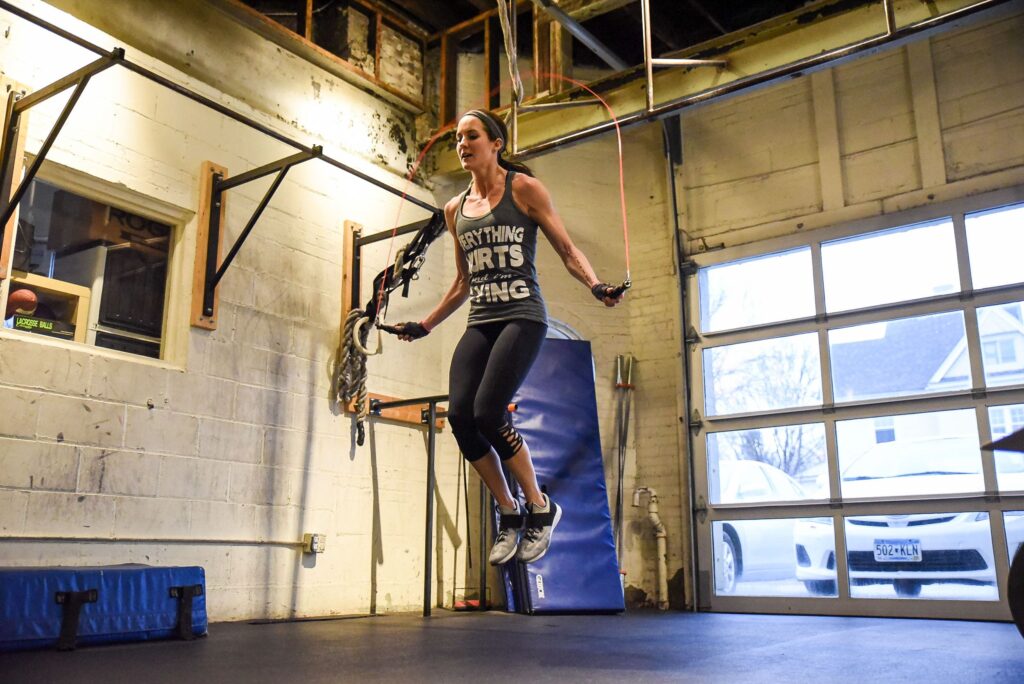
As fatigue increases, ground contact time increases and reactive force output decreases (Girard, Micallef and Millet, 2011). That’s when you start jumping higher, bending your knees more, losing rhythm, and tripping on the rope.
Improving your double unders before the Open is less about “trying harder” and more about improving the systems that support efficiency under fatigue.
Let’s break down the three most impactful ways to do that.
Tip 1: Improve Reactive Stiffness and Ground Contact Efficiency
Why Reactive Stiffness Matters
Double unders are essentially a series of low-amplitude plyometric jumps. Every rep depends on a fast stretch-shortening cycle and short ground contact time.
Reactive strength—the ability to rapidly produce force following an eccentric load—is strongly associated with plyometric performance and running economy (Markovic and Mikulic, 2010). When reactive stiffness drops, you compensate by increasing knee flexion and jumping higher, which wastes energy and disrupts timing.
Research shows that plyometric training improves neuromuscular efficiency and the mechanical properties of the muscle-tendon unit (Markovic, 2007). This translates into shorter ground contact times and better force transmission—exactly what you need for efficient double unders.
What Science Says About Ground Contact Time
Elite jumpers and sprinters display shorter ground contact times and higher reactive strength indices (RSI) compared to less trained individuals (Flanagan and Comyns, 2008). While double unders are not maximal jumps, they rely on similar elastic mechanisms.
Fatigue increases contact time and reduces stiffness (Girard, Micallef and Millet, 2011). This explains why your rope starts clipping your feet during high-rep sets.
Improving ankle stiffness and reactive strength makes your bounce more automatic and less energy-costly.
How to Apply This Before the Open
You don’t need an advanced plyometric program. Add 2–3 short sessions per week, either before or after your workout.
A. Low-Amplitude Pogos
- 3–4 sets of 20–30 seconds
- Focus on minimal knee bend
- Stay tall, bounce from the ankles
- Keep contact time short
This type of submaximal plyometric work improves stiffness and neuromuscular coordination without excessive fatigue (Markovic, 2007).
B. Single-Leg Hops (Low Volume)
- 2–3 sets of 10–15 reps per side
- Controlled and rhythmic
- Emphasize stiffness, not height
Single-leg plyometrics enhance unilateral ankle stability and tendon stiffness, which supports balance and symmetry during double unders.
C. Rhythm Sets With a Rope
Immediately after pogo work, perform 2–3 short sets of relaxed double unders (20–40 reps). The goal is to transfer the elastic stiffness you just trained into rope rhythm.
The key here is intent. Think “bounce off the floor,” not “jump high.” Research on motor control suggests that external focus cues (like “bounce” rather than “extend knees”) improve movement efficiency and performance (Wulf, 2013).
Over the next few weeks, this small addition can make your double unders feel lighter and more automatic.
Tip 2: Train Coordination Under Fatigue (The Right Way)
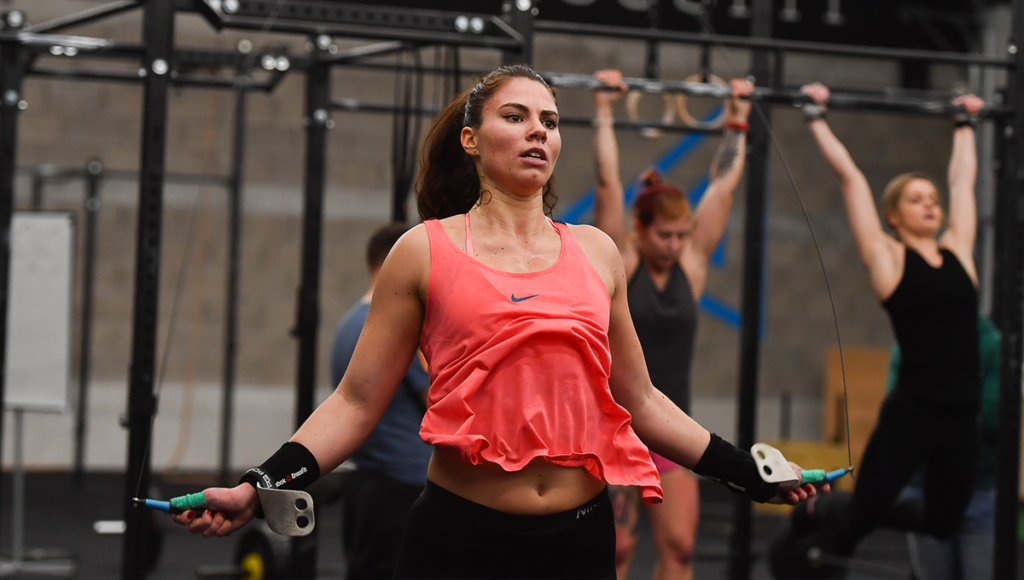
Fatigue Disrupts Motor Control
Double unders rarely appear fresh in competition. They often follow thrusters, wall balls, or rowing.
Fatigue impairs motor coordination and increases variability in movement patterns (Enoka and Duchateau, 2008). As your central nervous system tires, timing precision decreases.
This is why you can hit 100 unbroken in warm-ups—but trip every 15 reps in a workout.
If you want your skill to hold up in the Open, you must practice under metabolic stress.
But Don’t Just “Practice More”
Mindless volume isn’t the solution. Repeating poor reps under heavy fatigue reinforces bad patterns. Motor learning research shows that high-quality repetitions with appropriate variability produce better long-term retention (Schmidt and Lee, 2011).
You need structured exposure to fatigue—not chaos.
What the Evidence Says About Skill Retention
Motor learning improves when athletes practice in conditions that resemble competition demands, a principle known as specificity (Schmidt and Lee, 2011). However, excessively degraded technique can reduce skill acquisition.
The solution is controlled fatigue exposure.
How to Apply This Before the Open
Use contrast conditioning and fatigue layering.
A. Contrast Sets
Example:
- 250-meter row at moderate-hard pace
- Immediately into 30–50 double unders
- Rest 60–90 seconds
- Repeat 4–6 rounds
This keeps heart rate elevated but allows partial recovery so you can maintain quality mechanics.
Over time, reduce rest intervals to simulate Open intensity.
B. Broken Set Practice
Instead of always chasing unbroken sets, practice planned breaks.
For example:
- 120 double unders as 40-30-30-20
- 10–15 seconds between sets
Research on pacing strategies shows that deliberate energy distribution improves performance in high-intensity tasks (Abbiss and Laursen, 2008). Learning to break strategically prevents catastrophic failure.
C. Error Recovery Drills
Miss a rep? Immediately resume.
Do not reset mentally for 30 seconds. In competition, you won’t have that luxury.
Rapid error recovery trains attentional control and resilience under stress. Psychological research shows that attentional focus and quick reset strategies reduce performance decrements after mistakes (Beilock and Carr, 2001).
Practicing this now will pay off when the judge is counting and the crowd is loud.
Tip 3: Improve Efficiency, Not Just Endurance
Double Unders Are Metabolically Demanding
Jump rope can elicit heart rates near 85–95% of max during high-intensity intervals (Baker, Cormie and Young, 2010). It’s not “just a skill.” It’s a serious metabolic hit.
If your technique is inefficient, energy cost skyrockets.
Running economy research shows that small inefficiencies increase oxygen consumption and fatigue (Saunders et al., 2004). The same principle applies here: extra knee bend, excessive arm swing, and jumping too high increase energy expenditure.
The Role of Elastic Energy
The stretch-shortening cycle stores elastic energy in tendons, reducing metabolic cost (Komi, 2000). When stiffness decreases, muscles must work harder, increasing oxygen demand.
This is why smooth double unders feel easy and sloppy ones feel exhausting.
How to Apply This Before the Open
A. Control Jump Height
You only need enough vertical displacement for the rope to pass twice—usually 1–2 inches higher than a single under.
Use a phone in slow motion to check.
Lower jump height reduces energy cost and improves repeatability.
B. Wrist-Driven Speed
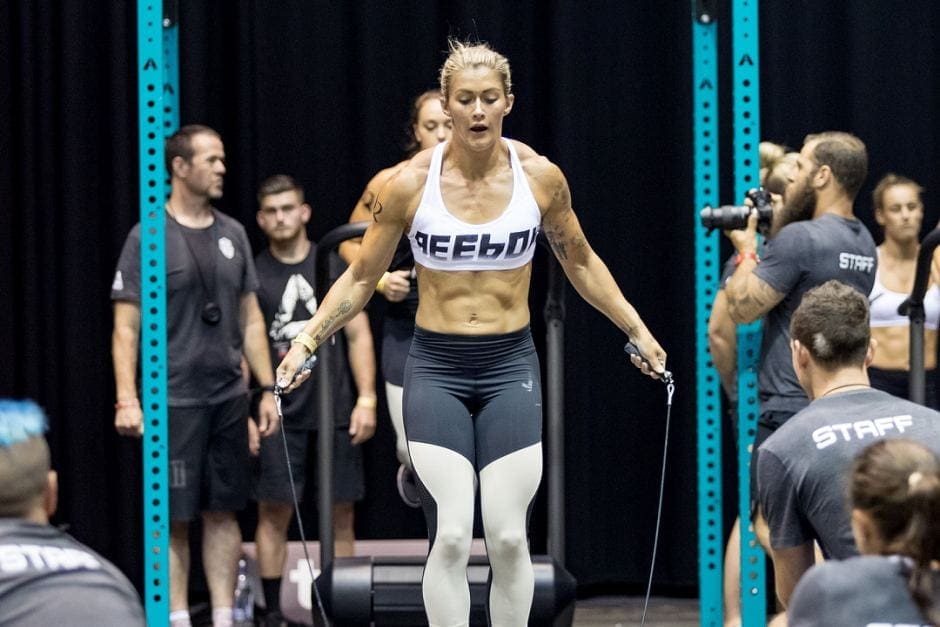
Excessive shoulder movement increases energy use and disrupts rope timing.
Studies on movement economy show that minimizing unnecessary motion improves efficiency (Saunders et al., 2004).
Keep elbows slightly in front of the torso and rotate from the wrists.
Cue: “Spin fast, jump low.”
C. Breathing Rhythm
Breathing patterns influence endurance performance and perceived exertion (Seiler, 2010). Many athletes unconsciously hold their breath during double unders.
Practice:
- Inhale for 3–4 reps
- Exhale for 3–4 reps
Find a rhythm that stabilizes your torso and reduces panic.
Breathing control reduces sympathetic overactivation and improves pacing.
Putting It All Together: A 4-Week Mini Plan Before the Open
You don’t need to overhaul your programming. Add this structure:
Twice per week:
- 3–4 sets pogo jumps (20–30 seconds)
- 2–3 sets short double under rhythm sets
Once or twice per week:
- 4–6 rounds row + double under contrast
Once per week:
- Open-style conditioning piece including double unders under fatigue
Throughout:
- Focus on low jump height
- Wrist-driven rope speed
- Fast recovery after misses
These additions are small, but grounded in science. Over four weeks, they can dramatically improve consistency.
Common Mistakes That Science Explains
Jumping Too High
Increases energy cost and disrupts timing. Less economical movement leads to faster fatigue (Saunders et al., 2004).
Over-Bending Knees
Reduces elastic recoil and increases muscular demand (Komi, 2000).
Practicing Only Fresh
Fails to train motor control under competition fatigue (Enoka and Duchateau, 2008).
Ignoring Breathing
Raises perceived exertion and reduces pacing control (Seiler, 2010).
Final Thoughts
Double unders aren’t just about coordination. They’re about reactive strength, motor control, and metabolic efficiency working together.
Before the 2026 CrossFit Open starts, focus on:
- Improving ankle stiffness and ground contact efficiency
- Practicing skill under structured fatigue
- Reducing wasted energy through better mechanics
These are small adjustments backed by solid sports science. They won’t just help you survive double unders—they’ll help you stay smooth when everyone else is unraveling.
And when that Open workout drops with 150 double unders in the middle?
You won’t panic, you’ll crush it.
References
- Abbiss, C.R. and Laursen, P.B. (2008) ‘Describing and understanding pacing strategies during athletic competition’, Sports Medicine, 38(3), pp. 239–252.
- Baker, J.S., Cormie, P. and Young, W.B. (2010) ‘The effect of training with elastic bands on aerobic fitness and muscle strength in adolescents’, Journal of Strength and Conditioning Research, 24(9), pp. 2312–2319.
- Beilock, S.L. and Carr, T.H. (2001) ‘On the fragility of skilled performance: What governs choking under pressure?’, Journal of Experimental Psychology: General, 130(4), pp. 701–725.
- Enoka, R.M. and Duchateau, J. (2008) ‘Muscle fatigue: what, why and how it influences muscle function’, Journal of Physiology, 586(1), pp. 11–23.
- Flanagan, E.P. and Comyns, T.M. (2008) ‘The use of contact time and the reactive strength index to optimize fast stretch-shortening cycle training’, Strength and Conditioning Journal, 30(5), pp. 32–38.