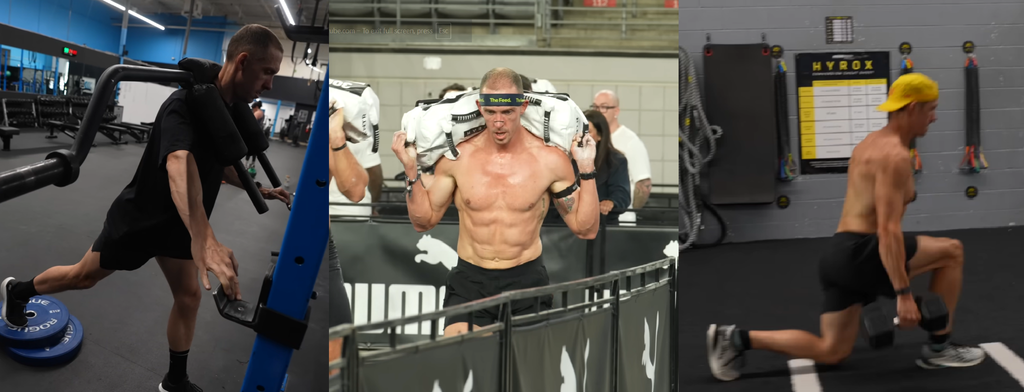


HYROX is a unique test of strength, endurance, and resilience. Athletes are required to produce force repeatedly under fatigue, especially in pushing movements such as the sled push, sled pull, wall balls, and burpee broad jumps. Among these, pushing power stands out as a key determinant of performance.
Whether you are trying to move a heavy sled efficiently or maintain speed during high repetition wall balls, your ability to generate force quickly and repeatedly is critical.


Improving pushing power is not simply about getting stronger. It involves a combination of maximal strength, rate of force development, neuromuscular coordination, and muscular endurance. Science consistently shows that training methods targeting these components can significantly enhance athletic performance across functional fitness domains.
This article breaks down the three best exercises for increasing pushing power in HYROX, based on scientific evidence. Each exercise is selected because it develops specific qualities that transfer directly to race performance. You will also learn how to implement them effectively into your training.
Understanding Pushing Power in HYROX

What Is Pushing Power?
Pushing power refers to the ability to generate force rapidly in movements that involve extending the hips, knees, and ankles while transferring that force through the upper body. In HYROX, this includes:
- Sled push
- Wall balls
- Burpee broad jumps
- Transitions that require explosive forward movement
Power is defined as force multiplied by velocity. This means you need both strength and speed to maximize pushing performance.
The Physiology Behind It
Several physiological factors influence pushing power:
- Muscle cross sectional area, which determines force production
- Neural drive, which controls how quickly muscles are activated
- Tendon stiffness, which affects energy transfer efficiency
- Fiber type composition, particularly the proportion of fast twitch fibers
Research shows that training programs combining heavy resistance training with explosive movements produce the greatest improvements in power output. This is often referred to as complex or contrast training.
Why Specific Exercises Matter
General strength training helps, but specificity is key. Exercises that mimic the movement patterns, joint angles, and force demands of HYROX events provide better transfer. This is why the following three exercises are particularly effective.
Exercise 1: Heavy Sled Push
Why It Works
The sled push is the most specific exercise you can use to improve pushing power for HYROX. It directly replicates the movement pattern, force requirements, and energy demands of the race.

Scientific evidence shows that resisted sprinting and sled pushing increase horizontal force production, which is crucial for acceleration and forward propulsion. These adaptations are highly transferable to functional fitness tasks.
Key Benefits
- Develops maximal force in a horizontal direction
- Enhances rate of force development under load
- Improves coordination between lower and upper body
- Builds muscular endurance specific to HYROX demands
Technique Guidelines
- Maintain a forward lean with a neutral spine
- Drive through the balls of your feet
- Keep arms locked and stable on the sled handles
- Use short, powerful steps
Programming Recommendations
To build pushing power, use heavy loads that challenge your ability to maintain speed:
- Load: 75 to 100 percent of race weight or heavier
- Distance: 10 to 25 meters per effort
- Sets: 4 to 8
- Rest: 2 to 3 minutes between sets
You can also include lighter, faster sled pushes to train velocity:
- Load: 40 to 60 percent of race weight
- Focus: maximal speed and explosiveness
Scientific Support
Studies on resisted sprinting show significant improvements in acceleration and horizontal force production. These gains are directly linked to improved performance in tasks requiring forward propulsion.
Exercise 2: Barbell Back Squat
Why It Works
The back squat is one of the most effective exercises for developing lower body strength, which is the foundation of power. Without sufficient strength, your ability to generate force quickly is limited.
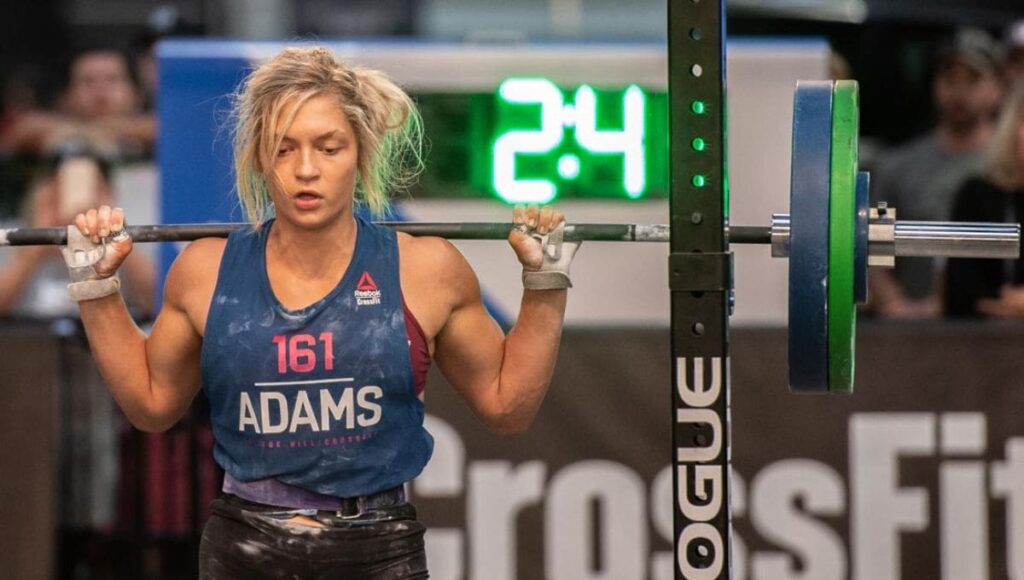
Research consistently demonstrates a strong correlation between maximal squat strength and power output in athletic movements such as jumping and sprinting.
Key Benefits
- Increases maximal force production in the hips and legs
- Improves neuromuscular efficiency
- Enhances joint stability under load
- Builds the strength base needed for power development
Technique Guidelines
- Position the bar securely across the upper back
- Keep the chest up and core braced
- Descend until the hips are below parallel if mobility allows
- Drive upward explosively while maintaining control
Programming Recommendations
For pushing power, focus on heavy loads with intent to move explosively:
- Load: 80 to 90 percent of one repetition maximum
- Repetitions: 3 to 5 per set
- Sets: 4 to 6
- Rest: 2 to 4 minutes
You can also incorporate velocity based training if you have access to measurement tools. Moving submaximal loads quickly has been shown to improve power output.
Variations for HYROX
- Pause squats to improve force production from a dead stop
- Tempo squats to increase time under tension
- Front squats for more upright posture and core engagement
Scientific Support
Heavy resistance training increases motor unit recruitment and firing frequency. These adaptations are essential for producing high levels of force quickly, which is a key component of power.
Exercise 3: Plyometric Push Ups
Why It Works
Plyometric push ups train explosive upper body pushing power. While HYROX is often thought of as lower body dominant, the upper body plays a critical role in force transfer and stability during pushing movements.

Plyometric training enhances the stretch shortening cycle, allowing muscles to produce more force in less time. This is essential for explosive performance.
Key Benefits
- Improves rate of force development in the upper body
- Enhances neuromuscular coordination
- Increases efficiency of the stretch shortening cycle
- Transfers to movements like wall balls and burpees
Technique Guidelines
- Start in a strong push up position
- Lower under control
- Explode upward so the hands leave the ground
- Land softly and immediately transition into the next repetition
Programming Recommendations
- Repetitions: 5 to 10 per set
- Sets: 3 to 5
- Rest: 1 to 2 minutes
- Focus on quality and explosiveness rather than fatigue
Progressions
- Beginner: standard push ups with explosive intent
- Intermediate: clap push ups
- Advanced: depth push ups using elevated surfaces
Scientific Support
Plyometric training has been shown to significantly improve power output by enhancing the efficiency of the stretch shortening cycle. This leads to faster and more forceful muscle contractions.
How to Combine These Exercises
The Power Development Model
To maximize pushing power, combine strength and explosiveness within the same training program. A simple structure could include:
- Heavy strength work first
- Explosive movements second
- Specific conditioning last
Example Weekly Structure
- Day 1: Heavy squats and sled pushes
- Day 2: Plyometric push ups and conditioning
- Day 3: Mixed HYROX simulation
Contrast Training Approach
Pair heavy and explosive exercises:
- Back squat followed by sled push
- Plyometric push ups after upper body strength work
This method enhances post activation potentiation, which can improve power output.
Common Mistakes to Avoid
Ignoring Technique
Poor form reduces force production and increases injury risk. Always prioritize movement quality.
Training Only One Quality
Focusing only on strength or only on conditioning limits progress. Power requires both.
Overtraining
High intensity work requires adequate recovery. Without it, performance will decline.
Nutrition and Recovery for Power
Protein Intake
Adequate protein supports muscle repair and growth. Aim for 1.6 to 2.2 grams per kilogram of body weight.
Carbohydrates
Carbohydrates fuel high intensity training and support recovery.
Sleep
Sleep is critical for neuromuscular recovery and performance. Aim for 7 to 9 hours per night.
Final Thoughts
Improving pushing power in HYROX requires a targeted approach. The heavy sled push, back squat, and plyometric push up each develop essential components of power. When combined intelligently, they create a powerful training system that translates directly to race performance.
Consistency, proper programming, and attention to detail will determine your success. Focus on quality training, and the results will follow.
References
- Cormie, P., McGuigan, M.R. and Newton, R.U. (2011). Developing maximal neuromuscular power. Sports Medicine, 41(1), pp.17 to 38.
- Cronin, J. and Hansen, K. (2005). Strength and power predictors of sports speed. Journal of Strength and Conditioning Research, 19(2), pp.349 to 357.
- Kawamori, N. and Haff, G.G. (2004). The optimal training load for the development of muscular power. Journal of Strength and Conditioning Research, 18(3), pp.675 to 684.
- Markovic, G. and Mikulic, P. (2010). Neuro muscular adaptations to plyometric training. Sports Medicine, 40(10), pp.859 to 895.
- Morin, J.B., Petrakos, G., Jimenez Reyes, P., Brown, S.R., Samozino, P. and Cross, M.R. (2017). Very heavy sled training for improving horizontal force output. International Journal of Sports Physiology and Performance, 12(6), pp.840 to 844.