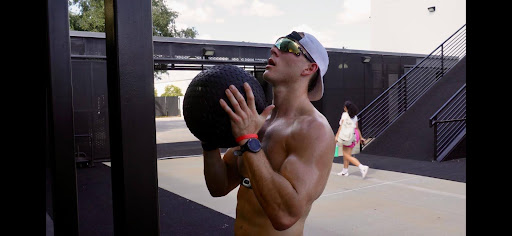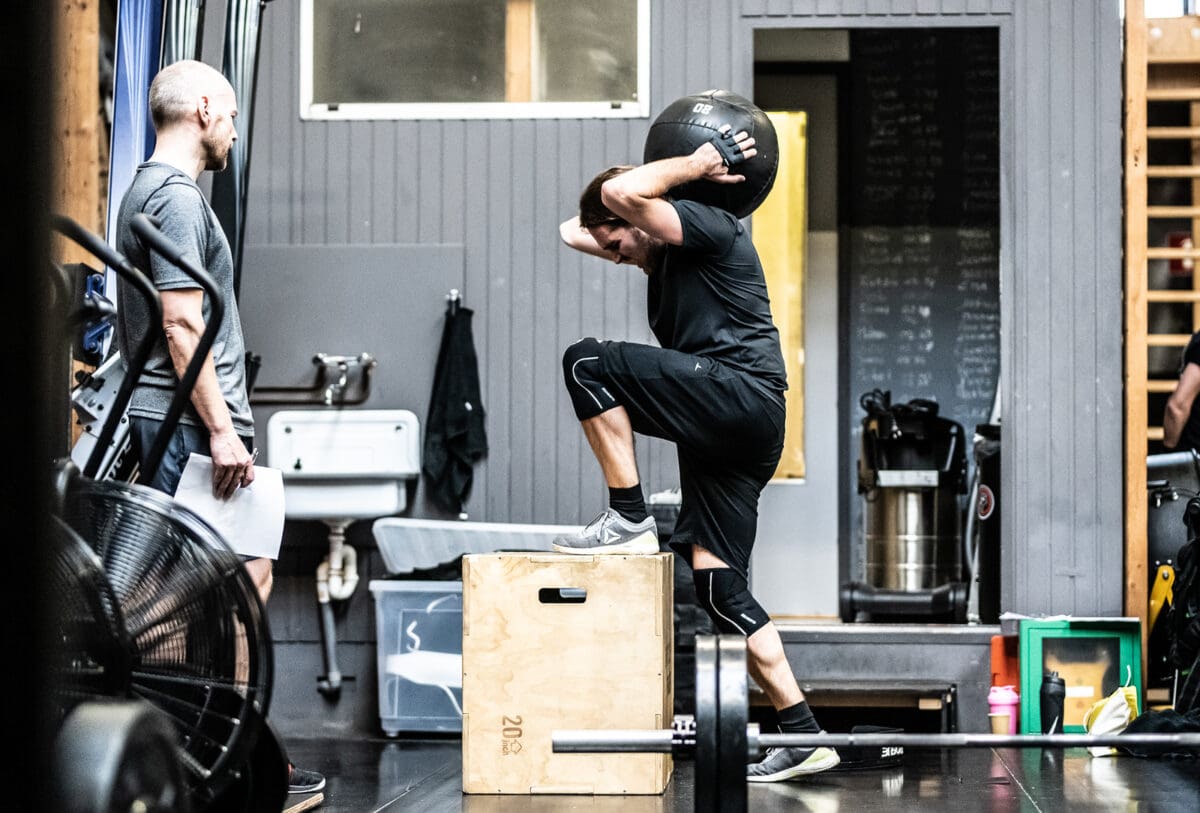


Medicine ball box step overs look simple. Step up. Step across. Step down. Repeat.
But once the reps climb and your heart rate spikes, they become a grind. Your lungs burn. Your legs fill with fatigue. Your grip tightens around the ball. Technique starts to slip.


The good news? There are science-backed ways to make medicine ball box step overs feel smoother, more efficient, and less exhausting — without cutting intensity.
This guide breaks down five proven strategies grounded in biomechanics, physiology, and strength science. If you apply them correctly, you will conserve energy, reduce joint stress, and improve performance.
Let’s get into it.
Understanding the Demands of Medicine Ball Box Step Overs
Before we optimize the movement, we need to understand what makes medicine ball box step overs challenging.
This exercise combines:
- Unilateral lower body strength
- Hip and knee extension power
- Balance and proprioception
- Core stabilization
- Loaded anterior carriage
- Aerobic and anaerobic conditioning
Step-ups and step-overs require significant activation from the quadriceps, gluteus maximus, and gluteus medius. EMG analyses show high glute and quad activation during step-up variations, especially when performed with load. The unilateral nature also increases stabilizer demand at the hip and trunk.
Adding a medicine ball increases metabolic cost. Research on load carriage demonstrates that even moderate external loads significantly raise oxygen consumption and heart rate. Holding the ball anteriorly further increases trunk stabilization demand compared to unloaded stepping patterns.
That combination explains why medicine ball box step overs can spike fatigue quickly.
Now let’s make them easier.
Hack #1: Adjust Box Height for Optimal Joint Mechanics
Why Box Height Matters
Box height dramatically changes joint angles, muscle recruitment, and stress on the knee.
As step height increases:
- Knee flexion increases
- Patellofemoral joint stress rises
- Quadriceps demand increases
- Balance demand increases
Research on squatting and stepping mechanics shows that deeper knee flexion significantly increases compressive forces at the knee joint. While some stress is necessary for adaptation, excessive height can increase fatigue and discomfort without improving training stimulus.
A box that is too high turns medicine ball box step overs into near single-leg squats. That increases energy cost and may compromise technique under fatigue.
The Optimal Range
For most athletes, the ideal height places the hip crease slightly above the knee when the working foot is on the box.
This height:
- Allows strong hip extension
- Minimizes excessive knee torque
- Maintains balance control
- Preserves cadence during high-rep sets
Lowering the box slightly can significantly reduce metabolic cost while maintaining muscular stimulus.
Science Behind It
Studies examining patellofemoral forces during deep knee flexion show that compressive forces increase as the knee bends further. Additionally, biomechanical modeling of step-ups demonstrates increased quadriceps torque demand with higher step heights.
Reducing unnecessary joint torque conserves muscular energy and reduces early fatigue accumulation.
Practical Application
If you struggle to maintain rhythm during medicine ball box step overs:
- Test a slightly lower box
- Film from the side
- Ensure the shin stays relatively vertical at foot contact
- Avoid excessive forward knee travel
You should feel powerful, not strained, on every rep.
Hack #2: Use a Slight Forward Torso Lean to Shift Load to the Glutes
The Biomechanics of Torso Position
An upright torso increases knee extensor demand. A slight forward torso lean increases hip extensor contribution.
This matters because:
- The glutes are larger and more fatigue-resistant than the quads
- The hip joint can generate more torque than the knee
- Posterior chain dominance reduces anterior knee stress
Research comparing front-loaded and back-loaded squats demonstrates that trunk angle significantly alters muscle activation patterns and joint loading.
Similarly, step-up mechanics shift depending on torso position.
Why This Makes Medicine Ball Box Step Overs Easier
When you lean slightly forward (while maintaining a neutral spine):
- You increase hip moment arm
- You recruit more gluteus maximus
- You reduce knee extensor overload
- You distribute effort across larger muscle groups
This spreads the workload and delays local quad fatigue.
Core Activation Bonus
Anterior load (medicine ball) already increases trunk stabilization demand. Research on trunk muscle activation shows that anterior loading increases core engagement compared to unloaded patterns.
A controlled forward lean:
- Enhances posterior chain activation
- Maintains spinal stiffness
- Improves force transfer
Practical Cue
Instead of staying perfectly upright, try this:
- As your foot plants on the box, hinge slightly at the hips
- Drive through the whole foot
- Think “push the box down” rather than “stand up”
The movement should feel powerful and smooth, not knee-dominant and choppy.
Hack #3: Control Tempo to Reduce Energy Leaks
Why Tempo Matters
Fast, uncontrolled stepping wastes energy.
Research on movement efficiency shows that fatigue impairs motor coordination and increases variability. When rhythm breaks down, metabolic cost rises.
Slightly slowing the eccentric (lowering phase) improves:
- Neuromuscular control
- Force distribution
- Joint stability
Resistance training research demonstrates that controlled tempo increases time under tension and improves motor learning without necessarily increasing energy expenditure excessively.
The Sweet Spot Tempo
For medicine ball box step overs:
- Controlled step up (about 1–2 seconds)
- Smooth transition over the box
- Controlled step down (1–2 seconds)
- Immediate but stable foot placement
Avoid:
- Crashing down
- Bouncing off the floor
- Rushing transitions
Efficient reps conserve energy.
Motor Control and Fatigue
Studies show that fatigue reduces joint position sense and coordination accuracy. That means sloppy reps require more corrective muscle activation.
By maintaining deliberate tempo, you:
- Reduce stabilizer overactivity
- Preserve coordination
- Lower cumulative fatigue
In longer workouts, this difference adds up.
Practical Drill
Use a metronome during training:
- 60–70 beats per minute
- One movement per beat
Research on rhythm and performance shows that external pacing can improve movement economy and consistency.
Hack #4: Brace and Breathe Properly
The Role of Core Stability
Medicine ball box step overs are not just a leg exercise.
They require:
- Trunk stiffness
- Pelvic control
- Force transfer between limbs
Research on spinal stabilization shows that anticipatory core activation improves movement efficiency and reduces energy leaks.
If your trunk collapses slightly each rep, your legs work harder to compensate.
The Breathing Factor
Breathing pattern directly affects trunk stability.
Studies on respiratory muscle function demonstrate that proper diaphragmatic breathing improves trunk stiffness and performance during loaded movement.
Poor breathing patterns:
- Increase perceived exertion
- Accelerate fatigue
- Reduce stability
How to Apply It
Before each rep:
- Inhale through the nose
- Expand ribs 360 degrees
- Brace as if preparing for a light punch
- Step up while maintaining tension
- Exhale gradually at the top or during transition
Avoid:
- Holding breath excessively during high reps
- Shallow chest breathing
- Relaxing trunk between steps
Proper bracing reduces energy waste and improves stepping efficiency.
Hack #5: Strengthen the Weak Links
Sometimes medicine ball box step overs feel hard because something is underdeveloped.
Let’s break down the most common weak links.
Weak Link 1: Glute Medius and Hip Stability
Research shows that hip abductors play a critical role in stabilizing the pelvis during unilateral tasks.
If the glute medius is weak:
- Knee collapses inward
- Balance becomes unstable
- Energy cost increases
Fix it with:
- Lateral band walks
- Single-leg RDLs
- Side planks
Improved hip stability reduces wobble and improves stepping efficiency.
Weak Link 2: Ankle Dorsiflexion
Limited ankle mobility alters knee mechanics and increases compensatory movement.
Research links restricted dorsiflexion to altered landing and stepping mechanics, which can increase knee stress.
Improve it with:
- Calf stretching
- Ankle mobilizations
- Loaded dorsiflexion drills
Better ankle range improves foot placement and balance during medicine ball box step overs.
Weak Link 3: Unilateral Strength
Studies comparing unilateral and bilateral training show that single-leg strength improves balance and functional force production.
If your single-leg squat strength is low, high-rep step overs will feel disproportionately difficult.
Build strength with:
- Bulgarian split squats
- Weighted step-ups
- Rear-foot elevated lunges
Stronger single legs make medicine ball box step overs feel lighter — even with the same load.
Weak Link 4: Work Capacity
Load carriage research clearly shows that added external weight increases metabolic cost.
If conditioning is the limiting factor, improve it directly:
- Interval step-up sessions
- Sled pushes
- Aerobic base training
Improved aerobic efficiency reduces heart rate drift and fatigue accumulation during high-rep sets.
Bonus: Warm Up Using the RAMP Protocol
Warm-ups matter.
The RAMP protocol (Raise, Activate, Mobilize, Potentiate) is widely supported in strength and conditioning research as an effective preparation structure.
For medicine ball box step overs:
Raise:
- 3–5 minutes of light cyclical work
Activate:
- Glute bridges
- Band walks
Mobilize:
- Ankle mobility drills
- Hip flexor stretches
Potentiate:
- Low box step-overs at moderate speed
- Light loaded step-ups
A proper warm-up improves neuromuscular efficiency and can enhance subsequent power output through post-activation potentiation mechanisms.
Bringing It All Together
Medicine ball box step overs challenge strength, coordination, balance, and conditioning simultaneously.
To make them easier:
- Choose the right box height
- Shift load toward the hips
- Control tempo
- Brace and breathe correctly
- Fix weak links
Each strategy is grounded in biomechanics and physiology. None require fancy equipment. All improve efficiency.
When you apply them together, the movement feels smoother, stronger, and more sustainable — especially during high-volume workouts.
Master efficiency first. Intensity comes second.
Key Takeaways
| Strategy | Why It Works | What To Do |
|---|---|---|
| Optimize box height | Reduces excessive knee torque and energy cost | Use a height where hip crease is slightly above knee |
| Slight forward lean | Increases glute contribution and reduces quad overload | Hinge slightly and drive through whole foot |
| Control tempo | Improves motor control and reduces wasted energy | 1–2 seconds up and down, smooth transitions |
| Brace and breathe | Enhances trunk stiffness and movement efficiency | 360-degree brace before each rep |
| Strengthen weak links | Improves stability and force production | Train glutes, ankles, unilateral strength, and conditioning |
References
- Anderson, F.C. and Pandy, M.G., 2003. Individual muscle contributions to support in normal walking. Gait & Posture, 17(2), pp.159–169.
- Behm, D.G. and Colado, J.C., 2012. The effectiveness of resistance training using unstable surfaces and devices for rehabilitation. Sports Medicine, 42(12), pp.1037–1054.
- Bell, D.R., Padua, D.A. and Clark, M.A., 2008. Muscle strength and flexibility characteristics of people displaying excessive medial knee displacement. Journal of Athletic Training, 43(5), pp.475–481.
- Boudreau, S.N., Dwyer, M.K. and Mattacola, C.G., 2009. Hip muscle activation during functional exercises in individuals with and without patellofemoral pain syndrome. Journal of Orthopaedic & Sports Physical Therapy, 39(6), pp.395–404.
- Escamilla, R.F., 2001. Knee biomechanics of the dynamic squat exercise. Medicine & Science in Sports & Exercise, 33(1), pp.127–141.
- Forestier, N., Teasdale, N. and Nougier, V., 2002. Alteration of the position sense at the ankle induced by muscular fatigue in humans. Medicine & Science in Sports & Exercise, 34(1), pp.117–122.