The barbell deadlift has long been considered a cornerstone of strength training. It is often described as one of the most effective compound lifts for building posterior chain strength, including the back, glutes, and hamstrings. However, it is not the only path to a strong, well developed back. In fact, many lifters avoid deadlifts due to mobility limitations, injury history, or simply personal preference.
The good news is that science shows multiple alternative exercises can build back strength and muscle just as effectively when programmed correctly. The key lies in understanding movement patterns, muscle activation, and progressive overload.


This article explores three of the best back exercises that do not require the barbell deadlift. Each exercise is supported by research on muscle activation and hypertrophy. You will also learn how to perform them correctly and how to use them to build a strong, resilient back.
Why You Do Not Need Deadlifts for Back Development
Muscle Activation and Hypertrophy Principles
Muscle growth is primarily driven by three factors:
- Mechanical tension
- Muscle damage
- Metabolic stress
Resistance training studies consistently show that hypertrophy can be achieved through a wide variety of exercises as long as sufficient tension is applied and volume is adequate. There is no single exercise that is essential.
Electromyography studies have demonstrated that different exercises can produce similar activation levels in key back muscles such as the latissimus dorsi, erector spinae, and trapezius. This means that alternatives to the deadlift can still provide strong growth stimuli.
Injury Risk and Fatigue Considerations
The deadlift is effective but also highly demanding. It places significant stress on the spine and requires precise technique. Research shows that fatigue can quickly degrade lifting form, increasing the risk of injury.
For some individuals, especially beginners or those returning from injury, lower risk exercises with similar muscle activation can be a better choice.
Movement Variety Improves Development
The back is not a single muscle. It is a complex group including:
- Latissimus dorsi
- Trapezius
- Rhomboids
- Erector spinae
- Teres major
Different exercises target these muscles through various planes of motion. A well rounded program benefits from diversity rather than relying on one lift.
Exercise 1: Pull Ups and Chin Ups
Why Pull Ups Are One of the Best Back Exercises
Pull ups are one of the most effective bodyweight exercises for developing the upper back. They primarily target the latissimus dorsi but also recruit the biceps, rhomboids, and trapezius.
Research comparing vertical pulling movements shows high levels of lat activation during pull ups, often exceeding that of machine based alternatives. Unlike the deadlift, which emphasizes the posterior chain in a hip hinge pattern, pull ups focus on vertical pulling strength. This complements overall back development.
Scientific Evidence for Pull Ups
Electromyography data shows that pull ups generate strong activation in the latissimus dorsi and middle trapezius. Studies comparing pull ups with lat pulldowns indicate similar or greater muscle activation when bodyweight is used effectively.
In addition, bodyweight training has been shown to produce comparable hypertrophy to free weights when intensity is sufficient.
How to Perform Pull Ups Correctly
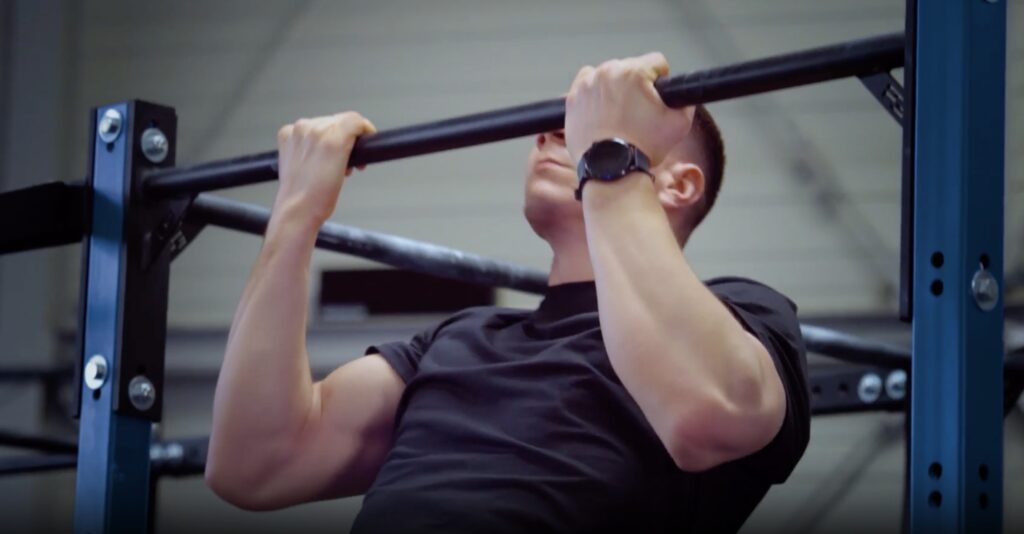
Start by hanging from a bar with your hands slightly wider than shoulder width. Your palms should face away from you for pull ups and toward you for chin ups.
Pull your body upward by driving your elbows down and back. Focus on engaging your lats rather than just pulling with your arms. At the top, your chin should clear the bar. Lower yourself under control until your arms are fully extended. Avoid swinging or using momentum. Keep your core tight throughout the movement.
Progressions and Variations
- Assisted pull ups using bands
- Negative pull ups for beginners
- Weighted pull ups for advanced lifters
- Neutral grip pull ups for joint comfort
Key Benefits
- High activation of the latissimus dorsi
- Minimal equipment required
- Scalable for all fitness levels
- Improves relative strength
Exercise 2: Chest Supported Rows
Why Chest Supported Rows Are Highly Effective
Chest supported rows eliminate lower back involvement, allowing you to focus purely on the upper and mid back. This makes them an excellent alternative to deadlifts, especially for those with lower back issues.
By stabilizing the torso, these rows reduce momentum and increase muscle tension. This leads to more targeted activation of the rhomboids, trapezius, and lats.
Scientific Evidence for Rowing Movements
Rowing exercises consistently show high activation in the middle trapezius and rhomboids. Studies comparing free weight and machine based rows indicate that both can effectively stimulate hypertrophy when performed with proper intensity.
Chest supported variations may also reduce spinal loading, making them safer for long term training.
How to Perform Chest Supported Rows
- Lie face down on an incline bench set to about 30 to 45 degrees. Hold a pair of dumbbells or use a barbell if available.
- Let your arms hang straight down. Pull the weights toward your torso by driving your elbows back.
- Squeeze your shoulder blades together at the top of the movement. Lower the weights slowly under control.
- Avoid shrugging your shoulders or using momentum.
Variations to Try
- Dumbbell chest supported row
- Machine chest supported row
- T bar row with chest support
- Single arm chest supported row
Key Benefits
- Reduces stress on the lower back
- Improves mind muscle connection
- Targets mid back muscles effectively
- Suitable for all experience levels
Exercise 3: Romanian Deadlifts with Dumbbells

Why This Variation Works Without a Barbell
While this exercise still involves a hip hinge, using dumbbells instead of a barbell changes the loading pattern and can reduce spinal stress. Dumbbell Romanian deadlifts emphasize the hamstrings and glutes while still engaging the erector spinae. This provides many of the posterior chain benefits of the deadlift without the same technical demands.
Scientific Evidence for Hip Hinge Movements
Research on hip hinge exercises shows strong activation of the hamstrings and gluteus maximus, along with significant engagement of the spinal erectors. Studies also suggest that unilateral and dumbbell variations can improve muscle balance and reduce asymmetries.
How to Perform Dumbbell Romanian Deadlifts
- Stand upright holding a pair of dumbbells in front of your thighs. Keep your chest up and shoulders back.
- Push your hips backward while maintaining a slight bend in your knees. Lower the dumbbells along your legs.
- Stop when you feel a stretch in your hamstrings. Return to the starting position by driving your hips forward.
- Keep your back neutral throughout the movement.
Variations to Consider
- Single leg Romanian deadlift
- Staggered stance Romanian deadlift
- Tempo controlled Romanian deadlift
Key Benefits
- Strengthens the posterior chain
- Improves hip hinge mechanics
- Lower spinal loading compared to barbell deadlifts
- Enhances balance and coordination
Programming These Exercises for Maximum Results
Training Frequency and Volume
Research suggests that training each muscle group at least twice per week leads to greater hypertrophy compared to once per week.
For back training, aim for:
- 10 to 20 sets per week
- 6 to 12 repetitions for hypertrophy
- Progressive overload over time
Example Weekly Back Routine
Day 1:
- Pull ups: 4 sets
- Chest supported rows: 4 sets
- Romanian deadlifts: 3 sets
Day 2:
- Chin ups: 3 sets
- Single arm rows: 4 sets
- Single leg Romanian deadlifts: 3 sets
Importance of Progressive Overload
To build muscle, you must gradually increase the challenge. This can be done by:
- Adding weight
- Increasing repetitions
- Improving technique
- Reducing rest time
Recovery and Adaptation
Muscle growth occurs during recovery. Ensure:
- Adequate protein intake
- Sufficient sleep
- Balanced training volume
Common Mistakes to Avoid
Using Momentum Instead of Muscle
Swinging or jerking reduces muscle tension and increases injury risk.
Neglecting Full Range of Motion
Partial repetitions limit muscle activation and growth.
Ignoring Technique
Poor form can lead to imbalances and injuries.
Overtraining the Lower Back
Even without deadlifts, excessive loading can fatigue the lower back.
Final Thoughts
You do not need the barbell deadlift to build a strong and muscular back. Pull ups, chest supported rows, and dumbbell Romanian deadlifts provide powerful alternatives supported by scientific evidence.
By focusing on proper technique, progressive overload, and balanced programming, you can achieve impressive back development without relying on one single exercise. The best program is one that you can perform consistently and safely. Choose exercises that fit your body, your goals, and your experience level.
References
- Andersen, V. et al. (2014). Muscle activation and strength in squat and deadlift exercises. Journal of Strength and Conditioning Research, 28(10), 2825-2833.
- Boeckh-Behrens, W. and Buskies, W. (2000). Results of electromyographic studies of back exercises. Strength and Conditioning Journal, 22(2), 35-43.
- Contreras, B. et al. (2015). A comparison of gluteus maximus activation between barbell, dumbbell, and machine exercises. Journal of Applied Biomechanics, 31(6), 452-458.
- Gentil, P. et al. (2017). Effects of different resistance training frequencies on muscle size and strength. Sports Medicine, 47(6), 1207-1216.
- Lehman, G. (2005). The influence of grip width and forearm pronation or supination on muscle activity during pull ups. Journal of Strength and Conditioning Research, 19(3), 587-591.