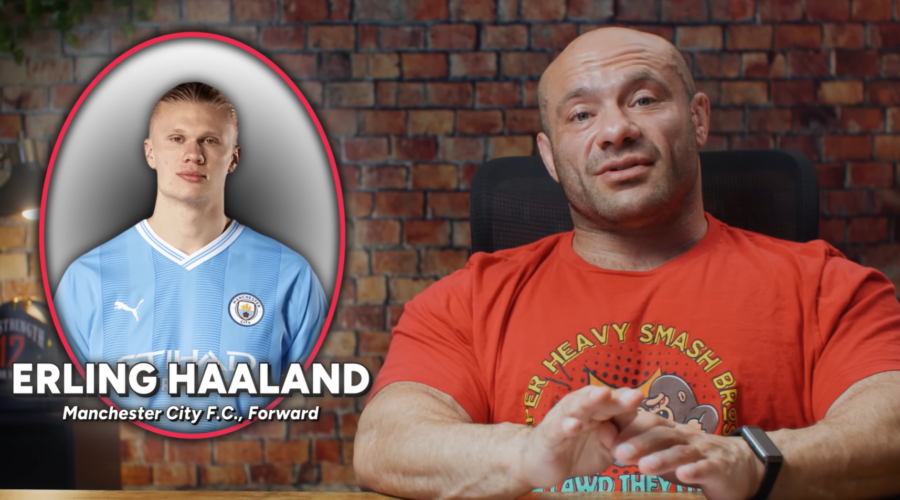


Erling Haaland is widely regarded as one of the most physically dominant footballers in the world, combining elite speed, power, coordination, and goal-scoring ability in a 6-foot-5 frame.
In a recent Renaissance Periodization YouTube video, exercise scientist Dr. Mike Israetel analyzed footage of the Manchester City striker, examining what makes Haaland such a unique athlete and separating effective training practices from common misconceptions.


Watching clips of Haaland score seemingly impossible goals, Israetel was visibly impressed.
“I’m sorry. I don’t even know what happened that time,” he said after one highlight. “How do you train to do those things?”
According to Israetel, the answer begins with understanding the difference between sport skill and physical preparation.
Elite Skill Comes From Playing the Sport
While strength and conditioning can improve athletic performance, Israetel emphasized that technical mastery comes primarily from practicing the sport itself.
“The way you get better at any sport is predominantly playing and or drilling and or using some kind of subsection of technique from that sport,” he explained. Using Haaland’s finishing ability as an example, Israetel noted that weight training alone cannot teach the timing, coordination, and body control required to score goals under pressure.
However, strength training can help athletes sprint faster, jump higher, kick harder, and reduce injury risk. For footballers, he identified three key physical priorities:
- Anterior chain development, including the abdominals, hip flexors, and quadriceps
- Vertical force production through squatting and lower-body strength work
- Posterior chain development involving the glutes, hamstrings, calves, and lower back
Why Mobility Matters for Football Players
One area where Israetel strongly agreed with Haaland’s approach was mobility training.
Reviewing footage of Haaland working on hamstring flexibility, Israetel explained that mobility can play a major role in injury prevention and athletic performance.
“If you’re more flexible and more mobile, you’re going to have lower injury rate and more capability,” he said.
He also stressed that meaningful flexibility improvements require consistent practice over time rather than occasional stretching sessions.
“The important thing for flexibility training is that it has to be very regular, like most days of the week.”
Dr. Mike Questions Some Popular Training Methods
Not every aspect of Haaland’s routine earned praise.
Israetel was skeptical of balance drills performed on unstable surfaces, arguing that most balance improvements are highly specific to the task being trained.
“This kind of thing might work, but it’s highly unlikely it does a whole lot of anything,” he said while reviewing Bosu-ball exercises.
He also questioned the value of training in hypoxic chambers and extreme heat for performance development. While acknowledging the psychological benefits of difficult training environments, Israetel argued that athletes generally achieve better physiological adaptations when they can train at full intensity under normal conditions.
“If you train your physiology, you want to train in conditions that push your physiology as much as possible,” he explained.
Nutrition Habits That Earned Dr. Mike’s Approval
When the discussion shifted to nutrition, Israetel found much more to like.
Reviewing Haaland’s preference for milk and high-quality meat, he praised milk as one of the most nutrient-dense foods available.
“Milk is absolutely a superfood,” Israetel said. “Milk has the highest quality protein known to man.”
He also supported Haaland’s emphasis on ethically raised animal products, noting that both performance and animal welfare can be considered when making dietary choices.
A Powerful Athlete With Room for Debate
By the end of the video, Israetel concluded that Haaland’s success stems primarily from exceptional talent, years of sport-specific practice, and a solid foundation of strength, mobility, and conditioning. At the same time, his review highlighted an important lesson for athletes: not every training trend contributes equally to performance.
Some methods may look impressive, but the fundamentals of sport practice, progressive strength training, mobility work, and sound nutrition remain the biggest drivers of long-term athletic development.
About the Author
Jeremiah Oliva

Jeremiah Oliva is a writer passionate about fitness, sports, and active living. He has experience in songwriting and managing content and social media for online radio and magazine platforms.
He covers HYROX, CrossFit®, and competitive fitness, with a focus on performance, mindset, and athlete development.
Outside of writing, Jeremiah trains in boxing, cycles, explores the outdoors with his kids, and plays the guitar.