

A woman aged 30 or older should be able to hold a strict wall sit for about 45 to 60 seconds as a practical baseline target. Holding 60 to 90 seconds reflects good lower body muscular endurance for most recreationally active women. Reaching two minutes with consistent form is a strong result.
There is an important caveat. Research does not provide a large, widely accepted set of population norms for a standard two leg wall sit in women over 30. That means no honest article can give you one scientifically validated pass or fail number for every woman in this age group. Wall sit performance is also strongly affected by body mass, training experience, knee angle, foot position, wall friction, and how strictly the hold is judged.


The best use of a wall sit is as a repeatable personal test. If you can hold a consistent position for longer over several weeks, you have improved your lower body muscular endurance. The number is useful feedback, but it is not a diagnosis of fitness, health, or athletic potential.
A Practical Wall Sit Target by Age
A sensible target for women aged 30 to 39 is 60 seconds with good technique. For women aged 40 to 49, 45 to 60 seconds is a useful target. For women aged 50 to 59, building toward 30 to 45 seconds is a solid goal. For women aged 60 and older, 20 to 30 seconds with a comfortable and controlled position can be a meaningful starting point.
These are practical training benchmarks rather than population averages. They are designed to give you a realistic next goal while recognizing that bodyweight exercises are influenced by individual body size and physical history. A woman who strength trains regularly may exceed these times comfortably, while someone returning to exercise after a long break may need a lower starting target.
Forget Protein – Harvard Health Experts Reveal 6 Super Effective Nutrients to Stop Muscle Loss
A wall sit mainly assesses lower body muscular endurance. It does not directly measure maximal leg strength, aerobic fitness, balance, bone density, or overall health. Research on a related single leg wall squat test found that performance reflected a combination of muscular endurance, coordination, and lower body function rather than isolated hip or knee strength alone. This is a useful reminder that a wall sit score represents one physical quality, not your complete fitness profile.
What Counts as a Proper Wall Sit?
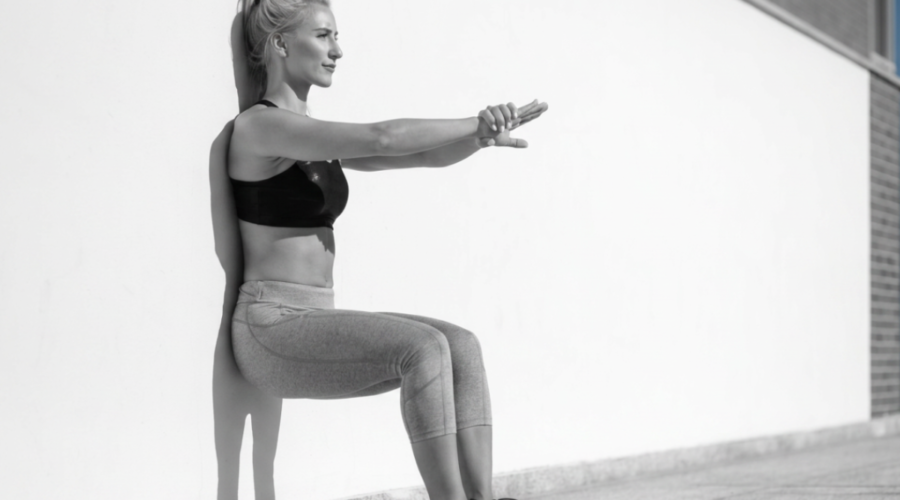
To make your score meaningful, use a consistent test position. Stand with your back against a wall and walk your feet forward. Slide down until your thighs are approximately parallel to the floor and your knees are close to a 90 degree bend. Keep your feet flat, your knees tracking in line with your toes, and your back in contact with the wall.
Your hands should remain off your thighs. Pushing down on your legs reduces the work required from the lower body and makes the result less comparable. Keep your torso upright, breathe normally, and start the timer once you have established the position.
End the test when you stand up, place your hands on your thighs, shift into a noticeably higher position, lose foot contact, or feel pain. Mild muscle burning in the thighs is normal during an isometric hold. Sharp pain, joint pain, numbness, dizziness, or discomfort that feels wrong is not a signal to push through.
The knee angle matters. A high wall sit with the knees much more open than 90 degrees is easier. A very deep wall sit is harder and can feel less comfortable for some people. Use a position close to parallel, then repeat that same position each time you test.
Why Technique Changes the Time
A wall sit is an isometric exercise. Your muscles produce force without creating large visible joint movement. The quadriceps work to hold the knee position, while the glutes, hamstrings, calves, trunk, and hip muscles help maintain the position and balance.
Small changes in body position can change the challenge. Moving the feet farther from the wall, lowering the hips, or allowing the knees to travel farther forward can alter the forces placed on the lower body. Research examining wall squat positions has shown that foot position changes quadriceps muscle activation. That is why two people can report the same wall sit duration while having completed very different tests.
Use the same wall, footwear, foot position, and depth whenever possible. Consistent testing conditions make it easier to see whether you are actually improving.
How to Interpret Your Result
A wall sit time under 30 seconds is not bad. It simply shows that lower body isometric endurance is an area you can improve. This may be common if you are new to exercise, returning after an injury, carrying more body mass, or unaccustomed to sustained lower body work.
A hold of 30 to 60 seconds shows a developing foundation. You are able to maintain the position long enough to create a meaningful endurance challenge. For many women beginning a structured training plan, this is an excellent place to start.
Holding 60 to 90 seconds suggests good lower body endurance when the position is consistent and your thighs remain close to parallel. A time of 90 to 120 seconds is very strong for a general fitness test. Beyond two minutes, the result shows high specific endurance for the wall sit, although longer is not always automatically better.

There is little reason to chase extremely long wall sits if your main goal is stronger legs, muscle growth, sports performance, or everyday function. Once you can hold a strict two minute wall sit, adding resistance training, single leg exercises, squats, step ups, or lunges may provide a more efficient new challenge.
Why Wall Sits Feel So Hard
Wall sits create sustained tension in the quadriceps without the regular relaxation that occurs between repetitions in many dynamic exercises. As the hold continues, the muscles need to maintain force while blood flow can be restricted by the ongoing contraction. This produces the familiar burning sensation in the thighs.
The exercise also requires you to support a portion of your own body mass. As a result, wall sit performance is partly a measure of relative strength and endurance. Two women with equal quadriceps strength may record different times if one has a substantially different body mass or body proportion.
Training history matters too. Someone who cycles, hikes, runs hills, plays field sports, or performs regular strength training may have more lower body endurance than someone who does not. Age matters, but it is not the only factor and should not be treated as destiny. Regular resistance training can improve strength and muscle size in adults across a wide range of ages.
Can Wall Sits Build Stronger Legs?
Wall sits can improve isometric endurance and can be useful when you need a simple lower body exercise with minimal equipment. They may be particularly useful for beginners who are learning to tolerate leg training or for people who want to add short lower body work at home.
However, wall sits should not be your only leg exercise if you want to build substantial strength and muscle. Research on resistance training shows that strength and hypertrophy improve through progressive resistance training, with different training methods being effective when the effort and training volume are sufficient.
Dynamic exercises such as squats, split squats, step ups, leg presses, and deadlifts allow you to gradually increase the external load and train the legs through movement. Wall sits can complement these exercises, but they are not a complete replacement for them.
A practical approach is to use wall sits as a finisher after lower body strength work. This lets you build endurance without asking the wall sit to do every job. If you only have access to a wall and your bodyweight, wall sits can still be a useful starting point while you build the capacity for more exercises.
How to Improve Your Wall Sit Time
Start with a hold time you can complete with good technique. If your current maximum is 20 seconds, perform three sets of 10 to 15 seconds rather than repeatedly testing your maximum. Rest for 60 to 90 seconds between sets.
Train wall sits two or three times each week on nonconsecutive days. Add five seconds to each hold when you can complete every set with stable form. This gradual progression gives the muscles and connective tissues time to adapt.
Once you can perform three sets of 45 seconds comfortably, you can progress by extending the hold time, lowering the position slightly if it remains comfortable, or adding a light dumbbell held at your chest. Adding load changes the exercise, so do not compare a weighted score directly with your bodyweight wall sit score.
You can also include dynamic lower body training. Bodyweight squats, split squats, glute bridges, step ups, and controlled lunges build the muscles that support wall sit performance. A combination of dynamic strength training and occasional wall sits is usually more useful than relying on one static hold.
A Simple Four Week Progression
During the first week, perform three wall sits of 20 seconds. In the second week, perform three holds of 25 seconds. In the third week, aim for three holds of 30 seconds. During the fourth week, repeat the 30 second holds or test one strict maximum attempt after a thorough warm up.
The goal is not to force progress every workout. If your legs are sore from a hard lower body session, maintain your current hold time or reduce it slightly. Adaptation comes from consistent training and recovery, not from pushing through every sign of fatigue.
Who Should Be Careful With Wall Sits?
Wall sits are generally simple, but they are not appropriate for everyone at every stage. If you have current knee pain, a recent lower body injury, uncontrolled high blood pressure, a cardiovascular condition, or have been advised to avoid intense isometric exercise, seek individualized guidance from a qualified health professional before testing a maximum hold.
Isometric exercise can cause meaningful short term changes in blood pressure during the effort. Research has also found that structured isometric training can improve resting blood pressure in some adults, but this does not mean every person should self prescribe long, maximal holds. Your health history and medication use matter.

For healthy beginners, the safest option is to begin below your maximum, breathe continuously, and stop if symptoms feel unusual. Strong effort is normal. Pain and dizziness are not.
The Bottom Line
For a woman aged 30 or older, holding a strict wall sit for 45 to 60 seconds is a good practical goal. Holding 60 to 90 seconds is strong, while two minutes represents high lower body endurance for this specific exercise.
The most important factor is not comparing yourself with an arbitrary standard. Use a consistent position, track your own hold time, and improve it gradually. Combine wall sits with dynamic lower body strength training for a more complete approach to stronger and more capable legs.
References
- Lehecka, B., Black, J., Jindra, J., McCloud, C. and Pummell, C. (2025) ‘The single leg wall squat test: An assessment of functional lower extremity endurance in university students’, International Journal of Sports Physical Therapy, 20(8), pp. 1198–1202.
- Wolf, M., Hecksteden, A., Morsch, A., Hessel, M., Shuster, I., Hasenfuss, G., Graf, C. and Meyer, T. (2023) ‘Resistance training prescription for muscle strength and hypertrophy in healthy adults: A systematic review and Bayesian network meta analysis’, British Journal of Sports Medicine, 57(18), pp. 1211–1220.
- Zhang, L., Sun, X., Su, P., Li, J., Chang, Y., Gao, Y. and Zhang, L. (2025) ‘Physiological characteristics of forearm muscles during different movement patterns of wrist’, Chinese Journal of Mechanical Engineering, 38, article 141.
- Zhao, Y., Wang, X., Li, H., Zhang, X. and Chen, Y. (2025) ‘Sex based comparison of the blood pressure, haemodynamic and cardiac autonomic adaptations following isometric exercise training in sedentary adults: A randomised controlled trial’, Frontiers in Physiology, 16, article 1566038.
Key Takeaways
| Key point | Practical meaning |
|---|---|
| A useful initial target | Aim for 45 to 60 seconds with thighs close to parallel |
| A strong result | Hold 60 to 90 seconds with stable technique |
| A high endurance score | A strict two minute hold is a strong wall sit result |
| Technique determines the score | Keep your knees near 90 degrees and do not use your hands on your thighs |
| Track personal progress | Use the same setup every time so results are comparable |
| Build more complete leg strength | Combine wall sits with squats, split squats, step ups, or other progressive lower body exercises |