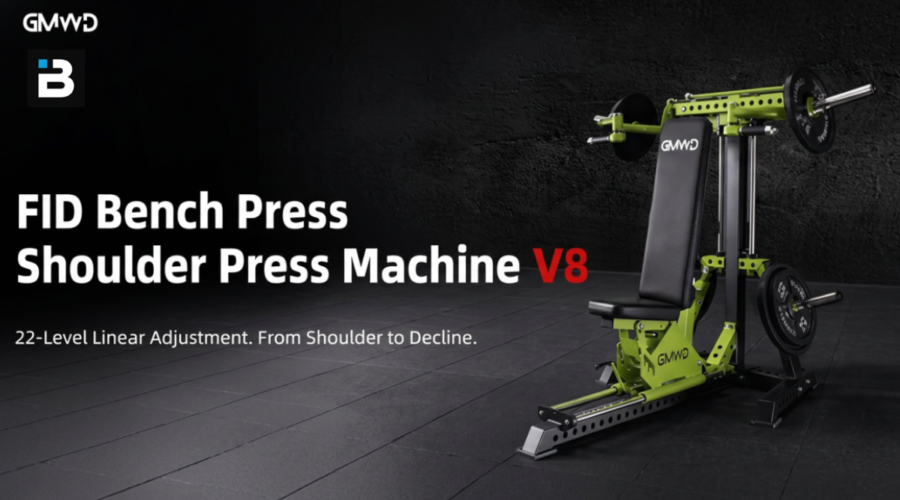


The GMWD V8 is the kind of machine that immediately makes sense for a certain type of home gym owner.
Instead of dedicating floor space to separate flat, incline, decline, and shoulder press machines, the V8 combines all four movements into one plate-loaded station. It also gives you independent pressing arms, rotating handles and an unusually large number of adjustments for the bench and arm assembly.


There is a lot going on here, and that is both the V8’s biggest strength and one of the things you need to consider before buying it.
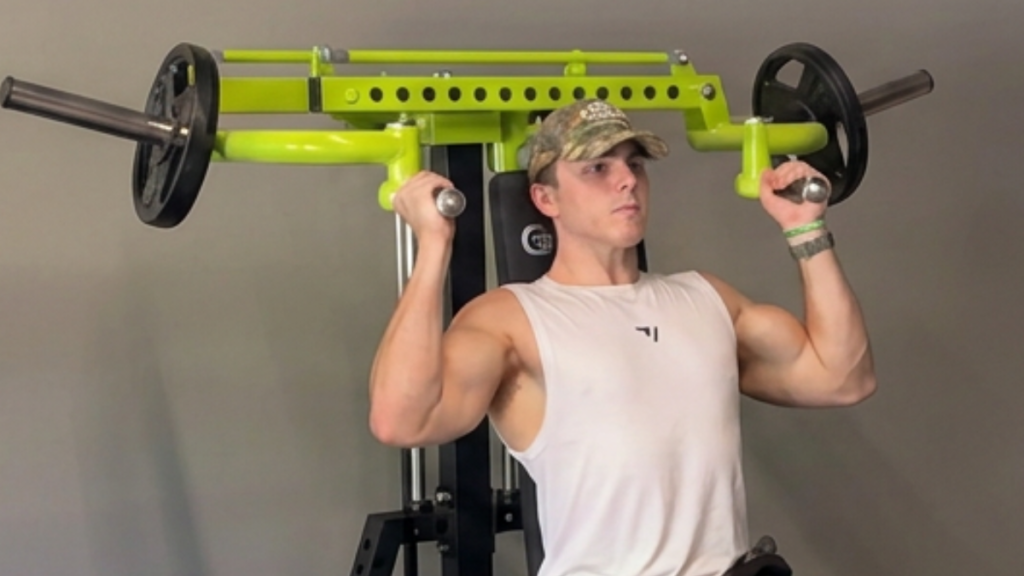
Based on its design and specifications, this is not a basic chest press aimed at casual training. It weighs 260 pounds, uses a substantial 3 x 3-inch, 14-gauge, 2-inch Olympic plates steel frame and can support up to 600 pounds across its two pressing arms.
The result is a machine that looks and feels much closer to a dedicated gym station than a typical piece of lightweight home fitness equipment.
What Is the GMWD V8?
The GMWD V8 is a plate-loaded pressing machine that can be configured for four main exercises:
- Decline chest press
- Flat chest press
- Incline chest press
- Seated shoulder press
That description sounds straightforward, but the V8 offers far more adjustment than simply moving the backrest up and down.
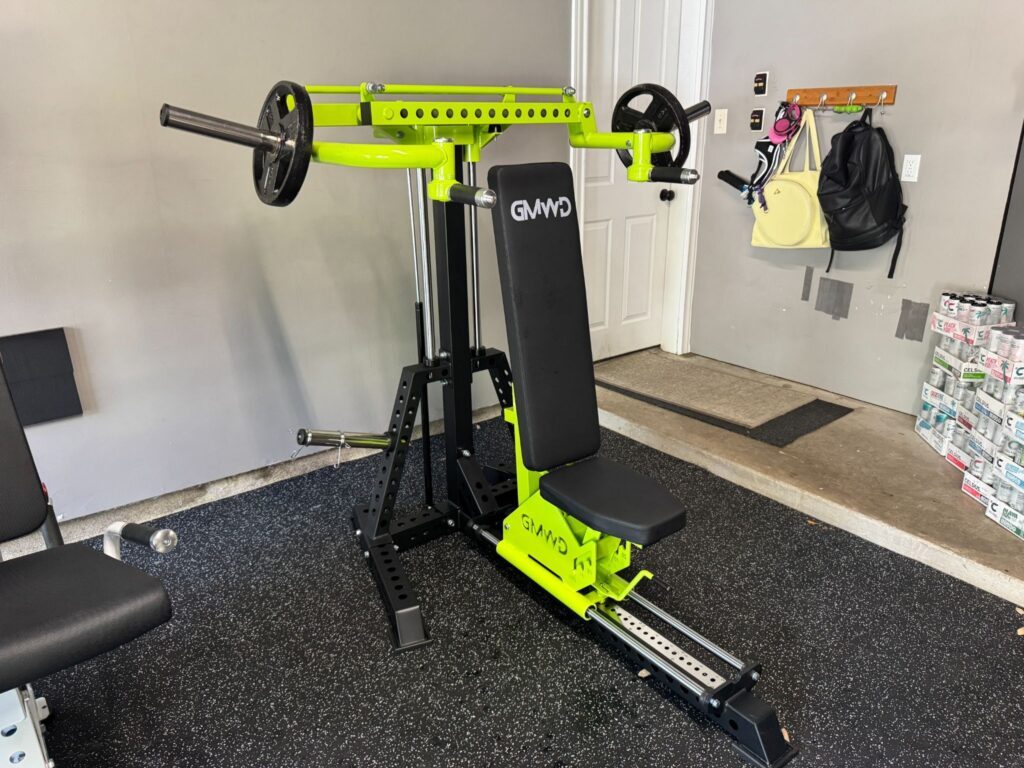
You can change the backrest angle, tilt the seat, slide the entire bench forward or backward, raise or lower the pressing assembly and rotate the handles into different grip positions.
The two pressing arms also move independently. You can press with both sides together, alternate arms or train one side at a time.
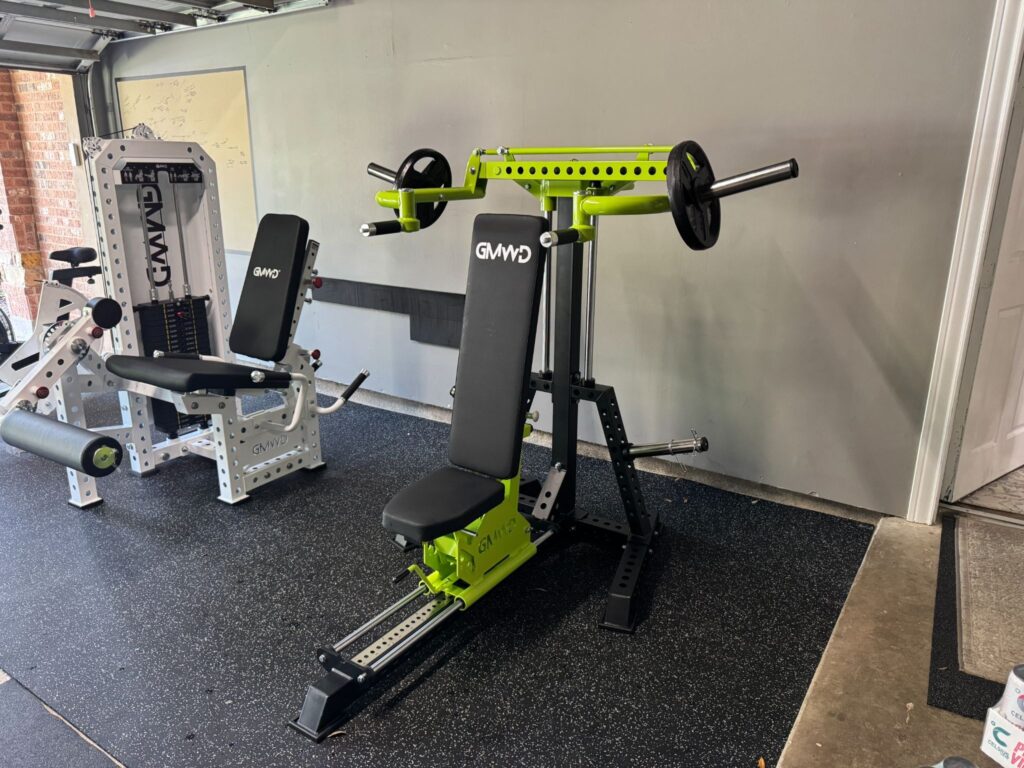
This mechanism is known as a “scissor arm” design, and is perfect for unilateral training as well. The handles move inward as you press, creating a converging path that is intended to resemble the arc of a dumbbell press rather than the straight-forward path of a basic machine press.
That does not automatically mean the movement will feel perfect for everyone. Arm length, shoulder width, mobility and preferred technique all play a role. However, the independent and converging design feels less restrictive than a standard pressing machine with fixed parallel handles.
GMWD V8 Specifications
The V8 measures approximately 67.3 inches long, 67 inches wide and 59.6 inches high.
At 260 pounds, it is a substantial piece of equipment before you add any weight plates. The main frame is made from 3-by-3-inch, 14-gauge steel tubing.
Each pressing arm has a listed loading capacity of 300 pounds, giving the machine a total capacity of 600 pounds.
Its main specifications include:
- Eight backrest positions: -10, 0, 15, 30, 45, 60, 70 and 80 degrees
- Three seat positions: 0, 10 and 20 degrees
- Twelve numbered handle angles
- Twenty-two horizontal bench positions
- Twenty-two vertical press-arm positions
- Sixteen pounds of unloaded starting resistance
- Two 11.7-inch loading horns
- Two 11.7-inch rear storage horns
- Two-inch Olympic plate compatibility
- A maximum listed user weight of 800 pounds
- A manufacturer-recommended height range of 5 feet 1 inch to 6 feet 5 inches
- Delivery in three separate boxes
The recommended height range is useful, but it should not be treated as a guarantee that the machine will fit every person within those limits equally well. Someone with particularly long arms or a short torso may need a very different setup from another person of the same height.
Fortunately, the large number of adjustments gives users plenty of room to experiment.
Design and Build
The first thing that stands out about the V8 is its size. This is not a compact machine that you can wheel into a corner after training. Once it is assembled, it is likely to stay exactly where you put it.
The frame uses a wide, reinforced triangular base with rubber feet. Two storage horns sit toward the rear of the machine, allowing you to keep Olympic plates on the frame.
Those storage horns are convenient, but they should also add useful mass to the back of the machine when loaded. Exactly how stable it feels under heavy pressing will depend on the floor, assembly quality and loading pattern, but the 260-pound frame gives it a solid foundation.
The 3-by-3-inch tubing also gives the machine the appearance of more expensive commercial-style equipment.
Independent Converging Press Arms
The independent arms are one of the most appealing parts of the V8.
On a machine with one connected pressing arm, your stronger side can sometimes contribute more without you noticing. The V8 keeps the two sides mechanically separate, so each arm has to produce its own force.
That gives you several ways to train:
- Press both arms together
- Alternate repetitions
- Perform single-arm sets
- Add extra work for one side
This does not mean the machine will automatically correct a muscular imbalance. It does, however, make differences between your left and right sides easier to notice and gives you a practical way to include unilateral pressing.
The converging movement is also a welcome feature.
As you press, the handles travel inward rather than remaining completely parallel. GMWD says the movement was designed to resemble a dumbbell press, allowing the hands to come closer together near the top of the repetition.
The design should provide a different sensation from a straight-path press machine, especially during chest-focused movements.
Adjustability
This is where the V8 really separates itself from simpler home press machines.
There are a lot of possible settings, and it may take a few workouts to learn which combinations work best for you. Once you find them, the numbered positions make it easy to recreate the same setup.
Eight Backrest Positions
The backrest can be adjusted to -10, 0, 15, 30, 45, 60, 70 or 80 degrees. That covers everything from a mild decline press to an almost upright shoulder press.
The intermediate positions are particularly useful. You are not limited to choosing between a flat bench and one steep incline. You can use a low 15- or 30-degree angle for chest-focused work, move to 45 degrees for a steeper incline or use the higher positions when you want more shoulder involvement.
The precise muscular emphasis will depend on your setup and technique, but having several angles gives you much more control over the movement.
Three Seat Positions
The seat can be set at 0, 10 or 20 degrees. A slight seat angle can make the higher incline and shoulder press positions feel more secure by helping prevent you from sliding forward.
GMWD says the seat adjustment can help stabilize the pelvis and reduce lower-back strain. That may be true for some users, but it is not a guaranteed result. The real advantage is that you can alter the seat position instead of being forced into one fixed angle.
Twelve Grip Angles
The V8’s handles rotate through 12 numbered positions. This allows you to move between a more traditional overhand grip, a neutral-style grip and several positions in between.
That flexibility matters because not everyone feels comfortable pressing with the same hand orientation. A grip that works well for a broad-shouldered lifter may feel awkward for somebody with a narrower frame.
The rotating handles let you experiment with wrist and shoulder position until you find an angle that feels natural.
Twenty-Two Bench Positions
The entire bench can slide horizontally through 22 numbered positions.
This changes how close you sit to the handles and has a major effect on the starting point of each press.The large number of bench settings should make it possible to dial in a good position for different exercises and body proportions.
Once you find the right number for flat, incline and shoulder pressing, it is worth recording those settings so you do not have to rediscover them every session.
Twenty-Two Arm-Height Positions
The pressing assembly also has 22 vertical positions.
This lets you align the arms with the chosen backrest angle. For example, you can lower the assembly for flat or decline pressing and raise it for incline and overhead work.
A built-in gas spring helps support the weight of the assembly while you adjust it.
That is a particularly practical feature. Without assistance, repositioning a large steel arm assembly could be awkward. GMWD says the gas spring allows smoother, one-handed adjustment and helps prevent the arms from dropping suddenly.
Flat Chest Press
In the flat position, the V8 gives you a stable alternative to barbell and dumbbell bench pressing.
You do not need to unrack a bar above your face, and you do not have to lift heavy dumbbells from your knees into the starting position. The independent arms still require both sides to work separately, although the machine removes much of the stabilization required by free weights.
The converging path should appeal to lifters who like bringing dumbbells closer together at the top of a press.
The key will be finding the right combination of bench depth, arm height and handle angle. With so many settings available, a poor initial setup does not necessarily mean the machine does not fit you. It may simply mean the bench or arms need to be moved by another notch or two.
Incline Chest Press
You can choose from 15-, 30-, 45- and 60-degree backrest settings, which gives you far more variety than a fixed incline machine.
The lower settings allow you to perform a relatively shallow incline press, while the steeper positions progressively bring more of the shoulders into the movement.
The adjustable seat becomes especially useful here. Tilting it slightly can help keep you from sliding forward as the backrest gets steeper.
Between the backrest angles, 22 bench positions and 22 arm heights, there should be enough adjustment to create several noticeably different incline setups.
Decline Chest Press
The -10-degree position turns the V8 into a mild decline press. This is not an extreme decline angle, which may make it more approachable than a traditional steep decline bench.
It also avoids the awkward process of lying head-down and unracking a barbell from above the body.
When trying the decline setup, it makes sense to begin with a light load and experiment with the bench and handle positions before adding more weight.
Shoulder Press
At the 60-, 70- and 80-degree settings, the V8 can be used as a seated shoulder press. The adjustable handles are especially relevant here. Many shoulder press machines lock you into a fully pronated grip, which does not feel comfortable for everyone.
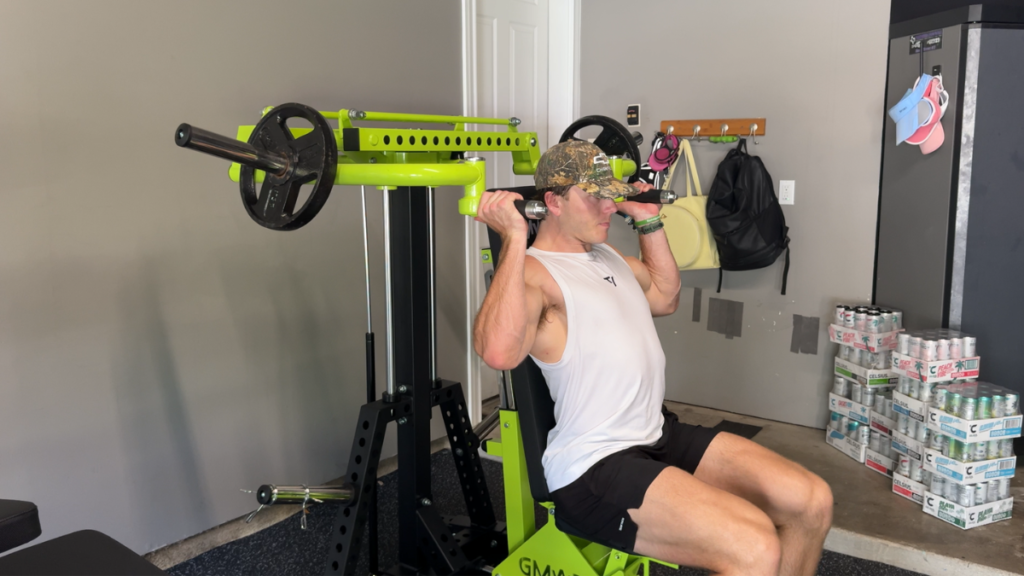
With the V8, you can rotate the handles toward a neutral or semi-neutral position. That extra freedom should help more users find a workable overhead pressing setup, although it does not make the exercise suitable for every shoulder condition.
The independent arms also let you perform alternating or single-arm shoulder presses, adding another useful option for upper-body training.
Loading and Plate Storage
The V8 uses two-inch Olympic weight plates.
If your current home gym uses standard one-inch plates, they will not fit the machine without replacing them with compatible Olympic plates.
Each arm has an 11.7-inch loading horn, and there are two additional 11.7-inch horns at the rear for storage.
Having storage built into the machine is convenient because it keeps commonly used plates within reach and may eliminate the need for a separate plate tree.
How many plates you can fit on each horn will depend on their thickness. Thin iron plates will allow much more total weight than thick bumper plates.
The unloaded starting resistance is listed at approximately 16 pounds. That should make the machine usable for warm-up sets without adding plates, although the actual resistance may feel different depending on the arm position and pressing angle.
Size and Space Requirements
The V8 occupies roughly 67 by 67 inches of floor space. In practice, you will need more room than those dimensions suggest. You need enough clearance to walk around the machine, load plates and move the bench and press assembly safely.
This is why the V8 makes the most sense in a dedicated garage, basement or gym room.
It can replace several pressing stations, but it is not small. In an apartment or multipurpose room, it is likely to dominate the available space.
You should also choose its location carefully before assembling it. At 260 pounds, moving the completed machine will not be easy.
Assembly
The V8 is delivered in three boxes, so buyers should expect a fairly involved assembly process.
I assembled the machine alone in approximately three hours, and the instructions were clear. Another reviewer said the assembly was straightforward. Those are individual experiences rather than guaranteed assembly times.
Given the machine’s size and weight, having a second person available would make the process easier and quicker.
It is also worth checking the route from the delivery point to your gym before the boxes arrive. Measure doors, hallways and staircases, and consider assembling the machine in the room where it will remain.
What I Like About the GMWD V8
The biggest positive is the level of adjustment.
A lot of multi-function machines technically perform several exercises but do none of them particularly well because the seat and handles remain in almost the same position.
The V8 takes a different approach. You can change nearly every part of the setup:
- Backrest angle
- Seat angle
- Bench depth
- Arm height
- Handle angle
That gives it a much better chance of accommodating different users and different pressing movements.
The independent arms are another strong feature. They add unilateral and alternating options while preventing one side from mechanically moving the other.
The integrated plate storage, gas-assisted arm adjustment and numbered settings also show that GMWD has thought about how the machine will be used from session to session.
Potential Drawbacks
The V8 is versatile, but it will not be the right choice for everyone.
Its main disadvantages include:
- A large permanent footprint
- A 260-pound assembled weight
- A significant assembly process
- Possible handle interference in certain configurations
It is also important to remember that this is an upper-body pressing machine. It does not replace a rack, cable station, pulling machine or lower-body equipment.
For someone building a gym from scratch, it would not be the first machine I would prioritize. For somebody who already owns the basic equipment and wants to add dedicated chest and shoulder work, it makes much more sense.
Price and Value
At the time of review, the V8 was listed at $1,199.99. Its great value comes from replacing several dedicated press machines and allowing multiple users to customize their positions.
For someone who performs several chest and shoulder pressing movements every week, it could become one of the most-used stations in the gym.
For a beginner with limited equipment, the money would probably be better spent first on a rack, barbell, plates and adjustable bench. Those items support a much wider range of exercises.
The V8 is more compelling as a specialist addition to an established home gym.
Who Is the GMWD V8 For?
The V8 is best suited to:
- Home-gym owners with permanent floor space
- Bodybuilding-focused lifters
- People who perform a high volume of chest and shoulder work
- Lifters who prefer machines to barbell bench pressing
- Users who want single-arm and alternating press options
- Households with several people using the same gym
- Anyone who already owns Olympic weight plates
It is less suitable for:
- Small apartments
- Multipurpose rooms
- Users who need foldable or portable equipment
- People who own only one-inch plates
- Buyers expecting to test the machine and return it after assembly
- Beginners who have not yet purchased basic full-body equipment
Final Verdict
The GMWD V8 is a thoughtfully designed and unusually adjustable plate-loaded press machine.
Its biggest strength is the ability to fine-tune almost every part of the pressing position. With eight backrest angles, three seat settings, 12 handle positions and separate 22-position adjustments for the bench and pressing assembly, the V8 gives users a lot of control over how each exercise feels.
The independent converging arms add unilateral training options and should provide a less restrictive movement than a basic connected-arm press.
There are some important limitations. The V8 takes up a considerable amount of space, weighs 260 pounds and will require time to assemble and learn.
For a serious home-gym owner who already has the basics covered, the GMWD V8 offers a strong combination of exercise variety, heavy construction and personalized setup options. It can handle decline, flat, incline and shoulder pressing without requiring four separate machines.
For the right user, someone with enough space, Olympic plates and a strong focus on upper-body pressing, it is a compelling addition to a well-equipped training space.