

A muscular torso is built by training the large muscles of the chest, back, shoulders, and trunk consistently. Beginners do not need a long list of isolation exercises to get there. They need a small number of movements they can learn, repeat, and gradually make harder.
Dumbbells are an excellent place to start. Each arm works independently, which helps prevent the stronger side from taking over. Dumbbells also allow the hands to follow a more natural path than a fixed bar, making them a practical option for many people learning to lift. Research shows that resistance training can increase muscle size and strength across a wide range of loading styles when the sets are sufficiently challenging and performed consistently.


The best beginner dumbbell exercises should train several muscles at once, provide a clear path for progression, and be simple enough to perform with control. The dumbbell bench press, one arm dumbbell row, and dumbbell Romanian deadlift cover those requirements. Together, they train the major muscles that make a torso look bigger, stronger, and more athletic.
What Builds a Muscular Torso?
A jacked torso is not just a large chest. A well developed chest, broad lats, thick upper back, strong shoulders, and a stable trunk create the overall look most people want. The muscles on the back of the body matter just as much as the muscles visible in the mirror.
Muscle growth occurs when training places enough mechanical tension on a muscle over time. That tension needs to be repeated through hard sets, gradual progression, enough recovery, and adequate nutrition. Research indicates that training volume matters for hypertrophy, with additional productive sets generally supporting greater muscle growth up to the point that recovery becomes a limiting factor.
5 Signs You’re Aging Better Than Most People
Beginners should not confuse productive training with exhausting training. You do not need to take every set to complete failure. Training close to failure can be effective, but stopping with about one or two clean repetitions still available often helps a new lifter maintain better form and train consistently.
These three exercises provide a balanced foundation. The dumbbell bench press trains pushing muscles. The one arm dumbbell row trains pulling muscles. The Romanian deadlift strengthens the posterior chain, which includes the glutes, hamstrings, and spinal erectors. This combination gives your body the balance needed for long term progress.
1. Dumbbell Bench Press
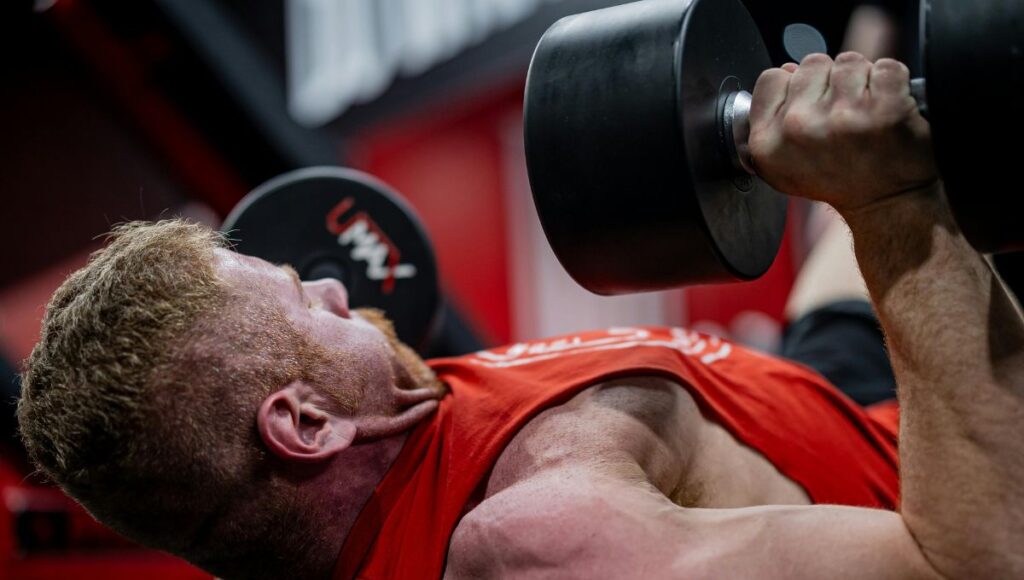
The dumbbell bench press is one of the best exercises for building the chest. It also trains the front of the shoulders and triceps, making it a highly efficient upper body movement for beginners.

The pectoralis major is the largest chest muscle and plays a major role in bringing the upper arm across the body. During a dumbbell bench press, the chest works with the triceps and front deltoids to press the weights upward. Because each dumbbell moves separately, both sides of the body must produce force and stabilize their own load.
Research comparing dumbbell and barbell pressing has found that dumbbell pressing can produce similar activation of the pectoralis major while using less total load. This makes dumbbells a valuable tool for building the chest, especially when learning to control a pressing movement.
How to Perform the Dumbbell Bench Press
Sit on the end of a flat bench with a dumbbell resting on each thigh. Keep your feet firmly on the floor. Lean back while bringing the dumbbells into position beside your chest.
Start with your palms facing forward or slightly inward if that feels more comfortable for your shoulders. Press the dumbbells upward until your elbows are straight. Keep the weights under control at the top instead of letting them collide.
Lower the dumbbells slowly toward the sides of your chest. Your elbows should travel at a moderate angle from your torso rather than flaring directly to the sides. Lower only as far as you can while maintaining a comfortable shoulder position and a stable upper back.
Keep your shoulder blades gently pulled back against the bench. Maintain a natural curve in your lower back, but do not exaggerate the arch. Your feet should remain planted throughout the set to help you create a stable pressing position.
How to Program the Dumbbell Bench Press
Begin with three sets of eight to 12 repetitions. Use a load that makes the final repetitions challenging while allowing you to control the path of both dumbbells.
Rest for two to three minutes between sets. Longer rest periods can help you maintain performance and complete more quality repetitions, which is useful when muscle growth is the goal.
When you can complete 12 repetitions on all three sets with controlled technique, increase the weight by the smallest available amount. If the new weight forces you back to eight repetitions, that is fine. Build toward 12 repetitions again before the next increase.
2. One Arm Dumbbell Row
A bigger back makes the torso look wider and more complete. The one arm dumbbell row is one of the most useful beginner exercises for training the lats and upper back because it offers support from the bench and allows you to focus on one side at a time.
This exercise trains the latissimus dorsi, rhomboids, middle trapezius, rear deltoids, biceps, and forearm muscles. The lats contribute heavily to back width because they run from the upper arm down toward the lower back. The upper back muscles add thickness and help control the shoulder blades.
Rows are essential because pressing alone can create an unbalanced program. The bench press trains the front of the torso, while rowing builds the muscles behind it. Research on rowing variations confirms that these movements create meaningful activation of the upper back and trunk muscles, although the exact emphasis changes with body position and technique.
How to Perform the One Arm Dumbbell Row
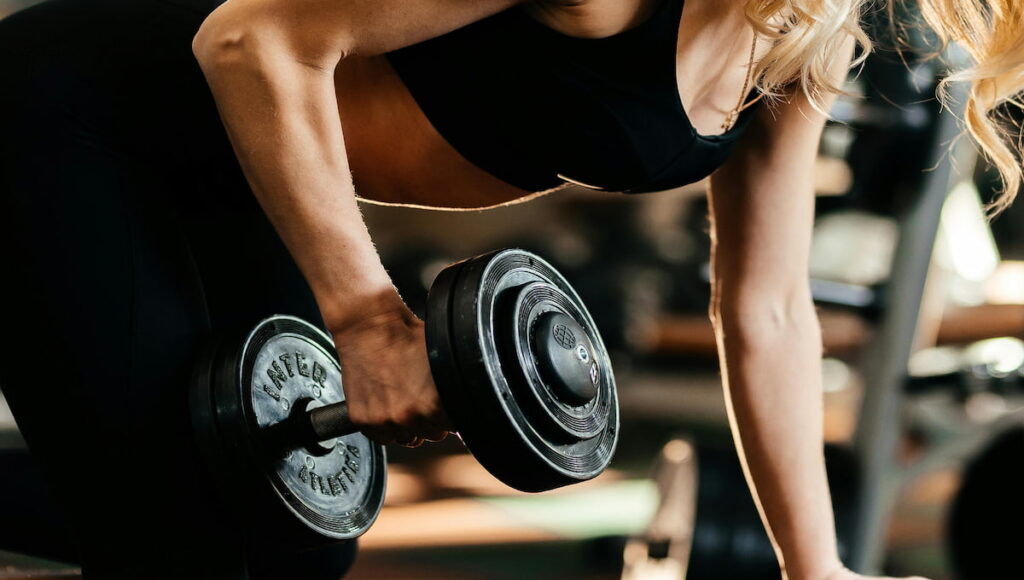
Place your left knee and left hand on a flat bench. Put your right foot on the floor and hold a dumbbell in your right hand. Position your torso so it is stable and close to parallel with the floor.
Allow the dumbbell to hang beneath your shoulder with your arm straight. Keep your spine neutral and your rib cage controlled. Pull the dumbbell toward your hip or lower ribs by driving your elbow back.
Pause briefly near the top of the movement. Avoid twisting your torso upward or opening your chest toward the ceiling. Lower the dumbbell under control until your arm is straight again, then repeat. Complete the planned repetitions on one side before switching to the other.
Think about pulling your elbow toward your hip rather than curling the dumbbell with your hand. This cue can help keep the focus on the back muscles. If you need to jerk the weight upward or rotate your body to finish a repetition, the dumbbell is too heavy.
How to Program the One Arm Dumbbell Row
Perform three sets of eight to 15 repetitions on each side. A slightly higher repetition range works well because the dumbbells allow you to control each side independently and accumulate quality work for the back.
Start at the lower end of the range while you learn the movement. As your control improves, build toward 15 repetitions. Add weight once you can reach the top of the range without twisting your torso or shortening the movement.
You can alternate this exercise with dumbbell bench presses. Complete a set of bench presses, rest briefly, then complete rows on each side. This method saves time while training opposing muscle groups in the same session.
3. Dumbbell Romanian Deadlift
The dumbbell Romanian deadlift trains the back side of your body. It targets the hamstrings and glutes while requiring the spinal erectors, upper back, forearms, and trunk muscles to work hard isometrically.
Although many people think of it as a leg exercise, it is important for building a muscular torso. A strong posterior chain improves overall proportions, reinforces good lifting mechanics, and develops the muscles that support the spine and hips. Training the front and back of the body creates a more complete physique than focusing only on chest, shoulders, and arms.
The Romanian deadlift is a hip hinge. It is different from a squat because the hips move backward while the knees bend only slightly. The hamstrings lengthen as the torso lowers, then the glutes and hamstrings work to extend the hips and return you to standing.
How to Perform the Dumbbell Romanian Deadlift
Stand tall with your feet about hip width apart. Hold a dumbbell in each hand with your palms facing your thighs. Keep a small bend in your knees.
Push your hips backward while allowing the dumbbells to travel down close to your legs. Your torso will lean forward naturally as your hips move back. Keep your spine neutral and your chest long without forcing it upward.
Lower the dumbbells until you feel a strong stretch through the hamstrings. Do not chase extra depth by rounding your lower back. The appropriate range of motion is the deepest position you can reach while keeping control of your hips and spine.
Drive your feet into the floor, squeeze your glutes, and return to standing. Finish tall without leaning backward. The movement should feel smooth and controlled from beginning to end.
How to Program the Dumbbell Romanian Deadlift
Start with three sets of eight to 12 repetitions. Use a controlled lowering phase that lasts about two seconds. A steady eccentric phase helps beginners learn the hinge and can increase the time the hamstrings spend under tension.
Begin lighter than you think you need. This movement can create substantial hamstring soreness when you are new to it. Increase the weight only when you can maintain a neutral spine, feel the movement mainly in your hamstrings and glutes, and avoid discomfort in the lower back.
Train the Romanian deadlift one or two times each week. It pairs well with the other two exercises because it trains muscles that the pressing and rowing movements do not fully cover.
How to Build a Simple Beginner Workout
Perform these three exercises two or three times each week on nonconsecutive days. This schedule gives your muscles frequent practice while allowing time for recovery.
Start each workout with the dumbbell bench press, followed by the one arm dumbbell row and dumbbell Romanian deadlift. Perform three sets of each exercise. This gives you nine working sets per session and provides enough training stimulus without making the plan unnecessarily complicated.
Keep a record of your dumbbell weight and repetitions. Your goal is to improve one variable at a time. You might add one repetition to a set, improve your control, or increase the dumbbell weight once you reach the top of your target range.
Progress will be gradual, especially after the first few weeks. That is normal. The important factor is not adding weight every session. It is repeating good quality training for months.
Common Mistakes to Avoid
The first mistake is choosing weights that are too heavy. Heavy dumbbells are useful only if you can control them through a productive range of motion. If your shoulders hurt during pressing, your torso rotates during rows, or your lower back rounds during Romanian deadlifts, reduce the load.
The second mistake is training only the chest and arms. A muscular torso needs back development and posterior chain strength. Rows and hip hinges may not provide the same immediate mirror feedback as presses, but they are essential for a balanced and athletic build.
The third mistake is constantly changing exercises. Beginners improve quickly when they practice the same movements long enough to develop skill and progressively add challenge. Keep these exercises in your program for at least eight to 12 weeks before deciding whether you need more variety.
The Bottom Line
The dumbbell bench press, one arm dumbbell row, and dumbbell Romanian deadlift are three of the best beginner exercises for building a jacked and muscular torso. They train the chest, shoulders, triceps, lats, upper back, glutes, hamstrings, and trunk with a small amount of equipment.
Use manageable weights, perform controlled repetitions, and train consistently two or three times each week. Add repetitions or load gradually while keeping your form solid. That simple approach is enough to build real muscle and strength.
References
- Fenwick, C.M.J., Brown, S.H.M. and McGill, S.M. (2009) ‘Comparison of different rowing exercises: Trunk muscle activation and lumbar spine motion, load, and stiffness’, Journal of Strength and Conditioning Research, 23(2), pp. 350–358.
- Morton, R.W., Murphy, K.T., McKellar, S.R., Schoenfeld, B.J., Henselmans, M., Helms, E., Aragon, A.A., Devries, M.C., Banfield, L., Krieger, J.W. and Phillips, S.M. (2018) ‘A systematic review, meta analysis and meta regression of the effect of protein supplementation on resistance training induced gains in muscle mass and strength in healthy adults’, British Journal of Sports Medicine, 52(6), pp. 376–384.
- Saeterbakken, A.H., van den Tillaar, R. and Fimland, M.S. (2011) ‘A comparison of muscle activity and 1RM strength of three chest press exercises with different stability requirements’, Journal of Sports Sciences, 29(5), pp. 533–538.
- Schoenfeld, B.J., Ogborn, D. and Krieger, J.W. (2017) ‘Dose response relationship between weekly resistance training volume and increases in muscle mass: A systematic review and meta analysis’, Journal of Sports Sciences, 35(11), pp. 1073–1082.
- Wolf, M., Hecksteden, A., Morsch, A., Hessel, M., Shuster, I., Hasenfuss, G., Graf, C. and Meyer, T. (2023) ‘Resistance training prescription for muscle strength and hypertrophy in healthy adults: A systematic review and Bayesian network meta analysis’, British Journal of Sports Medicine, 57(18), pp. 1211–1220.
Key Takeaways
| Key point | Practical meaning |
|---|---|
| Train the whole torso | Include a press, row, and hip hinge rather than only chest and arm work |
| Build the chest | Use the dumbbell bench press for the chest, shoulders, and triceps |
| Build the back | Use the one arm dumbbell row for the lats and upper back |
| Build the posterior chain | Use the dumbbell Romanian deadlift for the glutes, hamstrings, and trunk |
| Train regularly | Perform the workout two or three times weekly on nonconsecutive days |
| Progress patiently | Add repetitions or load only when you can maintain controlled technique |