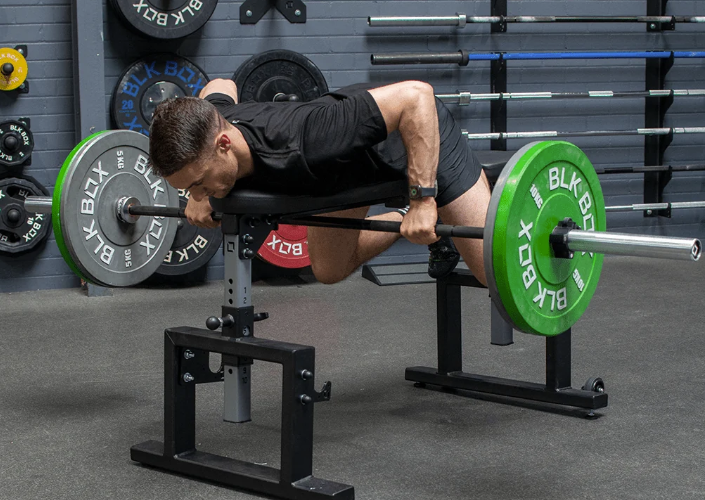


A thick, muscular back is one of the clearest signs of strength and athleticism. Building it, however, often comes with a challenge. Many of the best rowing exercises require your lower back to work hard just to keep your body in position. For lifters dealing with fatigue, previous injuries, or simply high training volumes, that can become a limiting factor. This is where the seal row stands out.
Unlike bent over rows, Pendlay rows, or traditional barbell rows, the seal row removes almost all demand from the lower back by supporting your torso on a bench. That means your upper back muscles can do the work without your spinal erectors becoming the weak link.


But is it really the perfect exercise for building muscle? Does taking the lower back out of the equation actually improve hypertrophy, or does it remove an important training stimulus? The science provides some interesting answers.
What Is the Seal Row?
The seal row is a horizontal pulling exercise performed while lying face down on a flat bench elevated high enough that your arms can move freely beneath it. You pull a barbell, dumbbells, or specialized seal row bar toward your chest before lowering the weight under control. Because your chest remains supported throughout every repetition, your torso stays fixed. This removes the need to stabilize your spine and eliminates momentum from the lift.
Is the Reverse Nordic Curl the Perfect Exercise for Stronger Quads?
The result is an exercise that places almost all of the workload on the muscles responsible for pulling your arms backward. The primary muscles involved include the latissimus dorsi, rhomboids, middle trapezius, rear deltoids, teres major, and the elbow flexors including the biceps brachii and brachialis.
Why Lower Back Fatigue Can Limit Muscle Growth
Heavy rowing exercises are excellent for building muscle, but they come with a hidden cost. During bent over rows, your spinal erectors must contract isometrically throughout the set to maintain your body position. As the set becomes more difficult, these muscles often fatigue before your upper back reaches its limit.
This means you may stop a set because your lower back is exhausted rather than because your lats or rhomboids have received sufficient stimulus.
Research consistently shows that mechanical tension is the primary driver of muscle hypertrophy. When another muscle group limits performance before the target muscles reach high levels of effort, total hypertrophy stimulus may be reduced.
Supporting the chest allows the upper back to continue working close to failure without interference from postural fatigue.
The Science Behind Chest Supported Rows
Several electromyography studies have compared different rowing variations to determine which muscles are most active. Research examining chest supported rows found high activation of the middle trapezius, rhomboids, posterior deltoids, and latissimus dorsi while significantly reducing spinal extensor involvement compared with unsupported rowing movements.
Although EMG cannot directly predict muscle growth, it provides valuable insight into which muscles perform most of the work during an exercise.
Studies examining resistance training volume also show that reducing fatigue in supporting muscles allows athletes to perform more quality repetitions across multiple sets.
This becomes particularly valuable during hypertrophy focused training where accumulating effective repetitions close to muscular failure is essential.
Benefits of the Seal Row
Excellent Isolation of the Upper Back
One of the biggest advantages of the seal row is that it isolates the upper back exceptionally well. Without needing to think about balance, hip position, or spinal stability, lifters can concentrate entirely on pulling with the shoulder blades and elbows.
Many coaches report that athletes achieve a stronger mind muscle connection during chest supported rows compared with traditional barbell rows. Improved exercise execution often leads to better technique consistency across every repetition.
Minimal Lower Back Stress
Perhaps the greatest advantage of the seal row is its ability to almost completely eliminate lower back fatigue. This makes it particularly valuable for people who already perform heavy squats, deadlifts, Olympic lifts, or functional fitness workouts.
Instead of accumulating additional spinal loading, they can continue training their upper back without interfering with recovery. For athletes managing chronic lower back discomfort, the seal row often provides a way to maintain pulling volume without aggravating symptoms.
Reduced Cheating
- Traditional rows often become less strict as fatigue increases.
- Lifters naturally begin extending their hips, swinging their torso, or using momentum to complete additional repetitions.
- The seal row removes these options.
- Every repetition begins from a dead stop, making it much harder to use momentum.
- This increases time under tension for the target muscles while encouraging better technique.
Easier Recovery
- Exercises that heavily load the spine generally require more systemic recovery.
- Since the seal row removes much of this stress, many lifters recover more quickly between sessions.
- That makes it easier to perform higher weekly training volumes without excessive fatigue.
Research has repeatedly shown that weekly training volume is one of the strongest predictors of muscle growth, provided recovery remains adequate.
Are There Any Downsides?
No exercise is perfect. The seal row has several limitations that should be considered.
Equipment Availability
Many commercial gyms do not have dedicated seal row benches. Improvising with stacked boxes or elevated benches works, but setup can take time. This reduces convenience compared with traditional barbell rows.
Is the Copenhagen Plank the Perfect Core Exercise for Better Athleticism?
Less Total Body Involvement
Bent over rows train much more than the upper back. They also strengthen the spinal erectors, glutes, hamstrings, and core through prolonged isometric contractions. If your goal includes improving total body strength, traditional rows still have important value. The seal row deliberately removes much of this training effect.
Slightly Reduced Loading
Because momentum cannot assist the lift, most people use lighter weights during seal rows than during bent over rows. This does not necessarily reduce hypertrophy because muscle growth depends more on effort than absolute load when sets are taken close to failure. Numerous studies demonstrate similar hypertrophy across a broad range of training loads provided sufficient effort is achieved.
How to Perform the Seal Row Correctly
- Lie face down on a bench positioned high enough that your arms hang freely beneath your body.
- Grip the bar slightly wider than shoulder width if using a barbell.
- Allow your shoulder blades to fully protract at the bottom without losing control.
- Pull your elbows backward toward your hips while squeezing your shoulder blades together.
- Raise the bar until it lightly touches the underside of the bench or reaches your lower chest.
- Lower the weight slowly until your elbows fully extend.
- Avoid bouncing the bar or shortening the range of motion.
- Each repetition should begin from a complete stop.
- Controlling the lowering phase increases muscular tension and contributes to greater hypertrophy stimulus.

Who Benefits Most From Seal Rows?
Several groups of lifters may benefit especially from including seal rows.
- Bodybuilders seeking maximum upper back development often appreciate the improved muscle isolation.
- Powerlifters performing heavy squats and deadlifts can increase pulling volume without further stressing the lower back.
- CrossFit athletes frequently experience accumulated spinal fatigue from Olympic lifting and high repetition workouts, making chest supported rows a valuable accessory exercise.
- Older lifters may also find the reduced spinal loading allows consistent back training while minimizing discomfort.
Anyone returning from lower back irritation should consult a qualified healthcare professional before resuming training, but chest supported rows are commonly used during progressive return to lifting because they substantially reduce spinal demands.
Is the Seal Row the Perfect Back Exercise?
Perfect is probably too strong a word. Every exercise involves tradeoffs.
The seal row sacrifices some total body strength development in exchange for greater upper back isolation and dramatically lower spinal loading. For lifters whose primary goal is building muscle while managing fatigue, that tradeoff is often worthwhile.
It allows the lats, rhomboids, middle traps, rear delts, and biceps to receive intense stimulation without the lower back ending the set early. Combined with progressive overload, sufficient protein intake, and consistent weekly training volume, the seal row can become one of the most effective exercises in your entire back training program.
Rather than replacing every other rowing variation, it works best alongside other compound pulling exercises throughout different phases of training. For many lifters, it may not be the only back exercise they ever need, but it comes remarkably close when muscle growth is the primary objective.
Key Takeaways
| Topic | Key Takeaway |
|---|---|
| Main Benefit | The seal row isolates the upper back while minimizing lower back fatigue. |
| Primary Muscles | Lats, rhomboids, middle traps, rear delts, teres major, biceps, and brachialis. |
| Lower Back Stress | Chest support greatly reduces spinal loading compared with bent over rows. |
| Muscle Growth | High muscular tension with reduced fatigue can improve hypertrophy focused training quality. |
| Technique | Perform each repetition from a dead stop with full range of motion and controlled lowering. |
| Best Rep Range | Three to five sets of six to fifteen repetitions performed close to failure. |
| Best For | Bodybuilders, powerlifters, CrossFit athletes, older lifters, and anyone managing lower back fatigue. |
| Main Limitation | Requires elevated bench setup and provides less training for spinal erectors and core. |
| Overall Verdict | One of the best horizontal pulling exercises for maximizing upper back muscle while minimizing systemic fatigue. |
References
- Andersen, V., Fimland, M.S., Brennset, O., Haslestad, L.R., Lundteigen, M.S., Skalleberg, K., Saeterbakken, A.H., 2014. Muscle activation and strength in squat and bench press exercises performed with and without elastic bands. Journal of Strength and Conditioning Research.
- Dankel, S.J., Mattocks, K.T., Jessee, M.B., Buckner, S.L., Mouser, J.G., Counts, B.R., Laurentino, G.C. and Loenneke, J.P., 2017. Frequency, volume and muscle hypertrophy. Sports Medicine.
- Gentil, P., Fisher, J. and Steele, J., 2017. A review of the acute effects and long term adaptations of single joint and multi joint exercises during resistance training. Sports Medicine.
- Grgic, J., Schoenfeld, B.J., Orazem, J. and Sabol, F., 2022. Effects of resistance training performed to repetition failure or non failure on muscular strength and hypertrophy. Journal of Sport and Health Science.
- Schoenfeld, B.J., 2010. The mechanisms of muscle hypertrophy and their application to resistance training. Journal of Strength and Conditioning Research.
- Schoenfeld, B.J., Ogborn, D. and Krieger, J.W., 2017. Dose response relationship between weekly resistance training volume and increases in muscle mass. Journal of Sports Sciences.
- Schick, E.E., Coburn, J.W., Brown, L.E., Judelson, D.A., Khamoui, A.V., Tran, T.T. and Uribe, B.P., 2010. A comparison of muscle activation between a Smith machine and free weight bench press. Journal of Strength and Conditioning Research.
- Vigotsky, A.D., Halperin, I., Lehman, G.J., Trajano, G.S. and Vieira, T.M., 2018. Interpreting signal amplitudes in surface electromyography studies in sport and rehabilitation sciences. Frontiers in Physiology.