

Building a bigger chest is one of the most common goals for people starting strength training. A well developed chest improves upper body strength, enhances athletic performance, supports better posture when trained alongside the upper back, and makes everyday tasks such as pushing heavy objects much easier.
Many beginners assume they need dozens of different exercises or complicated training methods to see results. The truth is much simpler. Research consistently shows that muscle growth depends primarily on progressive overload, training volume, proper technique, and consistency. Choosing a handful of effective exercises and performing them well is far more productive than constantly changing workouts.



The chest is made up primarily of the pectoralis major and pectoralis minor. The larger pectoralis major has two main regions that can be emphasized by changing the angle of pressing movements. The clavicular portion contributes more during incline pressing, while the sternocostal portion is emphasized during flat and decline pressing. Although you cannot completely isolate one section of the chest, different exercises can shift the workload toward different fibers.
The five exercises below cover every major movement pattern a beginner needs. Together they develop strength, muscle mass, coordination, and stability while providing an excellent foundation for future progress.
Why Beginners Should Focus on Basic Compound Exercises
One of the biggest mistakes beginners make is spending too much time on isolation exercises before building basic strength.
Compound exercises train multiple muscles and joints at the same time. During chest pressing exercises, the pectorals work alongside the shoulders, triceps, and stabilizing muscles throughout the torso. This allows beginners to lift heavier loads, develop coordination, and stimulate more muscle growth with fewer exercises.
Scientific reviews have shown that progressive resistance training significantly increases muscle size and strength across all populations, including complete beginners. Early improvements come from both muscle growth and improvements in nervous system efficiency, allowing the body to recruit muscles more effectively.
Is the Floor Press the Perfect Bench Press Alternative for Stronger Pecs?
Isolation movements still have value, especially later in a training career, but beginners receive the greatest return from mastering fundamental movement patterns.
The Five Best Beginner Chest Exercises
1. Barbell Bench Press
The barbell bench press remains the king of chest exercises for good reason. It allows progressive loading, develops total upper body strength, and has been extensively studied by sports scientists.
The movement primarily targets the pectoralis major while heavily involving the anterior deltoids and triceps. Because both arms work together, beginners can usually lift heavier weights than during dumbbell exercises. Research examining muscle activation consistently demonstrates high activation of the pectoralis major during the flat bench press, making it one of the most effective movements for building overall chest mass.

To perform the exercise correctly, lie flat on the bench with your feet firmly planted on the floor. Grip the bar slightly wider than shoulder width. Retract your shoulder blades and keep them against the bench throughout the movement. Lower the bar under control until it lightly touches the middle of your chest before pressing it back to full extension.
Avoid bouncing the bar off your chest or lifting your hips from the bench. Control both the lowering and lifting phases. For beginners, performing three to four sets of six to ten repetitions provides an excellent balance between strength and muscle growth.
2. Incline Dumbbell Press
While the flat bench develops overall chest thickness, the incline dumbbell press places greater emphasis on the upper fibers of the pectoralis major.
Many beginners have underdeveloped upper chests because they only perform flat pressing. Including incline work creates a fuller appearance while improving pressing strength from different angles.
Dumbbells also introduce an additional stability challenge. Each arm works independently, helping reduce strength imbalances while requiring greater activation from stabilizing muscles around the shoulder. Electromyography studies have shown that moderate incline angles increase activation of the clavicular head of the pectoralis major compared with flat pressing.
Set the bench to approximately 30 to 45 degrees. Hold the dumbbells at shoulder level with your palms facing forward. Press upward until your arms are nearly straight before lowering under control until your elbows reach roughly ninety degrees.
Avoid using an excessively steep incline because it shifts much of the work toward the shoulders instead of the chest. Three sets of eight to twelve repetitions work well for most beginners.
3. Push Ups
Many experienced lifters overlook push ups, but they remain one of the best chest exercises ever created. Push ups require no equipment, improve upper body strength, strengthen the core, and teach proper pressing mechanics. They also develop shoulder stability, which helps beginners safely progress to heavier weights later.
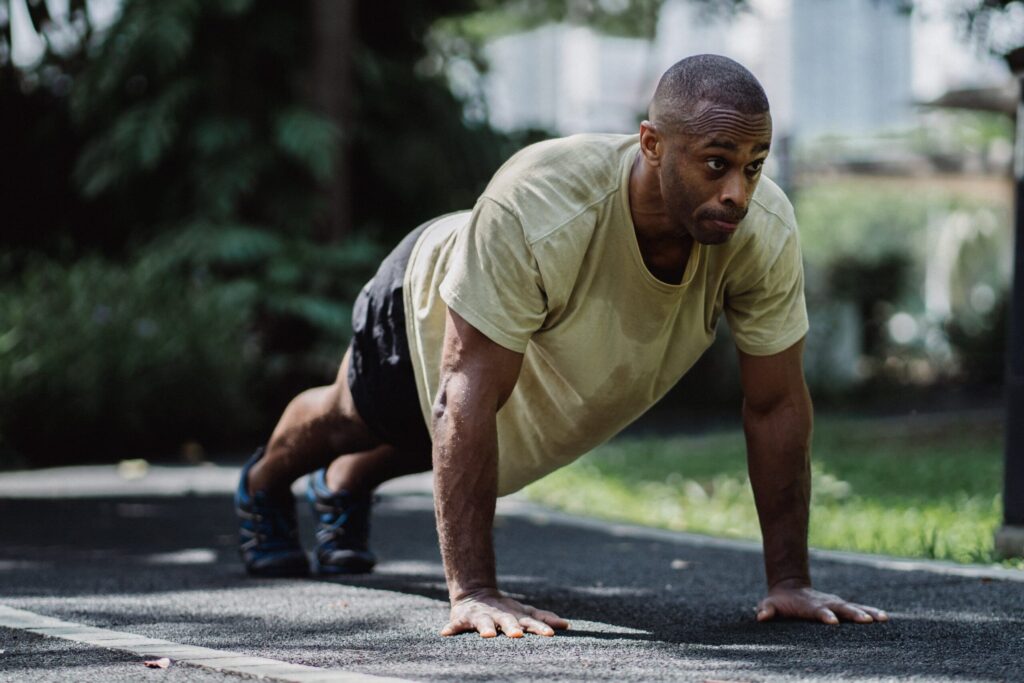
Research comparing push ups with bench pressing has found that when resistance is matched appropriately, muscle activation and strength improvements can be remarkably similar.
Beginners who cannot perform standard push ups can begin with incline push ups using a bench or sturdy box. As strength improves, gradually lower the incline until full push ups become manageable.
Start in a straight plank position with your hands slightly wider than shoulder width. Lower yourself until your chest nearly touches the floor while keeping your elbows at approximately forty five degrees from your body. Push back to the starting position without allowing your hips to sag. Focus on quality repetitions rather than rushing through high numbers. Three sets performed close to technical failure are highly effective.
4. Chest Supported Machine Press
Free weights are excellent, but machines also deserve a place in beginner training. Machine chest presses provide stability, allowing beginners to focus entirely on generating force through the chest without worrying about balance. This makes learning proper pressing mechanics much easier.
Research comparing machine and free weight training suggests that both methods effectively increase muscle size and strength. Free weights typically require greater stabilization, while machines may allow beginners to train closer to muscular failure safely. Adjust the seat so the handles line up with the middle of your chest. Grip the handles comfortably and press forward until your arms are nearly straight. Pause briefly before returning under control.
Avoid locking your elbows aggressively or allowing the weight stack to slam together. The machine press works particularly well after heavier compound exercises because it lets beginners continue training the chest while reducing technical demands.

Aim for three sets of ten to fifteen repetitions.
5. Cable Chest Fly
After completing compound pressing exercises, the cable chest fly provides excellent isolation for the pectorals. Unlike dumbbells, cables maintain tension throughout nearly the entire movement. This constant resistance increases the amount of work performed by the chest across the full range of motion.
Although fly movements cannot replace pressing exercises for overall strength, they provide additional muscle stimulus that contributes to hypertrophy.
Stand between two cable pulleys with the handles set roughly at shoulder height. Take a slight step forward and maintain a small bend in your elbows. Bring your hands together in a wide arc until they meet in front of your chest. Slowly reverse the movement while maintaining control.
Avoid turning the exercise into a press by excessively bending your elbows. Because this is an isolation movement, lighter loads with strict technique are more effective than heavy weights. Perform two to three sets of twelve to fifteen repetitions.
How Often Should Beginners Train Their Chest?
Most beginners benefit from training the chest twice each week.
Scientific evidence consistently shows that training each muscle group at least two times per week generally produces greater muscle growth than once weekly when total training volume is equal.
A simple weekly schedule might include one workout focused on heavier compound presses and another emphasizing moderate weights with higher repetitions.
This frequency provides enough practice to improve technique while allowing sufficient recovery between sessions.
Putting It All Together
The best beginner chest workout does not require endless exercise variations or complicated programming.
Mastering the barbell bench press builds overall strength. The incline dumbbell press develops the upper chest while improving balance between each side. Push ups teach body control and reinforce pressing mechanics. Machine chest presses allow beginners to safely accumulate additional training volume. Cable flys finish the workout by providing constant tension and targeted chest isolation.
Combined with progressive overload, adequate nutrition, consistent training, and proper recovery, these five exercises provide everything most beginners need to build a stronger and more muscular chest.
Patience remains the most important ingredient. Significant improvements in strength often appear within the first few months of consistent training, while visible muscle growth develops gradually over time. Focus on improving your technique, adding small amounts of weight whenever possible, and maintaining consistency. Those simple habits will produce far better results than constantly searching for the next miracle exercise.
Key Takeaways
| Topic | Recommendation |
|---|---|
| Best overall exercise | Barbell bench press for strength and muscle |
| Best upper chest exercise | Incline dumbbell press |
| Best bodyweight exercise | Push ups |
| Best beginner machine | Chest supported machine press |
| Best isolation exercise | Cable chest fly |
| Weekly frequency | Train chest twice per week |
| Weekly volume | Approximately 10 to 15 challenging sets |
| Rep range | 6 to 12 for compound lifts, 10 to 15 for isolation work |
| Recovery | Prioritize sleep, nutrition, and progressive overload |
| Protein intake | Approximately 1.4 to 2.0 g per kg of body weight daily |
References
- American College of Sports Medicine. (2009). Progression models in resistance training for healthy adults. Medicine & Science in Sports & Exercise, 41(3), 687 to 708.
- Grgic, J., Schoenfeld, B.J., Orazem, J. and Sabol, F. (2022). Effects of resistance training performed to repetition failure or non failure on muscular strength and hypertrophy. Scandinavian Journal of Medicine & Science in Sports, 32(11), 1541 to 1551.
- Kubo, K., Ikezoe, T., Yata, H. and Tsunoda, N. (2010). Time course of changes in muscle and tendon properties during strength training and detraining. Journal of Strength and Conditioning Research, 24(2), 322 to 331.
- Lasevicius, T., Schoenfeld, B.J., Silva Batista, M., Barros, T. and Aihara, A.Y. (2018). Muscle failure promotes greater muscle hypertrophy in low load but not high load resistance training. Journal of Strength and Conditioning Research, 36(2), 346 to 351.
- Schoenfeld, B.J. (2010). The mechanisms of muscle hypertrophy and their application to resistance training. Journal of Strength and Conditioning Research, 24(10), 2857 to 2872.
- Schoenfeld, B.J., Grgic, J., Ogborn, D. and Krieger, J.W. (2017). Strength and hypertrophy adaptations between low load and high load resistance training. Journal of Strength and Conditioning Research, 31(12), 3508 to 3523.
- Schoenfeld, B.J., Ogborn, D. and Krieger, J.W. (2016). Effects of resistance training frequency on measures of muscle hypertrophy. Sports Medicine, 46(11), 1689 to 1697.
- Signorile, J.F., Zink, A.J. and Szwed, S.P. (2002). A comparative electromyographical investigation of muscle utilization patterns using various hand positions during the bench press. Journal of Strength and Conditioning Research, 16(1), 65 to 71.