

A wider back is mostly about building the latissimus dorsi, commonly called the lats. These large muscles run from the lower back and pelvis toward the upper arm. When they grow, they contribute to the taper that makes the waist look smaller and the upper body look broader. The teres major, rear deltoids, traps, and rhomboids also add important visual thickness and shape around the upper back.
Dead stop exercises can be a useful way to train these muscles. In a dead stop repetition, the load or your body reaches a complete pause at the bottom before the next pull begins. This removes the momentum that can make rows and pull ups easier. It also gives you a consistent starting point for each repetition, which can make technique easier to judge.


There is no evidence that dead stop training alone creates a wider back than every other training method. Muscle growth depends primarily on doing enough challenging resistance training over time, using exercises that train the target muscles through a useful range of motion, and progressing the work you can perform. Dead stop exercises fit well into this approach because they make it harder to hide weak positions with bouncing or swinging.
The three exercises below give you one vertical pull and two horizontal pulls. Together, they train the lats, upper back, and shoulder blade muscles with different lines of pull.
Why Dead Stop Repetitions Work
A dead stop creates a brief pause at the bottom of a repetition. On a pull up, that means returning to a controlled dead hang. On a row, it means allowing the barbell or dumbbells to settle before pulling again. The purpose is not to make every repetition slow for its own sake. The purpose is to remove momentum and begin each repetition from a consistent position.
Momentum can let you move a heavier load, but it can also shift work away from the intended muscles. In a rowing movement, excessive hip drive or torso movement can make the exercise less specific to the upper back. In a pull up, swinging can reduce the challenge at the bottom of the range, where the lats and shoulder muscles must initiate the movement.
The pause also provides a simple quality check. If you cannot maintain position once the load settles, the weight is likely too heavy for the target repetition range. This makes dead stop work particularly useful for lifters who tend to rush their rows or use body English to finish sets.
Back width will not come from one exercise or one magic grip. Research comparing resistance training approaches shows that muscle growth can occur across a range of loads when sets are performed with sufficient effort. Multiple hard sets generally produce more muscle growth than a very low volume approach. The most productive plan is therefore one that lets you train hard, recover, and add repetitions or load over time.
Exercise One: Dead Hang Pull Up
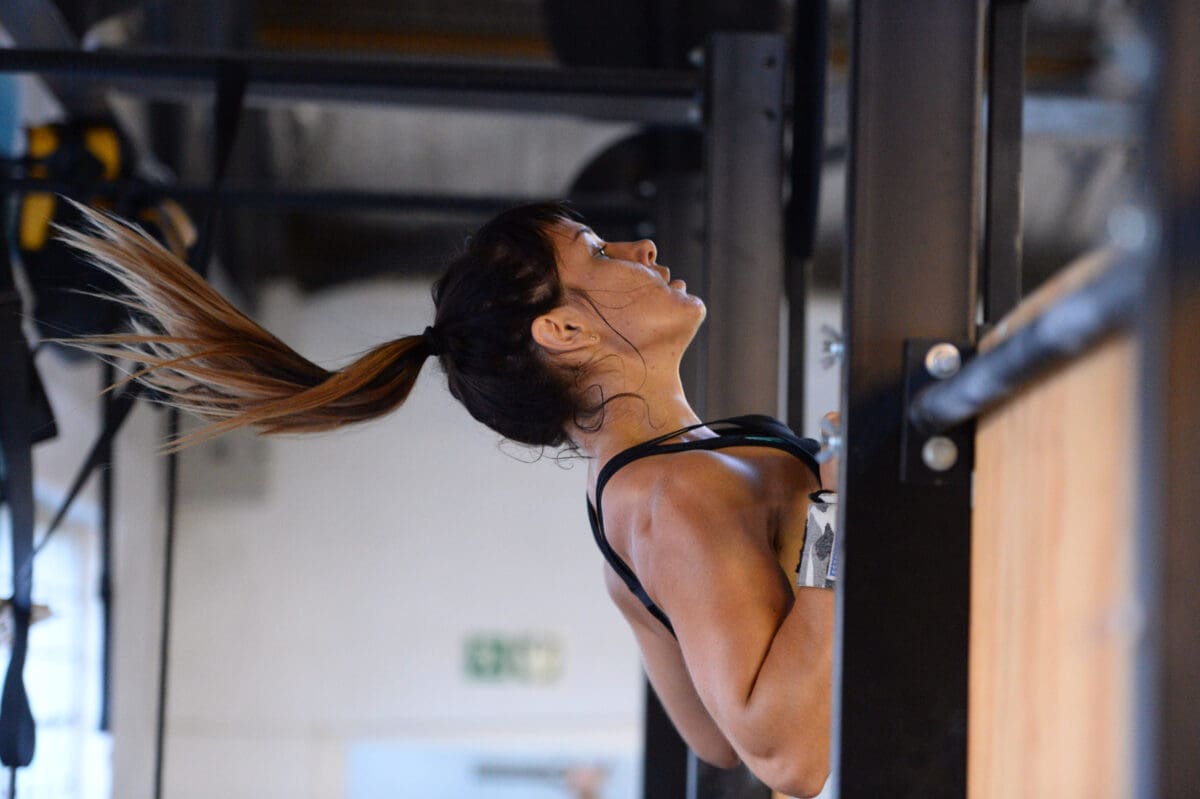
The dead hang pull up is the most direct bodyweight dead stop exercise for back width. Every repetition starts from a controlled hang with the elbows straight, then ends when your chest rises toward the bar and your elbows pull down toward your ribs.
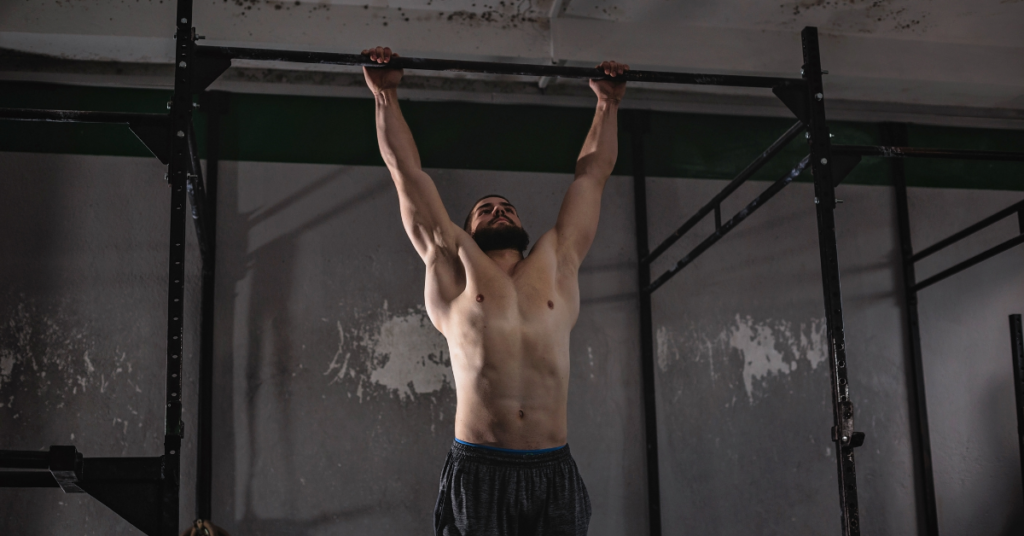
Vertical pulling exercises train the lats because the lats contribute strongly to shoulder extension and adduction. They also involve the biceps, lower trapezius, teres major, forearms, and muscles that control the shoulder blade. Pull ups are demanding because you move your own body mass, so performance is influenced by relative strength as well as absolute back strength.
How to Perform It
Hang from a stable bar with a grip that feels comfortable for your shoulders. A shoulder width or slightly wider overhand grip is a practical place to start. Begin each repetition with straight elbows and a controlled body position. Avoid a fully passive, painful shoulder position. Instead, keep your ribs controlled and create gentle tension through the shoulders.
Pull your elbows down toward your sides while bringing your chest toward the bar. Your torso may lean back slightly, but avoid kicking your legs forward or swinging your body upward. Lower under control until you return to the dead hang, pause briefly, then begin the next repetition.
A full dead hang makes the bottom position more demanding. If you cannot complete clean repetitions, use an assisted pull up machine, a resistance band, or an elevated foot supported variation. These options reduce the load while preserving the movement pattern.
How to Program It
For muscle growth, perform three to five challenging sets of six to 12 repetitions. If bodyweight pull ups limit you to fewer than six clean repetitions, assistance can help you accumulate productive training volume. If you can easily exceed 12 repetitions, add a small amount of external load.
Keep one or two repetitions in reserve on most sets. This means ending the set when you believe you could still complete one or two clean repetitions. Training close to failure can stimulate growth, but stopping before technique collapses helps maintain shoulder position and makes weekly training more sustainable.
Exercise Two: Pendlay Row
The Pendlay row is a barbell row performed from the floor. Each repetition begins with the bar resting on the ground, which creates a genuine dead stop. Unlike a conventional bent over row, where the bar may remain suspended between repetitions, the floor reset reduces the opportunity to bounce or use a continuous rhythm.
This exercise trains the lats, middle back, rear deltoids, and muscles that stabilize the trunk. It also challenges the spinal erectors isometrically because you must maintain a strong torso position while pulling. Research comparing rowing variations has shown that trunk position and row selection can substantially affect back muscle activity and the demands placed on the lower back.
How to Perform It
Set a loaded barbell on the floor. Stand with your feet around hip width apart, then hinge at the hips until your torso is close to parallel with the floor. Grip the bar with hands slightly wider than shoulder width. Keep your spine neutral and brace your trunk.
Pull the bar toward the lower chest or upper abdomen by driving your elbows back. Keep your torso as still as possible. Lower the bar back to the floor under control, let it settle completely, then reset your brace before beginning the next repetition.
The bar should return to the floor on every repetition. Do not turn the exercise into a bouncing touch and go row. The reset is the reason this variation is useful.
How to Program It
Use three to four sets of six to 10 repetitions. The Pendlay row is often best trained with moderate loads because heavy sets can become limited by lower back fatigue and technique. The goal is to pull with the back, not to turn every set into a hip driven power movement.
Place it early in your workout if you want to use challenging loads and focus on performance. If you perform heavy deadlifts in the same session, consider using fewer row sets or placing the Pendlay row on another day. Both exercises demand strong trunk bracing and can create substantial fatigue.
Exercise Three: Chest Supported Dead Stop Dumbbell Row
The chest supported dead stop dumbbell row removes much of the lower back demand found in unsupported rowing. That lets you focus more directly on the back muscles, which is useful when your lower back is already fatigued from squats, deadlifts, or daily life.
You need an adjustable bench set to a low incline and a pair of dumbbells. At the bottom of each repetition, allow the dumbbells to settle in a full stretched position before pulling again. The bench provides support, while the dead stop prevents you from using a bouncing rhythm.

Chest supported rows are especially useful for accumulating quality work. Because the torso is supported, the upper back can often be the limiting factor rather than the spinal erectors. This can make the exercise a practical complement to heavier unsupported rows.
How to Perform It
Set an adjustable bench to a low incline. Lie face down with your chest supported and your feet firmly planted. Hold the dumbbells with your arms hanging straight toward the floor.
Let your shoulder blades move naturally apart at the bottom without losing control of your shoulders. Pause for a moment, then pull the dumbbells toward your lower ribs. Drive your elbows back and slightly out, but do not aggressively shrug your shoulders toward your ears.
Lower the dumbbells slowly until your arms are straight again. Pause in the bottom position before beginning the next repetition. Use a load that allows you to keep your chest on the bench and reach a full stretch without losing control.
How to Program It
Perform three to five sets of eight to 15 repetitions. This exercise works well after pull ups or heavier barbell rows because it allows you to train the back with less demand on the lower back.
A neutral grip, where your palms face each other, is often comfortable for the wrists and shoulders. An overhand grip can place slightly more emphasis on the upper back and rear deltoids, although individual comfort should guide your choice. Use the grip that lets you train hard through a full range of motion without pain.
How to Build These Exercises Into a Wider Back Plan
A wider back needs more than occasional hard sets. Consistent training volume, progressive overload, adequate food intake, and recovery all matter. The three exercises in this article can form the core of a back session, but they should be adjusted to your current ability and recovery.
Start with dead hang pull ups when you are fresh. Follow them with Pendlay rows on a day when your lower back is not overly fatigued. Finish with chest supported dead stop dumbbell rows to add controlled volume for the lats and upper back.
Train the back at least twice each week if recovery allows. You do not need to perform all three exercises in every workout. One session might emphasize pull ups and chest supported rows, while another emphasizes Pendlay rows and assisted pull ups. This approach gives you repeated exposure to vertical and horizontal pulling without forcing excessive fatigue into one workout.
Progress can be simple. Add one repetition to a set when you can maintain form, then increase the load once you reach the top of your planned repetition range. Small improvements repeated over many weeks are more valuable than frequent exercise changes.
Technique Mistakes That Limit Back Growth
The first common mistake is cutting the range of motion short. A dead stop row should begin with the arms extended and the load settled. A dead hang pull up should begin from a controlled bottom position. Shortening the bottom of the movement may let you perform more repetitions, but it reduces consistency and can reduce the challenge placed on the target muscles.
How Heavy Should Beginners Deadlift in the Gym?
The second mistake is using too much weight. If your torso rises off the bench during chest supported rows, your lower back rounds during Pendlay rows, or you need to kick your legs during pull ups, reduce the load or use assistance. Good back training requires effort, but it should still look like back training.
The third mistake is treating vertical pulling as the only route to a wider back. Pull ups are excellent, but rows also train the lats while building the upper back musculature that frames the torso. Combining both movement patterns is a more complete approach.
The Bottom Line
Dead stop exercises are valuable because they make each repetition honest. They reduce momentum, create repeatable positions, and make it easier to focus on controlled pulling. The dead hang pull up, Pendlay row, and chest supported dead stop dumbbell row are a strong combination for building the lats and upper back.
Use full ranges of motion, choose loads you can control, and train enough hard sets to create a reason for your muscles to adapt. Over time, that consistent work is what builds a broader back.
References
- Fenwick, C.M.J., Brown, S.H.M. and McGill, S.M. (2009) ‘Comparison of different rowing exercises: Trunk muscle activation and lumbar spine motion, load, and stiffness’, Journal of Strength and Conditioning Research, 23(2), pp. 350–358.
- Lusk, S.J., Hale, B.D. and Russell, D.M. (2010) ‘Grip width and forearm orientation effects on muscle activity during the lat pull down’, Journal of Strength and Conditioning Research, 24(7), pp. 1895–1900.
- Schoenfeld, B.J., Ogborn, D. and Krieger, J.W. (2017) ‘Dose response relationship between weekly resistance training volume and increases in muscle mass: A systematic review and meta analysis’, Journal of Sports Sciences, 35(11), pp. 1073–1082.
- Schoenfeld, B.J., Grgic, J., Ogborn, D. and Krieger, J.W. (2017) ‘Strength and hypertrophy adaptations between low versus high load resistance training: A systematic review and meta analysis’, Journal of Strength and Conditioning Research, 31(12), pp. 3508–3523.
- Wolf, M., Hecksteden, A., Morsch, A., Hessel, M., Shuster, I., Hasenfuss, G., Graf, C. and Meyer, T. (2023) ‘Resistance training prescription for muscle strength and hypertrophy in healthy adults: A systematic review and Bayesian network meta analysis’, British Journal of Sports Medicine, 57(18), pp. 1211–1220.
Key Takeaways
| Key point | Practical meaning |
|---|---|
| Dead stops reduce momentum | Pause at the bottom so each repetition begins from a consistent position |
| Pull ups build width | Use a controlled dead hang to train vertical pulling through a full range |
| Pendlay rows add demanding back work | Reset the barbell on the floor between repetitions |
| Chest support adds quality volume | Use supported dumbbell rows when lower back fatigue limits unsupported rowing |
| Progress drives results | Add repetitions or load gradually while maintaining strict technique |
| Train both pull directions | Combine vertical and horizontal pulls for more complete back development |