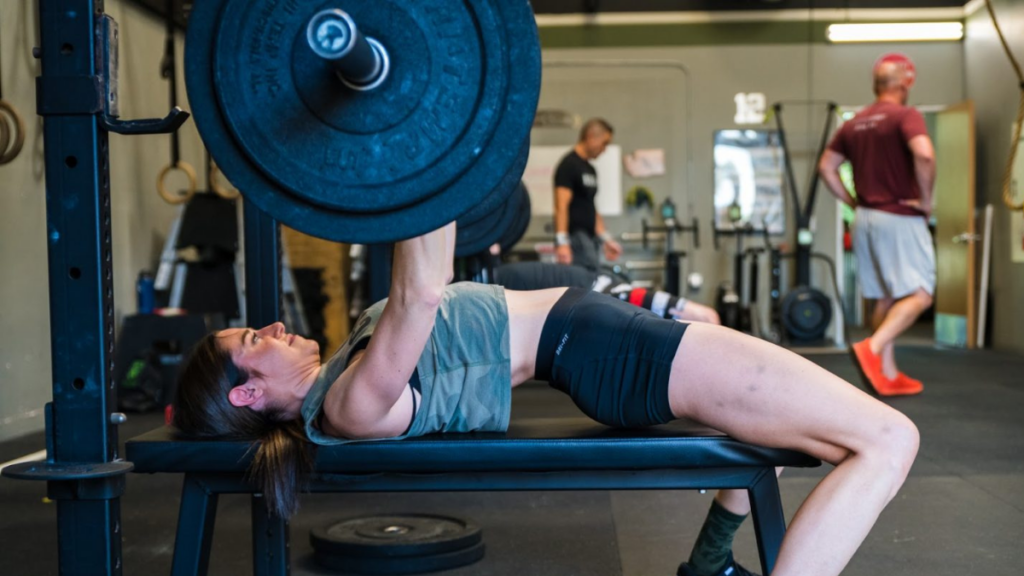


The triceps are a hugely important, but often undertrained muscle group of the arms. If you want to bulk up this part of your upper body then you need to focus attention on the triceps.
Add these three exercises into your training and accelerate your gains.
The Science of Triceps Hypertrophy and Barbell Loading
Muscle growth occurs when you subject muscle fibers to mechanical tension that exceeds their current capacity, signaling the body to repair and reinforce the tissue. Recent sports science literature confirms that exposing a muscle to heavy mechanical tension through a full range of motion triggers cellular pathways responsible for muscle protein synthesis. While cable machines provide smooth constant tension, barbells allow you to handle significantly greater absolute weight, exposing your muscle fibers to higher peak forces.
Barbells provide a distinct training advantage for beginners because bilateral loading creates a stable environment where you can safely move heavier loads. Research comparing multi joint compound pressing to single joint isolation movements demonstrates that heavy pressing variations elicit extremely high levels of triceps activation. The heavy external resistance forces your central nervous system to recruit fast twitch muscle fibers early in the set, translating directly to rapid mass and strength gains.
| Exercise Type | Heavy Loading Potential | Shoulder Stability Required | Triceps Recruitment |
|---|---|---|---|
| Dumbbell Kickback | Low | Moderate | Low to Moderate |
| Cable Pushdown | Moderate | Low | Moderate to High |
| Close Grip Bench Press | Maximum | High | Maximum |
When examining data from electromyographic studies, researchers measure the electrical activity within target muscles to determine which exercises recruit the highest percentage of motor units. The findings demonstrate that combining heavy horizontal pressing with skull crushers and overhead extensions creates total mechanical coverage across all three heads of the triceps brachii.
| Metric | Close Grip Bench Press | Lying Lying Triceps Extension | Overhead Barbell Extension |
|---|---|---|---|
| Lateral Head Activation | Maximum | Very High | High |
| Medial Head Activation | High | Maximum | High |
| Long Head Activation | Moderate | High | Maximum |
Selecting exercises that maximize motor unit recruitment while allowing for steady weight progression ensures that every workout brings you closer to your muscle building goals. The following sections break down the three essential barbell movements that every beginner should integrate into their upper body training routine.
Exercise One: The Close Grip Bench Press
The close grip bench press stands as the premier compound mass builder for the triceps brachii. By narrowing your grip on a standard bench press, you alter the mechanical leverage of the movement, shifting the primary workload away from the chest and placing tremendous mechanical tension directly onto your triceps.
To perform this exercise correctly, lie flat on a bench with your feet firmly planted on the floor to maintain a rigid base. Grab the barbell with an overhand grip with your hands spaced roughly shoulder width apart, or slightly narrower. Avoid putting your hands too close together, as gripping the bar with only a few inches between your hands places unnecessary torsional stress on your wrists and elbows without providing any additional triceps activation.
Unrack the bar and lower it under control to your lower chest or sternum, keeping your elbows tucked at roughly a thirty to forty five degree angle relative to your torso. Touch your chest lightly, then drive the barbell forcefully back up to the starting position by extending your elbows, locking out your triceps hard at the top of the movement.
| Execution Variable | Recommended Parameter |
|---|---|
| Repetition Range | 6 to 10 repetitions |
| Working Sets | 3 to 4 sets |
| Rest Interval | 2 to 3 minutes |
| Tempo | 3 seconds lowering, 1 second lifting |
Biomechanical research shows that keeping your elbows tucked closely to your sides during a close grip press maximizes elbow extension torque while minimizing shoulder stress. This mechanical setup allows you to handle heavy weights safely, making the close grip bench press an indispensable foundation for long term upper arm mass.
Exercise Two: The Barbell Lying Triceps Extension
While the close grip bench press builds overall triceps mass through heavy pressing, the barbell lying triceps extension, commonly known as the skull crusher, isolates elbow extension while providing a profound stretch to the muscle fibers. This movement targets the long and medial heads of the triceps with exceptional efficiency.
Lie flat on a workout bench while holding a barbell or EZ curl bar directly above your chest with a narrow overhand grip. Keeping your upper arms stable and angled slightly back toward your head, bend your elbows to lower the weight in a smooth arc toward your forehead or just past the top of your head.
Lower the bar until your elbows reach deep flexion and you feel a powerful stretch throughout the back of your arms. Without allowing your upper arms to sway forward or flare outward, contract your triceps to extend your elbows and return the bar to the starting position overhead. Using an EZ curl bar for this movement is often preferred because the angled grip reduces stress on your wrists and elbows.
| Execution Variable | Recommended Parameter |
|---|---|
| Repetition Range | 8 to 12 repetitions |
| Working Sets | 3 sets |
| Rest Interval | 90 seconds to 2 minutes |
| Tempo | 3 seconds lowering, 1 second contraction |
Electromyographic investigations into triceps extensions demonstrate that maintaining a slight backward tilt in your upper arms keeps constant tension on the muscle throughout the entire set. Preventing your upper arms from drifting forward keeps the load on your triceps rather than transferring it onto your shoulders.
Exercise Three: The Seated Overhead Barbell Triceps Extension
The seated overhead barbell triceps extension provides a unique biomechanical stimulus that no flat pressing or lying movement can replicate. Because the long head of the triceps crosses the shoulder joint, it reaches a position of maximum muscular stretch only when your arms are elevated fully overhead. Research confirms that training muscles at long muscle lengths drives superior hypertrophy via stretch mediated pathways.
Set up an adjustable bench with a vertical or high incline back support and sit down with your feet planted firmly. Hold a barbell or EZ curl bar overhead with a narrow overhand grip, locking your arms out vertically above your shoulders while keeping your core braced tightly.
Flex your elbows to lower the barbell behind your head in a controlled arc, keeping your upper arms as close to vertical as comfortably possible. Sink the weight down until you experience a deep, comfortable stretch across the back of your upper arms, then press the barbell back up to full elbow extension without letting your lower back arch excessively.
| Execution Variable | Recommended Parameter |
|---|---|
| Repetition Range | 10 to 12 repetitions |
| Working Sets | 3 sets |
| Rest Interval | 90 seconds to 2 minutes |
| Tempo | 3 seconds lowering, 1 second lifting |
Sports science literature evaluating muscle stretch emphasizes that overhead loading specifically targets the long head of the triceps, which accounts for the largest portion of overall triceps volume. Including an overhead extension variant ensures complete muscular development across the entire upper arm complex.
Program Integration and Practical Application
Knowing which exercises to select is only the first step toward building impressive arm size. Structuring these barbell movements into a well balanced weekly training plan determines whether you make rapid, continuous gains or plateau early. Beginners achieve optimal results by training their triceps twice per week alongside their chest or shoulder sessions, allowing at least forty eight hours between workouts for tissue repair and protein synthesis.
| Training Day | Focused Exercises | Sets and Repetitions |
|---|---|---|
| Session A | Close Grip Bench Press, Barbell Lying Triceps Extension | 3 sets of 6 to 8 reps / 3 sets of 8 to 12 reps |
| Session B | Seated Overhead Barbell Extension, Close Grip Bench Press | 3 sets of 10 to 12 reps / 3 sets of 8 to 10 reps |
Progressive overload remains the foundational driver of muscular adaptation. You must challenge your triceps over time by systematically adding weight to the bar, increasing your total repetitions, or improving your execution speed and control from week to week. Logging your training performances removes guesswork and ensures long term accountability.
The Undervalued Bicep Exercise That Triggers Faster Arm Growth Than Curls
Proper nutrition and quality sleep form the foundation of physical recovery. Consuming adequate dietary protein supplies the necessary amino acids to rebuild damaged muscle fibers, while sufficient rest regulates anabolic hormones required for growth. Mastering these three barbell exercises with consistency and progressive loading will unlock fast, noticeable triceps development.
Key Takeaways
| Concept | Summary |
|---|---|
| Triceps Mass Dominance | The triceps brachii makes up two thirds of upper arm volume, making it vital for arm mass. |
| Close Grip Bench Press | Provides maximum heavy loading potential to build baseline triceps thickness and strength. |
| Lying Extension | Isolates elbow extension and targets the medial and long heads through a deep stretch. |
| Overhead Extension | Exploits stretch mediated hypertrophy by loading the long head of the triceps overhead. |
| Progressive Overload | Demands systematic increases in weight or reps over time to drive continuous growth. |
References
Schoenfeld, B. J., Contreras, B., Krieger, J., Grgic, J., Delcastillo, K., Belliard, R., & Alto, A. (2019). Resistance training volume enhances muscle hypertrophy but with relative retrogression in advanced lifters. Medicine and Science in Sports and Exercise, 51(1), 94-103.
Barnett, C., Kippers, V., & Turner, P. (1995). Effects of variations of the bench press exercise on the electromyographic activity of the pectoralis major, anterior deltoid, and triceps brachii. Journal of Strength and Conditioning Research, 9(4), 222-227.
Wakahara, T., Miyamoto, N., Sugisaki, N., Murata, K., Kanehisa, H., Kawakami, Y., Fukunaga, T., & Yanai, T. (2012). Association between regional differences in muscle hypertrophy and surface electromyographic activity prior to resistance training. European Journal of Applied Physiology, 112(12), 4097-4107.
Pedrosa, G. F., Lima, F. V., Schoenfeld, B. J., Lacerda, L. T., Simões, M. G., Pereira, M. R., Diniz, R. C. R., & Chagas, M. H. (2022). Partial range of motion training elicits favorable hypertrophy targets when performed at long muscle lengths. European Journal of Sport Science, 22(8), 1250-1260.