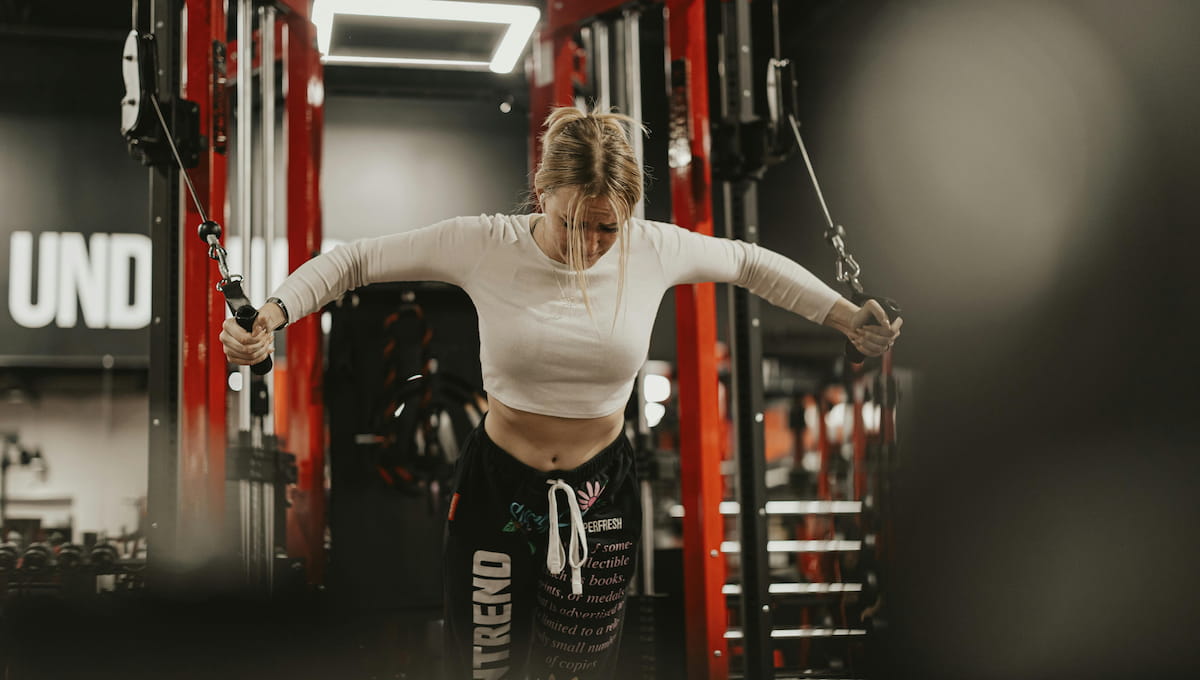


Building muscular arms does not require complicated workouts, heavy barbells, or a long list of exercises. Beginners can make excellent progress by using a cable machine well. Cables are easy to adjust, allow smooth resistance throughout the movement, and make it simpler to train your biceps and triceps with control.
Your arms are mainly made up of the biceps on the front of the upper arm and the triceps on the back. The triceps are the larger muscle group, so training them properly is particularly important if your goal is noticeably bigger arms. However, well developed biceps create the shape and detail that many people want when they flex or wear a short sleeve shirt.
The three exercises below give beginners a simple, effective cable routine. They cover elbow flexion for the biceps and elbow extension for the triceps, while using positions that are practical to learn and easy to progress. Combined with steady training, enough protein, and a gradual increase in workload, they can help you build stronger and more muscular arms.
Why Cable Exercises Work So Well for Beginners
Cable machines let you apply resistance in a consistent direction while moving through a comfortable range of motion. Unlike a dumbbell, which is affected by gravity in one direction, a cable can keep tension on the target muscle through much of the repetition. That can help beginners feel the intended muscles working and learn better control.
3 Best Beginner Cable Exercises for Building a More Muscular Back
Muscle growth is driven primarily by challenging a muscle with sufficient resistance training volume over time. Research shows that multiple hard sets per muscle group each week generally produce more muscle growth than very low training volumes. You do not need to start with a huge number of sets, but you do need to train consistently and gradually ask your muscles to do more work.
Cables also make it easy to use small weight increases. This is useful because large jumps in weight can make arm exercises feel too difficult and can encourage poor technique. Start with a load that allows smooth repetitions, then add a small amount of resistance when you can complete all your planned reps with solid form.

For most beginners, two arm sessions per week works well. This gives you enough practice to improve technique while allowing time to recover. Start with two or three sets of each exercise, using a weight that leaves you with roughly one to three repetitions still possible at the end of each set. You do not need to train to complete failure every time to build muscle.
Exercise 1: Cable Rope Hammer Curl
The cable rope hammer curl is one of the best beginner biceps exercises because it is comfortable, stable, and easy to learn. The neutral hand position, with palms facing each other, often feels natural on the wrists and elbows. It trains the biceps brachii, brachialis, and brachioradialis, which all contribute to a thicker and more muscular looking upper arm.
The biceps brachii flexes the elbow and helps turn the palm upward. The brachialis sits beneath the biceps and is a powerful elbow flexor. Building it can make the upper arm appear fuller from the side. The brachioradialis runs along the upper forearm and is strongly involved when you curl with a neutral grip.
How to Do the Cable Rope Hammer Curl
Set the pulley at its lowest position and attach a rope handle. Stand tall facing the machine, holding one end of the rope in each hand. Take a small step back so the weight stack is lifted before you begin.
Keep your elbows close to your sides and your chest upright. Curl the rope toward the front of your shoulders without swinging your torso backward. Pause briefly as your forearms approach vertical, then lower the handle slowly until your elbows are straight but not forced backward.
Your upper arm should remain mostly still. If your elbows travel far forward or your body rocks during the curl, the weight is probably too heavy. Use a lighter load and focus on a controlled lowering phase.
How to Program It
Perform two or three sets of eight to fifteen repetitions. A moderate to higher repetition range works very well for arm isolation exercises because it gives you time to practice control and accumulate useful training volume without needing extremely heavy loads.
When you can complete the top end of the range with consistent technique, increase the weight by the smallest available amount. This gradual approach helps you build strength without turning every workout into a test.
Exercise 2: Cable Rope Triceps Pressdown
The cable rope triceps pressdown is a beginner staple for good reason. It directly trains the triceps while allowing you to keep your shoulders in a stable and comfortable position. The rope attachment also lets your hands move naturally as you extend your elbows.
The triceps brachii has three heads, and its main job is to straighten the elbow. Since the triceps make up a large proportion of upper arm muscle mass, improving them is one of the most direct ways to make your arms look bigger. Pressdowns are especially useful because they are simple to set up and easy to adjust to your current strength level.
How to Do the Cable Rope Triceps Pressdown
Set the pulley slightly above head height and attach a rope. Face the machine and hold the rope with both hands. Stand tall with a small bend in your knees and bring your elbows close to your sides.
Start with your elbows bent and your forearms roughly parallel to the floor. Press the rope down by straightening your elbows. As you reach the bottom, allow the rope ends to move slightly apart while keeping your shoulders relaxed.
Pause when your elbows are straight, then return the rope upward under control. Your elbows should stay close to your body throughout the movement. Avoid leaning your body weight over the rope or turning the exercise into a downward chest press.
How to Program It
Perform two or three sets of ten to fifteen repetitions. Choose a weight that makes the final few repetitions challenging without causing your shoulders to rise toward your ears or your torso to swing.
A slow, controlled return is important. The lowering phase contributes to the total stimulus placed on the muscle, and rushing it makes it harder to maintain tension on the triceps. Aim for a smooth return that takes roughly two seconds.
Exercise 3: Overhead Cable Triceps Extension
The overhead cable triceps extension gives beginners an excellent way to train the triceps in a different shoulder position. It is especially valuable for the long head of the triceps, which crosses both the shoulder and elbow joints. Research has found that triceps training in an overhead shoulder position can produce greater long head muscle growth than training with the upper arms held by the sides.
This exercise can feel awkward at first, so start lighter than you think you need. Once you learn the position, it is one of the most productive cable exercises for developing fuller upper arms.
How to Do the Overhead Cable Triceps Extension
Set the pulley at its lowest position and attach a rope handle. Face away from the machine and hold the rope behind your head. Step forward until the stack is raised and the cable provides gentle tension.
Keep your ribs down, your chest tall, and your elbows pointed forward. Your upper arms should remain close to your head. Straighten your elbows to press the rope upward and forward until your arms are nearly straight.
Lower the rope slowly behind your head until you feel a comfortable stretch in the triceps. Do not force the range if your shoulders feel uncomfortable. A slightly smaller range with good control is more useful than pushing through pain or losing your position.
How to Program It
Perform two or three sets of eight to fifteen repetitions. Because the exercise places the arms overhead, most beginners should use a lighter load than they use for pressdowns.
Keep the movement focused on elbow extension. If your lower back arches heavily or your elbows flare far apart, reduce the weight. Your goal is not to move the largest possible load. Your goal is to make the triceps do the work through a controlled range of motion.
How to Build a Simple Beginner Cable Arm Workout
You can perform these exercises after your main upper body session or as a short arm focused workout. Start with the rope hammer curl, then move to the rope pressdown and overhead extension. Complete two sets of each exercise during your first few weeks.
As you become more confident with the movements, progress to three sets of each. This provides nine direct arm sets in a workout, which is plenty for many beginners when combined with pulling exercises such as rows and pulldowns, plus pressing exercises such as push ups and chest presses.

Rest for around one to two minutes between sets. Longer rest periods can help you maintain performance across multiple sets, which matters because good quality repetitions help you accumulate more productive training volume. Take enough time to feel ready for the next set rather than rushing simply to finish the workout sooner.
Train the routine twice each week, leaving at least one day between sessions. For example, you could train your arms on Monday and Thursday. Keep a simple record of your weights and repetitions. When you improve your repetitions or add a small amount of weight while maintaining good form, you are making progress.
Common Beginner Mistakes to Avoid
The most common mistake is using too much weight. Heavy loads can make people swing their bodies, move their elbows excessively, or shorten the range of motion. Those changes often shift work away from the intended muscles and make it harder to learn the exercise.
Another mistake is treating every set as an all out effort. Training close to failure can be effective, but beginners do not need to reach complete failure constantly. Leaving a small amount in reserve allows you to maintain cleaner technique and recover well enough to train consistently.
Finally, do not expect arm exercises alone to create your best results. Rows, pulldowns, presses, and push ups also train the arms while building the back, chest, and shoulders. Use these three cable movements as focused additions to a balanced strength program, eat enough protein, and give your body time to adapt.
The Bottom Line
The cable rope hammer curl, cable rope triceps pressdown, and overhead cable triceps extension are three excellent beginner exercises for more muscular arms. They are straightforward to learn, simple to progress, and effective for training the biceps and triceps through controlled repetitions.
Start with light to moderate weights, prioritize clean technique, and train consistently twice per week. As your strength improves, gradually add repetitions or small amounts of resistance. That patient approach is what turns a basic cable routine into stronger, more muscular arms.
References
- American College of Sports Medicine (2009) ‘American College of Sports Medicine position stand: Progression models in resistance training for healthy adults’, Medicine and Science in Sports and Exercise, 41(3), pp. 687 to 708.
- Grgic, J., Schoenfeld, B.J., Orazem, J., Sabol, F., Wolf, M. and Pedisic, Z. (2022) ‘Effects of resistance training performed to repetition failure or non failure on muscular strength and hypertrophy: A systematic review and meta analysis’, Journal of Sport and Health Science, 11(2), pp. 202 to 211.
- Maeo, S., Takahashi, T., Murase, T., Kanehisa, H. and Isaka, T. (2022) ‘Triceps brachii hypertrophy is substantially greater after elbow extension training performed in the overhead versus neutral shoulder position’, Journal of Applied Physiology, 132(3), pp. 746 to 754.
- Neumann, D.A. (2017) Kinesiology of the Musculoskeletal System: Foundations for Rehabilitation. 3rd edn. St. Louis, MO: Elsevier.
- Schoenfeld, B.J., Grgic, J., Ogborn, D. and Krieger, J.W. (2017) ‘Strength and hypertrophy adaptations between low versus high load resistance training: A systematic review and meta analysis’, Journal of Strength and Conditioning Research, 31(12), pp. 3508 to 3523.
- Schoenfeld, B.J., Ogborn, D. and Krieger, J.W. (2017) ‘Dose response relationship between weekly resistance training volume and increases in muscle mass: A systematic review and meta analysis’, Journal of Sports Sciences, 35(11), pp. 1073 to 1082.
- Schoenfeld, B.J., Pope, Z.K., Benik, F.M., Hester, G.M., Sellers, J., Nooner, J.L., Schnaiter, J.A., Bond Williams, K.E., Carter, A.S., Ross, C.L., Just, B.L., Hensley, C.P., Deshler, J.D., Vigotsky, A.D. and Krieger, J.W. (2016) ‘Longer interset rest periods enhance muscle strength and hypertrophy in resistance trained men’, Journal of Strength and Conditioning Research, 30(7), pp. 1805 to 1812.
Key Takeaways
| Exercise | Main focus | Beginner target | Key technique point |
|---|---|---|---|
| Cable rope hammer curl | Biceps, brachialis, and forearms | Two to three sets of eight to fifteen repetitions | Keep elbows close to your sides and do not swing |
| Cable rope triceps pressdown | Triceps | Two to three sets of ten to fifteen repetitions | Keep shoulders relaxed and elbows near your body |
| Overhead cable triceps extension | Triceps, particularly the long head | Two to three sets of eight to fifteen repetitions | Use a light load and keep your ribs down |
| Weekly plan | Arm muscle growth | Train the routine twice per week | Add repetitions or small weight increases over time |