

The bench press is one of the simplest ways to measure upper body pressing strength, but the number on the bar only makes sense when it has context. A 225 pound bench press means something different for a 165 pound man than it does for a 240 pound man. Training age, technique, range of motion, and age also matter.
This guide gives you practical one repetition maximum standards for men, drawn from the bodyweight and experience framework published by Modern Men’s Fitness. Use them as targets, not verdicts. They are not nationally representative averages and they cannot account for your arm length, injury history, sporting background, or quality of technique. They do, however, give you a sensible way to see where you are and decide what to chase next.


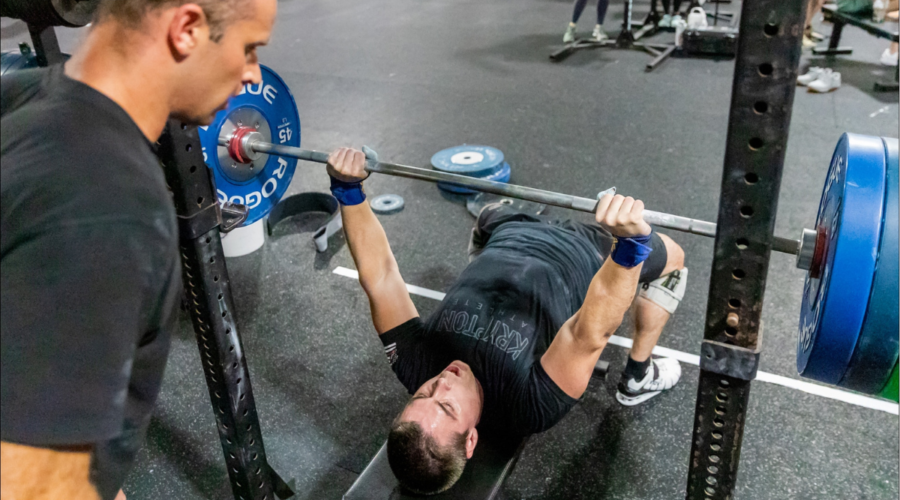
A true benchmark means pressing a barbell from a controlled touch on the chest to locked elbows, without a bench shirt or assistance. If you use a different variation, such as a Smith machine, a paused competition bench press, or a close grip bench press, log it separately. Comparing unlike lifts produces a number that looks precise but tells you very little.
What Your Bench Press Number Actually Measures
Your one repetition maximum, often called a 1RM, is the heaviest load you can lift once with sound technique. It reflects the coordinated contribution of your chest, front delts, triceps, upper back, and legs, as well as your ability to produce force in this particular movement pattern. It does not measure your entire fitness level, nor does it decide whether your physique is impressive or your training is productive.
Research supports using a properly administered 1RM as a repeatable measure of dynamic strength. A systematic review found good to excellent test and retest reliability across different exercises, ages, and training backgrounds. Still, normal day to day variation is real. Sleep, practice with heavy singles, fatigue, and how consistently you control the range of motion can move the result. Treat a small change as information, not a reason to rewrite your training.
If you do not want to test a maximal single, a hard set performed with a stable technique can estimate your current level. This is useful for beginners and anyone training alone. The estimate should only guide your programming because individual prediction error can be meaningful. Direct 1RM testing and several indirect methods are reliable at a group level, yet cannot be treated as identical for every lifter.
The standards at a glance
| Level | Bench press target | What it usually represents |
|---|---|---|
| Beginner | 0.5 times bodyweight | Learning the lift and building consistency |
| Novice | 0.75 times bodyweight | A solid early strength base |
| Intermediate | 1.0 times bodyweight | A strong, meaningful general fitness target |
| Advanced | 1.25 times bodyweight | Several years of focused, productive training for many lifters |
| Elite | 1.5 times bodyweight or more | Exceptionally strong relative pressing ability |
For example, an 180 pound man who benches 180 pounds has reached the intermediate bodyweight target. Reaching 225 pounds puts him at 1.25 times bodyweight, while 270 pounds is 1.5 times bodyweight. These ratios are a convenient starting point, but the bodyweight tables below are more specific.
Bench Press Standards for Men by Bodyweight
The figures below are raw one repetition maximum targets in pounds. They follow the supplied Modern Men’s Fitness framework. Choose the bodyweight closest to yours, then use your current result to identify the nearest level. When you sit between two bodyweights, use the lower row as a conservative target or interpolate modestly.
| Bodyweight | Beginner | Novice | Intermediate | Advanced | Elite |
|---|---|---|---|---|---|
| 114 pounds | 75 | 105 | 145 | 190 | 240 |
| 123 pounds | 80 | 115 | 155 | 205 | 260 |
| 132 pounds | 90 | 125 | 170 | 220 | 280 |
| 148 pounds | 100 | 140 | 190 | 250 | 315 |
| 165 pounds | 110 | 155 | 210 | 275 | 350 |
| Bodyweight | Beginner | Novice | Intermediate | Advanced | Elite |
|---|---|---|---|---|---|
| 181 pounds | 120 | 170 | 230 | 300 | 380 |
| 198 pounds | 130 | 185 | 250 | 325 | 415 |
| 220 pounds | 145 | 200 | 270 | 355 | 450 |
| 242 pounds | 155 | 215 | 290 | 380 | 480 |
| 275 pounds or more | 165 | 230 | 310 | 405 | 510 |
The tables show why a single universal standard can mislead. A 225 pound bench press is close to advanced for a 165 pound man but is nearer an intermediate target for a 220 pound man. It is still an excellent personal milestone, especially when it is achieved with consistent depth and control.
What the experience labels mean
Experience is not just a number of months spent holding a gym membership. A beginner is usually in the first six months of consistent lifting and is still developing skill and confidence. A novice typically has six to 18 months of productive work behind him and can often add weight regularly. An intermediate has usually trained purposefully for one to three years and needs planned weekly progression instead of automatic gains every session.
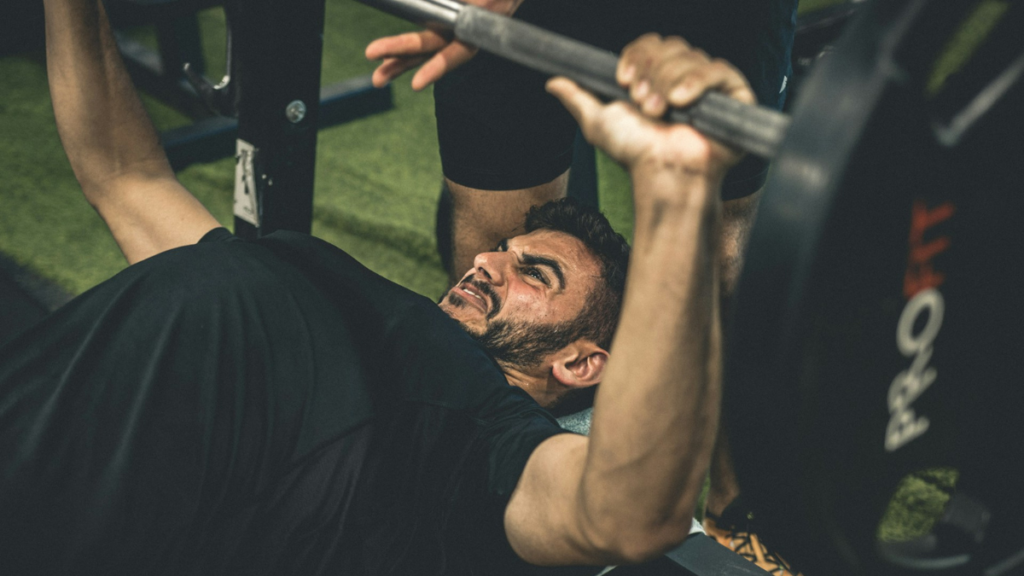
Advanced strength typically requires several years of serious, continuous training. Progress becomes slower and a lifter must manage volume, intensity, recovery, and weak points. Elite is not simply the next box to tick. It reflects unusually high relative performance and years of dedicated work. The most useful goal is usually the next realistic level, not the farthest category on the page.
How Age Changes the Target
Strength can decline with age, especially later in adulthood, but it is not a command to lower expectations prematurely. Older men can make substantial gains with resistance training. In one study, healthy men aged 60 to 71 substantially improved their bench press over 22 weeks of heavy resistance training, removing the measured difference from the young active comparison group.
The age adjustments below are a practical coaching model from the supplied standards source, rather than a universal biological formula. Use them to keep goals realistic after 40, not to limit your ambition. Apply the multiplier to the bodyweight standard that matches your experience level.
| Age group | Multiplier | Example for a 181 pound intermediate target |
|---|---|---|
| 20 to 29 | 1.00 | 230 pounds |
| 30 to 39 | 0.97 | 223 pounds |
| 40 to 49 | 0.90 | 207 pounds |
| 50 to 59 | 0.82 | 189 pounds |
| 60 to 69 | 0.72 | 166 pounds |
| 70 or older | 0.62 | 143 pounds |
For a 45 year old man weighing 198 pounds, the intermediate benchmark is 250 pounds before adjustment. Multiplying by 0.90 gives a practical age adjusted target of 225 pounds. That does not mean a 250 pound bench is unrealistic. It simply gives a fair reference point when comparing age groups.
How to Test Your Bench Press Fairly
Use the same setup every time you test. Set your eyes beneath the bar, keep your feet firmly planted, and create a stable upper back position before unracking. Lower the bar under control to the chest, press without the hips lifting, and lock the elbows at the top. A trusted spotter or correctly set safety arms are essential when attempting a true maximum.
Warm up with several lighter sets and make small jumps as the bar gets heavy. Rest long enough to feel ready for the next attempt. The goal is to find your heaviest successful lift, not to exhaust yourself with many maximal misses. Record bodyweight, the load, the date, and a brief note on the standard used. That makes the comparison useful six months later.
| Stage | Suggested work | Purpose |
|---|---|---|
| General warm up | Five to 10 minutes of easy movement | Raise temperature and rehearse the pattern |
| First bench sets | Light barbell work for eight to 10 repetitions | Practice range of motion and setup |
| Building sets | Three to five repetitions at moderate loads | Prepare without creating fatigue |
| Heavy singles | One repetition with small load increases | Find the best successful lift |
| Finish | Stop after a strong maximum or a technical limit | Preserve safety and a valid result |
How to Move Up a Level
Bench strength responds to progressive resistance training. The clearest route is to practice the lift consistently, add load or repetitions gradually, and build enough quality work to improve without grinding every session. A recent meta analysis found a dose response between resistance training prescription and strength gains, including chest strength, although more work is not automatically better once recovery becomes the limiting factor.
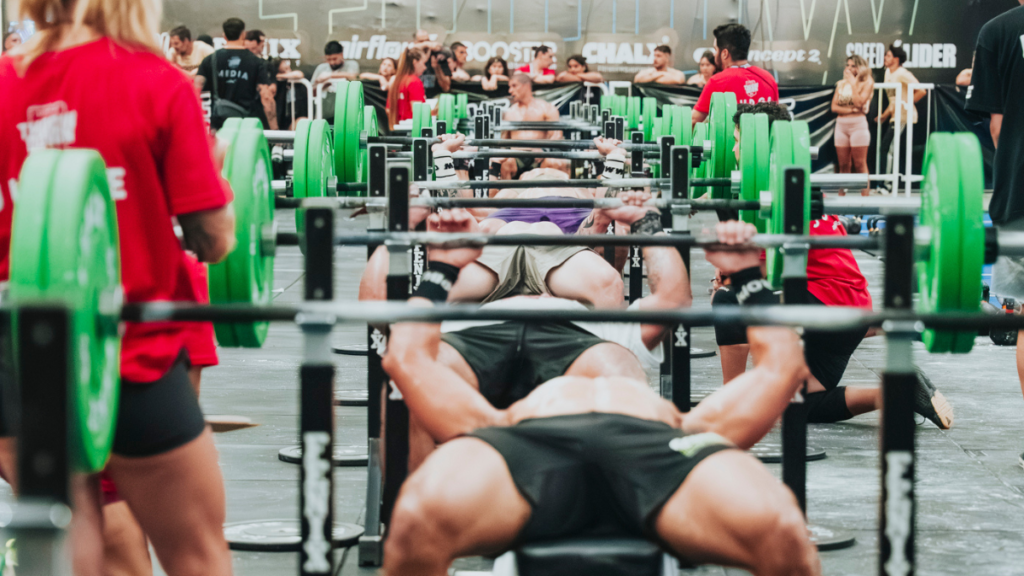
For most men, benching two times each week is a practical starting point. One day can include heavier work in the three to six repetition range, while the other can include moderate repetitions with crisp technique. Train rows and pulldowns as seriously as pressing work so your upper back provides a stable base. Include triceps and shoulder work when it supports your recovery rather than turning every session into an arm workout.
Protein supports strength gains when paired with resistance training, but it cannot replace training. A large meta analysis found that strength improvements rose with total protein intake up to about 1.5 grams per kilogram of bodyweight per day in people doing resistance training. Your total diet, energy intake, sleep, and ability to train consistently still matter more than any single supplement.
A goal ladder worth using
| Bodyweight | Bodyweight bench | 1.25 times bodyweight | 1.5 times bodyweight |
|---|---|---|---|
| 165 pounds | 165 | 205 | 250 |
| 180 pounds | 180 | 225 | 270 |
| 200 pounds | 200 | 250 | 300 |
| 220 pounds | 220 | 275 | 330 |
Your first major target should usually be a controlled bodyweight bench press. Once that is secure, aim for 1.25 times bodyweight. A 1.5 times bodyweight bench press is a demanding long term goal that requires focused training and is not necessary for health, muscle growth, or athletic success. If the next goal is 20 to 40 pounds away, it is close enough to focus your training and far enough to require patience.
The Bottom Line
The best bench press standard is one that helps you make a sensible decision. Compare your 1RM with men of a similar bodyweight, account for training experience and age, then aim to improve one level at a time. A bodyweight bench press is a strong general target for most men. A 1.25 times bodyweight lift shows advanced relative pressing strength, and 1.5 times bodyweight is exceptional.
Barbell vs Dumbbell Shoulder Press – Which Builds More Muscle Mass for Beginners?
Test honestly, train consistently, and keep the same technical standard when you retest. The barbell does not care whether the increase is dramatic. A steady improvement from 175 to 185 pounds is genuine progress, and stacking those small increases is how impressive benches are built.
References
- Candow, D.G., Chilibeck, P.D., Abeysekara, S. and Zello, G.A. (2011) ‘Short term heavy resistance training eliminates age related deficits in muscle mass and strength in healthy older males’, Journal of Strength and Conditioning Research, 25(2), pp. 326 to 333.
- Grgic, J., Lazinica, B., Schoenfeld, B.J. and Pedisic, Z. (2020) ‘Test retest reliability of the one repetition maximum strength assessment: a systematic review’, Sports Medicine Open, 6, 31.
- Modern Men’s Fitness (2026) ‘Bench press standards by age, bodyweight and experience level’ (Accessed: 30 September 2026).
- Sigvaldsen, E., Loturco, I., Larsen, F., Bruusgaard, J., Kalhovde, J.M. and Haugen, T. (2023) ‘Validity and reliability of upper body push and pull tests to determine one repetition maximum’, PLOS ONE, 18(7), e0288649.
- Tagawa, R., Watanabe, D., Ito, K., Otsuyama, T., Nakayama, K., Sanbongi, C. and Miyachi, M. (2022) ‘Synergistic effect of increased total protein intake and strength training on muscle strength: a dose response meta analysis of randomized controlled trials’, Sports Medicine Open, 8, 110.
- Tavares, F., Smeets, A., Van Camp, J., Essid, S., Barba, F.J., Leite, J.C., Mota, M.P. and Vicente, A.A. (2025) ‘The influence of individual resistance training variables on muscle strength: a systematic review and meta analysis’, Sports Medicine, 55, pp. 1645 to 1665.
Key Takeaways
| Point | What it means for you |
|---|---|
| Compare relative strength | Use bodyweight and experience, not a single universal number |
| First major goal | A controlled bodyweight bench press is a strong benchmark |
| Next targets | Aim for 1.25 times bodyweight, then consider 1.5 times bodyweight as a long term challenge |
| Test consistently | Use the same range of motion, setup, and equipment each time |
| Improve the lift | Bench consistently, progress gradually, recover well, and eat enough protein |