

A good back exercise should be easy to learn, simple to adjust, and challenging enough to keep using as you get stronger. Time to find out if the T bar row ticks those boxes.
What Is the T Bar Row?
The T bar row is a horizontal pulling exercise. In a common version, one end of a barbell is fixed in a landmine attachment, while you hold the other end and pull it toward your torso. Some gyms have a dedicated T bar machine with a chest pad and different handles. Other setups use a landmine attachment, a V shaped handle, or a close grip attachment.
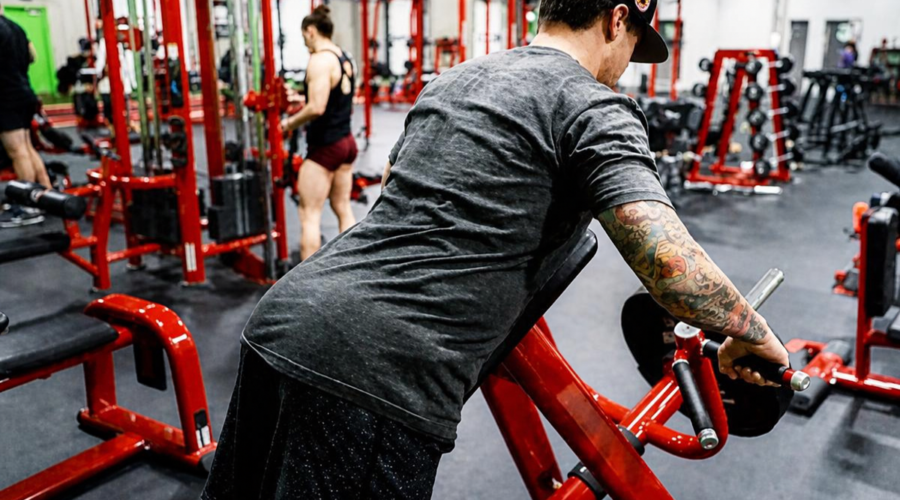
Those variations change the exercise. On a chest supported machine, the pad supports your torso, so you do not need to hold a bent over position throughout the set. On an unsupported landmine row, you hinge at the hips and use your trunk muscles to maintain your position while you row. The movement may look similar, but the demands are not identical.
The main action is to draw your upper arm back toward your body. Your back muscles help move and control the upper arm and shoulder blade, while your elbow flexors help bend your arms. Your trunk also has to contribute, particularly when the machine does not support your chest. Which muscles feel most involved can depend on the handle, grip, elbow path, range of motion, and your body position.
What the Research Can and Cannot Tell Us
There is limited direct research on the T bar row itself, so it is not possible to say that it is scientifically proven to be the best row for beginners. Studies of related rowing exercises give some useful clues, but they do not test every T bar machine or landmine variation.
For example, a small study comparing an inverted row, standing bent over row, and one arm cable row found that the bent over row produced substantial back muscle activity alongside the greatest measured lumbar spine loading of the three exercises. The inverted row placed less measured load on the lower back. This does not mean that a T bar row creates the same loading as a bent over row, or that spinal loading automatically means an exercise is unsafe. It does show why body support and trunk position are worth considering when choosing a row.
Research comparing free weight and machine based training in novice men found improvements in strength and muscle size across the training groups, whether they used machines, free weights, or a combination. A broader review comparing machines with free weights also found no clear difference in muscle growth. This suggests beginners do not need to choose an exercise based on the idea that one type of equipment is automatically better for building muscle
Researchers have also studied which exercises experts consider appropriate for novices. Their consensus included movements such as cable rows and chest supported rows. The T bar row was not specifically established as the ideal option, so it is more useful to judge it by its setup and how well you can perform it than by its name.
Why Beginners May Like the T Bar Row
The T bar row has a straightforward movement pattern: pull the handle toward your torso, then return it under control. A fixed bar path or machine can make the movement feel easier to coordinate than some free weight exercises. The handle also gives you something stable to hold, which can help you focus on controlling the pull instead of balancing a pair of dumbbells.
It is also easy to scale the challenge. You can begin with a light load, learn how the movement feels, and increase the resistance gradually as you become more confident. Resistance training can improve strength and muscle size across a range of equipment and loading approaches. You do not need to start with a heavy weight or train until you cannot complete another repetition to make progress.
Standing Abs vs Floor Abs Exercises: Which Is Better for Beginners?
The T bar row can also fit into a broader back workout. It trains a horizontal pulling pattern, which can complement exercises such as pulldowns, pull ups, or other vertical pulls. You do not need to use every type of row in one session. A beginner can choose a row that feels comfortable, learn to control it, and add variety later if there is a clear reason to do so.
When the Setup Makes a Difference
A chest supported T bar row is often a more approachable starting point if you find it difficult to hold a hip hinge or keep your torso steady. The pad provides support while you pull, which can reduce how much effort you need to spend maintaining your position. This can make it easier to focus on the rowing movement itself.
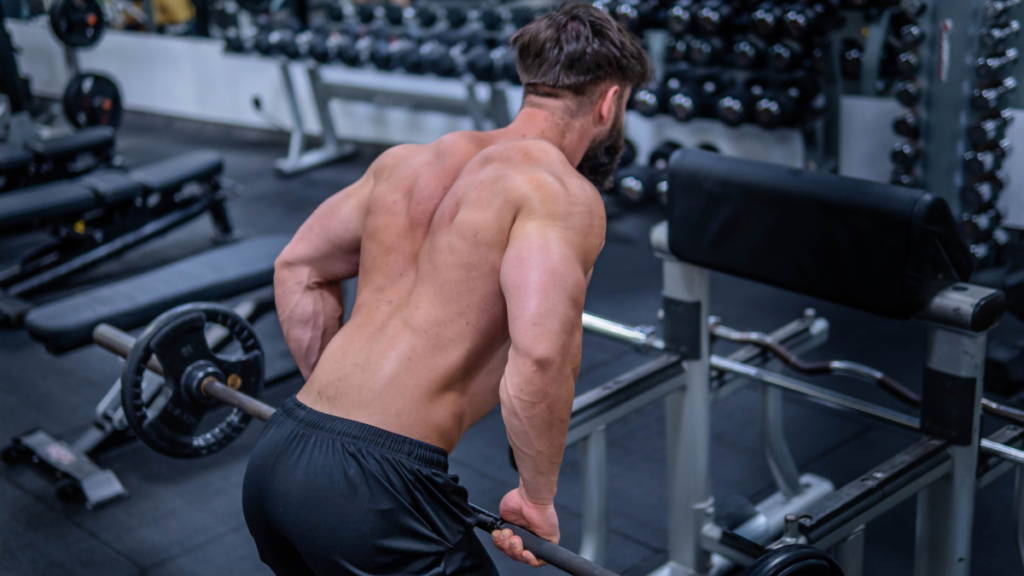
An unsupported landmine T bar row asks more of your trunk because you need to maintain your hinged position while moving the weight. That can be a useful challenge, but it adds a skill demand. If you notice your torso rising and falling with each repetition, or you feel your lower back doing most of the work, reduce the load or try a supported version.
A dedicated machine may have a different resistance curve, handle position, and range of motion from a landmine setup. Do not assume that the number on one machine matches the load on another, or that the technique you use on one setup transfers exactly to every other version. Use a load that allows you to move smoothly and keep your position consistent.
How to Perform a T Bar Row With Control
Start by setting the machine or landmine attachment so you can reach the handle without stretching or rounding your back. If the equipment has a chest pad, adjust it so your torso is supported and you can comfortably reach the handle. If you are using an unsupported setup, position your feet securely and hinge at your hips until you can hold the bar with your arms extended.
Before each repetition, brace your trunk gently and keep your spine in a comfortable, steady position. Pull the handle toward your lower chest or upper abdomen, keeping your elbows close to your body if that path feels natural. Your shoulders should move with your arms rather than shrugging up toward your ears. Pause briefly if you can do so without losing your position, then lower the weight under control.
You do not need to force an exaggerated squeeze or pull the handle as high as possible. Use a range of motion that lets you keep your torso and shoulders controlled. If you have to jerk the weight, lean back sharply, or shorten the movement to finish the repetition, it is probably too heavy for that set.
A Sensible Starting Plan
If the T bar row feels comfortable and you can keep good control, begin with two or three sets of around eight to twelve repetitions. This is a practical starting range, not a rule that everyone must follow. The research on resistance training shows that a variety of loads and training prescriptions can improve muscle size, while heavier loads tend to be more useful when the main goal is maximizing strength.
Choose a weight that lets you finish each set with your technique intact. As the movement becomes familiar, you can add a small amount of weight or perform an extra repetition while keeping the same control. Gradually increasing the training challenge is one way to continue progressing over time. There is no need to test a maximum lift when you are learning the movement.
If you are unsure about the setup, ask a qualified coach or gym staff member to show you how the equipment works. A lighter practice set can help you check whether the handle path and body position feel right before you use a more challenging load.
When Another Row May Be a Better Starting Point
If you want more support while learning the movement, try a chest supported row or seated cable row. A resistance band row can also be a useful option if it allows you to practice pulling with a load you can control. These alternatives can train a similar horizontal pulling pattern, and choosing one does not mean you will miss out on muscle or strength gains.
If your lower back feels uncomfortable during an unsupported T bar row, stop and reassess the setup rather than trying to push through the discomfort. You could reduce the weight, adjust your hinge, or use a supported row instead. A research finding about exercise loading cannot diagnose an individual’s pain or tell you which movement is right for a specific injury. If pain persists or you have a relevant medical condition, seek advice from a qualified health professional.
So, Is the T Bar Row the Perfect Back Exercise for Beginners?
The T bar row can be a strong choice for beginners, especially when the machine supports your chest and lets you adjust the load easily. Its value comes from being a manageable way to practice a horizontal pulling movement and train your back, not from having a special status that makes it essential.
The best starting row is the one you can set up correctly, perform with control, and progress over time. For some beginners, that will be a chest supported T bar row. For others, a seated cable row or another supported variation will feel easier to learn. The exercise name matters less than your ability to use it consistently and comfortably.
Key Takeaways
| Key takeaway | What it means |
|---|---|
| T bar rows have different setups | Chest supported and unsupported versions place different demands on your body. |
| Beginners have several good options | Cable rows, chest supported rows, and other variations can all train a horizontal pull. |
| Start with a manageable load | Use a weight that lets you control the pull and return without jerking or changing your body position. |
| Progress gradually | Add repetitions or a small amount of weight when you can maintain control. |
| The best row is individual | Choose the version that feels comfortable, suits your equipment, and fits your training goals. |
References
- Aerenhouts, D. and D’Hondt, E. (2020) ‘Using Machines or Free Weights for Resistance Training in Novice Males? A Randomized Parallel Trial’, International Journal of Environmental Research and Public Health, 17(21), 7848.
- Currier, B.S., D’Souza, A.C., Fiatarone Singh, M.A., Lowisz, C.V., Rawson, E.S., Schoenfeld, B.J., Smith-Ryan, A.E., Steen, J.P., Thomas, G.A., Triplett, N.T., Washington, T.A., Werner, T.J. and Phillips, S.M. (2026) ‘American College of Sports Medicine Position Stand. Resistance Training Prescription for Muscle Function, Hypertrophy, and Physical Performance in Healthy Adults: An Overview of Reviews’, Medicine & Science in Sports & Exercise, 58(4), pp. 851–872.
- Fenwick, C.M.J., Brown, S.H.M. and McGill, S.M. (2009) ‘Comparison of different rowing exercises: trunk muscle activation and lumbar spine motion, load, and stiffness’, Journal of Strength and Conditioning Research, 23(2), pp. 350–358.
- Lopez, P., Radaelli, R., Taaffe, D.R., Galvão, D.A., Newton, R.U., nonemacher, E., Teodoro, J.L., Kraemer, W.J., Häkkinen, K. and Pinto, R.S. (2021) ‘ resistance training prescription for muscle strength and hypertrophy in healthy adults: a systematic review and Bayesian network meta-analysis’, British Journal of Sports Medicine, 57(18), pp. 1211–1220.
- Schumann, M., Feuerbacher, J.F., Sünkeler, M., Freitag, N., Rønnestad, B.R., Doma, K. and Lundberg, T.R. (2023) ‘Compatibility of Concurrent Aerobic and Strength Training for Skeletal Muscle Size and Function: An Updated Systematic Review and Meta-Analysis’, Sports Medicine, 53, pp. 101–127.
- Steele, J., Androulakis-Korakakis, P., Perrin, C., Fisher, J.P., Gentil, P., Scott, C., Vangeneugden, J., Loenneke, J.P., Wolf, M., Paltved, C., Grgic, J., Refalo, M.C., Phillips, S.M., Winwood, P., Varović, D., Zourdos, M.C., Krieger, J.W. and Schoenfeld, B.J. (2025) ‘Selecting Resistance Training Exercises for Novices: A Delphi Study with Expert Consensus’, Sports Medicine, 55, pp. 1–16.