

Visible abdominal muscles are often associated with athletic performance and good health, but developing a strong and defined upper core becomes more important after the age of 30 for reasons that go well beyond appearance. Muscle mass naturally begins to decline with age, recovery slows slightly, and many men spend long hours sitting at desks, driving, or working in positions that reduce core strength and posture.
The good news is that the upper abdominal muscles respond well to consistent resistance training, provided the exercises are performed correctly and combined with sensible nutrition and overall body fat management. Contrary to popular belief, there is no exercise that burns fat specifically from the upper abs. However, targeted resistance exercises can increase muscle thickness and strength, making the abdominal muscles more visible once body fat levels decrease.


This guide examines the best upper abs exercises for men over 30, explains why they work, and looks at the science behind effective abdominal training.
Understanding the Upper Abs
Although people often refer to the upper abs and lower abs as separate muscles, they are actually different regions of the rectus abdominis. This long muscle runs from the pubic bone to the ribs and sternum. The visible six pack is created by tendinous intersections dividing this single muscle.
Different exercises can emphasize one region more than another because of changes in leverage and joint angles, but the entire muscle contracts together during most abdominal movements. The rectus abdominis works alongside the internal obliques, external obliques, transverse abdominis, diaphragm, spinal erectors, and hip muscles to stabilize the trunk, transfer force, and protect the spine during movement.

Research consistently shows that stronger core muscles improve athletic performance, reduce injury risk, and enhance balance and functional movement.
Why Core Training Matters More After 30
After the age of 30, men typically experience gradual reductions in muscle mass and strength, especially if resistance training is neglected. This process, known as sarcopenia, accelerates with age but can largely be slowed through regular strength training.
A stronger core also supports better posture, reduces excessive spinal stress during lifting, and improves force transfer during compound exercises such as squats, deadlifts, overhead presses, and pull ups.
Studies also suggest that core endurance is associated with reduced incidence of lower back pain in healthy adults, making abdominal training valuable for both performance and long term health.
What Makes an Upper Ab Exercise Effective?
Not every abdominal exercise produces the same level of muscle activation. Electromyography studies measure electrical activity within muscles during exercise. While higher activation does not always guarantee greater muscle growth, these studies provide useful insight into which exercises challenge the rectus abdominis most effectively.
An effective upper ab exercise usually combines spinal flexion with controlled resistance while minimizing excessive hip flexor dominance. Progressive overload also matters. Just like the chest or biceps, the abs become stronger when gradually exposed to greater challenges over time.
Best Upper Abs Exercises
Cable Crunch
The cable crunch is arguably one of the most effective exercises for developing thicker abdominal muscles because it allows progressive overload.

Unlike bodyweight crunches, resistance can be increased gradually as strength improves.
Begin by kneeling in front of a cable machine with a rope attachment positioned overhead. Hold the rope beside your head and keep your hips relatively fixed throughout the movement. Slowly flex your spine by bringing your rib cage toward your pelvis while maintaining control. Pause briefly before returning under tension.
Avoid pulling with the arms or simply bending at the hips. The movement should come primarily from spinal flexion. Studies comparing abdominal exercises consistently report high rectus abdominis activation during resisted crunch variations.
Stability Ball Crunch
The stability ball crunch increases the range of motion compared with floor crunches because the spine extends slightly over the ball before flexing. This larger movement may produce greater muscle activation while also improving spinal mobility.
Sit on the ball with your feet firmly planted and slowly lower yourself until your lower back rests against the ball. Brace your core before curling upward through the spine until your shoulders rise above the ball. Lower yourself slowly under control. The ball introduces instability that encourages greater involvement of stabilizing muscles without compromising technique.
Reverse Crunch
Although commonly associated with the lower abs, the reverse crunch strongly recruits the entire rectus abdominis while reducing neck strain. Lie on your back with knees bent at ninety degrees. Slowly curl your pelvis upward toward your rib cage rather than swinging your legs. Lower under complete control. The key is lifting the hips rather than simply moving the knees.
Decline Bench Crunch
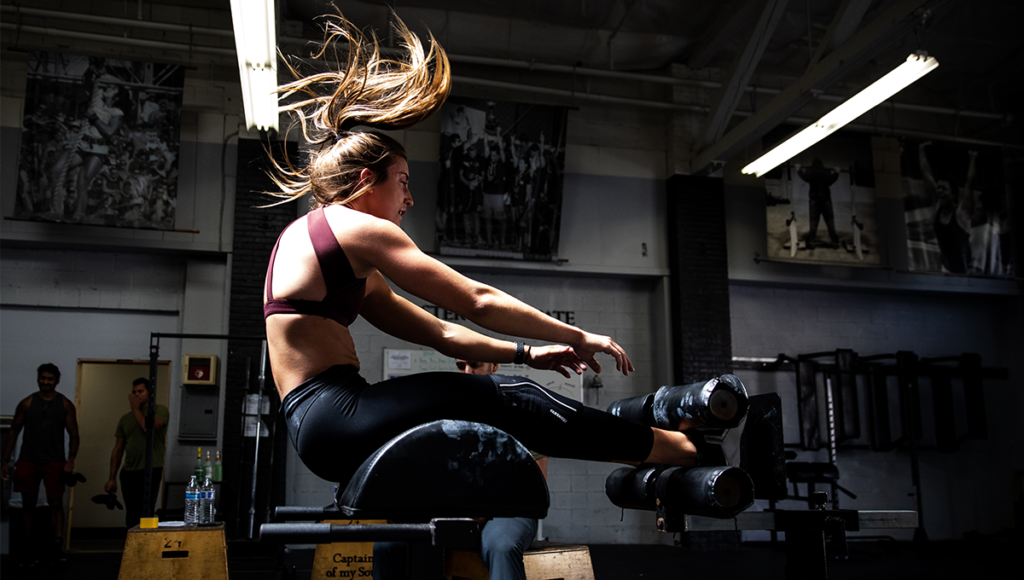
The decline bench increases resistance by forcing the abdominal muscles to work against gravity through a greater range. Anchor your feet securely and cross your arms over your chest. Slowly curl upward while focusing on shortening the distance between your ribs and pelvis.
Avoid excessive momentum or jerking at the top. For advanced trainees, holding a light weight plate across the chest can provide progressive overload.
Ab Wheel Rollout
The ab wheel rollout looks simple but is one of the most challenging core exercises available. Unlike crunches, rollouts emphasize anti extension strength. The rectus abdominis contracts intensely to prevent the lower back from arching.
Kneel with the wheel beneath your shoulders. Roll forward slowly while maintaining a neutral spine. Extend only as far as your core can remain braced before returning under control. Research shows exceptionally high abdominal activation during rollout exercises.
Hanging Knee Raise

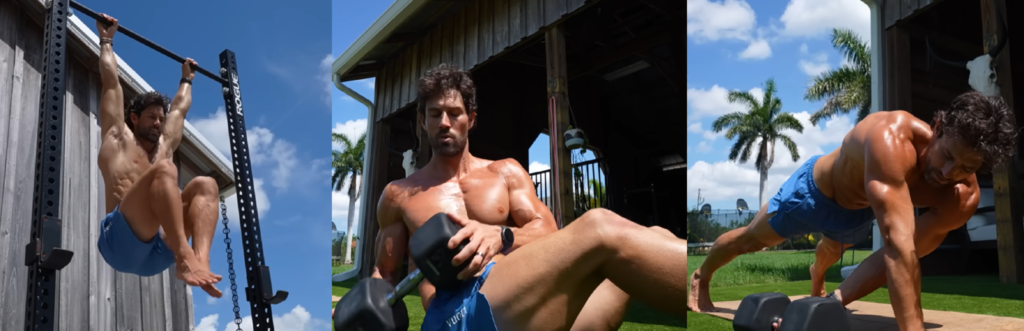
The hanging knee raise combines trunk stabilization with spinal flexion while improving grip strength and shoulder stability.
- Hang from a pull up bar with your legs straight.
- Slowly raise your knees by curling the pelvis upward rather than swinging.
- Control the lowering phase completely.
More advanced athletes can progress to straight leg raises once sufficient strength develops.
Crunch Machine
Machine crunches are sometimes overlooked, but they provide consistent external resistance throughout the movement. Adjust the machine so your lower back remains supported and perform slow controlled repetitions while focusing on spinal flexion. Because resistance is easily adjustable, machine crunches are excellent for progressive overload.
Training Tips for Men Over 30
Prioritize Quality Over Quantity
Hundreds of fast repetitions rarely build stronger abdominal muscles. Research consistently supports moderate repetition ranges combined with controlled tempo and progressive overload for muscle hypertrophy. Aim for approximately eight to fifteen controlled repetitions per set with resistance that becomes challenging near the end of each set.
Train the Core Two to Three Times Per Week
The abdominal muscles recover relatively quickly, but they still require adequate recovery between hard sessions. Two or three focused workouts each week generally provide enough training volume for strength and muscle growth while allowing recovery.
Use Progressive Overload
Many people stop challenging their abs after mastering bodyweight exercises. Just like every other muscle group, the rectus abdominis responds best when resistance gradually increases. Increase cable weight, add external resistance, perform more difficult exercise variations, or increase total training volume over time.
Focus on Proper Breathing
Exhaling during the contraction can improve abdominal engagement. Research indicates that breathing mechanics influence trunk stability and abdominal muscle recruitment. Avoid holding your breath unnecessarily during isolation movements unless performing heavy compound lifts that require bracing.
Common Mistakes
One of the biggest mistakes is relying entirely on high repetition crunches without increasing resistance. The abdominal muscles adapt just like every other muscle and require progressive challenge. Another common problem is using momentum instead of controlled spinal flexion. Swinging through repetitions reduces muscular tension and increases stress on other structures.
Neglecting compound exercises is another error. Heavy squats, deadlifts, overhead presses, and farmer carries all require substantial core activation and contribute to stronger abdominal muscles. Finally, many people ignore recovery. Sleep, nutrition, hydration, and stress management all influence muscle growth and body composition.
Sample Upper Ab Workout
This routine balances strength, hypertrophy, and trunk stability.
- Begin with cable crunches for three sets of ten to twelve repetitions.
- Follow with stability ball crunches for three sets of twelve to fifteen repetitions.
- Continue with hanging knee raises for three sets of ten to fifteen repetitions.
- Finish with ab wheel rollouts for three sets of eight to twelve repetitions.
Rest approximately sixty to ninety seconds between sets while maintaining strict technique throughout the session.
Final Thoughts
For men over 30, building stronger upper abs is about much more than achieving a visible six pack. A well developed core improves posture, supports heavy lifting, enhances athletic performance, and contributes to long term spinal health.
The most effective exercises combine controlled spinal flexion, progressive resistance, and proper technique. Cable crunches, stability ball crunches, decline crunches, reverse crunches, hanging knee raises, ab wheel rollouts, and machine crunches all have strong scientific support for activating the rectus abdominis.
Combined with consistent resistance training, adequate protein intake, sufficient recovery, and sustainable body fat reduction, these exercises can help build stronger, more visible abdominal muscles well beyond the age of 30.
Key Takeaways
| Topic | Main Point |
|---|---|
| Best exercise | Cable crunches offer excellent progressive overload for upper ab development. |
| Training frequency | Train the abs two to three times per week. |
| Repetition range | Eight to fifteen controlled repetitions work well for muscle growth. |
| Progressive overload | Increase resistance or difficulty over time just as with other muscle groups. |
| Body fat | Visible abs depend primarily on reducing overall body fat, not spot reduction. |
| Recovery | Sleep, nutrition, and rest are essential for muscle growth. |
| Functional benefit | Strong abs improve posture, lifting performance, balance, and spinal stability. |
References
- American College of Sports Medicine (2021) ACSM’s Guidelines for Exercise Testing and Prescription. 11th ed. Philadelphia: Wolters Kluwer.
- Behm, D.G., Drinkwater, E.J., Willardson, J.M. and Cowley, P.M. (2010) ‘Canadian Society for Exercise Physiology position statement: The use of instability to train the core in athletic and non athletic conditioning’, Applied Physiology, Nutrition, and Metabolism, 35(1), pp. 109 to 112.
- Escamilla, R.F., Lewis, C., Bell, D., Bramblet, G., Daffron, J., Lambert, S., Pecson, A., Imamura, R., Paulos, L. and Andrews, J.R. (2010) ‘Core muscle activation during Swiss ball and traditional abdominal exercises’, Journal of Orthopaedic and Sports Physical Therapy, 40(5), pp. 265 to 276.
- Hibbs, A.E., Thompson, K.G., French, D., Wrigley, A. and Spears, I. (2008) ‘Optimizing performance by improving core stability and core strength’, Sports Medicine, 38(12), pp. 995 to 1008.
- Marshall, P.W.M. and Murphy, B.A. (2005) ‘Core stability exercises on and off a Swiss ball’, Archives of Physical Medicine and Rehabilitation, 86(2), pp. 242 to 249.
- McGill, S.M. (2010) Ultimate Back Fitness and Performance. 4th ed. Waterloo: Backfitpro Inc.
- Schoenfeld, B.J. (2010) ‘The mechanisms of muscle hypertrophy and their application to resistance training’, Journal of Strength and Conditioning Research, 24(10), pp. 2857 to 2872.
- Schoenfeld, B.J., Grgic, J., Ogborn, D. and Krieger, J.W. (2017) ‘Strength and hypertrophy adaptations between low and high load resistance training’, Journal of Strength and Conditioning Research, 31(12), pp. 3508 to 3523.