

The wall sit looks deceptively simple. You lean against a wall, slide down until your knees reach about 90 degrees, and hold the position. There is no jumping, no heavy weights, and very little movement. Yet after less than a minute, most people start to feel their quadriceps burning.
The wall sit has become a popular benchmark in fitness because it measures muscular endurance, mental resilience, and lower body strength all at once. It is also accessible to almost everyone since it requires no equipment beyond a sturdy wall.


But how long should you actually be able to hold a wall sit? The answer depends on your age, fitness level, training history, and goals. While there is no universal standard, research on muscular endurance and strength provides clear guidance on what different hold times can reveal about your fitness. Here is what science says about wall sit performance, what counts as a good score, and how you can improve it safely.
What Is a Wall Sit?
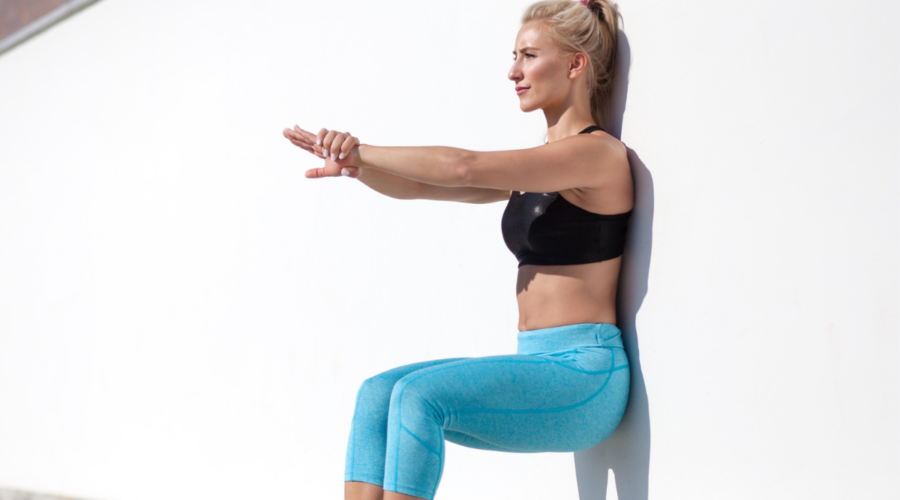
A wall sit is an isometric exercise. Unlike squats or lunges, your muscles generate force without changing length significantly. Your hips, knees, and ankles remain almost stationary while your quadriceps, glutes, calves, and core maintain tension.
The classic position involves placing your back flat against a wall, lowering yourself until your thighs are parallel to the floor, and keeping your knees directly above your ankles. Your feet remain flat, and your arms stay relaxed rather than pushing against your legs. Because the exercise eliminates movement, it allows people to focus entirely on maintaining muscular tension. This makes it an effective way to assess muscular endurance rather than explosive strength.

Why Wall Sit Time Matters
Many people assume longer is always better, but wall sit performance reflects several different physical qualities. The primary factor is muscular endurance. Your quadriceps must continue producing force even as fatigue builds. Local muscle endurance depends on muscle fiber characteristics, blood flow, metabolic efficiency, and training adaptations.
Holding the position also requires good trunk stability. Your core muscles help stabilize your spine while your glutes contribute to maintaining hip position. There is also a psychological component. As metabolites accumulate inside working muscles, discomfort increases rapidly. Continuing despite this sensation requires mental toughness alongside physical fitness.
How Much Should You Be Able to Bench Press?
Research consistently shows that muscular endurance is associated with better functional capacity, healthier aging, and improved athletic performance across many sports.
What Counts as a Good Wall Sit Time?
There is no official international standard, but coaches, sports scientists, and rehabilitation specialists commonly use practical benchmarks.
- Someone who struggles to reach 30 seconds may have below average lower body muscular endurance.
- Holding for around one minute represents a reasonable baseline for healthy adults with average fitness.
- A hold of 90 seconds to two minutes generally indicates good muscular endurance.
- Reaching three minutes places most people well above average.
- Holding for four to five minutes is exceptional and usually reflects specific training.
Elite endurance athletes and individuals who train wall sits regularly may exceed six or even eight minutes, although these performances become increasingly dependent on pain tolerance and specialized adaptation rather than everyday functional fitness.
The quality of the position matters just as much as the duration. A deep wall sit with thighs parallel to the floor creates much higher muscle demands than a shallower position. Comparing times only makes sense if technique is consistent.
Age Changes Expectations
Muscular endurance naturally changes throughout life. Young adults generally achieve the highest wall sit times because they combine muscle mass, cardiovascular efficiency, and rapid recovery. Beginning around the fourth decade of life, muscle mass gradually declines in a process known as sarcopenia. This decline affects strength and endurance, especially if resistance training is absent.
However, regular exercise dramatically slows these changes. Research consistently demonstrates that physically active older adults preserve muscular function far better than sedentary individuals. For this reason, a healthy 65 year old who performs regular strength training may outperform a sedentary person in their twenties. Rather than comparing yourself only to younger athletes, it is more useful to track your own improvement over time.
Men Versus Women
One surprising finding is that women often perform as well as, or even better than, men during isometric endurance tests like the wall sit. Men generally produce greater absolute strength because they possess more muscle mass. However, women often display greater fatigue resistance during sustained contractions involving moderate force.
Researchers believe this difference may result from several factors, including muscle fiber composition, circulation, metabolism, and differences in absolute force production. As a result, a woman who trains consistently may hold a wall sit just as long as a similarly trained man despite producing lower maximal strength.
Why Isometric Training Works
Wall sits belong to a broader category of isometric training. During isometric exercise, muscles contract without visible movement at the joint. For many years, dynamic exercises such as squats received most attention, but recent research has highlighted the unique benefits of isometric training. Regular isometric exercise increases maximal force production, improves muscular endurance, and strengthens connective tissues.
Research also suggests that isometric training performed several times each week can reduce resting blood pressure in adults with hypertension. Scientists believe repeated sustained contractions improve blood vessel function and vascular regulation. This means wall sits offer more than just stronger legs. They may also contribute to better cardiovascular health when included as part of a balanced exercise program.
Which Muscles Does a Wall Sit Train?
Although people usually notice the burning in their thighs, several muscle groups work together throughout the exercise.
- The quadriceps produce most of the force needed to maintain knee position.
- The gluteus maximus stabilizes the hips and helps maintain posture.
- The hamstrings contribute to joint stability even though they are not the primary movers.
- The calves maintain ankle stability while the core muscles prevent excessive spinal movement.
Because multiple muscles contract simultaneously, wall sits closely resemble the sustained postural demands encountered during hiking, skiing, climbing stairs, and many sports.
How Technique Changes Difficulty
Small adjustments can dramatically alter wall sit performance. The standard position places the knees at approximately 90 degrees. Lower positions substantially increase quadriceps activation while shallower positions reduce muscular demand.
Foot placement also matters. If the feet move too close to the wall, knee stress increases. If they move too far forward, maintaining balance becomes more difficult. Keeping the back fully supported by the wall allows consistent loading across the lower body.

Many people unknowingly drift upward as fatigue develops. Even raising the hips a few inches reduces muscle demand considerably. For meaningful comparisons, maintaining consistent depth is essential.
What Limits Your Performance?
When most people fail during a wall sit, it is not because their muscles suddenly lose all strength. Instead, several physiological processes combine.
Blood vessels inside contracting muscles become compressed, reducing oxygen delivery. Metabolic byproducts such as hydrogen ions accumulate, contributing to the familiar burning sensation. The nervous system gradually reduces motor unit output as fatigue develops. Pain perception increases until maintaining the position becomes psychologically difficult.
Athletes with higher muscular endurance develop adaptations that delay these fatigue mechanisms. Their muscles improve oxygen use, buffering capacity, and resistance to metabolic stress.
Can Wall Sits Build Muscle?
Wall sits can stimulate muscle growth, especially in beginners or individuals returning after inactivity. The sustained muscle tension creates mechanical loading, one of the primary drivers of hypertrophy. However, traditional resistance exercises generally produce greater muscle growth because they allow heavier loads across a full range of motion.
Research comparing isometric and dynamic training shows both approaches increase strength, although dynamic exercises usually provide greater improvements in overall muscle size. This means wall sits work best as a supplement rather than a replacement for squats, lunges, and other lower body exercises.
Are Wall Sits Good for Knee Health?
Wall sits are frequently used in physical therapy because they strengthen the quadriceps without repeated joint movement. Research on patellofemoral pain indicates that strengthening the quadriceps can improve symptoms and knee function when exercises are introduced appropriately.
However, wall sits are not suitable for everyone. People experiencing significant knee pain, recent ligament injuries, or severe arthritis should consult a healthcare professional before performing prolonged holds. Pain during the exercise should not be ignored. Mild muscular discomfort is expected, but sharp joint pain signals that the exercise should stop.
How to Improve Your Wall Sit Time
Improving wall sit performance follows the same principles as improving any other fitness quality. Progressive overload remains the most important factor. If your current maximum hold is 60 seconds, performing multiple sets of 30 to 45 seconds several times each week provides an effective training stimulus. Gradually increasing hold duration over time allows muscles to adapt without excessive fatigue.
Combining wall sits with traditional lower body strength exercises produces even greater improvements. Stronger muscles can sustain submaximal force for longer periods. Recovery also matters. Adequate protein intake, sufficient sleep, and consistent resistance training all support muscular adaptations. Most people notice measurable improvements within four to six weeks of regular practice.
The Bottom Line
The wall sit is much more than a simple challenge that leaves your legs shaking. It is an effective assessment of lower body muscular endurance, mental resilience, and overall fitness.
For most healthy adults, holding a proper wall sit for one minute represents a solid starting point. Reaching two minutes demonstrates good muscular endurance, while three minutes or more places you above average. Holds beyond four minutes usually reflect dedicated training and exceptional endurance.
Rather than chasing arbitrary records, focus on improving your own performance with consistent training and proper technique. When combined with traditional resistance exercises, wall sits can strengthen your legs, improve muscular endurance, support knee function, and even contribute to cardiovascular health.
The best wall sit time is not necessarily the longest one ever recorded. It is the one that reflects steady progress, sound technique, and a stronger, healthier body.
Key Takeaways
| Topic | Key Takeaway |
|---|---|
| What a wall sit measures | Primarily lower body muscular endurance with contributions from strength, core stability, and mental resilience. |
| Beginner benchmark | Around 30 to 60 seconds indicates a reasonable starting level for many healthy adults. |
| Good performance | Holding a proper wall sit for 90 seconds to 2 minutes reflects good muscular endurance. |
| Excellent performance | Three minutes or longer is above average, while four to five minutes is exceptional for most people. |
| Main muscles | Quadriceps perform most of the work, supported by the glutes, hamstrings, calves, and core. |
| Best training approach | Combine wall sits with traditional strength training and gradually increase hold duration over time. |
| Technique matters | Consistent knee angle and thigh position are essential for meaningful comparisons. |
| Health benefits | Isometric exercise can improve muscular endurance, strength, and may help lower resting blood pressure when practiced regularly. |
References
- ACSM. (2022) ACSM’s Guidelines for Exercise Testing and Prescription. 11th ed. Philadelphia: Wolters Kluwer.
- Ahtiainen, J.P., Walker, S., Peltonen, H., Holviala, J., Sillanpää, E., Karavirta, L., Sallinen, J., Mikkola, J., Valkeinen, H. and Häkkinen, K. (2016) ‘Heterogeneity in resistance training induced muscle strength and mass responses in men and women of different ages’, Age, 38(1), pp. 1 to 10.
- Buckner, S.L., Dankel, S.J., Mattocks, K.T., Jessee, M.B., Mouser, J.G., Bell, Z.W., Abe, T. and Loenneke, J.P. (2017) ‘The problem of muscle hypertrophy assessment: A review of current methodologies and future directions’, Sports Medicine, 47(12), pp. 2433 to 2444.
- Edwards, P.K., Ebert, J.R., Joss, B., Ackland, T., Wang, A. and Janes, G.C. (2017) ‘Exercise rehabilitation in the non operative management of patellofemoral pain syndrome: A systematic review and meta analysis’, Sports Medicine, 47(12), pp. 2503 to 2522.
- Oranchuk, D.J., Storey, A.G., Nelson, A.R. and Cronin, J.B. (2019) ‘Isometric training and long term adaptations: Effects of muscle length, intensity, and intent’, Sports Medicine, 49(6), pp. 885 to 897.
- Owen, A., Wiles, J., Swaine, I. and Hurst, H. (2010) ‘Effect of isometric exercise on resting blood pressure: A meta analysis’, Journal of Human Hypertension, 24(12), pp. 796 to 800.
- Pereira, M.I.R. and Gomes, P.S.C. (2003) ‘Muscular strength and endurance tests: Reliability and prediction of one repetition maximum’, Revista Brasileira de Medicina do Esporte, 9(5), pp. 325 to 335.