

Push ups are one of the simplest ways to assess upper body strength, muscular endurance, and control of your body weight. They require no equipment, can be performed almost anywhere, and challenge the chest, shoulders, triceps, core, and muscles around the shoulder blades at the same time.
For adults over 30, being able to perform a solid set of push ups is useful for more than gym performance. Muscular strength and endurance help support daily movement, long term independence, healthy body composition, and participation in sport. Push up capacity is also associated with broader markers of health and fitness, although it should never be treated as a complete health assessment on its own.


There is no single number every person aged 30 or older must hit. Your sex, body weight, training history, technique, injury history, and goals all matter. However, age based benchmarks can give you a practical place to start and help you set a worthwhile target.
What Push Ups Actually Measure
A strict push up is not only a chest exercise. During the movement, the pectoral muscles, triceps, and front of the shoulders produce the pressing force needed to move the body away from the floor. The abdominal muscles, glutes, and legs help keep the torso stable, while the muscles around the shoulder blades support efficient shoulder movement.
Because a push up uses a large percentage of your body weight, performance is affected by both strength and body mass. A very strong person who carries more body mass may find high repetition push ups harder than a lighter person with less absolute pressing strength. This is why push up numbers are useful, but they do not tell the full story.
The movement is best viewed as a test of relative upper body strength and local muscular endurance. In practical terms, it shows how well you can repeatedly control and press your own body weight with good alignment.
Research has also linked better push up performance with lower future cardiovascular disease risk in a group of active middle aged men. This does not mean that doing push ups alone prevents heart disease. It does show that the ability to perform repeated push ups can reflect a broader foundation of fitness, strength, and favorable health behaviors.
Push Up Standards for Adults Aged 30+
The most useful way to approach push up standards is to compare yourself with broad age ranges, then focus on improving your own result. The figures below are practical benchmarks for strict, continuous push ups performed with consistent technique. They should be treated as targets rather than a medical diagnosis or a judgment of fitness.
Men Aged 30 to 39
For men in their thirties, completing 20 strict push ups is a reasonable basic target. Reaching 30 to 40 repetitions shows good upper body muscular endurance for the general population, while 50 or more well performed repetitions is an excellent result.
A man who cannot yet complete 10 strict push ups should not assume he is incapable of getting stronger. It usually means that the current challenge is too demanding relative to his pressing strength, body weight, or movement skill. Modified push ups, elevated push ups, and structured strength training can all help build toward full repetitions.
Women Aged 30 to 39
For women in their thirties, 10 strict push ups is a strong baseline target. Completing 15 to 25 repetitions with controlled technique represents good upper body endurance, while 30 or more is an excellent result.
Women often have lower upper body muscle mass on average than men, which influences performance in body weight pressing exercises. That difference does not reduce the value of push ups. Regular resistance training can produce substantial gains in strength and muscle mass in women of all ages.
Men Aged 40 to 49
For men in their forties, 15 to 20 strict push ups is a useful minimum target. A score between 25 and 35 repetitions suggests good muscular endurance, while 40 or more high quality repetitions is an impressive score.
A gradual decline in muscle mass and strength can begin during adulthood, especially when resistance training is absent. However, this is not an unavoidable slide. Strength training remains effective throughout middle age and beyond, and many people improve their push up performance substantially after 40.
Women Aged 40 to 49
For women in their forties, aiming for 8 to 12 strict push ups is a sensible baseline. Completing 15 to 20 repetitions is a good result, while 25 or more demonstrates excellent upper body endurance.
The goal is not to chase a number at the expense of form. A set of 12 controlled push ups with a stable torso, comfortable shoulders, and full range of motion is more useful than 20 rushed repetitions with poor alignment.
Adults Aged 50 and Over
Push up capacity remains valuable after 50 because upper body strength supports everyday activities such as getting up from the floor, carrying bags, pushing doors, and maintaining confidence in physical tasks. Men aged 50 to 59 can use 10 to 15 strict push ups as a useful baseline, while women can aim initially for 5 to 10.
These are starting points, not ceilings. Older adults can increase strength and muscular endurance with well designed resistance training. The most important consideration is choosing a variation that allows good control and does not create pain in the shoulders, wrists, elbows, or lower back.
How to Test Your Push Up Score Properly
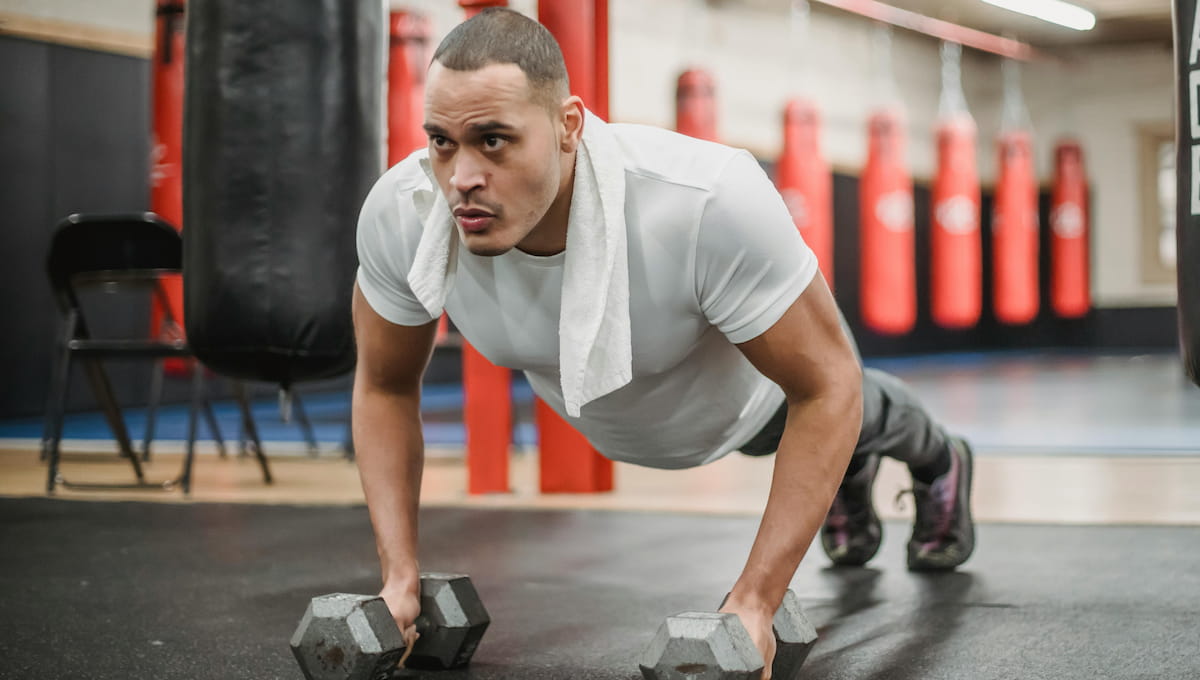
Your score only means something if every repetition is performed consistently. Start in a high plank with your hands placed slightly wider than shoulder width. Keep your head, shoulders, hips, knees, and ankles in one controlled line. Lower your chest toward the floor by bending your elbows, then press back to the starting position.

Your chest does not need to crash into the floor, but you should use a meaningful range of motion. Stop the test when your hips begin to sag, your lower back arches excessively, you shorten the movement, or you need a long rest at the top.
A continuous set is usually the easiest way to compare progress. Resting briefly in the top position may be acceptable for general training, but it makes comparisons less reliable. Use the same rules every time you test yourself.
If floor push ups currently cause discomfort or are too difficult, perform the test with your hands on a stable bench, countertop, or bar in a rack. Record the height of the surface so you can compare future sessions accurately. As your strength improves, use a lower surface until you can perform push ups from the floor.
Why Technique Matters More Than a Big Number
Poor push up technique can shift stress away from the chest and triceps while increasing strain on the shoulders and lower back. The most common error is allowing the hips to drop toward the floor. This reduces trunk stiffness and turns the movement into a poorly controlled back extension.
Another common problem is letting the elbows flare directly out to the sides. A moderate elbow angle is usually more comfortable for most people and helps keep the shoulders in a stronger position. Your hands should be stable, your torso should stay braced, and your neck should remain relaxed.
The shoulder blades should move naturally as you lower and press. Trying to pin them rigidly together throughout the entire repetition can make the movement feel awkward. Instead, think about controlling the body as one unit while allowing the shoulders to move comfortably.
How to Improve Your Push Up Number After 30
The most reliable way to improve is to practice push ups consistently while gradually increasing the training challenge. Two or three sessions per week is enough for most people to make progress, especially if they are currently inconsistent with upper body training.
If you can perform fewer than 10 strict push ups, use an elevated variation. Choose a height that allows you to complete sets of 6 to 12 good repetitions. As those sets become easier, lower the height of your hands or add repetitions.
If you can already do 10 to 20 push ups, perform several submaximal sets instead of taking every set to failure. For example, someone whose current maximum is 15 repetitions could perform four sets of 8 to 10 repetitions. This provides enough quality practice without allowing form to collapse.
If you can do more than 25 push ups, increase the challenge with slower lowering phases, pauses near the bottom, feet elevated push ups, weighted push ups, or more demanding variations such as close grip push ups. Resistance training exercises including dumbbell presses, bench presses, overhead presses, and triceps work can also improve the strength that supports push up performance.
Training close to muscular failure can help stimulate gains in muscular endurance and muscle growth, but every set does not need to reach complete exhaustion. Leaving one or two repetitions in reserve often allows better technique and more productive total training volume.
Do You Need to Be Able to Do Push Ups Every Day?
You can perform low volume push up practice frequently if your joints feel good and the total workload is manageable. However, hard push up sessions performed every day are not necessary for progress. Muscles and connective tissues need time to recover from demanding training, especially if you also lift weights, play sports, do manual work, or perform other pressing exercises.
For most people, two or three focused sessions each week provide an effective balance between practice and recovery. On other days, light mobility work, pulling exercises, walking, or lower body training can help create a more balanced routine.
Pulling exercises are particularly important. Rows, pull ups, lat pulldowns, and rear shoulder work help train the upper back, which supports shoulder function and balances a program that includes plenty of pressing.
When to Be Careful
Push ups should create muscular effort in the chest, shoulders, triceps, and core. They should not create sharp pain, tingling, numbness, or a sensation that the shoulder is unstable. If you experience pain, reduce the range of motion, use an elevated variation, or stop and seek advice from a qualified healthcare professional.
Wrist discomfort is common when people are new to floor push ups. Push up handles, dumbbells used as handles, or performing the exercise with hands elevated can reduce wrist extension and make the movement more comfortable. Shoulder pain deserves more caution because pushing through it can make an existing issue worse.
The Bottom Line
For most adults aged 30 and over, being able to perform 10 to 20 strict push ups is a worthwhile starting benchmark. Reaching 20 to 30 controlled repetitions represents good upper body muscular endurance for many people, while higher scores reflect excellent relative pressing capacity.
Your number matters less than your progress and the quality of your repetitions. Start with a variation you can control, train consistently, include pulling and lower body work in your routine, and gradually make the exercise more demanding. A stronger push up is a useful sign that your upper body strength, trunk control, and confidence in moving your own body are improving.
References
- American College of Sports Medicine, 2021. ACSM’s Guidelines for Exercise Testing and Prescription. 11th ed. Philadelphia: Wolters Kluwer.
- Borde, R., Hortobágyi, T. and Granacher, U., 2015. Dose response relationships of resistance training in healthy old adults: A systematic review and meta analysis. Sports Medicine, 45(12), pp. 1693 to 1720.
- Church, T.S., Earnest, C.P., Skinner, J.S. and Blair, S.N., 2007. Effects of different doses of physical activity on cardiorespiratory fitness among sedentary, overweight or obese postmenopausal women with elevated blood pressure. JAMA, 297(19), pp. 2081 to 2091.
- Dankel, S.J., Mattocks, K.T., Jessee, M.B., Buckner, S.L., Mouser, J.G., Counts, B.R., Laurentino, G.C., Loenneke, J.P., 2017. Frequency: The overlooked resistance training variable for inducing muscle hypertrophy? Sports Medicine, 47(5), pp. 799 to 805.
- Kyu, H.H., Bachman, V.F., Alexander, L.T., Mumford, J.E., Afshin, A., Estep, K., Veerman, J.L., Delwiche, K., Iannarone, M.L., Moyer, M.L. and others, 2016. Physical activity and risk of breast cancer, colon cancer, diabetes, ischemic heart disease, and ischemic stroke events: Systematic review and dose response meta analysis for the Global Burden of Disease Study 2013. BMJ, 354, i3857.
- Lasevicius, T., Schoenfeld, B.J., Silva Batista, C., Barros, T.S., Brendon, H., Aihara, A.Y., Cardoso, F.N. and Tricoli, V., 2018. Muscle failure promotes greater muscle hypertrophy in low load but not in high load resistance training. Journal of Strength and Conditioning Research, 36(2), pp. 346 to 354.
- Liu, C.J. and Latham, N.K., 2009. Progressive resistance strength training for improving physical function in older adults. Cochrane Database of Systematic Reviews, 3, CD002759.
- Yang, J., Christophi, C.A., Farioli, A., Baur, D.M., Moffatt, S., Zollinger, T.W. and Kales, S.N., 2019. Association between push up exercise capacity and future cardiovascular events among active adult men. JAMA Network Open, 2(2), e188341.
Key Takeaways
| Age group | Useful starting target | Good general benchmark | Main focus |
|---|---|---|---|
| Women aged 30 to 39 | 10 strict push ups | 15 to 25 strict push ups | Build controlled pressing strength and trunk stability |
| Men aged 30 to 39 | 20 strict push ups | 30 to 40 strict push ups | Improve muscular endurance without sacrificing form |
| Women aged 40 to 49 | 8 to 12 strict push ups | 15 to 20 strict push ups | Train consistently and use an elevated variation if needed |
| Men aged 40 to 49 | 15 to 20 strict push ups | 25 to 35 strict push ups | Maintain strength, movement quality, and recovery |
| Adults aged 50 and over | 5 to 15 strict push ups, depending on sex and training history | Steady improvement with pain free technique | Choose a suitable variation and progress gradually |