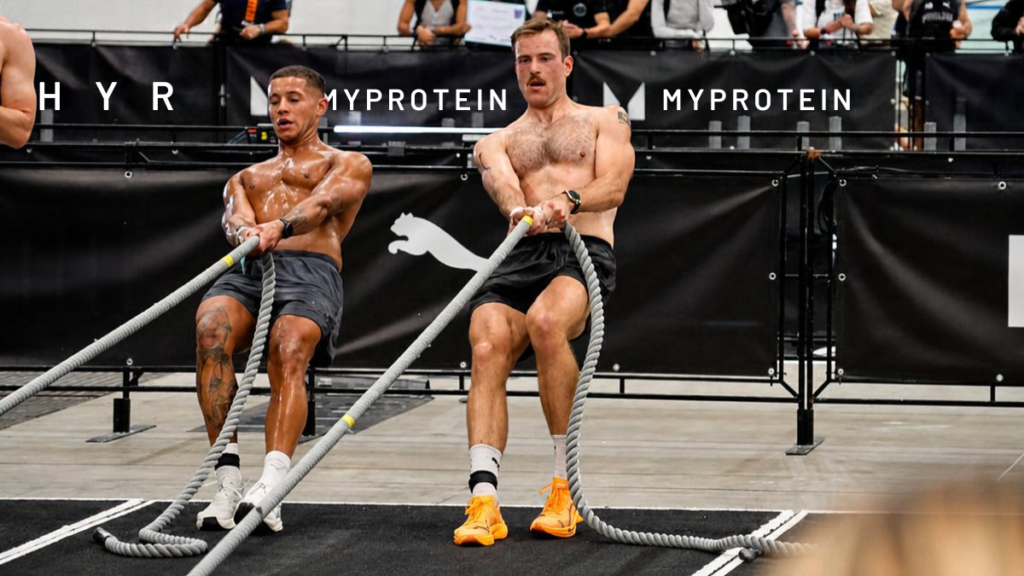


With the HYROX World Championships approaching in Stockholm, Jake Dearden has offered a detailed look at how he and doubles partner James Kelly are preparing for one of the most competitive races of the season.
In the first episode of his World Championships build-up series, Dearden and Kelly discussed the differences between doubles and singles racing, the training adaptations required for elite doubles competition, and the factors they believe are most likely to influence results on race day.


The pair head into Stockholm as one of the strongest and most experiences teams in the Elite 15 doubles field, especially after producing a 49:31 performance in Phoenix earlier this season. They will face a stacked field including includes favorites Alexander Rončević and Tim Wenisch, as well as several other pairings capable of challenging them for the podium.
One of the main themes throughout the episode was the idea that doubles should not simply be viewed as a shared version of a solo HYROX race.

Recovery and Effort
Dearden argued that doubles places greater demands on an athlete’s ability to repeatedly produce high power outputs while recovering quickly between efforts.
“I think preparing for doubles is a little bit different to the solos,” he said. “It’s more of an anaerobic event. You’re redlining then recovering, redlining then recovering over and over again.”
In singles racing, athletes generally try to stay in control and avoid exceeding their sustainable pace too early. In doubles, opportunities to recover while a partner is working allow athletes to race more aggressively.
Dearden’s coach, Jonathan Bullough shared “Doubles, you can basically imagine the complete opposite. Move fast, be aggressive,” Kelly said. “It basically feels like a sprint effort from start to finish.”
That difference influences the type of fitness both athletes believe becomes important.
Training for Doubles
According to Kelly, doubles requires athletes to produce more power, move faster through repetitions and recover more effectively between high-intensity efforts. While aerobic development remains a major component of preparation, he suggested that threshold work, VO2 max training and machine power output become increasingly important when targeting doubles performance.
Despite competing together, Dearden and Kelly are not following identical training programs.

Both athletes continue to work with their own coaches and complete sessions designed around their individual needs. During one training day featured in the video, Kelly completed a more strength-focused session while Dearden focused on aerobic work.
Dearden suggested this is often misunderstood by athletes preparing for doubles competition.
“I’m going to have my weaknesses. He’s going to have his weaknesses and his things that he needs to work on,” Dearden said. “We’re going to have our own programmes that are fundamentally going to get us better ourselves.”
The focus, he explained, is less about completing every session together and more about understanding how each athlete operates during training and competition.
Communication and Teamwork
Because Kelly is based in Australia and Dearden in the UK, opportunities to train alongside each other are limited. Both see the current training block as an opportunity to improve communication, practise transitions and gain a better understanding of each other’s strengths and weaknesses before the World Championships.
Communication was another topic that featured heavily throughout the discussion.
While many doubles teams spend significant time developing race strategies, Kelly believes adaptability is often more important than having a perfect plan.
“The best doubles teams are not the teams that have the best plan before the race,” he said. “They’re the teams that are able to adjust and change strategy within the race.”
He pointed to previous races where pre-planned tactics became irrelevant within the opening stages because of the pace of competition. The ability to react to changing circumstances, he argued, is one of the most important qualities in doubles racing.
Trust between partners was also highlighted repeatedly. Kelly explained that communication does not necessarily mean both athletes are constantly talking. Instead, successful partnerships often develop an understanding of when one athlete should take ownership and when the other should follow their lead.
“I trust him with my life out there,” Kelly said.
Running Segments
The pair also discussed their approach to running segments during races. Rather than simply working together, they use competition within the partnership as a way to maintain pace and intensity.
“If Jake is trying to outrun me and I’m trying to outrun Jake, we’re getting the most out of each other on the running course,” Kelly said.
According to Dearden, that mindset has worked well for the partnership and helps both athletes perform closer to their limits while still contributing to the overall team result.
When asked where doubles races are won and lost, neither athlete identified a single decisive moment.
Instead, they pointed to a collection of factors that become increasingly important at the highest level, including transitions, communication, movement standards, equipment exchanges and maintaining pace through the final stages of the race.

Kelly also highlighted wall balls as a station that can have a significant impact on the final standings, particularly in elite men’s competition.
“The wall balls alone can make or break anyone’s race,” he said.
Looking Towards Stockholm
Stockholm will also be a significant race for the partnership itself.
Dearden said the World Championships are expected to be the final time he and Kelly compete together under the current rules. Both athletes indicated they expect their preparation together in the weeks before the event to be beneficial, not only from a fitness perspective but also from a partnership perspective.
Whether that translates into a world title remains to be seen. What is clear from their discussions is that both athletes view doubles as a distinct discipline within HYROX, requiring different physical qualities, different race management and a greater emphasis on communication than many athletes may realise.
With just a few weeks remaining until Stockholm, those are the areas they appear most focused on refining.
Stay tuned to BOXROX for full coverage of the 2026 HYROX World Championships in Stockholm, with athlete interviews, race analysis, breaking news and results from across the championship weekend.