

Most people train their back to build bigger lats, a wider physique, or more strength on traditional rows and pulldowns. But training for athletic performance requires more than simply moving weight.
In a recent YouTube video, Lauren Pak of Jason and Lauren shares five exercises she uses to train her back with a focus on strength, stability, rotation and explosive power.


“Your back doesn’t just pull weight toward your body.”
Instead, Pak explains that the back also helps stabilize the shoulders, control the trunk, transfer force between the upper and lower body, and produce force during athletic movements such as sprinting, throwing, carrying and changing direction.
Exercise 1: Pull-Ups
Pak starts with pull-ups, which she describes as her preferred vertical pulling exercise for athletes.
While lat pulldowns are still useful, pull-ups require greater control of the entire body. The movement involves the back while also demanding shoulder stability, core activation and relative strength.
For those struggling with bodyweight pull-ups, Pak recommends using assistance from a resistance band or machine.
One of her key technique cues is to think about driving the elbows toward the floor rather than simply trying to pull the body toward the bar. This can help maintain tension through the lats and upper back while keeping the movement controlled.
Exercise 2: Barbell Dead-Start Row
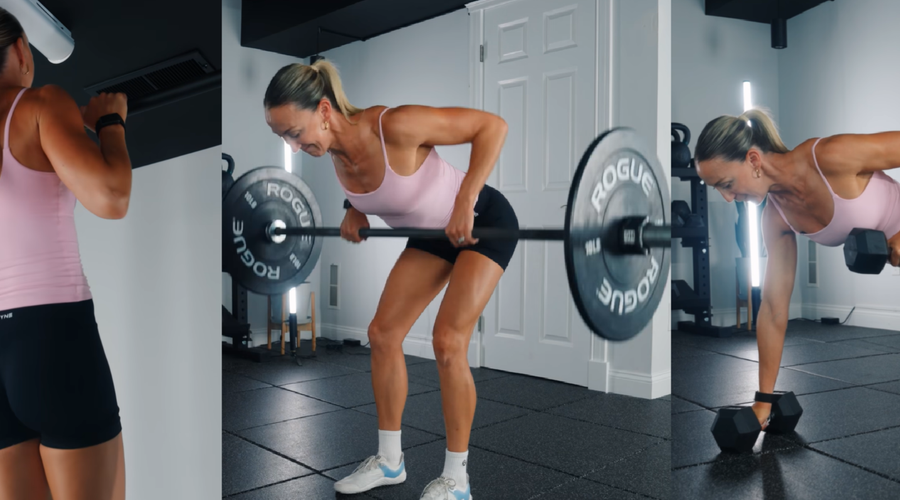
For horizontal pulling, Pak chooses the barbell dead-start row.
Unlike a traditional bent-over row, each repetition begins with the barbell on the floor, reducing the opportunity to rely on momentum. From a hinged position with a neutral torso, the bar is rowed toward the ribs before returning to the floor.
Pak particularly likes the exercise because the dead-start position allows athletes to develop starting strength while also building upper-back strength and explosiveness.
Exercise 3: Renegade Row
The renegade row takes back training into a full-body movement.
Pak explains that the back does not work independently from the core and hips during athletic movements. The renegade row challenges the body to resist rotation while performing a single-arm row.
A wider foot position can make the exercise more manageable, while keeping the hips from rocking helps maintain tension through the core and opposite hip.
Exercise 4: High-to-Low Cable Row
The high-to-low cable row introduces controlled rotation.
Using a staggered stance, Pak allows a slight reach and rotation at the top before pulling the cable down while rotating through the movement. The exercise emphasizes the lats while adding a rotational component that traditional rows may not provide.
For Pak, this creates an important contrast with the renegade row, where the goal is to resist rotation.
Exercise 5: Medicine Ball Slam
The final exercise is the medicine ball slam, which Pak uses to develop explosive power through the back.
Although it is not a traditional back exercise, the movement allows the lats to produce force rapidly while the hips and core contribute to the motion.
Pak emphasizes that athletic training should include more than slow strength movements. Athletes also need to develop the ability to produce force quickly.
“We also want to be able to move weights fast, and we want to be explosive.”
Building a More Athletic Back
Pak’s five-exercise approach does not mean abandoning traditional back exercises. Instead, it adds movements that challenge strength, stability, rotation and power.
Pull-ups, dead-start rows, renegade rows, high-to-low cable rows and medicine ball slams each bring a different quality to back training.
For anyone looking to train more like an athlete, Pak recommends adding one or two of these movements while focusing on moving well, getting stronger and developing explosiveness.
About the Author
Jeremiah Oliva

Jeremiah Oliva is a writer passionate about fitness, sports, and active living. He has experience in songwriting and managing content and social media for online radio and magazine platforms.
He covers HYROX, CrossFit®, and competitive fitness, with a focus on performance, mindset, and athlete development.
Outside of writing, Jeremiah trains in boxing, cycles, explores the outdoors with his kids, and plays the guitar.