

If you are new to strength training and want bigger arms, chin-ups and biceps curls are both useful exercises. Chin-ups train several muscles at once, including the biceps, while curls let you focus more directly on the muscles that bend your elbow. The best choice depends on what you can do with good form and how you plan to progress.
For most beginners, curls are the easier exercise to adjust and track. Chin-ups can be an effective addition, especially if you can perform them with control or use assistance. A routine that includes both can train your arms directly while building pulling strength in your back and upper body.


What counts as bigger arms?
The visible size of your upper arm comes from more than the biceps. The triceps, on the back of the arm, also contribute substantially to upper-arm size. Chin-ups and biceps curls mainly challenge the elbow flexors, which include the biceps brachii, brachialis, and brachioradialis. Neither exercise trains the triceps as its main target.
This means neither chin-ups nor curls provide a complete arm program on their own. They can help develop the front of the upper arm, but a beginner seeking overall arm growth should also include an exercise that trains the triceps, such as a push-up variation or a cable pressdown.
Arm size also depends on more than exercise choice. Consistent training, gradual increases in the challenge, and enough recovery all matter. A single exercise cannot guarantee bigger arms, and changes in muscle size take time.
How chin-ups train the biceps
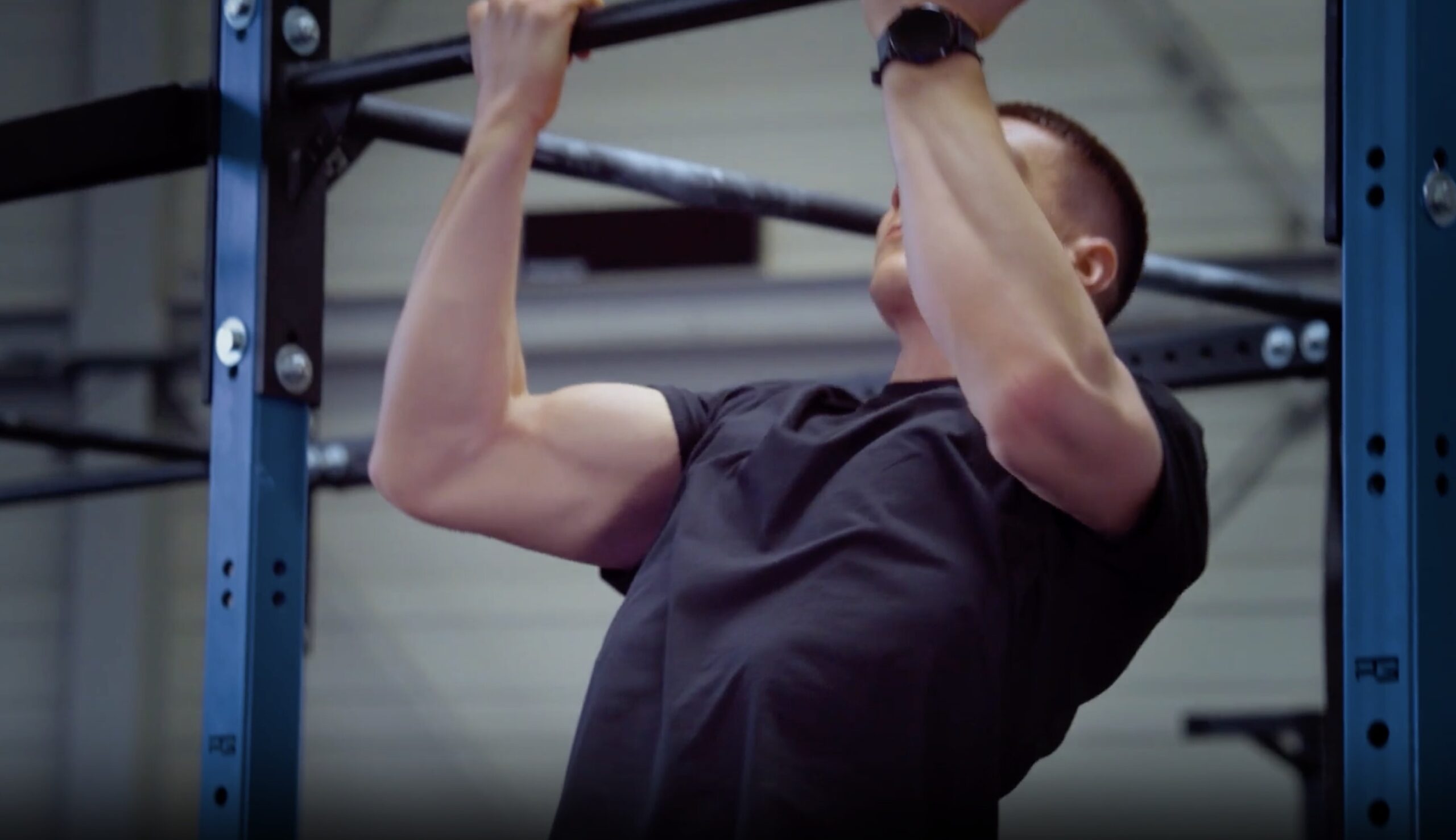
A chin-up is usually performed with an underhand grip, with the palms facing toward you. You begin hanging from a bar and pull your body upward until your chin reaches bar height, then lower yourself under control. The movement involves the shoulders and elbows, so the back and arm muscles work together.
The biceps help bend the elbows as you pull upward. Research comparing chin-ups with overhand pull-ups has found greater biceps activity during chin-ups. Other research on pull-up variations has also measured biceps activity during the upward phase. These findings show that chin-ups challenge the biceps, but muscle activity measured during one workout does not tell us exactly how much muscle growth an exercise will produce over time.
Chin-ups can be demanding for beginners because the resistance is largely based on body weight. If you cannot complete a repetition with controlled movement, you may struggle to get enough challenging practice. An assisted chin-up machine, a resistance band, or a feet-supported version can make the exercise more manageable. Use the same controlled range of motion and assistance each session so you can judge whether you are improving.
How biceps curls train the arms
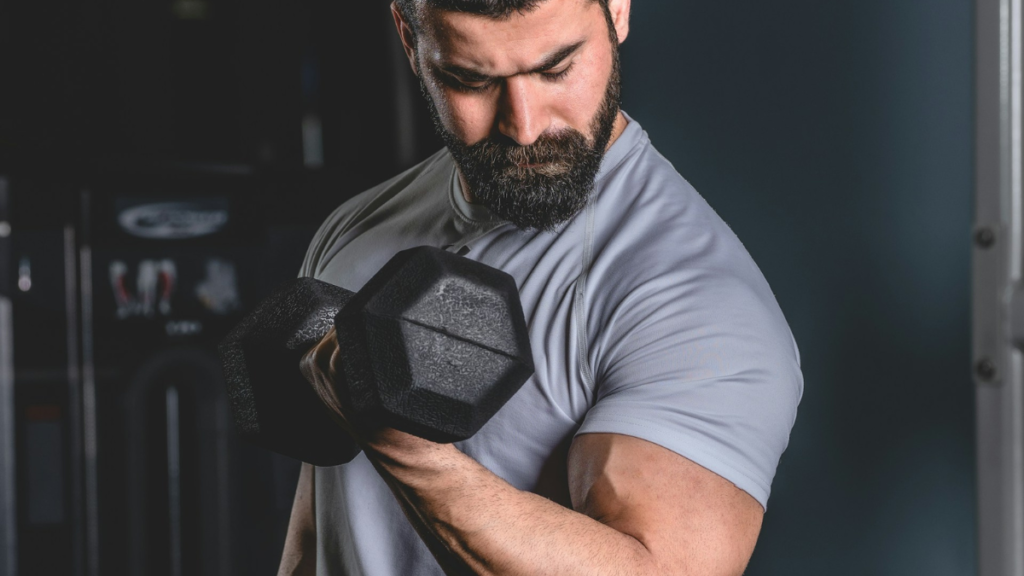
A biceps curl is a single-joint exercise. You hold a dumbbell, barbell, or cable handle and bend your elbow to bring the weight toward your shoulder, then lower it with control. Since the movement is relatively simple to set up and scale, beginners can choose a light enough weight to learn the technique and add resistance gradually.
Curls make it easier to focus on the elbow flexors without also needing to lift your body. You can adjust the load in small increments, perform the exercise seated or standing, and stop a set when your form begins to change. This can make curls easier to learn and measure than chin-ups, especially if you are not yet strong enough to perform an unassisted chin-up.
A study comparing dumbbell rows with biceps curls found greater growth in elbow-flexor muscle thickness in the arm trained with curls over the study period. That result suggests a direct curl can be useful for targeting the elbow flexors. However, it was a small study involving untrained men, and it did not compare curls with chin-ups. It cannot establish that curls always produce more growth than chin-ups for every beginner.
Chin-ups vs biceps curls for muscle growth
There is no strong basis for declaring one exercise the universal winner for arm size. The available research provides useful clues about muscle activity and the effects of direct arm training, but it does not offer a long-term, direct comparison of chin-ups and curls for beginners.
Curls have a practical advantage for beginners who want to train the elbow flexors directly. They are easy to scale, and you can keep the target muscles working even if your back and grip are not yet strong enough to complete chin-ups. Chin-ups have a broader benefit because they train the arms alongside the back and other muscles involved in pulling. If you can perform them with good technique, they can be a valuable part of a strength program.
The most useful exercise is one that lets you train consistently with a suitable level of challenge. If chin-ups are currently too difficult, you do not need to choose between forcing poor repetitions and skipping them altogether. Use assistance or focus on curls while you build the strength and skill needed to progress.
How beginners can make each exercise effective
Use controlled repetitions
For curls, keep your upper arm relatively still and bend at the elbow. Avoid swinging your body to lift a weight that is too heavy. Lower the weight in a controlled way instead of letting it drop. For chin-ups, avoid kicking or swinging to get to the top. If you cannot control the lowering phase, reduce the difficulty with more assistance.
A controlled repetition helps you repeat the same movement and makes it easier to notice when your technique is changing. It does not need to be unusually slow. The priority is to use a range of motion you can control and to keep the movement consistent.
Choose a challenging but manageable load
A weight or assistance level should let you complete several repetitions while keeping good form. If every set feels easy, you can gradually increase the load or reduce the assistance. If you cannot perform the exercise without swinging, shortening the range of motion, or losing control, make it easier.
Research reviews indicate that resistance training can build muscle across a range of loads when the sets provide a sufficient challenge. Training every set to the point where you cannot complete another repetition is not necessary for most people. Beginners can finish a set when they think they could complete only a few more good repetitions, then adjust as they gain experience.
Progress gradually
To keep giving your muscles a reason to adapt, gradually make training more demanding. With curls, this can mean adding a small amount of weight or completing more repetitions with the same weight. With chin-ups, you might perform more repetitions, use slightly less assistance, or progress toward a harder variation.
Do not increase the difficulty at the expense of technique. If adding weight causes you to swing through curls, or using less assistance turns chin-ups into partial repetitions, return to the previous level and build from there. A clear training record can help you see whether your repetitions, load, or assistance have changed over several weeks.
A beginner routine using both exercises
A simple approach is to include both exercises in your weekly training. For example, perform curls for two or three sets, then use assisted chin-ups for two or three sets. Choose a number of repetitions that allows you to maintain good form, and rest long enough between sets to repeat the movement with control.
You can train these movements on two days each week, leaving recovery time between sessions. Research on resistance-training volume supports the idea that weekly working sets can influence muscle growth, though the best amount varies by person and training history. Start with a manageable amount, then add work gradually if you are recovering well and making progress.
Because chin-ups also challenge the back, you do not need to treat them as a pure biceps exercise. Include them as part of your pulling work and use curls for additional direct elbow-flexor training. For more complete arm development, add a triceps exercise to the program as well.
The verdict
For beginners who want to build bigger arms, biceps curls are often the most practical starting point because they are easy to adjust and directly challenge the elbow flexors. Chin-ups are also valuable if you can perform them with control or use assistance. They train the biceps while involving the back and other pulling muscles.
3 Best Isolation Exercises for Wider Biceps
You do not have to pick only one. Use curls to make direct arm training straightforward, and include chin-ups to build pulling strength as your ability improves. Keep both exercises challenging, use consistent technique, and progress gradually. For fuller upper-arm development, train the triceps too.
Key Takeaways Table
| Exercise | Main advantage for beginners | Best use |
|---|---|---|
| Biceps curls | Easy to adjust the weight and focus on the elbow flexors | Direct arm training |
| Chin-ups | Train the biceps along with the back and other pulling muscles | Pulling strength and additional arm work |
| Assisted chin-ups | Make the chin-up easier to perform with control | Building toward unassisted repetitions |
| Both exercises | Provide direct arm work and a broader pulling movement | A balanced beginner routine |
References
- Dickie, J.A., Faulkner, J.A., Barnes, M.J. and Lark, S.D. (2017) ‘Electromyographic analysis of muscle activation during pull-up variations’, Journal of Electromyography and Kinesiology, 32, pp. 30–36.
- Grgic, J., Schoenfeld, B.J., Orazem, J. and Sabol, F. (2022) ‘Effects of resistance training performed to repetition failure or non-failure on muscular strength and hypertrophy: A systematic review and meta-analysis’, Journal of Sport and Health Science, 11(2), pp. 202–211.
- Mannarino, P., Matta, T., Lima, J., Simão, R. and Freitas de Salles, B. (2021) ‘Single-joint exercise results in higher hypertrophy of elbow flexors than multijoint exercise’, Journal of Strength and Conditioning Research, 35(10), pp. 2677–2681.
- Schoenfeld, B.J., Ogborn, D. and Krieger, J.W. (2017) ‘Dose-response relationship between weekly resistance training volume and increases in muscle mass: A systematic review and meta-analysis’, Journal of Sports Sciences, 35(11), pp. 1073–1082.
- Schoenfeld, B.J., Grgic, J., Ogborn, D. and Krieger, J.W. (2017) ‘Strength and hypertrophy adaptations between low- vs. high-load resistance training: A systematic review and meta-analysis’, Journal of Strength and Conditioning Research, 31(12), pp. 3508–3523.
- Youdas, J.W., Amundson, C.L., Cicero, K.S., Hahn, J.J., Harezlak, D.T. and Hollman, J.H. (2010) ‘Surface electromyographic activation patterns and elbow joint motion during a pull-up, chin-up, or Perfect-Pullup™ rotational exercise’, Journal of Strength and Conditioning Research, 24(12), pp. 3404–3414.