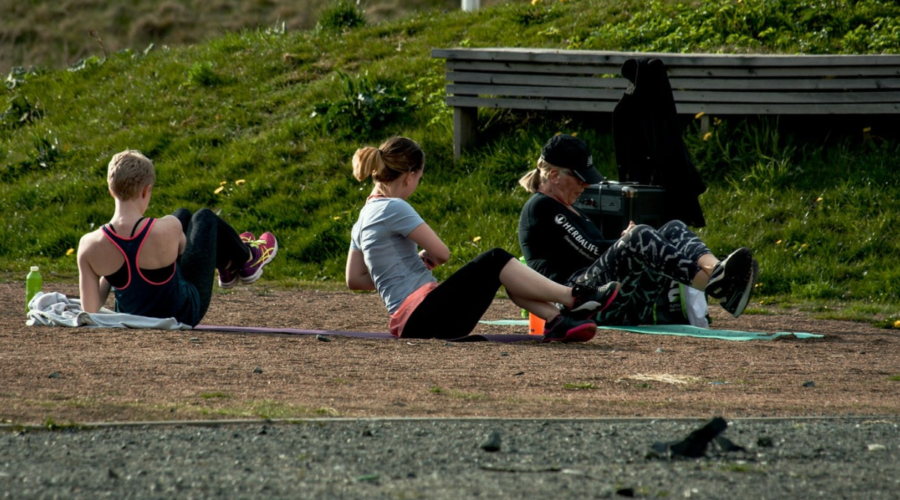


Leg raises and sit-ups both train your midsection, but they challenge it in different ways. Sit-ups involve lifting your torso toward your thighs. Leg raises involve lifting your legs while keeping your torso on the floor, or hanging from a bar. Those movements place different demands on your abdominal muscles and hip flexors.
So which one builds better abs?
What do we mean by “abs”?
The abdominal muscles include the rectus abdominis, the long muscle at the front of the torso; the external and internal obliques, which run along the sides; and the deeper transverse abdominis. These muscles help move and stabilize the trunk.
The rectus abdominis is the muscle most associated with a visible six-pack. It contracts when you curl your trunk, as in a sit-up, and it also helps keep your lower back and pelvis controlled when your legs move. The obliques contribute to trunk rotation and side bending, as well as stability. No single exercise works every abdominal muscle in exactly the same way.

It is also useful to separate “building abs” from “seeing abs.” Building means developing the abdominal muscles through training. Seeing their definition depends partly on how much body fat covers them. Abdominal exercises can strengthen the muscles, but they do not guarantee a visible six-pack.
How sit-ups train your abs
A sit-up is a trunk flexion exercise. You lie on your back, then raise your torso toward your thighs. Your abdominal muscles help curl the trunk, while your hip flexors help bring your torso and thighs closer together. The amount of work each muscle does depends on the sit-up style, your range of motion, and whether your feet are held down.
A controlled sit-up lets you practice moving the torso through a clear range of motion. You can make the exercise easier by bending your knees, reducing the range, or starting with a curl-up that lifts only your head and shoulders. You can make it harder by extending the range or adding resistance once your technique is steady.
The name “sit-up” covers a lot of variations, and research does not always compare the same version. In a small study of healthy young adults, researchers compared sit-ups and leg raises and found that the abdominal muscle response varied by movement phase. The lowering phase of the sit-up produced higher abdominal activation in the protocol they tested. That finding suggests the controlled return to the floor matters, but it does not prove sit-ups build more muscle over time.
How leg raises train your abs
A leg raise involves lifting your legs while keeping your trunk relatively still. In a lying leg raise, you start on your back and lift your legs from the floor. In a hanging leg raise, you hang from a bar and lift your knees or straight legs toward your torso. These are different exercises, and hanging versions add demands on grip, shoulders, and trunk control.
The hip flexors are heavily involved because they lift the thighs. The abdominal muscles work to stabilize the trunk and help control the pelvis, especially as the legs lower. If the lower back arches away from the floor during a lying leg raise, you may be losing the pelvic control the exercise is meant to challenge. A bent-knee version shortens the lever and is usually easier to control than lifting straight legs.
Research comparing abdominal exercises has found that leg lifts can produce substantial activity in the hip flexors, while abdominal activation varies with the version performed. This matters because feeling a strong effort in the front of your hips does not necessarily mean your abs are getting a better training stimulus. Good control, a range you can manage, and gradual progression are more useful guides than simply choosing the exercise that feels hardest.
Which one activates the abs more?
There is no simple winner that applies to every person and every variation. Studies measuring muscle activity have reported different results depending on the exercise setup, participants, and muscles measured. Some have found higher abdominal activity during particular sit-up variations, while others have found that leg raises can strongly involve the lower portion of the rectus abdominis or the hip flexors.
It is tempting to treat these measurements as a ranking of which exercise builds more muscle. But electromyography, or EMG, measures electrical activity during a task. It can help researchers compare how muscles respond in that moment, but it does not directly measure how much muscle someone gains after weeks of training. An exercise that produces a higher EMG reading in one test is not automatically the better long-term choice.

It is also difficult to isolate an “upper ab” or “lower ab” with a single movement. The rectus abdominis is one continuous muscle, and research comparing its upper and lower portions has generally found that the regions work together rather than behaving like entirely separate muscles. You may feel one area more during a particular exercise, but that sensation does not mean you can fully switch the other area off.
Which builds better abs?
For building abdominal strength and muscle, the better exercise is the one you can perform with control, repeat consistently, and progressively challenge. If you are new to direct core training, a basic curl-up or bent-knee sit-up may be easier to learn and adjust. If you already control those movements well, a leg raise can add a different challenge, particularly when you keep your pelvis steady as your legs lower.
Neither exercise needs to be an all-or-nothing choice. A routine can include a trunk-flexion exercise, such as a curl-up or sit-up, alongside a leg-raise variation. This gives you practice with both moving your torso and controlling your pelvis while your legs move. You can also train the trunk with other movements, such as planks or loaded carries, which challenge stability in different ways.
For either exercise, make progress in small steps. First build a comfortable range of motion and smooth repetitions. Then add repetitions, slow down the lowering phase, increase the range, or use a harder variation. When you can complete the exercise without swinging, straining, or losing control of your lower back, it may be time to progress. You do not need to take every set to complete failure to make training worthwhile.
How to choose the right variation
Choose a sit-up variation if you want to focus on lifting and lowering your torso and can do so without discomfort. If a full sit-up feels too difficult, start with a smaller curl-up. If it feels easy, add resistance or use a controlled tempo rather than rushing through more repetitions.
Choose a leg-raise variation if you can keep your trunk steady while your legs move. Start with bent knees if straight legs make your back arch or the movement feel uncontrolled. For hanging leg raises, begin with knee raises before progressing to straight legs. Keep the motion deliberate, and avoid using momentum to swing your legs upward.
Pain is a reason to change the exercise, not to force a particular version. If sit-ups or leg raises cause discomfort in your back, hips, or neck, reduce the range or choose a different movement. Anyone with a current injury or ongoing symptoms should seek guidance from a qualified health professional.
What about visible abs?
Sit-ups and leg raises can train your abdominal muscles, but doing more of either one does not guarantee that abdominal fat will decrease. A small randomized trial found that a specific, high-volume abdominal endurance program was associated with a greater reduction in trunk fat than treadmill exercise alone in a group of overweight men. The result is interesting, but the study involved only 16 participants and combined abdominal work with aerobic exercise. It does not show that ordinary sets of sit-ups or leg raises reliably remove fat from the stomach.

For a more defined midsection, muscle development and overall body composition both matter. The exercise comparison is only one part of the picture. A consistent overall training routine and eating habits that support your goals will have more influence on how much abdominal definition you can see than choosing sit-ups over leg raises.
The verdict
Sit-ups are a practical choice for training trunk flexion and are easy to scale from a short curl-up to a more demanding, loaded variation. Leg raises challenge the abdominal muscles to control the trunk while the hip flexors lift the legs. They can be highly demanding, but technique can break down if the legs are too straight or the range is too large.
For most people, the best approach is to choose the version they can control and progress, then include both movement patterns if they fit their routine. Consistent, well-controlled training matters more than chasing the exercise that feels hardest or relying on short-term muscle activation measurements to predict long-term results.
Key takeaways
| Question | Key takeaway |
|---|---|
| Which exercise is better for everyone? | Neither. The best option depends on the version you can control and progress. |
| What do sit-ups emphasize? | Lifting and lowering the torso, with help from the abdominal muscles and hip flexors. |
| What do leg raises emphasize? | Lifting the legs while the abdominal muscles help control the trunk and pelvis. |
| Do leg raises isolate the lower abs? | No. The rectus abdominis works as a continuous muscle, although different movements can change how its regions respond. |
| Do either exercise guarantee visible abs? | No. Training develops the muscles, while visible definition also depends on body composition. |
| Should you choose only one? | Not necessarily. Both can fit into a balanced routine if they suit your goals and feel comfortable. |
References
- Clark, K.M., Holt, L.E. and Sinyard, J. (2003) ‘Electromyographic comparison of the upper and lower rectus abdominis during abdominal exercises’, Journal of Strength and Conditioning Research, 17(3), pp. 475–483.
- Grgic, J., Schoenfeld, B.J., Orazem, J. and Sabol, F. (2022) ‘Effects of resistance training performed to repetition failure or non-failure on muscular strength and hypertrophy: A systematic review and meta-analysis’, Journal of Sport and Health Science, 11(2), pp. 202–211.
- Kim, K. and Lee, T. (2016) ‘Comparison of muscular activities in the abdomen and lower limbs while performing sit-up and leg-raise’, Journal of Physical Therapy Science, 28(2), pp. 491–494.
- Lehman, G.J. and McGill, S.M. (2001) ‘Quantification of the differences in electromyographic activity magnitude between the upper and lower portions of the rectus abdominis muscle during selected trunk exercises’, Physical Therapy, 81(5), pp. 1096–1101.
- Sundstrup, E., Jakobsen, M.D., Andersen, C.H., Jay, K. and Andersen, L.L. (2012) ‘Muscle activation strategies during strength training with heavy loading versus repetitions to failure’, Journal of Strength and Conditioning Research, 26(1), pp. 189–195.
- Brobakken, M.F., Krogsæter, I., Helgerud, J., Wang, E. and Hoff, J. (2023) ‘Abdominal aerobic endurance exercise reveals spot reduction exists: A randomized controlled trial’, Physiological Reports, 11(22), e15853.