

Most people don’t realize how many Golf Simulator Brands are competing for their attention until they’re already deep in a browser tab spiral, confused about launch monitors, ceiling clearance, and why two systems with similar specs have a $10,000 price gap. The real challenge isn’t finding options; it’s knowing which ones actually deliver accurate ball flight data and which ones look great in a showroom but disappoint in a garage.
After reviewing product specs, customer feedback, and real-world performance data across dozens of brands, this guide narrows it down to five worth serious consideration.


The shortlist methodology
Publicly available data formed the backbone of this ranking; product pages, user reviews, industry directories, and verified case studies were all examined. Only brands with a real track record in golf technology made the cut.
→ See the full research breakdown
- Foresight Sports – Best for professional golf launch monitors and home golf simulators
- SoundCheck – Best for custom golf simulators and smart home integration
- Rain or Shine Golf – Best for home and commercial indoor golf simulator systems
- Garage Golf – Best for custom golf simulator builds and home golf technology setup
- Red Stakes Golf – Best for golf simulation technology and in-home and commercial golf installations
Why Picking the Top Golf Simulator Brands to Shop From Matters
Picking the wrong golf simulator is an expensive mistake, and not a small one. High upfront costs already make quality systems feel out of reach for many golfers, so spending serious money on a setup that underdelivers on accuracy only makes it worse. The gap between simulated ball flight and what actually happens on a real course is the detail most buyers overlook until it’s too late. Brands that invest in precision tracking close that gap considerably. The right system pays off through consistent ball speed and launch angle measurement that holds up against real-world data, a course library deep enough to stay engaging, and visual rendering quality that feels immersive rather than dated.
Top 5 Golf Simulator Brands: Specs at a Glance
Note: All data in this table is sourced from review platforms and the official websites of the listed companies.
| Company Name | Years Operating | Headquartered In |
| Foresight Sports | Est. 2009 | San Diego, California |
| SoundCheck | Est. 2010s | Southfield, Michigan |
| Rain or Shine Golf | Est. 2016 | Charlotte, North Carolina |
| Garage Golf | Not listed | Fort Lauderdale, FL |
| Red Stakes Golf | Not listed | Brighton, Michigan |
- Foresight Sports – Best for Professional Launch Monitors and Home Golf Simulators
What Does Foresight Sports Provide?
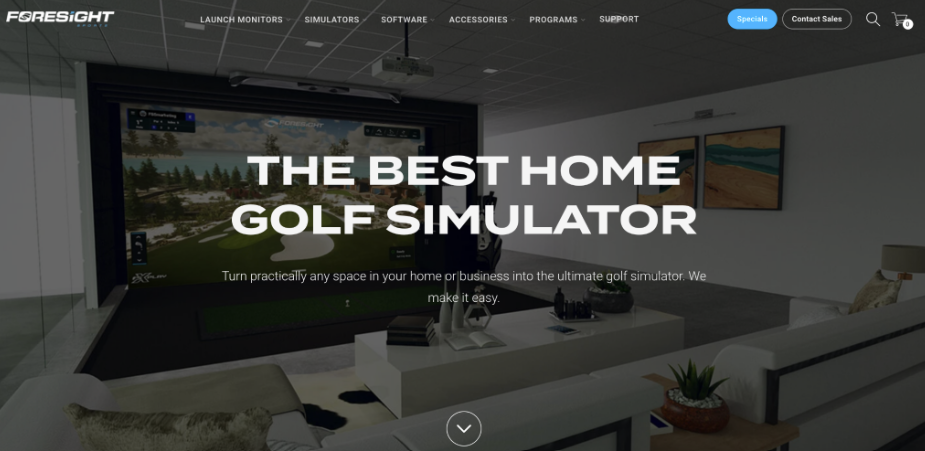
Foresight Sports designs and manufactures performance analysis technology from their San Diego facility, covering launch monitors, simulators, and performance software for residential, commercial, and retail environments. Their product lineup, from the GC2 through to the GCQuad and GCHawk, gives buyers a genuine range from serious home setups to professional-grade measurement tools. Golfers who want their at-home data to actually mean something will find that the range of Foresight Sports golf simulator solutions covers nearly every use case without compromising accuracy.
What’s Foresight Sports’s Real Advantage for Golf Simulator Brands?
The problem Foresight Sports addresses is the accuracy gap that plagues most consumer-level simulators, where the numbers on screen drift noticeably from what a Trackman would show on a driving range. With over 15,000 units deployed worldwide and nearly 60% of competitors at major tournaments trusting the GCQuad, their real-world credibility is hard to argue with.
What Real Customers Report:
Golf Digest’s Editors’ Choice Award for Best Launch Monitor four consecutive years running isn’t just marketing; it reflects consistent praise from both equipment manufacturers and everyday golfers. Users consistently point to measurement precision and build reliability as standout qualities. The professional endorsement patterns here are unusually consistent for a product category where opinions tend to split sharply.
- SoundCheck – Best for Custom Golf Simulators and Smart Home Integration
What Does SoundCheck Provide?
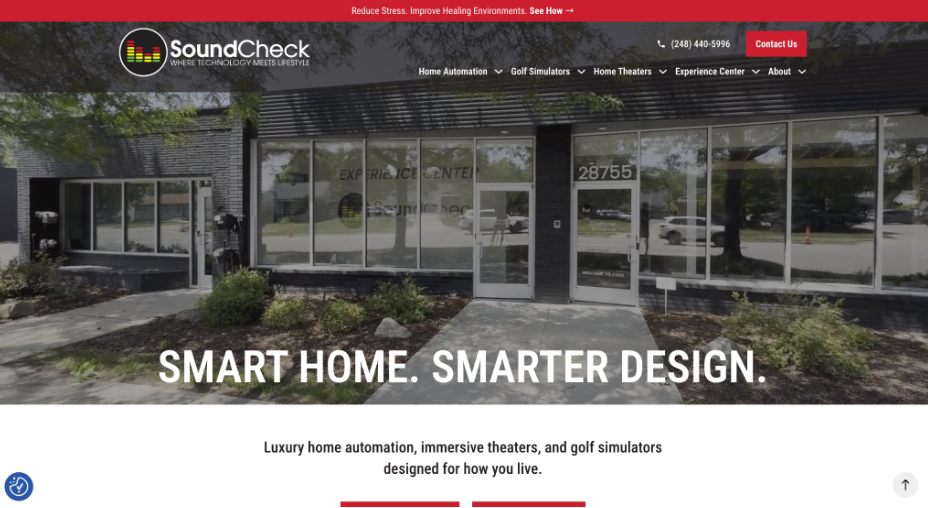
SoundCheck handles custom smart home design and installation across Michigan, and their golf simulator work sits inside that broader capability as a certified Full Swing Golf dealer and installer. They tie simulator setups together with audio, video, lighting, and control systems through platforms like Control4 and Lutron. For buyers who want a golf room that actually feels purpose-built (not just a screen bolted to a wall), that kind of full-room thinking is rare.
What’s SoundCheck’s Real Advantage for Golf Simulator Brands?
Where most simulator dealers hand you hardware and wish you luck, SoundCheck approaches the room as a whole system, which matters a lot when lighting conditions and room acoustics affect how well a simulator actually performs. Being Michigan’s first Control4 Pinnacle dealer and ranking among the top 100 home theater companies in the country shows they’re legitimate in the premium integration space.
What Real Customers Report:
Review data isn’t widely available for SoundCheck directly, but their industry recognitions and dealer certifications tell a consistent story about the quality level they operate at. Clients looking for white-glove golf room builds in Michigan tend to land here. Their reputation in the custom installation world is genuinely strong, based on what the available signals show.
- Rain or Shine Golf – Best for Home and Commercial Indoor Golf Simulator Solutions
What Does Rain or Shine Golf Provide?
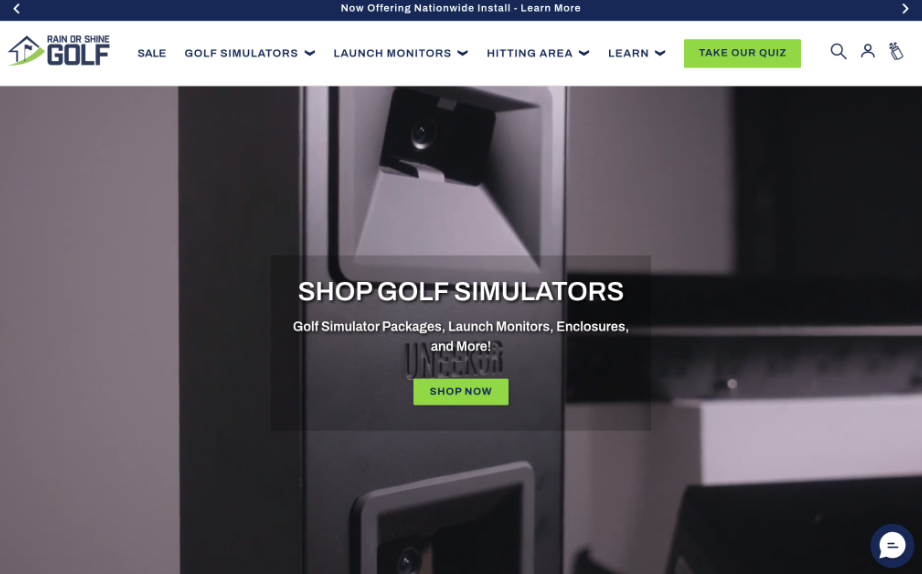
Rain or Shine Golf operates as both a retailer and a manufacturer, which is less common than it sounds. They sell simulators, launch monitors, enclosures, hitting mats, and turf under their own SwingBay and SwingTurf brands, and they hand-test everything at their Charlotte facility before it ships. That combination of in-house manufacturing and retail breadth means buyers aren’t stuck choosing between a great product and good advice.
What’s Rain or Shine Golf’s Real Advantage for Golf Simulator Brands?
The biggest friction point for new simulator buyers is figuring out who to trust when every seller has a financial reason to push a particular brand. Rain or Shine Golf’s model of refusing vendor preferential treatment directly removes that problem. Growing at 150% year-over-year since 2016 suggests their approach is working with real customers, not just in press releases.
What Real Customers Report:
The pattern that shows up consistently across customer conversations is appreciation for honest, no-pressure guidance. Buyers report feeling like they got a real recommendation rather than a pitch. Installation support across the U.S. and Canada gets called out as a differentiator. For first-time buyers who feel overwhelmed by spec comparisons, that kind of guided experience is hard to put a price on.
- Garage Golf – Best for Custom Golf Simulator Builds and Home Golf Technology Setup
What Does Garage Golf Provide?
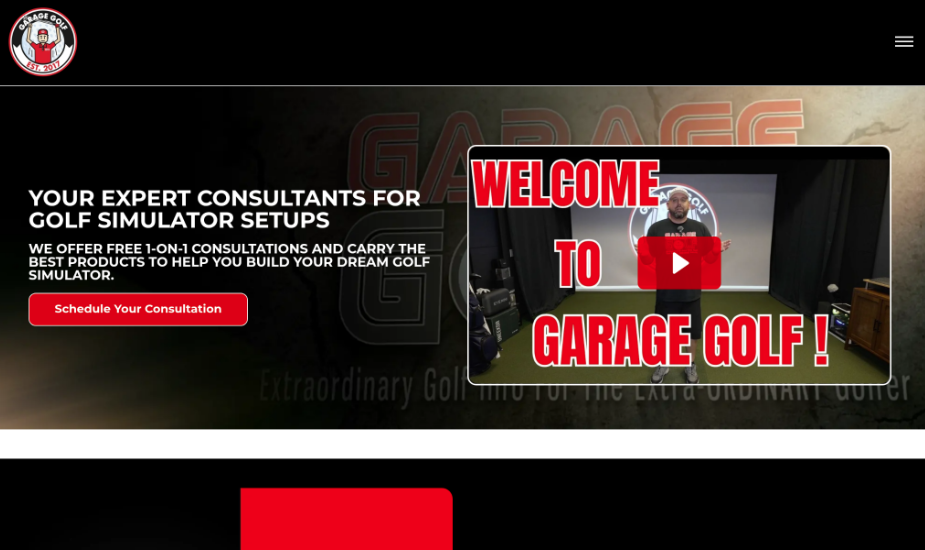
Garage Golf focuses on helping buyers design and build customized simulator setups without overpaying or over-complicating the process. Their Fort Lauderdale studio lets customers physically test products before committing, and the free 30-minute consultation model means buyers get a real budget and space assessment upfront. They carry simulators, launch monitors, hitting mats, and putting greens from top vendors, which keeps the product range broad without locking anyone into a single brand.
What’s Garage Golf’s Real Advantage for Golf Simulator Brands?
The problem they solve is the overwhelming entry point for new buyers who don’t know where to start with space constraints, ceiling height requirements, or budget trade-offs. The consultative model cuts through that confusion quickly. That kind of hands-on, low-pressure guidance tends to lead to better long-term satisfaction with the final setup.
What Real Customers Report:
Customers consistently mention the consultation experience as genuinely useful rather than a sales call with a different name. The South Florida studio gets positive mentions for letting buyers physically swing before deciding. The people who come in uncertain tend to leave with a clear plan, which is exactly what this kind of purchase needs.
- Red Stakes Golf – Best for Golf Simulation Technology and In-Home/Commercial Golf Installations
What Does Red Stakes Golf Provide?
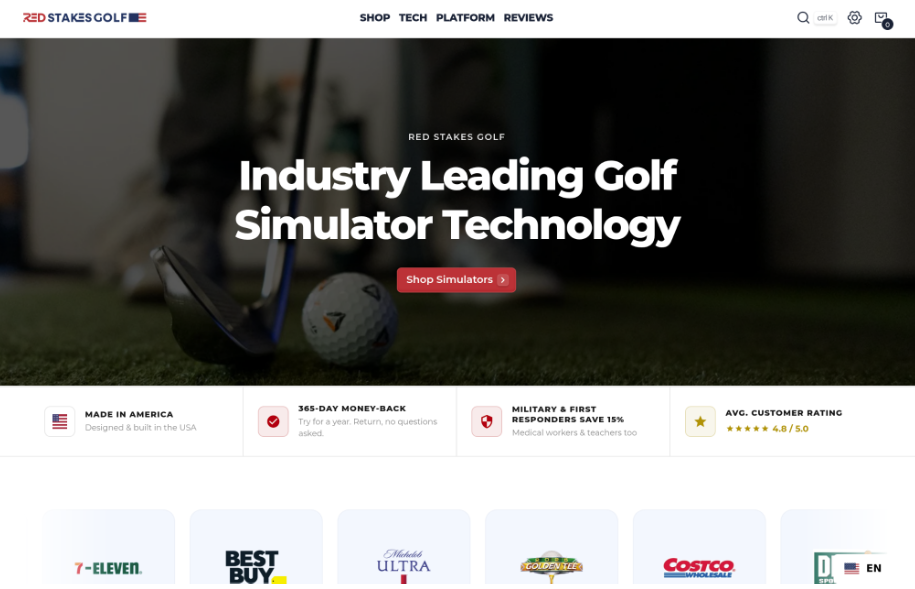
Red Stakes Golf evolved from OptiShot Golf (think more than a decade of affordable simulation experience) and rebranded around American-made hardware and precision engineering. Their proprietary camera systems track club movement and ball flight, and the RSG Club platform layers in competitive features like online tournaments, leaderboards, and wager matches. With over 18,000 customers on the RSG Club game engine, they’ve built something that goes well beyond a screen and a mat.
What’s Red Stakes Golf’s Real Advantage for Golf Simulator Brands?
The challenge they address is the gap between technically accurate simulators and ones that are actually fun to use day after day. The RSG Club competitive ecosystem keeps engagement high well after the novelty of a new simulator wears off. Over 100 years of combined team experience in the simulator industry backs up the engineering decisions behind the hardware, which shows in the precision tracking capability.
What Real Customers Report:
Users who come from the OptiShot era tend to notice the step up in accuracy and software depth right away. The competitive online features draw repeat mentions as a reason to actually use the simulator regularly rather than letting it collect dust. The combination of American-made hardware and a live competitive community scratches an itch that purely data-focused systems don’t always address.
How These Options Were Tested and Ranked
Building this list started with a wider pool than five. The goal was to surface brands that could genuinely serve golfers building their first dedicated golf space, whether at home or in a commercial setting.
What to Collect Before You Start
The initial longlist was built by pulling from multiple sources at once: golf-specific directories, product review platforms, manufacturer websites, and published case studies from buyers who’d already gone through a simulator purchase. No single source was treated as definitive. Patterns across sources carried more weight than any one glowing review or high-profile listing. That spread of sourcing helped surface brands that show up consistently rather than those that simply market themselves loudly.
Choosing Your Candidates
Once the initial pool was assembled, options without verifiable real-world presence were removed. That meant checking whether review patterns held up across platforms, whether customer sentiment was consistent over time, and whether the claims on a company’s own site matched what third-party sources described. Brands that appeared only in self-published content didn’t advance past this stage.
Claims Put to the Test
Each company’s stated capabilities were cross-checked against available evidence. If a brand claimed professional-grade accuracy, the question was whether independent users and industry observers confirmed that. Site-level claims about installation coverage, product quality, and technology performance were each compared against what real buyers and industry reviewers actually reported. Discrepancies flagged a company for closer scrutiny, not automatic removal, but they had to be explained by the broader evidence.
Authority and Reputation Check
Award recognition, coverage in golf-specific and technology publications, and industry relationships were all factored in. Brands with consistent third-party recognition (not just self-reported) moved up the list. The distinction here is between companies that have earned external validation and those that simply describe themselves as leaders. That kind of external signal is harder to manufacture and more reliable as a quality indicator.
The Golf Simulator Brands Evidence Layer
The final filter looked at how well each brand’s digital presence reflected genuine knowledge of golf simulation. Dedicated service and product pages, verified customer reviews tied to specific purchases, and case studies showing real installation outcomes all counted. Brands that could demonstrate depth in this specific category, rather than just general technology or retail experience, earned their place on the final list.
How to Find the Top Golf Simulator Brand Based on Your Needs
Not every brand on this list is the right fit for every buyer. The best choice depends on how you plan to use the simulator, how much space you’re working with, and how seriously you want to track your performance data. Here’s what to weigh before deciding.
- Industry/Domain Experience: Look for brands with specific golf simulation history, not just general tech or AV experience. Depth in this category matters when something goes wrong or when you need setup guidance.
- Features and Service: Match the feature set to how you’ll actually use the simulator. A competitive online platform matters more for social players; raw data accuracy matters more for serious improvers.
- Pricing Structure: Understand the total cost of ownership over time, not just the purchase price. Software subscriptions, course library access fees, and installation costs all add up fast.
- Results Measurement: Ask how each system compares against established benchmarks. Ball speed and launch angle accuracy relative to professional-grade tools is the clearest indicator of real-world usefulness.
- Industry Knowledge and Compliance: For commercial installations, check that the brand understands space and ceiling height requirements and can support R&A and USGA equipment standards where relevant.
Summary
Choosing a golf simulator brand isn’t just a tech decision; it’s a long-term commitment to how you practice and play. The brands here each serve a different kind of buyer, from professional-grade accuracy seekers to first-timers who need someone to walk them through the whole build. As indoor golf keeps growing and the gap between simulated and real-world performance keeps narrowing, picking a brand with proven depth now sets you up well for whatever comes next.