

Legs are tough to train. Many of the lower body barbell movements are hard exercises, and many people choose to skip them. These 3 are all interesting movements to keep your body guessing and your gains progressing.
But the truth is, their benefits are significant. If you can perform and program them correctly, the payoff is huge in terms of muscle and strength gains.
The Role of Progressive Overload and Recovery
Progressive overload is the fundamental principle driving physical adaptation. For beginners starting with weak legs, progression does not necessarily mean adding heavy external weights right away. Increasing training volume, slowing down movement tempo, expanding the range of motion, or reducing rest intervals all serve as effective methods of progressive overload. Science shows that introducing small, incremental increases in workload stimulates muscle protein synthesis without overwhelming recovery capacity, allowing beginner tissues to adapt smoothly over time.
Adequate rest and recovery play an equally vital role in strengthening weak legs. Beginner muscle tissue requires sufficient time between training sessions to repair micro-tears and rebuild structural proteins. Exercising the lower body two to three times per week with at least forty-eight hours of recovery between sessions provides the optimal balance for neuromuscular adaptation. Combined with proper hydration and balanced nutrition, this structured frequency ensures continuous strength development while preventing chronic fatigue.
The Top 3 Science-Backed Exercises for Weak Legs
Add these into your training.
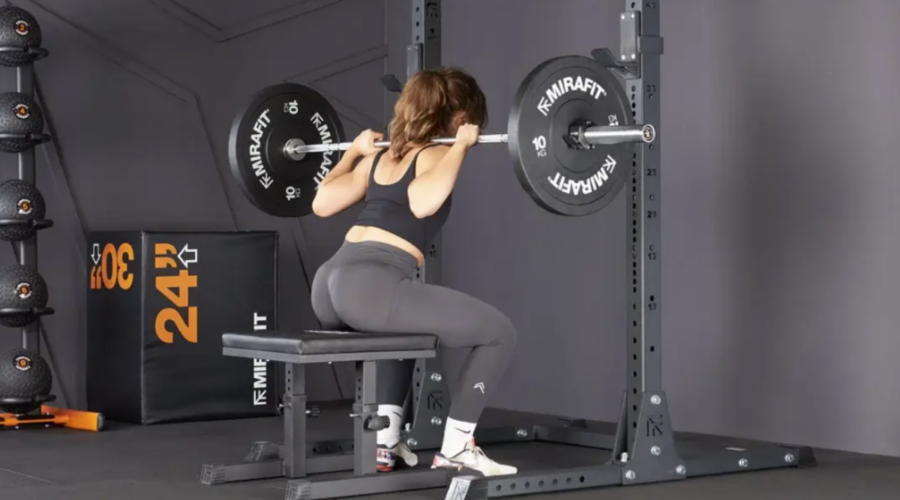
Exercise 1: The Box Squat
Biomechanical analyses reveal that sitting back onto a box shifts the body’s center of mass posterior, which increases engagement of the gluteus maximus and hamstrings while relieving excess pressure on the anterior knee structures.
To perform this movement correctly, stand a few inches in front of a chair with your feet shoulder-width apart. Slowly hinge at your hips and bend your knees, lowering your hips back and down until your thighs make contact with the seat. Pause briefly without completely relaxing your core, then press firmly through your heels to return to a standing position.
Exercise 2: The Seated Leg Extension
This exercise specifically targets the quads, including the rectus femoris and vastus medialis, without requiring any balance or spinal loading. Isolating the quadriceps in a seated position allows you to build targeted muscular endurance and strength, which directly enhances knee joint stability during daily walking and standing activities.
Using controlled movement tempos during seated leg extensions maximizes muscular tension while avoiding rapid momentum.
Performing high-repetition sets with lighter resistance stimulates blood flow to the knee tendons, delivering essential nutrients that promote tissue health. As muscular endurance builds, you can gradually increase resistance to foster continued strength development without stressing lower back or hip joints.
Exercise 3: The Glute Bridge
The glute bridge is a premier ground-based exercise designed to strengthen the posterior chain, which includes the gluteal muscles, hamstrings, and lower back stabilizers. Many beginners with weak legs suffer from dominant quadriceps and underactive glutes due to hours spent sitting throughout the day. Strengthening the glutes through a floor-based bridge restores proper muscular balance across the pelvis, which in turn reduces stress on the knees and improves overall walking mechanics.
To perform the glute bridge, lie on your back on a comfortable mat with your knees bent and your feet flat on the floor, spaced hip-width apart. Drive your heels firmly into the ground and lift your hips toward the ceiling until your body forms a straight line from your shoulders to your knees. Pause at the top to squeeze your glutes, then slowly lower your hips back down.
Adding single-leg variations or holding the top position statically offers clear paths for ongoing progression. A static hold at the top of the bridge builds isometric strength in the hamstrings and glutes, which helps stabilize the pelvis during gait. Beginners can easily adjust the intensity by altering foot placement; placing heels closer to the hips emphasizes the quadriceps, while moving heels slightly further away shifts emphasis onto the hamstrings. This versatility makes the glute bridge an indispensable component of any beginner leg-strengthening program.
Designing a Balanced Beginner Lower Body Routine
Program Structure and Frequency Guidelines
Structuring a successful lower body routine requires matching exercise variables to your current physical capabilities. Beginners should aim to train these three core exercises two to three times per week, leaving at least one rest day between workouts. Each session should begin with a light five-minute warm-up, such as gentle flat walking or seated leg swings, to elevate muscle temperature and prepare the nervous system for work. Keeping workout sessions short and focused prevents excessive muscle soreness while encouraging consistent habit formation.

Managing volume is critical when working with weak legs to avoid overtraining and joint irritation. Starting with two to three sets of eight to twelve repetitions per exercise provides enough stimulus to trigger physical adaptations without causing overwhelming fatigue. As your strength and stamina improve over several weeks, you can gradually increase repetitions or add a third set to each exercise. Tracking your sets, reps, and perceived exertion in a simple journal helps document progress and keeps you motivated as your legs grow stronger.
Exercise Parameters
| Exercise Name | Target Muscle Groups | Primary Benefit for Beginners | Recommended Sets and Reps |
|---|---|---|---|
| Supported Box Squat | Quadriceps, Glutes, Hamstrings | Offloads body weight while teaching proper hip hinge mechanics | 2 to 3 sets of 8 to 10 reps |
| Seated Leg Extension | Quadriceps, Knee Stabilizers | Isolates thigh muscles with zero spine or balance stress | 2 to 3 sets of 10 to 12 reps |
| Glute Bridge | Gluteus Maximus, Hamstrings | Activates dormant posterior chain muscles to protect knees | 2 to 3 sets of 10 to 12 reps |
Scientific Principles for Ongoing Success
Long-term success in rebuilding lower body strength relies on patience, proper form, and respecting your body’s physiological limits. Moving through each repetition with slow, deliberate control yields far better muscle activation than rushing through movement patterns using momentum. Focusing on mind-muscle connection during each contraction helps train your brain to recruit a higher percentage of motor units, accelerating your overall strength development.
1 Rep Max Lift Back Squat – How Does Your Score Compare Against Other Lifters Your Age?
It is equally important to differentiate between beneficial muscle fatigue and harmful joint pain. Mild burning sensations within muscle bellies indicate effective work, whereas sharp or pinching sensations inside joint capsules signal a need to modify movement depth or reduce resistance. Adjusting your training parameters whenever joint discomfort arises ensures that your fitness journey remains safe, sustainable, and enjoyable over months and years to come.
Key Takeaways
| Feature | Key Takeaway Detail |
|---|---|
| Core Philosophy | Target foundational muscle groups using joint-friendly, scalable exercises rather than heavy loads. |
| Primary Movement | The Supported Box Squat teaches safe squat depth while reducing knee shear stress via rearward hip movement. |
| Isolation Focus | The Seated Leg Extension builds isolated quadriceps strength without placing axial load on the spine. |
| Posterior Chain | The Glute Bridge reactivates dormant glutes and hamstrings to balance pelvic alignment and support knee joints. |
| Ideal Frequency | Train two to three non-consecutive days per week with 48 hours of recovery between workouts for optimal progress. |
References
- Andersen, L.L., Magnusson, S.P., Nielsen, M., Haleem, J., Poulsen, K. and Aagaard, P., 2006. Neuromuscular activation in conventional therapeutic exercises and heavy resistance exercises: implications for rehabilitation. Physical Therapy, 86(5), pp.683-697.
- Escamilla, R.F., 2001. Knee biomechanics of the dynamic squat exercise. Medicine and Science in Sports and Exercise, 33(1), pp.127-141.
- Folland, J.P. and Williams, A.G., 2007. The adaptations to strength training: morphological and neurological contributions to increased strength. Sports Medicine, 37(2), pp.145-168.
- Schoenfeld, B.J., 2010. The mechanisms of muscle hypertrophy and their application to resistance training. Journal of Strength and Conditioning Research, 24(10), pp.2857-2872.
- Selkowitz, D.M., Beneck, G.J. and Powers, C.M., 2013. Which exercises target the gluteal muscles while minimizing hip flexor activity? Implications for gluteal strengthening programs. Journal of Orthopaedic and Sports Physical Therapy, 43(2), pp.54-64.