

Strong glutes do much more than improve appearance. The muscles of the buttocks play a central role in athletic performance, posture, lower body strength, and injury prevention. Whether your goal is to build lean muscle, improve your physique, or simply move better, training your glutes should be a priority.
For beginners, the biggest mistake is often choosing complicated exercises that require advanced mobility, balance, or technical skill. Research consistently shows that simple, well performed exercises combined with progressive overload produce excellent results for muscle growth and strength.



The gluteal muscles consist of the gluteus maximus, gluteus medius, and gluteus minimus. The gluteus maximus is the largest muscle in the body and is primarily responsible for hip extension. The gluteus medius and minimus help stabilize the pelvis and control movement during walking, running, and single leg activities.
The three exercises below are beginner friendly, highly effective, and supported by scientific evidence. They target the glutes through different movement patterns, making them an excellent foundation for building lean, athletic, and attractive glutes.
Why Beginners Should Focus on the Basics
Building muscle is not about finding the most creative exercise. It is about consistently applying enough mechanical tension to the muscles while gradually increasing the challenge over time.
Studies on resistance training consistently show that beginners experience rapid improvements in both strength and muscle size when following a structured program built around fundamental movement patterns. Learning proper technique also reduces injury risk and creates a stronger base for more advanced exercises later.
Another important factor is muscle activation. Electromyography studies have demonstrated that certain exercises consistently produce high levels of glute activation, making them excellent choices for people looking to maximize training efficiency.
Instead of trying dozens of different exercises, beginners are better served by mastering a few proven movements.
Exercise 1: Barbell or Bodyweight Hip Thrust
The hip thrust has become one of the most popular glute exercises for good reason. Multiple studies have shown that it produces very high activation of the gluteus maximus while placing relatively little stress on the lower back.

For beginners, bodyweight hip thrusts are an excellent starting point. As strength improves, adding a barbell, dumbbell, or resistance band provides the progressive overload necessary for continued muscle growth.
Why It Works
The hip thrust trains the glutes through full hip extension, which is the primary function of the gluteus maximus. Unlike some squat variations, the exercise maintains significant tension at the top of the movement where the glutes are fully contracted.
Research comparing different lower body exercises has consistently shown that the hip thrust produces among the highest levels of glute muscle activation.
The exercise is also relatively easy to learn because it requires less balance and mobility than many standing exercises.
How to Perform It
- Sit on the floor with your upper back against a sturdy bench.
- Place your feet flat on the floor about shoulder width apart.
- Drive through your heels while squeezing your glutes to lift your hips until your body forms a straight line from your shoulders to your knees.
- Pause briefly at the top while maintaining a strong glute contraction.
- Lower under control until your hips almost touch the floor before repeating.
- Avoid arching your lower back. The movement should come from your hips rather than your spine.
Beginner Training Recommendation
Perform three sets of ten to fifteen repetitions. Rest between sixty and ninety seconds between sets. When bodyweight becomes easy, gradually add resistance while maintaining perfect technique.
Exercise 2: Goblet Squat
Few exercises have been studied as extensively as the squat. While squats train the quadriceps, they also recruit the gluteus maximus significantly, especially when performed with adequate depth.
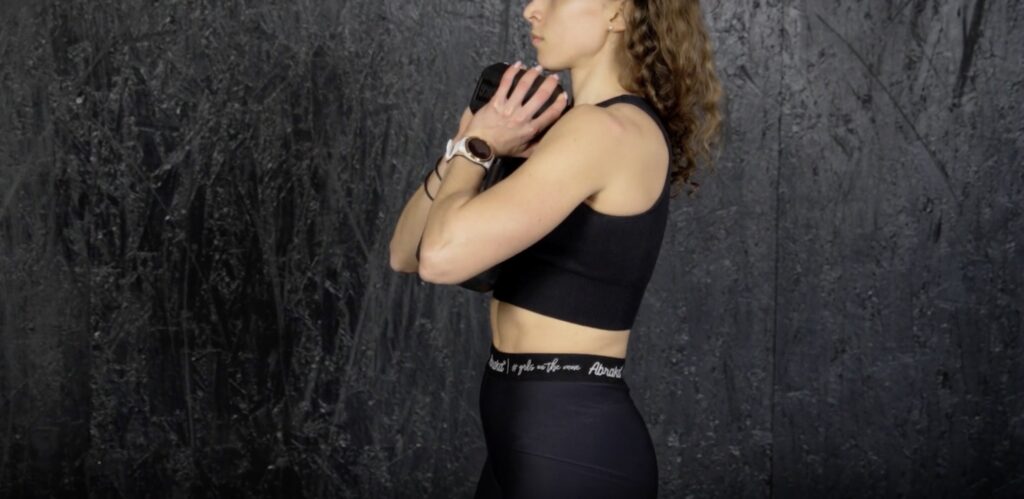
The goblet squat is particularly well suited for beginners because holding a dumbbell close to the chest naturally encourages better posture and technique compared to a traditional barbell squat.
Why It Works
The squat strengthens multiple muscle groups simultaneously, including the glutes, quadriceps, hamstrings, and core. This makes it one of the most efficient exercises available.
Research has shown that increasing squat depth generally increases glute activation. Beginners should aim for a depth that allows good form while remaining pain free.
Squats also improve functional strength by mimicking everyday movements such as sitting down and standing up. Because the goblet squat is stable and relatively easy to learn, it provides an excellent introduction to lower body resistance training.
How to Perform It
- Hold a dumbbell vertically against your chest.
- Stand with your feet approximately shoulder width apart and your toes slightly turned outward.
- Brace your core and lower yourself by bending your hips and knees at the same time.
- Descend until your thighs are at least parallel with the floor or lower if your mobility allows.
- Drive through your whole foot to return to the starting position while squeezing your glutes as you stand.
- Keep your chest lifted throughout the movement and avoid allowing your knees to collapse inward.
Beginner Training Recommendation
Perform three sets of eight to twelve repetitions. Choose a weight that allows you to complete every repetition with proper form while leaving one or two repetitions in reserve. Increase the weight gradually as your strength improves.
Exercise 3: Bulgarian Split Squat
Although it looks intimidating at first, the Bulgarian split squat is one of the most effective exercises for building strong and athletic glutes. Since each leg works independently, the exercise challenges balance, coordination, and hip stability while increasing glute activation.

Beginners can start using only their bodyweight before progressing to dumbbells.
Why It Works
Single leg exercises increase the demand placed on the working leg while also forcing the gluteus medius to stabilize the pelvis. Research comparing unilateral and bilateral lower body exercises has shown that single leg movements are highly effective for improving lower body strength, correcting muscular imbalances, and enhancing athletic performance.
The Bulgarian split squat also allows a large range of motion at the hip, which contributes to greater mechanical tension on the glutes. For beginners, it teaches control and coordination while simultaneously building strength.
How to Perform It
- Stand about two feet in front of a bench.
- Place one foot behind you on the bench.
- Lower your body by bending the front knee while keeping your torso slightly inclined forward.
- Descend until your front thigh is roughly parallel to the floor or slightly below if comfortable.
- Drive through the heel of the front foot to return to the starting position.
- Complete all repetitions on one leg before switching sides.
- Focus on moving slowly and maintaining balance throughout each repetition.
Beginner Training Recommendation
Perform two or three sets of eight to ten repetitions on each leg. Start with bodyweight before progressing to dumbbells. Prioritize smooth movement over heavy weights.
The Importance of Progressive Overload
No exercise produces results forever without increasing the training stimulus. Progressive overload simply means gradually asking your muscles to do more work over time. This can involve increasing the weight, performing additional repetitions, adding another set, or improving exercise quality.
3 Best Six Pack Bodyweight Exercises for Men Aged 30+ that Want Great Abs
Research consistently identifies progressive overload as one of the primary drivers of muscle hypertrophy. Beginners often underestimate how effective small improvements can be. Adding just five pounds to an exercise every few weeks or completing one additional repetition with good form can produce substantial changes over several months.
Consistency matters far more than dramatic increases in training volume.
Putting It All Together
These three exercises provide an excellent foundation for beginners because they complement each other.
- The hip thrust emphasizes powerful hip extension and direct glute loading.
- The goblet squat develops total lower body strength while effectively recruiting the glutes.
- The Bulgarian split squat improves unilateral strength, balance, coordination, and pelvic stability while challenging the glutes through a large range of motion.
Performing these exercises two or three times per week with progressive overload, adequate protein intake, and sufficient recovery creates an evidence based strategy for building lean, athletic, and attractive glutes.
The secret is not finding a magical exercise. It is consistently performing proven movements with excellent technique while gradually becoming stronger over time.
Key Takeaways
| Topic | Key Point |
|---|---|
| Best exercise for direct glute activation | Hip thrusts strongly target the gluteus maximus and are beginner friendly. |
| Best full body lower body movement | Goblet squats build strength in the glutes, quadriceps, and core while reinforcing proper technique. |
| Best unilateral exercise | Bulgarian split squats improve glute strength, stability, balance, and muscular symmetry. |
| Training frequency | Train the glutes two or three times per week with progressive overload. |
| Nutrition | Consume sufficient protein and support training with appropriate calorie intake based on your goal. |
| Long term success | Consistency, good technique, and gradual progression produce the best results. |
References
- American College of Sports Medicine. (2009). Progression models in resistance training for healthy adults. Medicine and Science in Sports and Exercise, 41(3), pp. 687 to 708.
- Contreras, B., Vigotsky, A.D., Schoenfeld, B.J., Beardsley, C. and Cronin, J. (2015). A comparison of gluteus maximus, biceps femoris and vastus lateralis electromyographic activity in the back squat and barbell hip thrust exercises. Journal of Applied Biomechanics, 31(6), pp. 452 to 458.
- Damas, F., Libardi, C.A. and Ugrinowitsch, C. (2018). The development of skeletal muscle hypertrophy through resistance training. Sports Medicine, 48(Suppl. 1), pp. 247 to 265.
- Escamilla, R.F. (2001). Knee biomechanics of the dynamic squat exercise. Medicine and Science in Sports and Exercise, 33(1), pp. 127 to 141.
- Grgic, J., Schoenfeld, B.J., Orazem, J. and Sabol, F. (2022). Effects of resistance training performed to repetition failure or non failure on muscular strength and hypertrophy. Journal of Sport and Health Science, 11(2), pp. 202 to 211.
- Schoenfeld, B.J. (2010). The mechanisms of muscle hypertrophy and their application to resistance training. Journal of Strength and Conditioning Research, 24(10), pp. 2857 to 2872.
- Schoenfeld, B.J., Ogborn, D. and Krieger, J.W. (2017). Dose response relationship between weekly resistance training volume and increases in muscle mass. Journal of Sports Sciences, 35(11), pp. 1073 to 1082.
- Schoenfeld, B.J., Grgic, J., Ogborn, D. and Krieger, J.W. (2019). Strength and hypertrophy adaptations between low load and high load resistance training. Journal of Strength and Conditioning Research, 33(Suppl. 1), pp. S1 to S18.
- Morton, R.W., Murphy, K.T., McKellar, S.R., Schoenfeld, B.J., Henselmans, M., Helms, E., Aragon, A.A., Devries, M.C., Banfield, L., Krieger, J.W. and Phillips, S.M. (2018). A systematic review, meta analysis and meta regression of the effect of protein supplementation on resistance training induced gains in muscle mass and strength in healthy adults. British Journal of Sports Medicine, 52(6), pp. 376 to 384.