

Crunches and sit-ups both train your abdominal muscles, but they are not quite the same exercise. A crunch involves curling your upper body toward your pelvis while your lower back stays on the floor. A sit-up takes you farther, lifting your torso until you are upright. That extra movement changes which muscles help you complete the rep.
If your goal is to build a more muscular six-pack, crunches are usually the better place to start. They make it easier to focus on bending your trunk and working your abs. Sit-ups can still be useful, especially when you want to train the movement itself or build abdominal endurance. The best choice depends on your technique, your training goals, and whether you can make the exercise challenging over time.



Neither exercise can reveal your abs by itself. Visible definition depends on building the abdominal muscles and reducing enough body fat for their shape to show. Crunches and sit-ups can contribute to the first part. They cannot target fat loss from your stomach.
What Is the Difference Between a Crunch and a Sit-Up?
How to do a crunch
Lie on your back with your knees bent and feet on the floor. Place your hands across your chest or lightly beside your head. Brace your stomach, then curl your shoulders and upper back off the floor. Think about bringing your ribs toward your pelvis. Pause briefly, then lower under control.
A crunch uses a relatively short range of motion. Your lower back and hips stay mostly in place while your trunk flexes. That makes it easier to keep the movement focused on your abdominal muscles instead of turning the rep into a hip flexion exercise.
How to do a sit-up
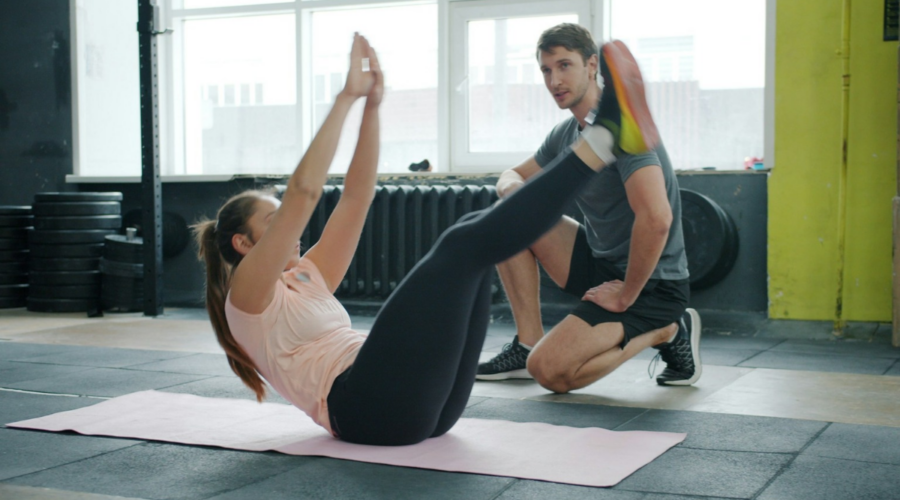
Start in the same position, with your knees bent and feet on the floor. Lift your torso farther than you would in a crunch until you reach a seated position, then lower yourself back down. The movement involves more hip flexion, and your hip flexors help bring your torso upright.
There are many sit-up variations. Keeping your feet anchored, reaching your arms forward, or changing your knee position can all alter how the exercise feels. So can your technique. A controlled sit-up that includes a deliberate curl through the trunk is different from a fast repetition driven mostly by momentum.
Which Exercise Works Your Abs Better?
Crunches keep the focus on trunk flexion
The rectus abdominis is the long muscle at the front of your abdomen that forms the familiar six-pack shape. It helps flex the trunk, as when you curl your shoulders toward your hips. The external and internal obliques also contribute to trunk movement and control.
Because a crunch limits how far your torso travels, it is generally easier to keep the rep centered on trunk flexion. In a small study comparing a traditional military-style sit-up with a modified sit-up emphasizing trunk flexion, the modified version produced more activity in the rectus abdominis and external obliques. The traditional version involved more hip flexion and more activity from the rectus femoris, one of the hip flexor muscles.

That finding does not prove that crunches always build more muscle than sit-ups. The study compared two sit-up styles, and it measured short-term electrical activity rather than long-term growth. Still, it supports a practical point: when your goal is to train your abs, choose a variation that lets you move through your trunk rather than relying mainly on your hips.
Sit-ups involve your hip flexors more
The sit-up’s longer movement can make it feel harder, but feeling harder does not automatically mean your abs are getting a better growth stimulus. As your torso rises, the hip flexors contribute more to the action. If your feet are anchored, or you pull yourself up quickly, you may notice the effort shifting toward the front of your hips.
That does not make sit-ups a bad exercise. Hip flexion is a normal part of the movement, and sit-ups can develop trunk and hip flexion strength and endurance. They are simply less focused on the abdominal muscles than a well-executed crunch may be for some people.
Muscle activity is not the same as muscle growth
Researchers often use surface electromyography, or EMG, to record electrical activity in a muscle during a movement. EMG studies can help show which muscles are involved in a particular exercise. They cannot tell you exactly which exercise will build more muscle over months of training.
A review of the research cautions against treating a higher EMG reading in a single workout as proof of superior long-term hypertrophy. Muscle growth depends on the training stimulus over time, including whether the exercise is challenging enough and whether you can progressively increase the demand. That is why the most useful question is not simply which exercise produces the biggest burn. It is which one you can perform well, train consistently, and make harder as you get stronger.
Can Crunches or Sit-Ups Build a Bigger Six-Pack?
Both can train your abdominal muscles, but bodyweight repetitions can become too easy if you keep adding more and more reps without increasing the challenge. One study found that adding external load to crunches increased abdominal muscle activity in the participants tested. That supports a simple progression: once bodyweight crunches are no longer challenging, hold a weight across your chest or use a cable crunch variation and gradually increase the load.
You can also make the exercise harder by using a slower, controlled lowering phase, increasing your range of motion where comfortable, or adding a pause near the top. Choose a version that allows you to maintain good control. Swinging, bouncing, or pulling on your head can make it harder to judge how much work your abs are doing.

A wider resistance-training literature supports using a full range of motion when it suits the exercise and can be performed comfortably. For crunches, that means allowing your upper back to extend gently before curling upward, rather than keeping your torso rigid throughout. Do not force an exaggerated stretch or continue through pain. The goal is a controlled movement that your body can tolerate and repeat.
Training volume also matters. A single set of occasional crunches is unlikely to provide the same training stimulus as regular, appropriately challenging work. A practical starting point is two or three sets of a challenging abdominal exercise two or three times per week, with enough repetitions to approach fatigue while keeping your technique steady. This is a starting point, not a magic formula. Adjust the work based on your recovery and the rest of your training.
You do not need to do hundreds of repetitions every day. Instead, progress gradually. Add a few repetitions, use a slightly heavier weight, or select a harder variation when your current sets become manageable. Keep a record of what you do so you can tell whether your training is moving forward.
What About the Lower Abs?
The rectus abdominis is one continuous muscle, even though tendinous intersections give it the segmented appearance associated with a six-pack. You cannot completely isolate a separate “lower ab” muscle from the rest of the rectus abdominis. Exercises that involve lifting the legs or curling the pelvis can still train the abdominal region, but they also involve the hip flexors to varying degrees.
A small ultrasound study comparing crunches, sit-ups, and leg raises found that the rectus abdominis changed thickness during all three exercises. The crunch and sit-up produced greater average thickness changes than the leg raise in that test. The study was small and looked at acute muscle changes during the exercises, so it does not establish which exercise produces the most long-term growth.
For a balanced program, it makes sense to include more than one type of abdominal movement over time. You could pair a loaded crunch with a reverse crunch, a dead bug, or another controlled trunk exercise. These movements train the torso in different ways, and variety can help you find options that match your strength and comfort. It is not necessary to chase a special exercise that promises to isolate only the lower abs.
Will Ab Exercises Burn Belly Fat?
Crunches and sit-ups strengthen and condition your abdominal muscles, but they do not selectively burn the fat covering them. In a randomized study, participants completed frequent abdominal exercise for six weeks. Their curl-up endurance improved, but the program did not significantly reduce abdominal fat or change several body-composition measures.
That distinction matters if you want visible abs. Training builds the muscle, while changes in overall body fat influence how much of that muscle you can see. Fat loss is not controlled by choosing an exercise for a specific body part. A broader plan that supports gradual fat loss, including nutrition habits you can maintain and regular physical activity, is more relevant to reducing body fat than adding more crunches alone.
The amount of body fat at which abs become visible varies from person to person. Genetics, fat distribution, abdominal muscle size, and other individual differences all affect how definition appears. There is no single body-fat percentage or number of weekly sit-ups that guarantees the same look for everyone.
How to Choose the Right Exercise for You
Choose crunches if you want a simple way to focus on trunk flexion, or if you are learning to control your abdominal muscles. Start with bodyweight repetitions, then add resistance when you can complete your sets without much effort.
Choose sit-ups if you specifically want to practice the full movement or build sit-up endurance. Use a controlled pace and notice whether you feel the movement in your abdomen or mostly at the front of your hips. If your hip flexors take over or the exercise feels uncomfortable, try a crunch or a modified sit-up that emphasizes curling through your torso.
3 Best Exercises for Building the Upper Body Beginners Often Ignore
You do not have to choose only one forever. Use crunches as your primary direct ab exercise if they suit your goals, and include sit-ups when they serve a clear purpose in your training. If a movement causes pain, stop and choose a variation you can perform comfortably.
Final Verdict: Crunches or Sit-Ups for a Jacked Six-Pack?
For building your abs, crunches are generally the better choice for most people because they are easier to keep focused on trunk flexion and simpler to load progressively. Sit-ups can still be useful for general abdominal and hip-flexion strength or for improving sit-up performance, but the extra range of motion also brings the hip flexors further into the movement.
The bigger factor is how you train. Use controlled repetitions, make the exercise progressively more challenging, and give your muscles time to recover. Pair that work with a broader training and nutrition plan if visible definition is your goal. Crunches can help build a six-pack, but neither crunches nor sit-ups can uncover it on their own.
Key Takeaways
| Topic | Key takeaway |
|---|---|
| Best starting choice for ab training | Crunches are easier to focus on trunk flexion and progressively load. |
| Sit-up role | Sit-ups train a larger movement that involves the hip flexors more. |
| Muscle growth | Consistent, challenging training matters more than chasing a burn or high EMG reading. |
| Exercise progression | Add resistance or choose a harder variation when bodyweight sets become easy. |
| Visible abs | Ab exercises build muscle, while overall body-fat changes affect how visible the muscles are. |
References
- Gomirato, A.P. and Grenier, S.G. (2023) ‘Diagnostic ultrasound shows preferential activation of rectus abdominis segments with exercises targeting upper versus lower segments’, International Journal of Exercise Science, 16(1), pp. 1077–1086.
- Moraes, A.C., Pinto, R.S., Valamatos, M.J., Valamatos, M.J., Pezarat-Correia, P.L., Okano, A.H., Santos, P.M. and Cabri, J.M. (2009) ‘EMG activation of abdominal muscles in the crunch exercise performed with different external loads’, Physical Therapy in Sport, 10(2), pp. 57–62.
- Schoenfeld, B.J. and Grgic, J. (2020) ‘Effects of range of motion on muscle development during resistance training interventions: A systematic review’, SAGE Open Medicine, 8, 2050312120901559.
- Sullivan, W., Gardin, F.A., Bellon, C.R. and Leigh, S. (2015) ‘Effect of traditional vs. modified bent-knee sit-up on abdominal and hip flexor muscle electromyographic activity’, Journal of Strength and Conditioning Research, 29(12), pp. 3472–3479.
- Vigotsky, A.D., Halperin, I., Trajano, G.S. and Vieira, T.M. (2022) ‘Longing for a longitudinal proxy: Acutely measured surface EMG amplitude is not a validated predictor of muscle hypertrophy’, Sports Medicine, 52(2), pp. 193–199.
- Vispute, S.S., Smith, J.D., LeCheminant, J.D. and Hurley, K.S. (2011) ‘The effect of abdominal exercise on abdominal fat’, Journal of Strength and Conditioning Research, 25(9), pp. 2559–2564.