Most lifters start their arm workout with curls. That makes sense because fresh muscles can usually handle heavier loads and better technique. However, there is another strategy that can help maximize muscle growth. Finish your workout with a brutal bicep finisher that completely exhausts the muscle after your main pulling and curling exercises are done.
Finishers are designed to create a high level of muscular fatigue, increase metabolic stress, and recruit muscle fibers that may not have been fully challenged during heavier sets. When paired with progressive overload and enough weekly training volume, they can become an effective tool for building bigger and wider looking biceps.



The key is choosing exercises that keep tension on the muscle, allow you to train safely while fatigued, and target both heads of the biceps along with the brachialis. The brachialis is especially important because increasing its size can push the biceps upward, making your arms appear wider and thicker.
Here are three science backed bicep finishers that deserve a place at the end of your workouts.
Why Finishers Can Help Build Bigger Biceps
Muscle growth is primarily driven by sufficient training volume, mechanical tension, and taking sets close to muscular failure. Research consistently shows that hypertrophy can occur across a wide range of repetition ranges as long as effort is high and enough volume is accumulated.
Finishers work because they allow you to safely increase training volume without requiring maximal loads. They also produce high levels of metabolic stress and prolonged time under tension, two factors associated with muscle hypertrophy.
Research has also demonstrated that training close to failure increases motor unit recruitment. This means additional muscle fibers are forced to contribute as fatigue builds, especially during the final challenging repetitions.
For smaller muscle groups like the biceps, finishers can provide an efficient way to squeeze out a little more quality work without significantly increasing recovery demands.
Understanding What Makes the Biceps Look Wider
The biceps brachii has two heads. The long head runs along the outside of the upper arm, while the short head sits closer to the inside. Together they flex the elbow and assist with forearm supination.
The 5 Fat Loss Mistakes Even Experienced Gym-Goers Make
Many people focus exclusively on traditional curls, but the brachialis deserves equal attention. This muscle lies underneath the biceps brachii and becomes particularly active during elbow flexion regardless of forearm position. As it grows, it pushes the biceps upward, contributing to a fuller and wider appearance. The brachioradialis in the forearm also plays an important role during neutral grip movements such as hammer curls. Stronger forearms not only improve grip but also contribute to overall arm size and performance.
Exercise selection that includes supinated, neutral, and constant tension movements is therefore ideal for complete arm development.
Exercise 1: Bayesian Cable Curl
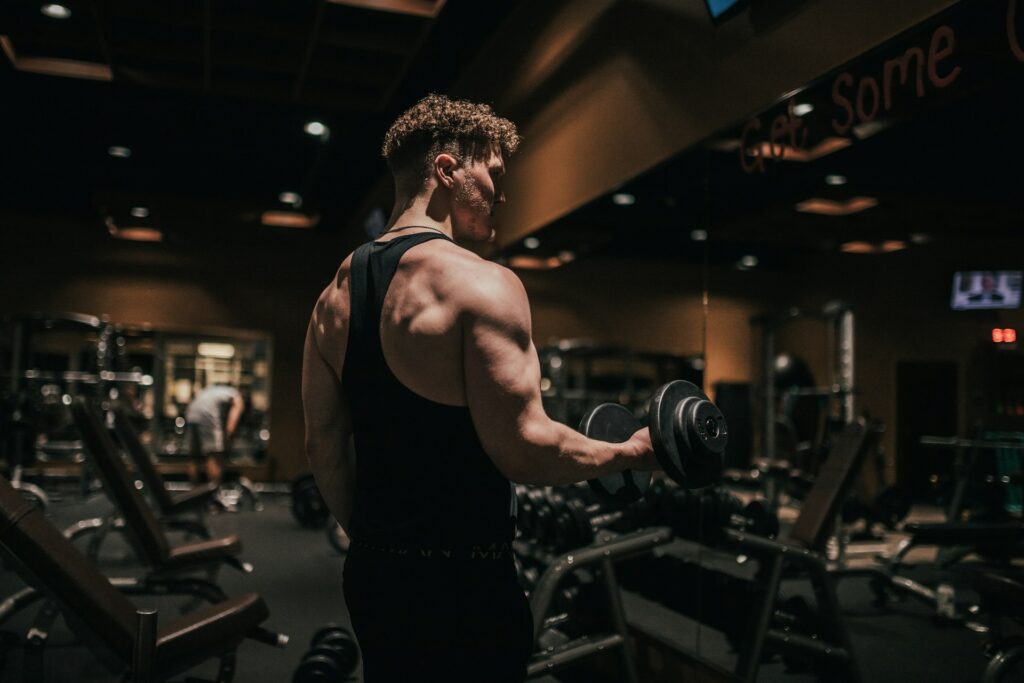
The Bayesian cable curl has become increasingly popular because it places the biceps under tension when the muscle is stretched. The cable is positioned behind the body, creating resistance throughout the movement while emphasizing the long head of the biceps.
How to Perform It
Stand facing away from a low cable pulley with the handle in one hand. Step forward until your arm is slightly behind your torso. Keep your shoulder stable while curling the handle toward your shoulder. Squeeze hard at the top before lowering under control until the elbow is fully extended.
Use a moderate weight that allows excellent control. Aim for 12 to 15 repetitions and take the final set close to complete muscular failure. The constant cable tension prevents the resting points that often occur with dumbbells, keeping the muscle working throughout every repetition.
Why It Works
Research has shown that training muscles at longer lengths may produce greater hypertrophy than training at shorter muscle lengths. The stretched position appears to create a stronger anabolic stimulus by exposing muscle fibers to high mechanical tension while lengthened.
Because the Bayesian curl loads the biceps heavily in this stretched position, it offers a unique stimulus that complements traditional standing curls.
After your heavier compound pulling exercises, this movement becomes an excellent finisher because it creates significant fatigue without requiring heavy loads.
Exercise 2: Cross Body Hammer Curl
Hammer curls are often viewed as a simple variation, but they may be one of the most valuable exercises for building wider looking arms. The neutral grip shifts more work toward the brachialis and brachioradialis while still heavily involving the biceps.

The cross body version slightly changes the line of pull and encourages a powerful contraction throughout the movement.
How to Perform It
Hold a dumbbell in each hand with your palms facing your body. Curl one dumbbell diagonally across your chest toward the opposite shoulder while keeping your elbow close to your side.
Lower slowly before repeating with the opposite arm.
Choose a weight that allows 10 to 15 controlled repetitions per arm. Focus on controlling the lowering phase instead of simply dropping the weight.
Why It Works
Electromyography studies show that different curl variations can shift muscular emphasis between the biceps, brachialis, and brachioradialis depending on grip position.
While no single exercise completely isolates one muscle, hammer curls consistently produce substantial brachialis activation. Increasing brachialis size contributes to greater upper arm thickness because the muscle sits underneath the biceps brachii.
This makes cross body hammer curls an ideal finishing exercise after traditional supinated curls.
Exercise 3: Cable Drag Curl Burnout
The drag curl changes the movement pattern by pulling the elbows backward as the bar travels close to the torso. Performing this exercise with a cable maintains continuous resistance and creates an intense contraction during the final stages of your workout.
How to Perform It
- Attach a straight bar to a low cable pulley. Stand upright and grip the bar with an underhand grip.
- Instead of allowing your elbows to drift forward, deliberately pull them backward while dragging the bar upward along your torso. Continue until the bar reaches your upper abdomen or lower chest.
- Lower the weight slowly while maintaining tension throughout the entire movement.
- Perform 15 to 20 repetitions immediately after your final heavy curl exercise.
Why It Works
Cable exercises provide a more consistent resistance profile compared with free weights because tension remains throughout the range of motion.
Research comparing different resistance profiles suggests that varying loading patterns may stimulate muscle growth through slightly different mechanisms. Including cable exercises helps expose the muscle to continuous loading that complements free weight training.
The drag curl also minimizes shoulder involvement, allowing the elbow flexors to perform more of the work during a fatigued state.
How to Use These Finishers
These exercises should not replace your primary arm training. Heavy chin ups, rows, barbell curls, and preacher curls still form the foundation of an effective program. Instead, add one or two finishers after your main workout.
Complete two or three sets while taking each set within one or two repetitions of muscular failure. This level of effort appears sufficient to maximize hypertrophy while reducing unnecessary fatigue. Keep rest periods between 45 and 75 seconds to maintain metabolic stress without sacrificing exercise quality.
Common Mistakes That Limit Growth
Many lifters treat finishers like conditioning circuits and rush through every repetition. Speed often comes at the expense of tension, which is the primary goal during these movements.
Another mistake is using weights that are too heavy. Momentum shifts work away from the biceps and places unnecessary stress on the shoulders and lower back.

Poor range of motion is another common problem. Fully lengthening the elbow under control allows the muscle to experience greater stretch, while squeezing hard at the top improves the quality of every repetition.
Finally, avoid performing finishers during every workout if recovery becomes compromised. Muscle growth occurs during recovery, not simply from adding more exercises.
The Bottom Line
Big arms are built through consistent hard work, intelligent programming, and enough weekly training volume. Bicep finishers are not magic, but they provide an effective way to increase training stimulus after your primary lifts are complete.
The Bayesian cable curl challenges the muscle in a stretched position that may enhance hypertrophy. The cross body hammer curl targets the brachialis to help create wider looking arms. The cable drag curl finishes the workout with constant tension and a deep muscular burn.
Choose one or two of these finishers at the end of your arm sessions, train with excellent technique, and focus on progressive improvement over time. Combined with proper nutrition, adequate protein, and enough recovery, they can help turn average arms into noticeably bigger and thicker biceps.
Key Takeaways
| Focus | Practical Takeaway |
|---|---|
| Training strategy | Use finishers after your primary pulling and curling exercises to increase training volume and fatigue. |
| Best finisher for stretch | Bayesian cable curls load the biceps in a lengthened position while maintaining constant tension. |
| Best finisher for width | Cross body hammer curls emphasize the brachialis, which contributes to thicker looking upper arms. |
| Best burnout exercise | Cable drag curls provide continuous resistance and a strong contraction without excessive shoulder involvement. |
| Training effort | Take sets within one or two repetitions of muscular failure using controlled technique. |
| Nutrition | Consume enough protein and calories to support muscle growth while prioritizing recovery and sleep. |
References
- Ahtiainen, J.P., Pakarinen, A., Alen, M., Kraemer, W.J. and Häkkinen, K. (2003) ‘Muscle hypertrophy, hormonal adaptations and strength development during strength training in strength trained and untrained men’, European Journal of Applied Physiology, 89(6), pp. 555 to 563.
- Grgic, J., Schoenfeld, B.J., Orazem, J. and Sabol, F. (2022) ‘Effects of resistance training performed to repetition failure or non failure on muscular strength and hypertrophy: A systematic review and meta analysis’, Journal of Sport and Health Science, 11(2), pp. 202 to 211.
- Maeo, S., Ando, Y., Kanehisa, H. and Kawakami, Y. (2021) ‘Greater muscle hypertrophy induced by lengthened position resistance training’, Frontiers in Physiology, 12, Article 689604.
- Morton, R.W., Murphy, K.T., McKellar, S.R., Schoenfeld, B.J., Henselmans, M., Helms, E., Aragon, A.A., Devries, M.C., Banfield, L., Krieger, J.W. and Phillips, S.M. (2018) ‘A systematic review, meta analysis and meta regression of the effect of protein supplementation on resistance training induced gains in muscle mass and strength in healthy adults’, British Journal of Sports Medicine, 52(6), pp. 376 to 384.
- Schoenfeld, B.J. (2010) ‘The mechanisms of muscle hypertrophy and their application to resistance training’, Journal of Strength and Conditioning Research, 24(10), pp. 2857 to 2872.
- Schoenfeld, B.J., Grgic, J., Ogborn, D. and Krieger, J.W. (2017) ‘Strength and hypertrophy adaptations between low load and high load resistance training: A systematic review and meta analysis’, Journal of Strength and Conditioning Research, 31(12), pp. 3508 to 3523.
- Vigotsky, A.D., Halperin, I., Lehman, G.J., Trajano, G.S. and Vieira, T.M. (2018) ‘Interpreting signal amplitudes in surface electromyography studies in sport and rehabilitation sciences’, Frontiers in Physiology, 8, Article 985.