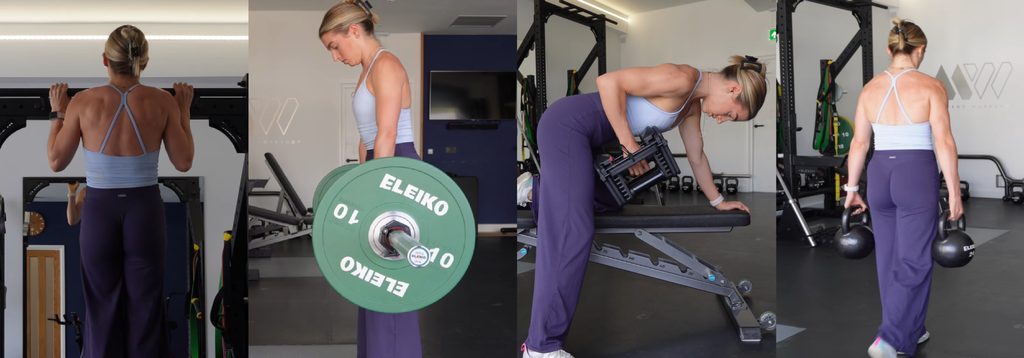
A big, muscular back is one of the clearest visual signals of strength and athleticism. Wide lats create the V-taper. Thick spinal erectors, traps, and rhomboids make your physique look powerful from every angle. And from a performance perspective, a strong back underpins almost every major lift and athletic movement.
Yet many people train their back for years with limited progress. The issue is rarely effort. It is usually strategy.


In 2026, we know far more about hypertrophy, biomechanics, motor learning, and recovery than we did even a decade ago. When you apply this evidence correctly, back training becomes far more effective and predictable.
This article breaks down three science-backed hacks to help you build a more muscular and jacked back. These are not trendy shortcuts or social media gimmicks. They are practical, research-supported methods you can apply immediately, whether you train for CrossFit, bodybuilding, or general strength.
Hack 1: Train Your Back Through Long Muscle Lengths Under High Mechanical Tension

Why Muscle Length Matters for Hypertrophy
One of the most important developments in hypertrophy research over the last decade is the recognition that muscle length during loading plays a critical role in muscle growth.
Mechanical tension is the primary driver of hypertrophy. However, not all tension is equal. When a muscle is loaded in a lengthened position, the fibers experience greater passive and active tension at the sarcomere level. This creates a stronger anabolic stimulus.
Multiple controlled studies have now shown that training at longer muscle lengths produces greater hypertrophy than training at shorter lengths, even when total volume is matched.
For the back, this is especially important because many lifters unintentionally bias shortened ranges of motion. Partial pull-ups, half rows, and fast, sloppy reps dramatically reduce the time the lats, mid-back, and spinal erectors spend under meaningful stretch.
What This Means for the Lats and Upper Back
The latissimus dorsi, teres major, rhomboids, and lower traps all reach their longest lengths when the arms are fully extended overhead or in front of the body with the scapulae protracted and upwardly rotated.
If you never load these positions, you are leaving growth on the table.
Exercises that emphasize long muscle lengths include:
- Dead-hang pull-ups with a controlled stretch at the bottom
- Lat pulldowns allowing full scapular elevation
- Chest-supported rows with full arm extension at the bottom
- Dumbbell rows that allow the shoulder to protract
- Straight-arm pulldowns with a deep stretch
Research comparing partial range training to full range training consistently shows superior hypertrophy with full range movements, particularly when the lengthened position is emphasized.
How to Apply This Hack in Training
The key is not just using full range of motion, but deliberately loading the stretched position under control.
Practical guidelines:
- Pause for 1 to 2 seconds in the stretched position on rows and pulldowns.
- Use slightly lighter loads if needed to maintain control.
- Avoid bouncing or using momentum to escape the bottom position.
- Maintain tension rather than fully relaxing at the bottom.
For example, on pull-ups, allow yourself to hang with active shoulders for a brief pause before initiating the next rep. On barbell or dumbbell rows, let the arms fully extend and the shoulder blades move naturally before pulling again.
Evidence Supporting Lengthened-Position Training
Recent randomized trials have demonstrated significantly greater muscle growth when resistance training emphasizes the lengthened portion of an exercise.
One study comparing preacher curls trained at long versus short muscle lengths found nearly double the hypertrophy in the long-length group. Similar findings have been observed in lower body muscles and are increasingly supported in upper body research.

While direct lat-specific studies are still emerging, the underlying muscle physiology applies across skeletal muscle groups.
Common Mistakes to Avoid
- Cutting reps short to lift heavier weight.
- Excessively arching or bracing to avoid stretch.
- Turning rows into hip hinges rather than back-dominant movements.
- Rushing through the eccentric phase.
If your back workouts feel easy at the bottom and hard only at the top, you are likely missing the most hypertrophic part of the movement.
Hack 2: Use High-Quality Volume With Exercise-Specific Intent
Why More Sets Is Not Always Better
Volume matters for hypertrophy, but quality matters more than sheer quantity. Research consistently shows a dose-response relationship between training volume and muscle growth, up to a point. Beyond that point, additional sets produce diminishing returns and can even impair recovery.
For back training, junk volume is extremely common. Many lifters perform high-rep sets where the arms and momentum dominate the movement, leaving the back under-stimulated.
The back is complex, with multiple muscles performing different functions. Treating all pulling exercises as interchangeable is a major mistake.
Understanding Back Muscle Function
To train the back effectively, you must respect the primary actions of its muscles:
- Lats: shoulder extension, adduction, and internal rotation
- Rhomboids and middle traps: scapular retraction
- Lower traps: scapular depression and upward rotation control
- Upper traps: scapular elevation
- Spinal erectors: spinal extension and anti-flexion
When exercise selection and execution align with these functions, muscle activation and hypertrophic stimulus increase significantly.
The Role of Intent and Motor Control
Electromyography studies show that intent matters. When lifters consciously focus on retracting the scapulae or driving the elbows down and back, activation of the target back muscles increases compared to mindless pulling.
This does not mean you need extreme “mind-muscle connection” cues, but you should have a clear intention for each exercise.
Examples:
- On lat pulldowns, think “drive elbows to hips.”
- On rows, think “pull shoulder blades together.”
- On deadlifts and back extensions, think “brace and extend through the spine.”
Studies have shown that internal focus cues can increase muscle activation in trained individuals, particularly for upper back muscles.
Structuring Weekly Back Volume
Current hypertrophy research suggests that most individuals grow best with approximately 10 to 20 challenging sets per muscle group per week, depending on training status and recovery capacity.

For the back, this should be divided across different movement patterns:
- Vertical pulls: 4 to 8 sets per week
- Horizontal rows: 6 to 10 sets per week
- Hip hinge or spinal extension work: 2 to 6 sets per week
This approach ensures balanced development without excessive fatigue.
Progressive Overload Still Matters
Quality volume does not mean avoiding progression. Progressive overload remains a cornerstone of hypertrophy.
However, progression does not always mean adding weight. You can also progress by:
- Increasing reps at the same load
- Improving control at long muscle lengths
- Reducing rest times slightly
- Increasing total weekly sets gradually
Long-term studies show that consistent, modest progression produces better results than aggressive loading followed by plateaus or injury.
Evidence Supporting Structured Volume and Intent
Meta-analyses on resistance training volume confirm that moderate-to-high weekly set volumes produce greater hypertrophy than low volumes, especially in trained populations.
Additional studies on attentional focus demonstrate that trained lifters can selectively increase activation of target muscles, particularly in multi-joint movements.
Taken together, these findings support a smarter, more intentional approach to back training volume.
Hack 3: Prioritize Recovery and Fatigue Management for Sustainable Growth
Why Your Back Needs More Recovery Than You Think
The back includes some of the largest muscle groups in the body. Training it hard creates significant systemic fatigue, especially when compound movements like deadlifts, heavy rows, and pull-ups are involved.
Many lifters fail to grow their back not because they train it too little, but because they train it too hard, too often, without adequate recovery.
Chronic fatigue blunts hypertrophy by impairing muscle protein synthesis, increasing injury risk, and reducing training quality.
The Role of Sleep and Nutrition
Sleep is one of the strongest predictors of training adaptation. Studies consistently show that sleep restriction reduces muscle protein synthesis, strength gains, and anabolic hormone profiles.

For optimal back growth:
- Aim for 7 to 9 hours of sleep per night.
- Maintain consistent sleep and wake times.
- Avoid high caffeine intake late in the day.
Nutrition also plays a critical role. Adequate protein intake is essential to support muscle repair and growth. Research suggests that intakes of approximately 1.6 to 2.2 grams of protein per kilogram of body weight per day maximize hypertrophy in resistance-trained individuals.
Carbohydrate availability is particularly important for back training due to the high energy cost of compound pulling movements.
Managing Fatigue Within the Week
Rather than annihilating your back in one session, spreading volume across two or three weekly sessions often produces better results.
For example:
- Session 1: Vertical pulls and light rows
- Session 2: Heavy rows and spinal erectors
- Session 3: Accessories and lengthened-position work
Research on training frequency shows that distributing volume across multiple sessions can improve recovery and maintain higher training quality.
Auto-Regulation and Proximity to Failure
Training close to failure is effective for hypertrophy, but constantly training to absolute failure is not necessary and may be counterproductive.
Evidence suggests that stopping 1 to 3 reps shy of failure produces similar hypertrophy with less fatigue compared to training to failure on every set.
This is especially relevant for heavy back exercises, where technical breakdown can increase injury risk.
Using rating of perceived exertion (RPE) or reps in reserve (RIR) can help regulate effort while maintaining a strong growth stimulus.
Deloads and Long-Term Progress
Long-term training studies show that planned reductions in volume and intensity help restore performance and maintain motivation.
A deload every 6 to 10 weeks, depending on training stress, allows connective tissues and the nervous system to recover, setting the stage for further growth.
Ignoring deloads often leads to stalled progress, nagging pain, and inconsistent training quality.
Evidence Supporting Recovery-Focused Training
Systematic reviews on sleep, nutrition, and fatigue management consistently demonstrate their importance in resistance training outcomes.
Athletes who manage recovery effectively show greater long-term strength and hypertrophy gains compared to those who rely solely on increased training stress.
Putting It All Together for a Bigger Back in 2026
Building a muscular and jacked back is not about chasing novelty. It is about applying what science already tells us, consistently and intelligently.
When you:
- Load your back muscles at long lengths
- Accumulate high-quality, intentional volume
- Respect recovery and fatigue management
You create the ideal environment for growth.
These three hacks work together. Lengthened-position training increases the stimulus per rep. Quality volume ensures that stimulus is sufficient and targeted. Recovery allows your body to actually adapt.
Apply them patiently, track your progress, and your back will not just look better, it will perform better too.
Bibliography
- American Journal of Physiology – Cell Physiology: Franchi, M.V., Reeves, N.D. and Narici, M.V., 2017. Skeletal muscle remodeling in response to eccentric vs. concentric loading.
- Journal of Applied Physiology: Schoenfeld, B.J., 2010. The mechanisms of muscle hypertrophy and their application to resistance training.
- Sports Medicine: Schoenfeld, B.J., Ogborn, D. and Krieger, J.W., 2017. Dose-response relationship between weekly resistance training volume and increases in muscle mass.
- European Journal of Applied Physiology: Pinto, R.S., et al., 2012. Effect of range of motion on muscle strength and thickness.
- Journal of Strength and Conditioning Research: Gentil, P., et al., 2017. Effects of attentional focus on muscle activation during resistance exercise.
- Journal of Sports Sciences: Morton, R.W., et al., 2018. Protein intake to maximize resistance training–induced gains.