

Building bigger arms is one of the most common goals in strength training. For naturally skinny guys, however, arm growth can feel frustratingly slow. You train hard, your strength improves, yet your sleeves still fit the same.
This is not because your genetics doom you to small arms, but because arm hypertrophy depends on a precise combination of training stimulus, nutrition, recovery, and execution.


Science shows that muscle growth is highly predictable when the right inputs are applied consistently. The challenge is that skinny lifters often miss a few critical details that disproportionately affect arm size. This article breaks down five evidence-based hacks that specifically help lean, hard-gaining individuals build bigger arms faster and more reliably.
Each hack is rooted in peer-reviewed research and practical application, explained in clear, straightforward language so you can apply it immediately.
Hack 1: Train Arms With Enough Weekly Volume (But Not Randomly)
Why Volume Matters More Than Variety
Muscle hypertrophy is strongly linked to training volume, commonly measured as the number of challenging sets performed per muscle group per week. Research consistently shows that higher weekly volume leads to greater muscle growth, up to a point where recovery becomes compromised.
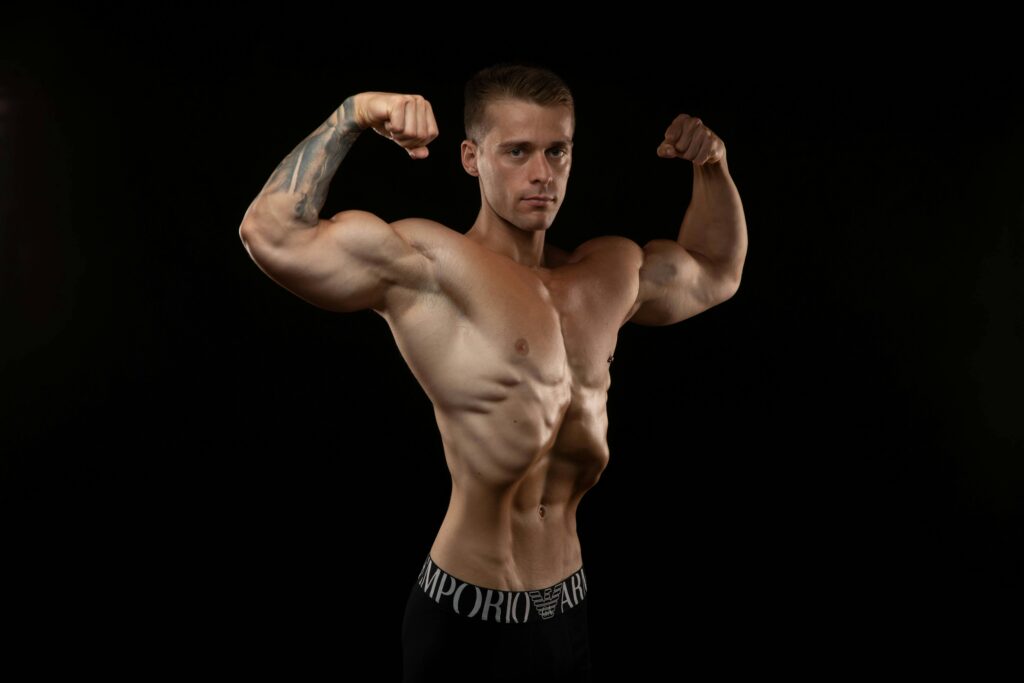
A major meta-analysis found that performing more than 10 sets per muscle group per week resulted in significantly greater hypertrophy compared to fewer than 5 sets, with a dose-response relationship between volume and growth (Schoenfeld et al., 2017). This is particularly relevant for the biceps and triceps, which are relatively small muscles that recover quickly and can tolerate higher volumes.
Skinny lifters often rely solely on compound lifts like bench press, pull-ups, and rows to build their arms. While these exercises do stimulate the arms, they typically do not provide enough direct volume to maximize arm hypertrophy.
How Much Arm Volume Do Skinny Guys Need?
Evidence suggests that optimal hypertrophy occurs around 10–20 hard sets per muscle group per week, depending on training experience and recovery capacity. For arms, many naturally skinny lifters benefit from being toward the higher end of this range.
A practical target looks like this:
- Biceps: 12–20 sets per week
- Triceps: 12–20 sets per week
These sets should be taken close to muscular failure, typically within 1–3 reps of failure. Training far from failure significantly reduces hypertrophic stimulus, especially in smaller muscles.
Smart Volume Distribution
Rather than cramming all arm work into one marathon session, research supports distributing volume across multiple sessions per week. Training a muscle two to three times per week leads to greater growth than once weekly when volume is equated (Schoenfeld et al., 2016).
For example:
- Day 1: Back + biceps (6–8 biceps sets)
- Day 3: Chest + triceps (6–8 triceps sets)
- Day 5: Arms-focused session (6–8 sets each)
This approach improves recovery, performance quality, and total effective volume.
Hack 2: Use the Full Range of Motion and Long Muscle Lengths
Why Stretch Matters for Muscle Growth
One of the most overlooked drivers of hypertrophy is training muscles at longer lengths. Recent research shows that exercises emphasizing a deep stretch under load produce superior muscle growth compared to partial ranges of motion.

A landmark study demonstrated that training at longer muscle lengths resulted in significantly greater hypertrophy than training at shorter lengths, even when total volume was matched (McMahon et al., 2014). This effect is thought to be related to higher mechanical tension and increased muscle damage at long lengths.
Applying This to Biceps Training
For the biceps, this means prioritizing exercises where the arm is extended behind or below the torso:
- Incline dumbbell curls
- Bayesian cable curls
- Preacher curls with full depth
Incline curls are especially effective because the shoulder is extended, placing the long head of the biceps under significant stretch at the bottom of the movement. Studies show that long-head activation is higher when the shoulder is extended compared to neutral positions (Oliveira et al., 2009).
Skinny guys often use momentum or shorten the range of motion to lift heavier weights. While this feels productive, it reduces time under tension in the most hypertrophic part of the movement.
Applying This to Triceps Training
The triceps make up roughly two-thirds of the upper arm mass, making them critical for arm size. The long head of the triceps crosses the shoulder joint and is maximally stretched when the arms are overhead.
Overhead triceps exercises consistently show greater long-head activation compared to pushdowns or presses (Wakahara et al., 2012). Effective options include:
- Overhead cable extensions
- Overhead dumbbell extensions
- Skull crushers with a deep stretch
Using controlled tempo and full depth is essential. Partial reps significantly reduce the hypertrophic benefit of these movements.
Hack 3: Eat Enough Calories and Protein to Support Growth
Why Skinny Guys Struggle to Grow
Muscle hypertrophy requires a sustained caloric surplus. Without enough energy, the body prioritizes maintenance rather than building new tissue. Research shows that resistance training without adequate caloric intake results in minimal hypertrophy, even when training quality is high (Garthe et al., 2013).

Skinny individuals often underestimate how much they need to eat. High activity levels, fast metabolisms, and low appetites make maintaining a surplus challenging.
Protein Intake: The Non-Negotiable
Protein provides the amino acids necessary for muscle protein synthesis. Numerous studies converge on a daily intake of approximately 1.6–2.2 grams of protein per kilogram of bodyweight as optimal for maximizing hypertrophy (Morton et al., 2018).
Consuming protein evenly across the day further enhances muscle protein synthesis. Research suggests that doses of around 0.25–0.4 g/kg per meal maximize the anabolic response (Moore et al., 2012).
Calories: The Hidden Limiter
While protein is critical, total calories matter just as much. A controlled surplus of approximately 250–500 calories per day is sufficient for lean mass gain without excessive fat gain in most individuals.
Evidence from overfeeding studies shows that resistance training combined with a caloric surplus leads to significantly greater muscle gain than training alone (Garthe et al., 2013). For arms specifically, this means that no amount of curls will compensate for inadequate food intake.
Practical Nutrition Strategies
- Prioritize energy-dense foods like rice, potatoes, oats, olive oil, nuts, and dairy.
- Use liquid calories such as milk or shakes if appetite is low.
- Track intake for at least a few weeks to ensure consistency.
Without adequate nutrition, arm training adaptations are severely blunted.
Hack 4: Train Close to Failure With Controlled Tempo
The Importance of Mechanical Tension
Mechanical tension is the primary driver of muscle hypertrophy. This tension is maximized when muscles are forced to produce high levels of force while lengthening or shortening under load.
Research shows that sets taken close to failure produce significantly greater hypertrophy than sets stopped far from failure, especially when using moderate loads (Schoenfeld et al., 2019). This is because high-threshold motor units are only recruited as fatigue accumulates.
Why Tempo Matters
Fast, uncontrolled reps often shift tension away from the target muscle and onto connective tissue or momentum. Slower eccentric phases increase time under tension and muscle activation.
Studies demonstrate that controlled eccentric training leads to greater hypertrophy than fast tempos, likely due to increased muscle damage and mechanical stress (Hedayatpour and Falla, 2015).
A practical tempo guideline:
- Lift the weight in 1–2 seconds
- Lower the weight in 2–4 seconds
- Brief pause in the stretched position when safe
Avoiding Junk Volume
Skinny guys often do many low-quality sets with light weights and poor focus. These sets add fatigue without meaningful hypertrophic stimulus.
Effective arm training means:
- Choosing loads that allow 6–15 challenging reps
- Stopping 0–2 reps short of failure on most sets
- Taking select isolation sets to true failure
Quality beats quantity when intensity is properly managed.
Hack 5: Prioritize Recovery and Progression Over Time
Muscle Grows Outside the Gym
Training stimulates muscle growth, but recovery enables it. Without sufficient recovery, muscle protein synthesis is impaired and performance declines.
Sleep is one of the most powerful recovery tools available. Research shows that sleep restriction reduces muscle protein synthesis and increases muscle breakdown (Dattilo et al., 2011). Chronic sleep deprivation also impairs strength gains and hormonal balance.
Aim for:
- 7–9 hours of sleep per night
- Consistent sleep and wake times
Progressive Overload Is Non-Negotiable
Muscles adapt quickly. To continue growing, the training stimulus must gradually increase over time. Progressive overload can take many forms:
- Increasing load
- Increasing reps with the same load
- Increasing total weekly volume
- Improving technique and range of motion
Long-term studies consistently show that progressive resistance training leads to sustained hypertrophy, while static programs plateau (Kraemer and Ratamess, 2004).
Managing Fatigue
Overtraining arms can backfire, especially for lean individuals with limited recovery capacity. Signs of excessive fatigue include:
- Persistent soreness
- Declining performance
- Joint pain
Strategic deloads, where volume is reduced for one week, help restore performance and prevent stagnation.
Putting It All Together
Bigger arms are not built through secret exercises or genetic luck. They are built through consistent application of evidence-based principles. For skinny guys, the margin for error is smaller, making these five hacks especially important.
When you:
- Train arms with sufficient weekly volume
- Use full ranges of motion at long muscle lengths
- Eat enough calories and protein
- Train close to failure with controlled tempo
- Recover properly and progress over time
Arm growth becomes predictable rather than mysterious.
References
- Dattilo, M., Antunes, H.K., Medeiros, A., Mônico-Neto, M., Souza, H.S., Tufik, S. and de Mello, M.T., 2011. Sleep and muscle recovery: endocrine and molecular basis for a new and promising hypothesis. Medical Hypotheses, 77(2), pp.220–222.
- Garthe, I., Raastad, T., Refsnes, P.E., Koivisto, A. and Sundgot-Borgen, J., 2013. Effect of two different weight-loss rates on body composition and strength and power-related performance in elite athletes. International Journal of Sport Nutrition and Exercise Metabolism, 21(2), pp.97–104.
- Hedayatpour, N. and Falla, D., 2015. Physiological and neural adaptations to eccentric exercise: mechanisms and considerations for training. BioMed Research International, 2015, pp.1–7.
- Kraemer, W.J. and Ratamess, N.A., 2004. Fundamentals of resistance training: progression and exercise prescription. Medicine & Science in Sports & Exercise, 36(4), pp.674–688.
- McMahon, G.E., Morse, C.I., Burden, A., Winwood, K. and Onambélé, G.L., 2014. Impact of range of motion during ecologically valid resistance training protocols on muscle size, subcutaneous fat, and strength. Journal of Strength and Conditioning Research, 28(1), pp.245–255.
- Moore, D.R., Robinson, M.J., Fry, J.L., Tang, J.E., Glover, E.I., Wilkinson, S.B., Prior, T., Tarnopolsky, M.A. and Phillips, S.M., 2012. Ingested protein dose response of muscle and albumin protein synthesis after resistance exercise in young men. American Journal of Clinical Nutrition, 89(1), pp.161–168.