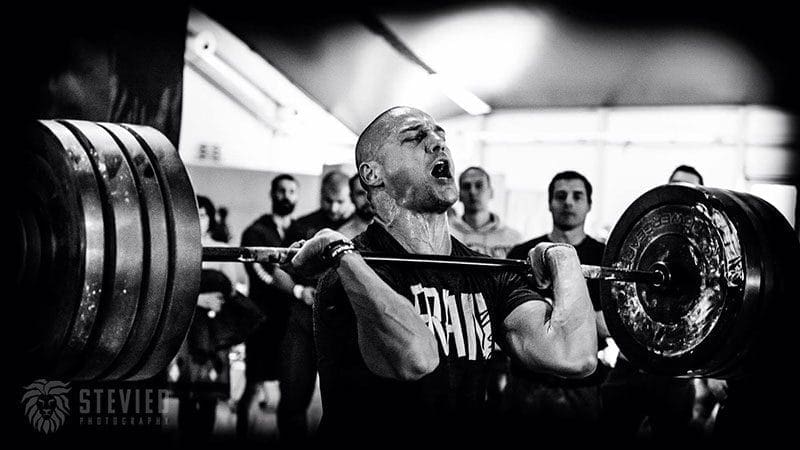


The barbell clean is one of the most powerful movements in strength and conditioning. It is fast, explosive, and brutally honest. If you cannot generate force quickly, the bar will not move. If you lack coordination, it will crash. If your strength is insufficient, it will stall.
Power is the key. In physics, power equals force multiplied by velocity. In the clean, that means producing high levels of force in very little time. The better you can do that, the more weight you can lift, and the more transferable athletic power you build.


This article breaks down exactly how to generate more power for the barbell clean using science-backed methods. We will look at biomechanics, muscle physiology, strength development, rate of force development, technical efficiency, programming, and recovery. Every recommendation is grounded in peer-reviewed research and applied strength science.
Let’s get to work.
Understanding Power in the Clean
What Is Power?
Power is defined as the rate at which work is performed. In resistance training, it is often described as force multiplied by velocity. High power outputs occur when you produce large forces quickly.
Research consistently shows that Olympic weightlifting movements, including the clean and its derivatives, produce some of the highest power outputs of any resistance exercises. Studies measuring peak power during the clean and its variations show values exceeding those seen in traditional strength exercises like the squat and deadlift.
If your goal is to improve clean performance, you must improve either:
- The amount of force you can produce.
- The speed at which you can produce that force.
- Or both.
Why the Clean Is So Effective for Power
Biomechanical analyses demonstrate that the second pull phase of the clean—where the hips, knees, and ankles extend violently—produces extremely high power outputs. This triple extension relies heavily on the glutes, quadriceps, hamstrings, and plantar flexors.
Research comparing weightlifting derivatives to other explosive exercises has shown that movements like the power clean and hang clean generate high peak power and high rates of force development. These qualities transfer strongly to sprinting and jumping performance.
In simple terms: if you want to clean more, you must become stronger and faster in triple extension.
Build Maximal Strength First
Strength Is the Foundation of Power
Multiple studies demonstrate a strong relationship between maximal strength and power output. Stronger athletes generally produce greater peak power during Olympic lifts and vertical jumps.
Maximal strength increases the ceiling of force production. Since power equals force times velocity, increasing force capacity raises your potential power output—even if velocity stays constant.
Heavy squats and pulls are particularly important. Research shows strong correlations between back squat strength and power clean performance. Athletes with higher relative squat strength typically clean more weight.
Squats: Your Primary Driver
Back squats and front squats directly improve the force production capacity of the lower body. The front squat is especially specific to the clean because it mimics the receiving position.
Research has demonstrated that improvements in squat strength lead to improvements in sprint performance, jump height, and weightlifting performance. Heavy resistance training increases neural drive, motor unit recruitment, and muscle cross-sectional area.
To generate more power in the clean:
- Train heavy squats in the 80–95 percent 1RM range.
- Prioritize full depth.
- Maintain upright torso strength with front squats.
Pulling Strength Matters
Clean pulls and deadlifts strengthen the posterior chain and reinforce forceful hip extension. Studies show that peak force production during pulls correlates with clean performance.
Heavy pulls above 100 percent of your clean max train force production without the technical demand of the catch. This allows you to overload the second pull safely.
Stronger hips equal more force. More force equals more potential power.
Improve Rate of Force Development
Why Rate of Force Development Is Critical
Rate of force development (RFD) refers to how quickly you can develop force. In the clean, you have milliseconds to apply maximal force to the bar. If you are slow, the bar will not reach sufficient height.
Research shows that elite weightlifters produce high force in very short time intervals, often under 200 milliseconds. This ability separates advanced lifters from beginners.
Improving RFD requires explosive training with moderate loads.
Train at Optimal Power Loads
Studies investigating optimal power loads in Olympic lifts suggest that peak power in the clean often occurs between 70 and 85 percent of 1RM, though it varies by athlete.
Training in this range:
- Maximizes bar velocity.
- Produces high force outputs.
- Stimulates adaptations in fast-twitch muscle fibers.
Velocity-based training research supports using loads that move fast enough to maintain high power output. Grinding reps do not build explosive power effectively.
Use Clean Variations
Power cleans, hang cleans, and high pulls reduce technical complexity and allow you to focus on aggressive extension.
Research comparing hang and floor variations shows that hang versions can produce equal or greater power outputs in some athletes. The reduced range of motion emphasizes explosive hip extension.
Add:
- Hang power cleans.
- Mid-thigh pulls.
- High pulls.
All reinforce violent triple extension.
Develop Fast-Twitch Muscle Fibers
Muscle Fiber Type and Power
Type II (fast-twitch) fibers generate more force and contract faster than Type I fibers. Power output is strongly associated with Type II fiber area.
Resistance training—especially high-load and explosive training—can increase Type II fiber cross-sectional area and enhance neural activation.
Weightlifting movements preferentially recruit high-threshold motor units due to their explosive nature.
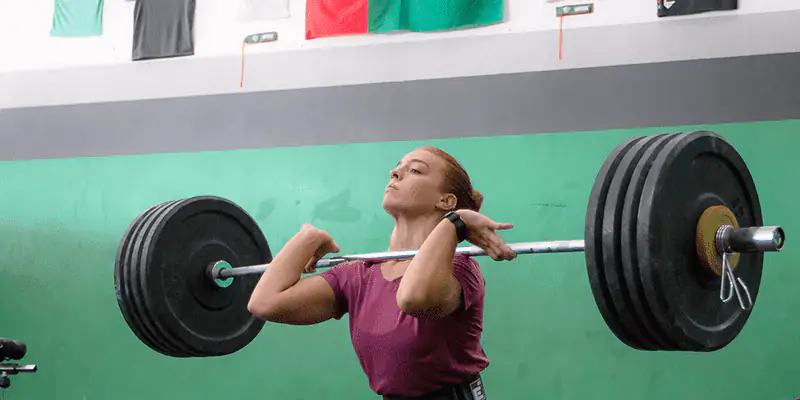
Train Explosively
Research shows that intent to move explosively, even with heavy loads, increases motor unit recruitment and RFD.
Every clean repetition should be performed with maximal intent. Even at 85 percent, you must think “fast.”
Explosive intent trains your nervous system to fire quickly and efficiently.
Master Technique for Efficient Power Transfer
Bar Path Efficiency
Biomechanical studies of elite lifters show a consistent bar path pattern: close to the body with minimal horizontal displacement.
A looping bar path wastes energy and reduces vertical force application.
Technical improvements increase mechanical efficiency, allowing more of your force production to move the bar upward instead of forward.
Timing of Triple Extension
Peak power in the clean occurs during the second pull. Research shows that coordinated extension of hips, knees, and ankles maximizes vertical impulse.
Poor sequencing reduces power output.
To improve timing:
- Use slow-motion video analysis.
- Perform segmental drills (clean pulls, tall cleans).
- Practice high-repetition technique sessions with moderate loads.
Efficiency equals more usable power.
Increase Lower-Body Stiffness and Elasticity
The Stretch-Shortening Cycle
The clean relies on the stretch-shortening cycle (SSC), particularly during the transition from the first to second pull.
Research shows that trained athletes utilize stored elastic energy and reflexive neural mechanisms to increase power output during explosive movements.
Improving SSC efficiency enhances bar speed.
Use Plyometrics
Plyometric training improves RFD, tendon stiffness, and jump performance. Multiple studies show that combining heavy resistance training with plyometrics enhances power more than either alone.
Add:
- Box jumps.
- Depth jumps.
- Broad jumps.
Two sessions per week can significantly improve explosive performance.
Strengthen the Posterior Chain
Hip Extension Drives the Clean
Electromyographic research shows high activation of the gluteus maximus and hamstrings during the second pull.
Weak hips limit force production.
Romanian deadlifts, hip thrusts, and good mornings strengthen hip extension. Studies on hip thrusts show strong carryover to sprint acceleration and horizontal force production.
Strong glutes equal stronger extension.
Improve Core Stability for Force Transfer
Force Leakage Reduces Power
The clean requires transferring force from the lower body to the bar through a rigid torso.
Research shows that trunk stiffness enhances force transmission and improves performance in compound lifts.
Core training should emphasize anti-extension and anti-rotation strength.
Add:
- Heavy front rack holds.
- Planks with load.
- Pallof presses.
A stable core ensures power generated at the hips reaches the bar.
Use Contrast and Complex Training
Post-Activation Performance Enhancement
Research demonstrates that heavy lifts performed before explosive movements can acutely enhance power output. This phenomenon is often called post-activation performance enhancement.
For example:
- Heavy squats followed by cleans.
- Heavy pulls followed by jump squats.
Studies show improved jump height and power when heavy resistance is paired with explosive work.
Use 3–5 heavy reps, rest 2–4 minutes, then perform explosive cleans.
Optimize Training Volume and Frequency
Avoid Fatigue-Induced Power Loss
Power declines rapidly under fatigue. Research shows bar velocity decreases as fatigue accumulates.
Train cleans early in the session.
Keep reps low (1–3 per set).
Stop sets when bar speed drops noticeably.
Two to three clean sessions per week is effective for most athletes.
Recovery Drives Adaptation
Sleep and Hormonal Environment
Sleep restriction reduces strength, power output, and reaction time. Research consistently shows that inadequate sleep impairs neuromuscular performance.
Aim for 7–9 hours per night.
Nutrition for Power
Adequate protein intake supports muscle repair and growth. Research suggests 1.6–2.2 grams per kilogram of body weight per day optimizes hypertrophy.
Creatine supplementation has been shown to increase strength and power output by enhancing phosphocreatine availability.
Carbohydrates replenish glycogen, supporting high-intensity training performance.
Periodize for Long-Term Gains
Undulating and Block Models
Research comparing periodization models shows that structured progression improves strength and power more effectively than non-periodized training.
Use phases:
- Accumulation: Build strength and muscle.
- Intensification: Increase load.
- Realization: Emphasize power and speed.
Cycle focus across weeks while maintaining some exposure to explosive lifts year-round.
Practical Weekly Template
Here is a sample structure:
Day 1
Heavy squats
Power cleans (70–80 percent)
Plyometrics
Day 2
Clean pulls
Hang cleans
Posterior chain accessory work
Day 3
Front squats
Full cleans
Core work
Low reps. High intent. Full recovery.
Common Mistakes That Kill Power
Too Much Volume
Excess fatigue reduces bar speed and neural quality.
Neglecting Strength
Explosiveness without strength limits ceiling potential.
Ignoring Technique
Power cannot compensate for inefficient movement.
Training to Failure
Failure training reduces velocity and neural efficiency.
Final Thoughts
Generating more power for the barbell clean requires a combination of maximal strength, rapid force development, technical efficiency, neuromuscular coordination, and proper recovery.
The science is clear:
- Get stronger.
- Move fast.
- Train explosively.
- Recover hard.
Power is trainable. With intelligent programming and consistent effort, your clean numbers will rise.
References
- Cormie, P., McGuigan, M.R. and Newton, R.U., 2011. Developing maximal neuromuscular power: Part 1 – Biological basis of maximal power production. Sports Medicine, 41(1), pp.17–38.
- Cormie, P., McGuigan, M.R. and Newton, R.U., 2011. Developing maximal neuromuscular power: Part 2 – Training considerations for improving maximal power production. Sports Medicine, 41(2), pp.125–146.
- Comfort, P., Fletcher, C. and McMahon, J.J., 2012. Determination of optimal loading during the power clean. Journal of Strength and Conditioning Research, 26(11), pp.2970–2974.
- Haff, G.G. and Nimphius, S., 2012. Training principles for power. Strength and Conditioning Journal, 34(6), pp.2–12.