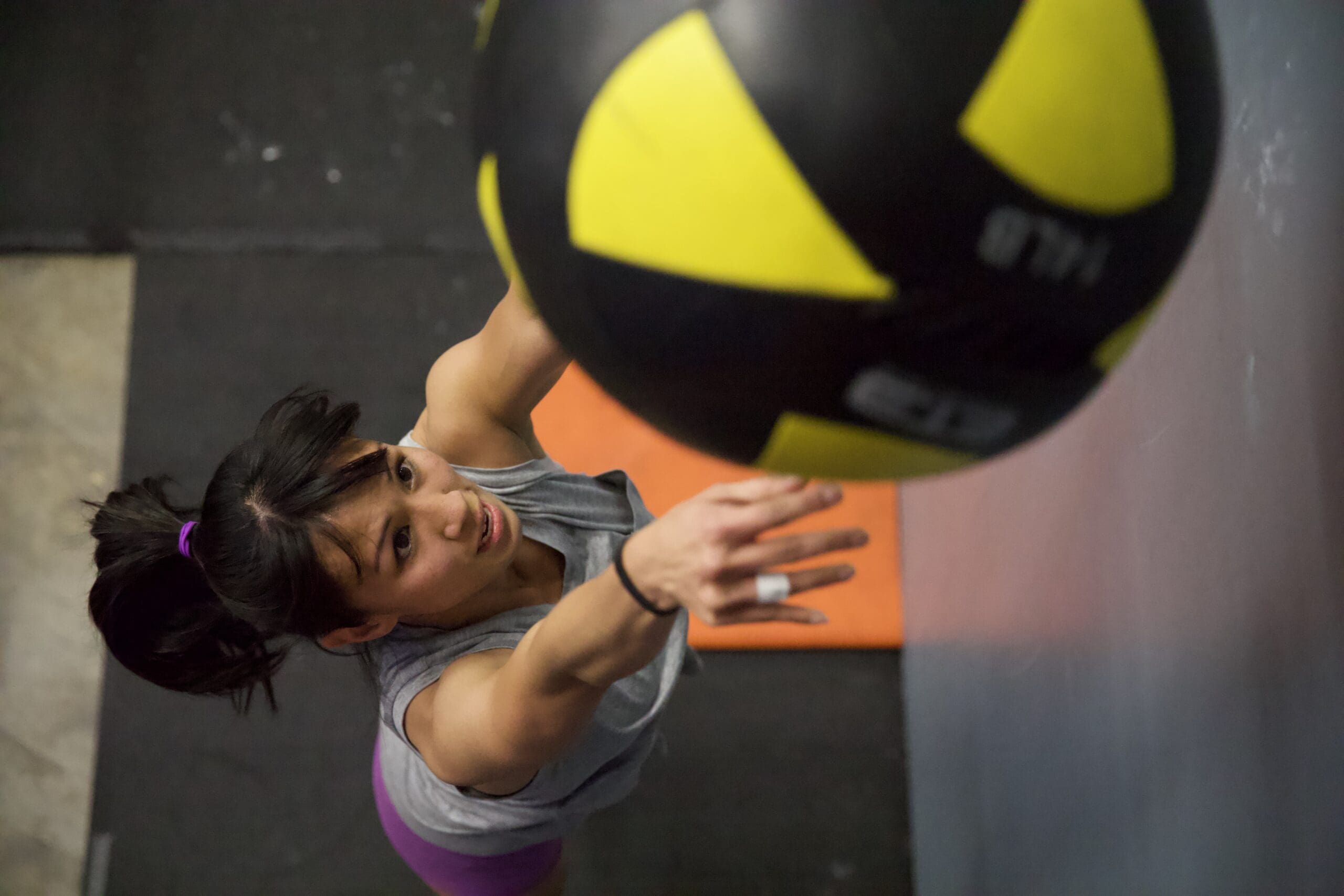


Wall balls are one of the most recognizable movements in functional fitness. They are simple, brutal, effective, and endlessly scalable. A medicine ball, a target on the wall, and a willingness to breathe hard are all you need.
But wall balls are not just a conditioning tool. They combine a front squat and an explosive push press into one continuous movement, demanding coordination, mobility, power, and muscular endurance. When programmed correctly, they can improve lower-body strength, upper-body power, aerobic capacity, and work capacity.


This article breaks down the science behind wall balls and then delivers three top functional fitness workouts built around them. Every claim is grounded in peer-reviewed research, and the workouts are designed for real-world athletes who want results.
Why Wall Balls Work
Before jumping into the workouts, it is worth understanding why wall balls are so effective.
The Biomechanics of the Wall Ball
A standard wall ball involves:
- Catching a medicine ball in the front rack position
- Descending into a squat
- Driving upward explosively
- Throwing the ball to a high target
- Receiving it again and repeating
This movement combines:
- A squat pattern
- Triple extension at the hips, knees, and ankles
- An upper-body press
- Reactive coordination
Medicine ball throws are widely used in sports science to assess and train power because they allow high force production at high velocity. Research shows that medicine ball throwing performance correlates strongly with upper-body and total-body power output.
Explosive movements that involve triple extension are key for athletic performance. Studies on power training demonstrate that movements involving rapid hip and knee extension improve neuromuscular function and rate of force development, both critical for sports and functional fitness.
Wall balls blend this explosive demand with a full-depth squat. Deep squats have been shown to activate the quadriceps, glutes, and adductors to a high degree, particularly when performed through a full range of motion. Full-depth squatting is also associated with greater improvements in lower-body strength compared to partial squats.
Wall Balls and Muscular Endurance
High-repetition wall balls challenge local muscular endurance in the legs and shoulders. Muscular endurance training, especially with moderate loads and high repetitions, has been shown to increase capillary density and mitochondrial adaptations in skeletal muscle. These changes improve fatigue resistance.

Repeated squat-to-press patterns also create substantial metabolic stress. Research indicates that training that generates high metabolic stress contributes to muscular adaptations, including hypertrophy and improved glycolytic capacity.
In short, wall balls train strength, power, and endurance at the same time.
Wall Balls and Aerobic Capacity
When programmed in high-repetition sets or mixed-modal workouts, wall balls significantly elevate heart rate. High-intensity functional training, which includes movements like wall balls, has been shown to improve VO2max and aerobic capacity.
VO2max is one of the strongest predictors of cardiovascular fitness and long-term health. Studies on high-intensity interval training (HIIT) show that repeated bouts of high-intensity work interspersed with short recovery periods improve both aerobic and anaerobic performance.
Wall balls fit perfectly into this model. Sets of 15 to 30 repetitions performed repeatedly create intervals of intense effort followed by brief recovery.
Hormonal and Metabolic Effects
Large, multi-joint movements performed at high intensity stimulate significant acute hormonal responses, including increases in growth hormone and testosterone. These responses are more pronounced when large muscle groups are used and rest periods are short.
Because wall balls recruit both lower and upper body musculature in a continuous fashion, they create a high systemic demand. This makes them effective for conditioning and body composition goals.
Now let’s put this science into action.
Workout 1: The Aerobic Capacity Builder
This workout focuses on sustained output, pacing, and improving aerobic capacity using wall balls as the central driver.
Structure
5 Rounds for Time:
- 25 Wall Balls
- 400-meter Run
Men: 20 lb ball to 10 ft target
Women: 14 lb ball to 9 ft target
Why It Works
This workout alternates between a cyclical aerobic movement (running) and a high-repetition functional movement (wall balls). This structure creates repeated intervals of elevated heart rate with minimal rest.
Research comparing interval training and continuous endurance training shows that interval-based protocols produce similar or greater improvements in VO2max in less time. The repeated exposure to high heart rates during both the wall balls and the run drives cardiovascular adaptation.

The 25-rep wall ball sets are large enough to create muscular fatigue in the legs and shoulders, increasing metabolic stress. As noted in resistance training research, metabolic stress contributes to muscle endurance and hypertrophy.
The 400-meter run reinforces aerobic capacity and promotes recovery through cyclical movement. Studies on concurrent training indicate that combining endurance and resistance modalities can improve overall conditioning when appropriately balanced.
Coaching Points
- Break the wall balls early if needed. Sets of 15 and 10 are better than hitting failure at 22.
- Focus on breathing rhythm: inhale on the catch, exhale on the throw.
- Use the run to control your heart rate rather than sprinting the first round.
Scaling Options
- Reduce to 15 wall balls per round.
- Substitute a 300-meter run or 500-meter row.
- Lower the ball weight.
Scientific Rationale Summary
This workout leverages:
- Interval-based conditioning to improve VO2max
- High-repetition resistance work to enhance muscular endurance
- Multi-joint movement to maximize systemic demand
Over time, this style of training improves cardiovascular health markers and work capacity.
Workout 2: The Power and Lactate Threshold Test
This workout is shorter, sharper, and far more intense.
Structure
For Time:
- 50 Wall Balls
- 40 Wall Balls
- 30 Wall Balls
- 20 Wall Balls
- 10 Wall Balls
Rest 1 minute between sets.
Men: 20–30 lb ball
Women: 14–20 lb ball
Why It Works
This descending ladder creates large, sustained sets under fatigue. The one-minute rest interval is intentionally short, preventing full recovery and keeping lactate levels elevated.
High-intensity efforts of 30 to 90 seconds rely heavily on anaerobic glycolysis. Research shows that repeated high-intensity efforts with incomplete recovery increase buffering capacity and improve lactate threshold.
Lactate threshold refers to the intensity at which lactate begins to accumulate rapidly in the blood. Improving this threshold allows athletes to sustain higher intensities for longer periods.

Medicine ball throws have been shown to effectively train power output. When performed explosively, they improve rate of force development. However, when volume is high and rest is short, they also challenge anaerobic capacity.
The first set of 50 wall balls will likely take 2–4 minutes. This places the athlete in a high glycolytic demand zone. The short rest keeps the body under stress, forcing adaptation.
Coaching Points
- Open with a sustainable pace. Do not sprint the first 20 reps.
- Keep the ball close to your body to minimize shoulder fatigue.
- Use your hips, not your arms, to drive the throw.
Scaling Options
- Start with 30-25-20-15-10 reps.
- Increase rest to 90 seconds.
- Lower the ball weight.
Scientific Rationale Summary
This workout targets:
- Anaerobic glycolysis
- Lactate tolerance
- Muscular endurance under fatigue
- Explosive hip extension
Research on high-intensity interval training shows that repeated near-maximal efforts improve both anaerobic and aerobic systems simultaneously. This workout is a practical expression of that principle.
Workout 3: The Total-Body Functional Grinder
This workout integrates wall balls into a mixed-modal session that builds strength endurance and resilience.
Structure
AMRAP 20 Minutes:
- 20 Wall Balls
- 15 Toes-to-Bar
- 10 Dumbbell Thrusters (moderate weight)
- 200-meter Farmer Carry
Why It Works
This session blends squatting, pressing, core stability, and loaded carries. The wall balls act as the engine, elevating heart rate and taxing the lower body.
Functional training research shows that multi-joint, multi-planar movements improve coordination and core stability more effectively than machine-based training.
The farmer carry adds a loaded gait component. Loaded carries have been shown to increase trunk muscle activation and improve grip strength, both essential for athletic performance.
The combination of wall balls and thrusters creates repeated knee and hip extension under fatigue. Research on resistance training volume indicates that total weekly volume is a key driver of adaptation. This workout accumulates a high number of squat repetitions in a short period.
The 20-minute duration places the session in a zone that stresses both aerobic and muscular endurance systems. Studies on high-intensity functional training programs show significant improvements in body composition, muscular endurance, and aerobic fitness over periods as short as 8–12 weeks.
Coaching Points
- Cycle wall balls smoothly rather than racing them.
- Keep the core braced during toes-to-bar to avoid excessive lumbar extension.
- Choose a farmer carry weight that forces posture control but allows unbroken movement.
Scaling Options
- Substitute hanging knee raises for toes-to-bar.
- Reduce wall balls to 15 reps.
- Shorten the workout to 15 minutes.
Scientific Rationale Summary
This workout develops:
- Total-body muscular endurance
- Core stability
- Grip strength
- Aerobic and anaerobic crossover capacity
It reflects the principles of functional training: integrated movement patterns performed at meaningful intensity.
Programming Wall Balls Safely and Effectively
Volume Considerations
High volumes of squatting can increase joint stress if technique breaks down. However, research shows that properly performed squats do not inherently increase knee injury risk and can improve joint stability.
Introduce volume gradually. Beginners may start with 60–80 total wall balls per session, while advanced athletes can exceed 150 depending on intensity.
Mobility Requirements
Adequate ankle dorsiflexion and thoracic extension are important for efficient wall balls. Limited mobility can increase compensations in the lumbar spine.
Regular mobility work for the calves, hips, and thoracic spine supports better mechanics.
Recovery
High-intensity functional workouts significantly elevate heart rate and stress the neuromuscular system. Research suggests that adequate recovery between intense sessions is essential to prevent overtraining and maintain performance improvements.

Two to three wall ball-focused sessions per week is sufficient for most athletes.
The Bottom Line
Wall balls are not just a conditioning tool. They are a powerful driver of strength, power, muscular endurance, and cardiovascular fitness.
The three workouts in this article target:
- Aerobic capacity
- Lactate threshold and anaerobic power
- Total-body functional endurance
Each workout is grounded in well-established exercise science principles, including interval training, metabolic stress, rate of force development, and concurrent training adaptations.
When programmed intelligently, wall balls can deliver serious results with minimal equipment.
References
- American College of Sports Medicine (2009) ‘Progression models in resistance training for healthy adults’, Medicine & Science in Sports & Exercise, 41(3), pp. 687–708.
- Buckner, S.L., Dankel, S.J., Mattocks, K.T., Jessee, M.B., Mouser, J.G., Counts, B.R., Loenneke, J.P. (2017) ‘The problem of muscle hypertrophy: Revisited’, Sports Medicine, 47(6), pp. 1041–1052.
- Comfort, P., Stewart, A., Bloom, L., Clarkson, B. (2014) ‘Relationships between strength, sprint, and jump performance in well-trained youth soccer players’, Journal of Strength and Conditioning Research, 28(1), pp. 173–177.
- Gibala, M.J., Little, J.P., Macdonald, M.J., Hawley, J.A. (2012) ‘Physiological adaptations to low-volume, high-intensity interval training in health and disease’, Journal of Physiology, 590(5), pp. 1077–1084.