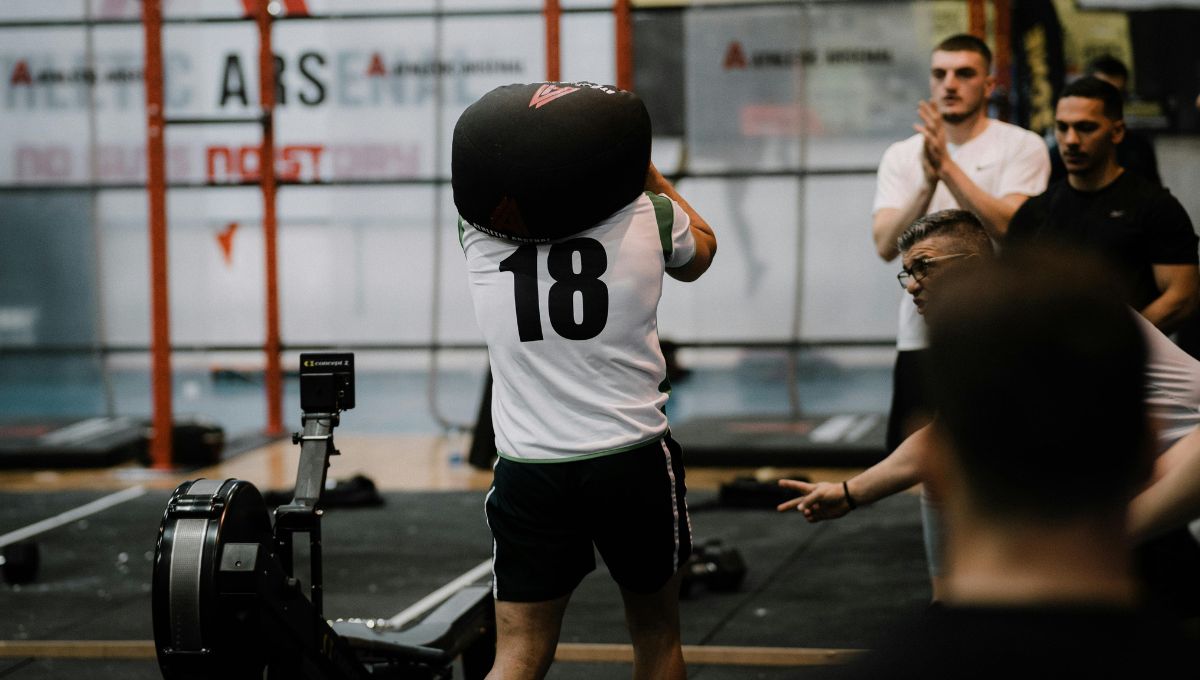


A strong back is not just about aesthetics. It is about performance, injury resilience, posture, and long-term health. Whether you are a CrossFit athlete, weekend warrior, office worker, or simply someone who wants to move better, your back plays a central role in nearly everything you do.
From picking up a barbell to carrying groceries, sprinting, pulling, pushing, and even breathing, the muscles of the back provide stability and force transfer across the entire body. Research consistently shows that well-designed resistance training programs significantly improve back strength, reduce injury risk, and enhance overall function.


Why Back Strength Matters
Before looking at the exercises, it is important to understand why back strength is so critical.
The Back as a Force Transfer System
The posterior chain — including the erector spinae, lats, glutes, hamstrings, and traps — functions as a coordinated system. During athletic movement, force generated by the lower body must transfer efficiently through the trunk and into the upper body.

Research shows that trunk strength and endurance are associated with improved athletic performance and reduced injury risk. Weakness or poor endurance in the back muscles is linked to low back pain and reduced functional capacity.
Back Strength and Injury Prevention
Low back pain is one of the most common musculoskeletal issues worldwide. Studies have shown that resistance training programs that include multi-joint movements significantly reduce chronic low back pain and improve function.
Strong spinal erectors, deep stabilizers, and scapular muscles improve spinal stability and movement control. Increased muscle strength enhances load tolerance, meaning your body can handle more stress without breaking down.
Functional Fitness and Real-World Movement
Functional fitness emphasizes compound movements, full-body coordination, and strength through natural movement patterns. The back is central to:
- Hip hinge patterns
- Pulling movements
- Rotational stability
- Load carrying
The three exercises below address all of these elements.
1. The Deadlift: The King of Posterior Chain Strength
If you could only choose one exercise to strengthen your back, the deadlift would be it.
Why the Deadlift Works
The deadlift trains:
- Erector spinae
- Gluteus maximus
- Hamstrings
- Latissimus dorsi
- Trapezius
- Core stabilizers
Electromyography (EMG) research consistently shows high activation of the erector spinae during deadlift variations. The glutes and hamstrings also demonstrate strong activation, making the deadlift one of the most comprehensive posterior chain exercises available.
The movement pattern — lifting an object from the ground — is deeply functional. It mirrors daily tasks like lifting boxes, children, or equipment. Training this pattern under controlled load increases tissue resilience and coordination.
Deadlifts and Low Back Health
Contrary to outdated myths, properly programmed deadlifting does not inherently damage the spine. In fact, resistance training that includes deadlift patterns has been shown to reduce pain and disability in individuals with chronic low back pain.
Strengthening the spinal extensors increases their endurance and load-bearing capacity. Greater muscular support reduces strain on passive structures like ligaments and discs.
Performance Benefits
Deadlifts improve:
- Jump performance
- Sprint speed
- Maximal strength
- Rate of force development
Stronger hip extensors correlate with improved athletic power. Since the deadlift trains hip extension under load, it has strong carryover to explosive sport movements.
How to Perform the Deadlift
- Stand with feet hip-width apart.
- Position the barbell over the mid-foot.
- Hinge at the hips while keeping the spine neutral.
- Grip the bar just outside the legs.
- Engage the lats by pulling the bar toward your shins.
- Drive through the floor and extend the hips.
- Stand tall without overextending the lower back.
- Reverse the movement under control.
Programming Guidelines
- 3 to 5 sets
- 3 to 8 repetitions
- 2 to 3 sessions per week depending on total training volume
Beginners should focus on technique and moderate loads before progressing.
2. The Pull-Up: Upper Back and Lat Power

The pull-up is one of the most effective upper-body functional movements ever developed.
Why the Pull-Up Is Essential
Pull-ups train:
- Latissimus dorsi
- Rhomboids
- Trapezius
- Posterior deltoids
- Biceps
- Core stabilizers
EMG studies show high lat activation during pull-ups, particularly in pronated and neutral grip variations. Compared to many machine-based lat exercises, pull-ups demand more scapular stabilization and core control.
Because you move your body through space, pull-ups build real-world pulling strength that translates into climbing, grappling, and object manipulation.
Scapular Stability and Shoulder Health
Strong scapular retractors and depressors help maintain shoulder joint integrity. Weak upper back muscles are associated with poor posture and increased shoulder injury risk.
Pull-ups reinforce scapular depression and retraction under load. This strengthens the structural support around the shoulder complex.
Core Activation During Pull-Ups
Pull-ups are not just an arm or lat exercise. Research indicates significant core activation during strict pull-ups. The body must resist swinging and maintain trunk stability, which enhances anti-extension strength.
How to Perform the Pull-Up
- Grip the bar slightly wider than shoulder width.
- Hang with arms fully extended.
- Engage the shoulders by pulling them down and back.
- Pull your chest toward the bar.
- Keep your ribs down and avoid excessive arching.
- Lower under control to full extension.
If you cannot perform strict pull-ups yet, use band assistance or controlled eccentric repetitions.
Programming Guidelines
- 3 to 5 sets
- 5 to 10 repetitions
- 2 to 3 sessions per week
Advanced athletes can add weight for progressive overload.
3. The Bent-Over Row: Horizontal Pulling Strength
Horizontal pulling is often neglected compared to vertical pulling. The bent-over row corrects that imbalance.
Why Horizontal Pulling Matters
Many athletes and gym-goers perform more pressing than pulling. This imbalance can lead to shoulder dysfunction and posture issues.
The bent-over row trains:
- Rhomboids
- Middle trapezius
- Posterior deltoids
- Latissimus dorsi
- Spinal erectors
EMG research shows strong activation of the middle trapezius and rhomboids during rowing movements. These muscles are critical for scapular retraction and thoracic extension.
Posture and Upper Back Endurance
Poor posture is often linked to weak thoracic extensors and scapular retractors. Resistance training improves muscular endurance and posture over time.
Stronger upper back muscles counteract prolonged sitting and forward shoulder posture.
Spinal Stability Under Load
The bent-over row also challenges the lumbar spine isometrically. The erector spinae must stabilize the torso while the arms move the load. This builds functional spinal endurance.
How to Perform the Bent-Over Row
- Hold a barbell with a shoulder-width grip.
- Hinge at the hips until the torso is nearly parallel to the ground.
- Maintain a neutral spine.
- Pull the bar toward the lower ribs.
- Squeeze the shoulder blades together.
- Lower under control.
Dumbbell rows and chest-supported rows are excellent alternatives.
Programming Guidelines
- 3 to 4 sets
- 6 to 12 repetitions
- 2 to 3 sessions per week
Focus on controlled movement and full range of motion.
Why These Three Exercises Work Together

These movements complement each other biomechanically.
- Deadlifts train hip hinge and global posterior chain strength.
- Pull-ups train vertical pulling and lat development.
- Bent-over rows train horizontal pulling and scapular control.
Together, they address:
- Spinal extensors
- Scapular stabilizers
- Lats
- Posterior deltoids
- Core stabilizers
They also cover both dynamic and isometric back strength.
Sample Functional Back Workout
Here is a simple template:
Day 1
Deadlift 4 x 5
Pull-Ups 4 x 6 to 8
Bent-Over Rows 3 x 8
Day 2
Romanian Deadlift 3 x 6
Weighted Pull-Ups 4 x 5
Single-Arm Dumbbell Row 3 x 10 per side
Rest at least 48 hours between heavy hinge sessions.
Common Mistakes to Avoid
Rounding the Lower Back
Maintaining spinal neutrality reduces unnecessary stress on passive structures.
Overtraining Volume
The back muscles respond well to progressive overload, but excessive volume without recovery increases injury risk.
Neglecting Technique
Proper mechanics maximize muscle activation and reduce compensation patterns.
Final Thoughts
Building a stronger back does not require endless exercise variations. It requires consistent training of foundational movement patterns.
The deadlift, pull-up, and bent-over row are supported by decades of biomechanical and clinical research. They build strength, resilience, posture, and performance.
Train them consistently, progress intelligently, and focus on technique. Over time, you will build a back that is not only strong, but functional and durable.
References
- Andersen, V., Fimland, M.S., Brennset, O., Haslestad, L.R., Lundteigen, M.S., Skalleberg, K., Saeterbakken, A.H. (2014) ‘Muscle activation and strength in squat and deadlift’, Journal of Strength and Conditioning Research, 28(10), pp. 2827–2835.
- Boeckh-Behrens, W.U. and Buskies, W. (2000) ‘EMG-analysis of rowing exercises’, European Journal of Applied Physiology, 82(5–6), pp. 478–486.
- Escamilla, R.F., Francisco, A.C., Kayes, A.V., Speer, K.P. and Moorman, C.T. (2002) ‘An electromyographic analysis of sumo and conventional style deadlifts’, Medicine & Science in Sports & Exercise, 34(4), pp. 682–688.
- Fenwick, C.M.J., Brown, S.H.M. and McGill, S.M. (2009) ‘Comparison of different rowing exercises: trunk muscle activation and lumbar spine motion, load, and stiffness’, Journal of Strength and Conditioning Research, 23(5), pp. 1408–1417.
- Fisher, J., Steele, J. and Smith, D. (2013) ‘High- and low-load resistance training: interpretation and practical application’, Sports Medicine, 43(5), pp. 387–399.
- Gordon, R. and Bloxham, S. (2016) ‘A systematic review of the effects of exercise and physical activity on non-specific chronic low back pain’, Healthcare, 4(2), pp. 22.
- Lehman, G.J., Buchan, D.D., Lundy, A., Myers, N. and Nalborczyk, A. (2004) ‘Variations in muscle activation levels during traditional latissimus dorsi weight training exercises’, Journal of Strength and Conditioning Research, 18(4), pp. 889–894.
- McGill, S.M. (2001) ‘Low back stability: from formal description to issues for performance and rehabilitation’, Exercise and Sport Sciences Reviews, 29(1), pp. 26–31.
- Schoenfeld, B.J. (2010) ‘The mechanisms of muscle hypertrophy and their application to resistance training’, Journal of Strength and Conditioning Research, 24(10), pp. 2857–2872.
- Steele, J., Bruce-Low, S. and Smith, D. (2015) ‘A review of the clinical value of isolated lumbar extension resistance training for chronic low back pain’, PM&R, 7(2), pp. 169–187.
Key Takeaways
| Exercise | Primary Focus | Key Benefit | Functional Carryover |
|---|---|---|---|
| Deadlift | Posterior chain, spinal extensors | Increases full-body strength and load tolerance | Lifting objects, jumping, sprinting |
| Pull-Up | Lats, scapular stabilizers | Builds vertical pulling strength and shoulder stability | Climbing, grappling, object control |
| Bent-Over Row | Rhomboids, mid traps, erectors | Improves posture and horizontal pulling strength | Posture, rowing, athletic pulling |