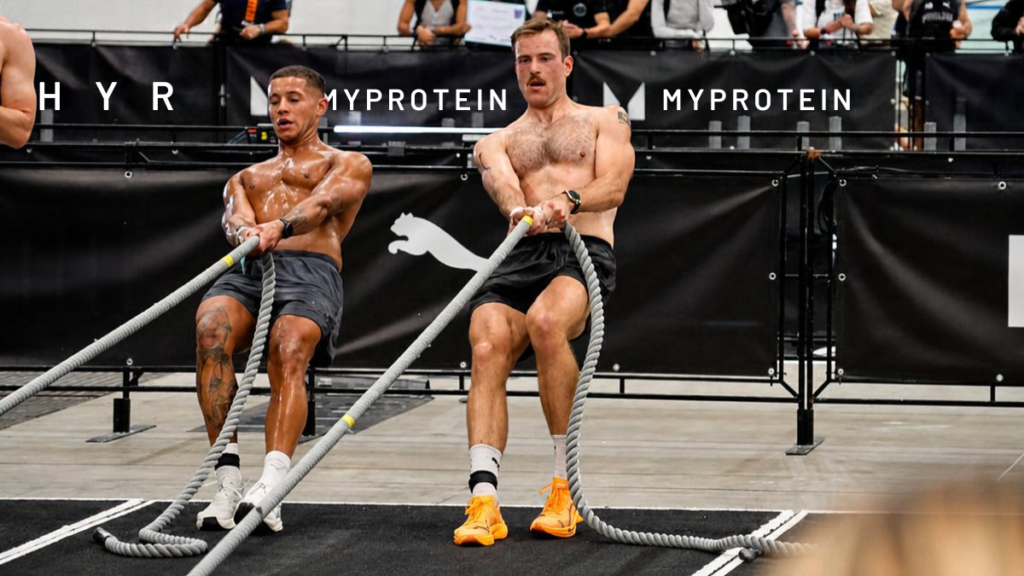


HYROX is not a traditional endurance race and it is not a pure strength competition. It is a demanding hybrid format that blends running with functional strength challenges that repeatedly stress the upper body. From sled pushes and pulls to farmers carries, wall balls, and burpee broad jumps, arm strength plays a critical role in performance.
Athletes often underestimate how much fatigue accumulates in the arms during a HYROX race. When grip fails or pushing power drops, overall performance declines sharply.


Improving arm strength for HYROX is not just about lifting heavier weights. It requires a strategic approach that integrates muscular strength, endurance, and neuromuscular efficiency. Scientific research shows that targeted resistance training, metabolic conditioning, and grip specific work can significantly enhance upper body performance under fatigue.
Understanding Arm Strength in HYROX
Before diving into the methods, it is important to understand what arm strength means in the context of HYROX. The arms are rarely working in isolation. Instead, they function as part of integrated movement patterns that involve the shoulders, back, and core.
Key Muscle Groups Involved
The primary muscles contributing to arm strength in HYROX include:
- Biceps brachii for pulling movements such as sled pulls
- Triceps brachii for pushing actions like sled pushes and wall balls
- Forearm flexors and extensors for grip endurance during carries
- Deltoids for shoulder stability and overhead work
- Latissimus dorsi for pulling strength and force transfer
Research in biomechanics demonstrates that compound upper body movements recruit multiple muscle groups simultaneously, increasing force production and efficiency. Multi joint coordination is essential for functional performance, especially in fatigue conditions.
The Role of Strength and Endurance
HYROX requires a blend of maximal strength and muscular endurance. Studies show that muscular endurance is highly correlated with repeated submaximal force output, which is exactly what athletes face during long race segments. At the same time, maximal strength provides a foundation that allows submaximal tasks to feel easier.
For example, if an athlete improves their maximal pulling strength, the relative intensity of a sled pull decreases. This reduces fatigue and improves overall efficiency.
Method 1: Build Foundational Strength with Compound Movements
The first and most important step is to develop a strong base using compound exercises. These movements train multiple muscle groups and closely mimic HYROX demands.
Why Compound Training Works
Compound exercises stimulate greater muscle activation and hormonal responses compared to isolation exercises. Research shows that multi joint movements increase testosterone and growth hormone levels, which support muscle development and strength gains.
They also improve intermuscular coordination, meaning the body learns to produce force more efficiently across different muscle groups.
Key Exercises for HYROX Arm Strength
Focus on the following movements:
- Pull ups and chin ups
- Bent over rows
- Deadlifts with a strong grip emphasis
- Push presses and overhead presses
- Dips and close grip bench press
These exercises target both pushing and pulling patterns while also engaging stabilizing muscles.
Programming for Strength
To maximize strength gains:
- Train 3 to 4 times per week
- Use loads between 70 and 90 percent of one repetition maximum
- Perform 3 to 5 sets of 4 to 8 repetitions
- Rest 2 to 3 minutes between sets
Research consistently shows that this loading range optimizes strength and hypertrophy adaptations.
Progressive Overload
Progressive overload is essential. Gradually increase the weight, volume, or intensity over time. Studies indicate that consistent overload is one of the primary drivers of muscle adaptation.
Transfer to HYROX Performance
Stronger athletes can produce higher force outputs with less effort. This means:
- Faster sled pushes
- More efficient sled pulls
- Better control during wall balls
Over time, this translates into reduced fatigue and improved race times.
Method 2: Develop Muscular Endurance and Fatigue Resistance
Strength alone is not enough. HYROX demands sustained effort over extended periods. Muscular endurance allows athletes to maintain output even when fatigued.
The Science of Muscular Endurance
Muscular endurance is influenced by several physiological factors:
- Increased mitochondrial density
- Enhanced capillary networks
- Improved energy efficiency within muscle fibers
Research shows that endurance training increases the ability of muscles to resist fatigue by improving oxygen delivery and utilization.
High Repetition Training
Incorporate higher repetition sets into your training:
- 12 to 20 repetitions per set
- Short rest intervals of 30 to 60 seconds
- Moderate loads around 50 to 70 percent of one repetition maximum
This type of training improves local muscular endurance and metabolic conditioning.
Circuit Training for HYROX Specificity
Circuit training closely mimics race conditions. Combine upper body exercises with minimal rest:
Example circuit:
- 15 wall balls
- 20 meter farmers carry
- 10 burpee broad jumps
- 12 push presses
Repeat for multiple rounds.
Studies show that circuit training enhances both aerobic and anaerobic capacity, making it ideal for hybrid competitions.
Lactate Tolerance and Performance
During high intensity efforts, lactate accumulates in the muscles, contributing to fatigue. Training under these conditions improves the body’s ability to buffer and clear lactate.
This allows athletes to sustain higher intensities for longer periods.
Practical Weekly Structure
- 2 endurance focused sessions per week
- Combine upper body and full body circuits
- Keep sessions between 20 and 40 minutes
Benefits for HYROX
Improved muscular endurance leads to:
- Less arm fatigue during long carries
- Better pacing during repeated efforts
- Higher consistency across all stations
Method 3: Strengthen Grip and Forearm Capacity
Grip strength is often the limiting factor in HYROX. When grip fails, performance drops regardless of overall strength.
Why Grip Strength Matters
Grip strength is strongly associated with overall strength and endurance. Research shows that grip strength correlates with performance in various athletic tasks, including pulling and carrying movements.

In HYROX, grip is essential for:
- Farmers carries
- Sled pulls
- Deadlifts
- Kettlebell holds
Types of Grip Strength
There are three main types:
- Crush grip for holding objects tightly
- Support grip for sustaining holds over time
- Pinch grip for holding objects between fingers and thumb
Each plays a role in competition.
Effective Grip Training Exercises
Incorporate the following:
- Farmers carries with heavy loads
- Dead hangs from a pull up bar
- Towel pull ups
- Plate pinches
- Thick bar training
Research shows that specific grip training improves forearm muscle activation and endurance.
Time Under Tension
Grip strength improves significantly with longer time under tension. For example:
- Hold carries for 30 to 60 seconds
- Perform hangs for maximum time
- Use slow controlled repetitions
Frequency and Progression
Train grip 2 to 3 times per week. Gradually increase load or duration.
Neuromuscular Adaptations
Grip training enhances neural drive to the forearm muscles, improving coordination and force production. This leads to better performance under fatigue.
Benefits for HYROX
- Reduced risk of dropping weights
- Improved control during carries
- Greater efficiency in pulling movements
Integrating the Three Methods
The most effective approach combines all three strategies into a structured training plan.
Weekly Example
- Day 1: Heavy compound strength training
- Day 2: Circuit based endurance training
- Day 3: Rest or active recovery
- Day 4: Strength training with grip emphasis
- Day 5: HYROX style conditioning session
- Day 6: Grip and accessory work
- Day 7: Rest
This structure ensures balanced development of strength, endurance, and grip capacity.
Recovery and Adaptation
Recovery is critical for progress. Studies show that adequate rest and nutrition are essential for muscle repair and growth.
Key recovery strategies:
- Sleep 7 to 9 hours per night
- Consume sufficient protein
- Manage training volume to avoid overtraining
Common Mistakes to Avoid
Overemphasis on Isolation Exercises
Isolation movements have value but should not replace compound training. HYROX requires integrated strength.
Neglecting Grip Training
Many athletes ignore grip until it becomes a weakness. Address it early.
Lack of Specificity
Training should reflect race demands. Generic workouts are less effective.
Insufficient Recovery
Without proper recovery, performance gains plateau.
Final Thoughts
Enhancing arm strength for HYROX requires a targeted and science based approach. By building foundational strength, improving muscular endurance, and developing grip capacity, athletes can significantly improve performance.
The key is consistency and intelligent programming. Focus on movements that transfer directly to competition, train under fatigue, and progressively challenge the muscles.
With the right approach, stronger arms will not just improve individual stations but elevate overall race performance.
Key Takeaways
| Strategy | What to Focus On | Key Benefit |
|---|---|---|
| Compound Strength Training | Pull ups, rows, presses, heavy loads | Increased force production and efficiency |
| Muscular Endurance Training | High rep sets, circuits, short rest | Better fatigue resistance and pacing |
| Grip Strength Development | Carries, hangs, grip specific work | Improved control and sustained performance |
References
- American College of Sports Medicine (2009) Progression models in resistance training for healthy adults. Medicine and Science in Sports and Exercise, 41(3), pp. 687–708.
- Baar, K. (2014) Using molecular biology to maximize concurrent training. Sports Medicine, 44(2), pp. 117–125.
- Campos, G.E. et al. (2002) Muscular adaptations in response to three different resistance training regimens. Journal of Applied Physiology, 88(1), pp. 50–60.
- Fry, A.C. (2004) The role of resistance exercise intensity on muscle fibre adaptations. Sports Medicine, 34(10), pp. 663–679.
- Hickson, R.C. (1980) Interference of strength development by simultaneously training for strength and endurance. European Journal of Applied Physiology, 45(2), pp. 255–263.
- Kraemer, W.J. and Ratamess, N.A. (2004) Fundamentals of resistance training. Medicine and Science in Sports and Exercise, 36(4), pp. 674–688.
- McGill, S.M. (2010) Core training evidence translating to better performance and injury prevention. Strength and Conditioning Journal, 32(3), pp. 33–46.