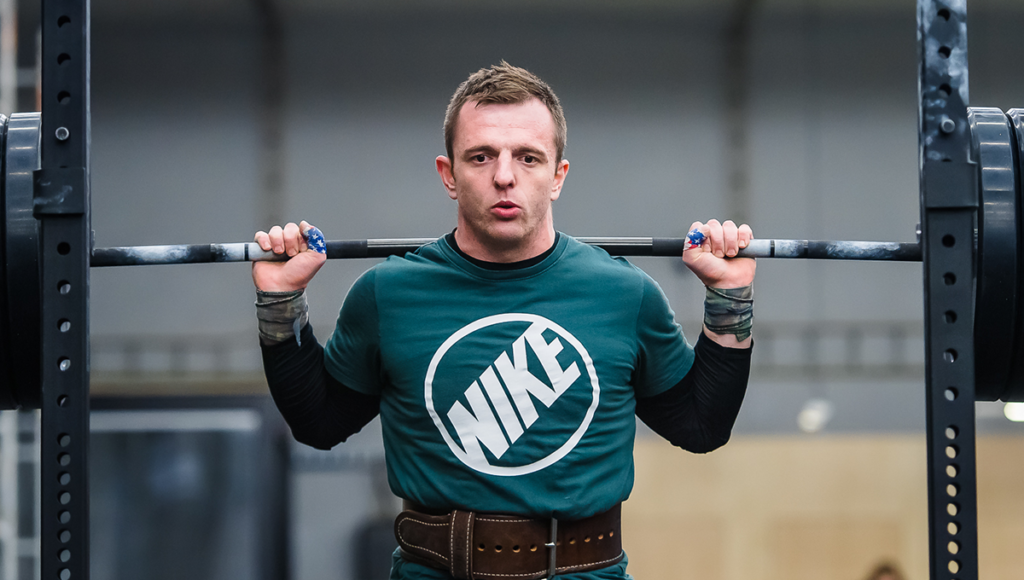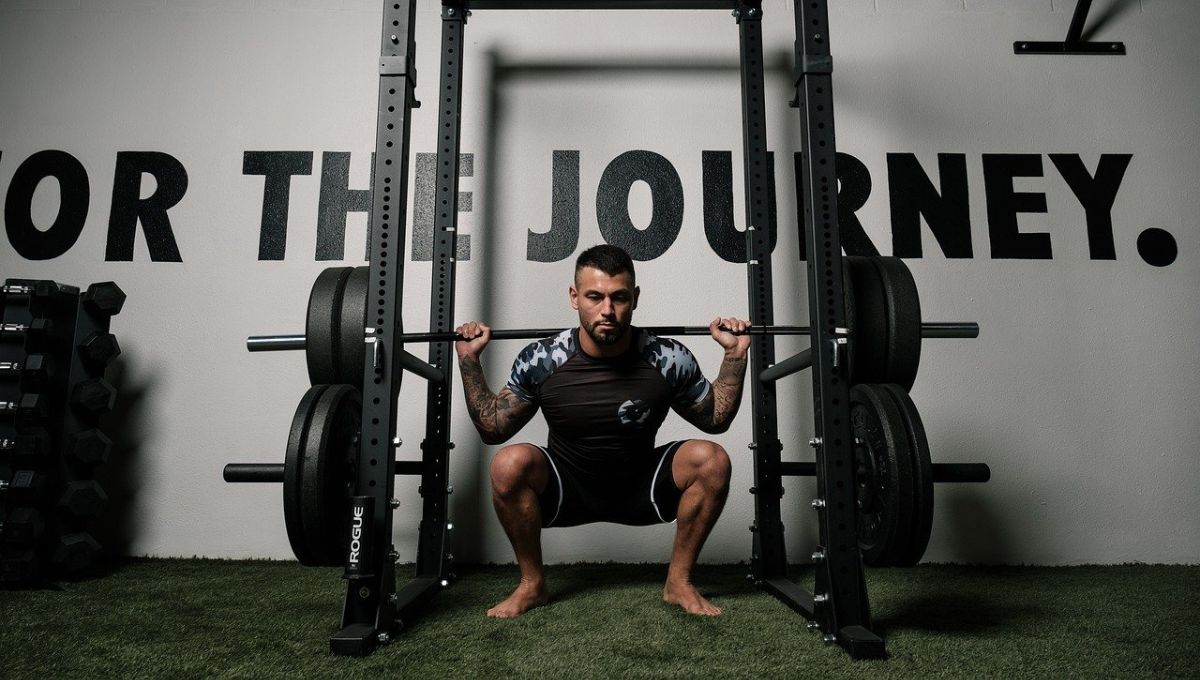


The back squat is one of the most effective exercises for building strength, muscle, athletic performance, and long term health. It trains nearly every major muscle group in the lower body while challenging the core, improving coordination, and developing force production that transfers to sports and daily life.
Yet despite its reputation, most men never develop a genuinely strong back squat. Many spend years training without making meaningful progress. Some remain stuck at the same weight for months. Others avoid heavy squats altogether because they feel uncomfortable, intimidating, or technically difficult.



The interesting part is that genetics are rarely the main reason. Research consistently shows that progressive resistance training produces substantial improvements in strength across different ages and training backgrounds when programs are designed correctly.
If your squat has stalled, the problem is usually not your potential. It is more likely your approach. Here are three evidence based reasons why most men never build an impressive back squat and what separates the people who do.
Why the Back Squat Matters
The back squat is often called the king of exercises because it demands coordinated effort from the quadriceps, glutes, hamstrings, adductors, calves, spinal erectors, and core musculature. Unlike machine exercises, it requires the body to stabilize a heavy external load through multiple joints simultaneously.
Studies have repeatedly shown that multi joint resistance exercises like the squat stimulate high levels of muscle activation while promoting increases in maximal strength and lean muscle mass.
3 Best Exercises for Super Jacked Serratus Anterior Muscles
Strong squat performance is also linked with improved athletic qualities. Research has demonstrated relationships between squat strength and sprint speed, vertical jump performance, and overall lower body power. Perhaps even more importantly, resistance training involving compound movements supports bone health, metabolic function, and functional independence throughout life. The squat is not simply about lifting impressive numbers. It is about building a stronger, more capable body.
Reason 1: They Never Apply Progressive Overload Correctly
Most men understand that they should “lift heavier over time,” but very few actually follow a structured progression.
Instead, many approach squats emotionally rather than systematically. One week they attempt a personal record. The following week they reduce the weight dramatically because they feel tired. Sometimes they skip squats altogether because another workout seemed more exciting. This inconsistency prevents long term adaptation.
Strength Is an Adaptation to Stress
The human body becomes stronger because it adapts to gradually increasing mechanical stress. When muscles, connective tissues, and the nervous system experience workloads beyond what they have previously handled, they adapt by becoming stronger and more efficient. Research on resistance training consistently identifies progressive overload as one of the primary drivers of strength development.
Progressive overload does not always mean adding more weight every workout. It can also involve increasing repetitions, performing additional sets, improving technique, reducing rest periods when appropriate, or increasing training quality. The important point is that training becomes progressively more challenging over time.
Random Training Produces Random Results
Many recreational lifters squat based entirely on how motivated they feel. If they feel energetic, they load the bar heavily. If not, they stop early or replace squats with easier exercises. Research examining structured resistance training programs consistently shows superior strength gains compared with unplanned training because progression is managed rather than left to chance.
Experienced strength athletes rarely guess. They follow programs that gradually increase workload while incorporating recovery periods to prevent excessive fatigue.
The Nervous System Learns Too
Strength improvements during the early phases of training are driven largely by neural adaptations rather than muscle growth alone. Research has shown improvements in motor unit recruitment, firing frequency, and coordination following resistance training. In simple terms, your brain becomes better at activating the muscles needed for a powerful squat.
These adaptations require repeated practice under consistent conditions. If you only squat once every few weeks or constantly change your exercise selection, your nervous system never becomes highly skilled at the movement. Consistency builds efficiency.
Reason 2: They Prioritize Weight Over Technique
The internet has made lifting impressive numbers more visible than ever before. Unfortunately, it has also encouraged many lifters to chase heavier loads before mastering sound movement. Poor technique limits long term progress far more than most people realize.
Efficient Movement Creates Greater Force
An effective squat depends on coordinated movement across the hips, knees, ankles, and trunk. The exact technique varies depending on individual anatomy, mobility, and limb proportions. There is no universally perfect squat style. However, research consistently shows that maintaining spinal stability while allowing coordinated movement at the hips and knees improves force production and reduces unnecessary stress on passive structures.
Lifters who maintain balance, brace effectively, and move with control typically lift more weight over time than those who sacrifice positioning for heavier loads.
Depth Matters More Than Ego
Many lifters perform partial squats simply because they can use more weight. Partial range training has specific applications for advanced athletes, but studies comparing full squats with partial squats generally show that full range resistance training produces greater improvements in muscle development, mobility, and overall strength across larger movement ranges. Reaching an appropriate depth also increases activation of the gluteal muscles and adductors while promoting balanced lower body development.
The goal is not necessarily to force every athlete into an identical position. The goal is to achieve the deepest safe squat your mobility and anatomy allow while maintaining good control.
Mobility Is Often Overlooked
Many men blame weak legs when the real issue is limited ankle or hip mobility. Restricted ankle dorsiflexion often leads to excessive forward lean or heels lifting from the floor. Limited hip mobility may alter movement patterns and reduce stability.
Research indicates that improving mobility can enhance squat mechanics and movement quality, although mobility alone is not enough. Technique practice and strength development must occur together. Strong squatters usually spend time improving movement quality instead of simply forcing heavier weights onto the bar.
How Many Sit Ups Should You Be Able to Do Based on Your Age?
Reason 3: They Recover Poorly Between Sessions
Training creates the stimulus for adaptation. Recovery allows adaptation to happen. Without adequate recovery, performance eventually plateaus regardless of how hard someone trains.
Muscle Grows Outside the Gym
Resistance training causes microscopic damage to muscle fibers along with significant metabolic stress. Recovery allows protein synthesis to repair and strengthen these tissues. Research consistently shows that dietary protein supports muscle protein synthesis after resistance exercise. Daily protein intake becomes particularly important for maximizing muscle growth and recovery.
Most evidence suggests active individuals benefit from higher protein intakes than the general population, particularly when trying to maximize muscle hypertrophy. Without sufficient nutrition, progress slows dramatically.
Sleep Is a Performance Enhancer
Sleep is often treated as optional, yet it may be one of the most powerful recovery tools available. Research has linked sleep restriction with reduced strength performance, impaired recovery, slower reaction times, and less favorable hormonal responses.

During sleep, numerous physiological processes support tissue repair, learning, and recovery from heavy training. Athletes who consistently sleep well often recover faster and perform better during subsequent training sessions. The strongest squatters usually protect their sleep with the same discipline they apply to training.
Fatigue Can Hide Fitness
One common mistake is assuming that poor performance always means strength has disappeared. In reality, accumulated fatigue often masks existing fitness. Research on periodization demonstrates that planned reductions in training volume allow fatigue to decrease while preserving strength adaptations. This often results in improved performance after a recovery phase.
Deload weeks are not signs of weakness. They are part of intelligent programming.
What Strong Squatters Do Differently
The men who eventually build impressive squats usually share similar habits.
- They treat technique as a skill that requires continual practice.
- They train consistently instead of relying on motivation.
- They follow structured progression rather than chasing random personal records.
- They eat enough protein to support recovery.
- They prioritize sleep.
- They accept that progress takes years rather than weeks.
- Perhaps most importantly, they understand that setbacks are normal.
Every experienced lifter has endured stalled progress, difficult training cycles, and disappointing sessions. What separates successful athletes is that they continue showing up and following the process.
How Strong Is a Strong Back Squat?
Many people wonder what qualifies as an impressive squat. There is no single answer because body weight, age, training experience, and sport all influence performance. For a healthy recreational male, squatting approximately 1.5 times body weight represents a solid level of strength. Reaching double body weight is generally considered an advanced achievement requiring years of dedicated training.
Elite powerlifters often exceed these numbers substantially, but comparing yourself with world class athletes is rarely productive. The better comparison is your previous self. If your squat continues improving over time while your technique remains solid, you are moving in the right direction.
The Bottom Line
Building a strong back squat is rarely about discovering a hidden training trick. It comes down to consistently applying principles that sports science has supported for decades. Progressive overload drives adaptation.
Good technique improves efficiency and long term development. Recovery allows strength gains to occur between workouts. Most men struggle because they neglect one or more of these foundations. They train inconsistently, prioritize ego over movement quality, or fail to recover adequately.
The men who become exceptional squatters are usually not doing extraordinary things. They simply perform the ordinary things extraordinarily well, week after week, month after month, and year after year. If you commit to structured progression, refine your technique, and recover as seriously as you train, there is an excellent chance your strongest squat is still ahead of you.
Key Takeaways
| Key Point | Why It Matters |
|---|---|
| Progressive overload is essential | Gradually increasing training demands drives long term strength gains. |
| Technique should come before heavier loads | Efficient movement improves performance while reducing unnecessary injury risk. |
| Full range squats offer broad benefits | Appropriate squat depth supports muscle development, mobility, and functional strength. |
| Recovery determines adaptation | Sleep, nutrition, and planned recovery allow muscles and the nervous system to become stronger. |
| Consistency beats motivation | Regular structured training produces better long term results than occasional hard workouts. |
| Strength takes time | Building an advanced back squat typically requires years of disciplined training. |
References
- American College of Sports Medicine. (2009). American College of Sports Medicine position stand. Progression models in resistance training for healthy adults. Medicine & Science in Sports & Exercise, 41(3), pp.687 to 708.
- Ahtiainen, J.P., Pakarinen, A., Alen, M., Kraemer, W.J. and Häkkinen, K. (2003). Muscle hypertrophy, hormonal adaptations and strength development during strength training in strength trained and untrained men. European Journal of Applied Physiology, 89(6), pp.555 to 563.
- Bird, S.P., Tarpenning, K.M. and Marino, F.E. (2005). Designing resistance training programmes to enhance muscular fitness. Sports Medicine, 35(10), pp.841 to 851.
- Bloomquist, K., Langberg, H., Karlsen, S., Madsgaard, S., Boesen, M. and Raastad, T. (2013). Effect of range of motion in heavy load squatting on muscle and tendon adaptations. European Journal of Applied Physiology, 113(8), pp.2133 to 2142.
- Cormie, P., McBride, J.M. and McCaulley, G.O. (2009). Power time, force time, and velocity time curve analysis of the countermovement jump. Journal of Strength and Conditioning Research, 23(1), pp.177 to 186.
- Grgic, J., Lazinica, B., Mikulic, P., Schoenfeld, B.J. and Pedisic, Z. (2022). Effects of resistance training performed to repetition failure or non failure on muscular strength and hypertrophy. Journal of Sport and Health Science, 11(2), pp.202 to 211.
- Häkkinen, K., Pakarinen, A., Alen, M., Kauhanen, H. and Komi, P.V. (1988). Neuromuscular and hormonal adaptations in athletes to strength training in two years. Journal of Applied Physiology, 65(6), pp.2406 to 2412.
- Kraemer, W.J. and Ratamess, N.A. (2004). Fundamentals of resistance training. Progression and exercise prescription. Medicine & Science in Sports & Exercise, 36(4), pp.674 to 688.