

The bodyweight squat is one of the simplest exercises you can do, yet it reveals a surprising amount about your fitness. It tests lower body muscular endurance, coordination, mobility, balance, and even cardiovascular fitness when performed for higher repetitions. Whether you train in CrossFit, lift weights, run, or simply want to stay healthy, knowing how many bodyweight squats you should be able to perform provides a useful benchmark.
Unlike maximal strength tests such as a one repetition maximum squat, bodyweight squats are accessible to almost everyone. They require no equipment and can be performed almost anywhere. That makes them an excellent way to assess functional fitness across different ages and experience levels.



There is no single perfect number because factors such as age, body weight, sex, training history, and squat technique all influence performance. However, research on muscular endurance and physical fitness provides enough evidence to establish realistic standards for healthy adults.
Why Bodyweight Squats Matter
Squats mimic one of the most fundamental human movement patterns. Every time you stand up from a chair, pick something up from the floor, or climb stairs, you perform a variation of a squat.
Strong legs contribute to athletic performance, independence in older adults, injury prevention, and long term health. Lower body strength is strongly associated with improved mobility and lower risk of disability later in life.
Muscular endurance, which is your ability to repeatedly produce force over time, also plays an important role in everyday activities and sports. Research consistently shows that greater muscular endurance is associated with improved functional capacity and reduced fatigue during daily tasks.
3 Best Beginner Exercises for Ripped and Attractive Abs
Unlike heavy barbell squats, bodyweight squats primarily test muscular endurance rather than maximal strength. They challenge the quadriceps, glutes, hamstrings, calves, and core while requiring coordinated movement across multiple joints.
What Does Science Say About Muscular Endurance?
The American College of Sports Medicine recognizes muscular endurance as one of the five essential components of health related fitness alongside cardiovascular endurance, muscular strength, flexibility, and body composition.
Muscular endurance reflects how long muscles can continue working before fatigue sets in. This quality becomes increasingly important for recreational athletes and for maintaining independence as people age. Research has demonstrated that muscular endurance training improves mitochondrial function, increases capillary density within muscles, and enhances fatigue resistance. These adaptations make everyday movement easier while also improving athletic performance.
Bodyweight squats offer a practical way to assess this quality because they involve large muscle groups working together repeatedly.
How Many Bodyweight Squats Should You Be Able to Do?
The following standards assume you perform continuous bodyweight squats with good technique, reaching approximately parallel or slightly below parallel while maintaining control throughout each repetition.
Beginners
If you can perform 20 to 30 consecutive bodyweight squats with solid form, you have established a reasonable baseline level of lower body endurance.
For someone new to exercise, this demonstrates adequate muscular endurance and coordination. It also provides a strong starting point for future improvements.
Intermediate
Completing 40 to 60 continuous squats with consistent technique indicates above average muscular endurance.
Most recreationally active adults who strength train regularly or participate in activities such as hiking, CrossFit, cycling, or running should comfortably reach this range.
Advanced
Performing 75 to 100 controlled repetitions demonstrates excellent lower body endurance.
Athletes in sports requiring repeated leg effort often exceed this range while maintaining good movement quality.
Elite
More than 100 consecutive bodyweight squats performed with proper depth and technique reflects exceptional muscular endurance. This level is typically seen in highly conditioned endurance athletes, CrossFit competitors, military personnel, or individuals who specifically train high repetition exercises.

General Fitness Standards
The following table provides practical benchmarks for healthy adults.
Bodyweight Squat Standards
| Performance Level | Consecutive Squats |
|---|---|
| Poor | Fewer than 20 |
| Fair | 20 to 30 |
| Good | 31 to 50 |
| Very Good | 51 to 75 |
| Excellent | 76 to 100 |
| Exceptional | More than 100 |
These numbers assume proper squat mechanics throughout the entire test. Partial repetitions or poor movement quality should not count toward your total.
Technique Matters More Than Repetitions
A hundred shallow squats are far less valuable than fifty technically sound repetitions.
- Each squat should include the following characteristics.
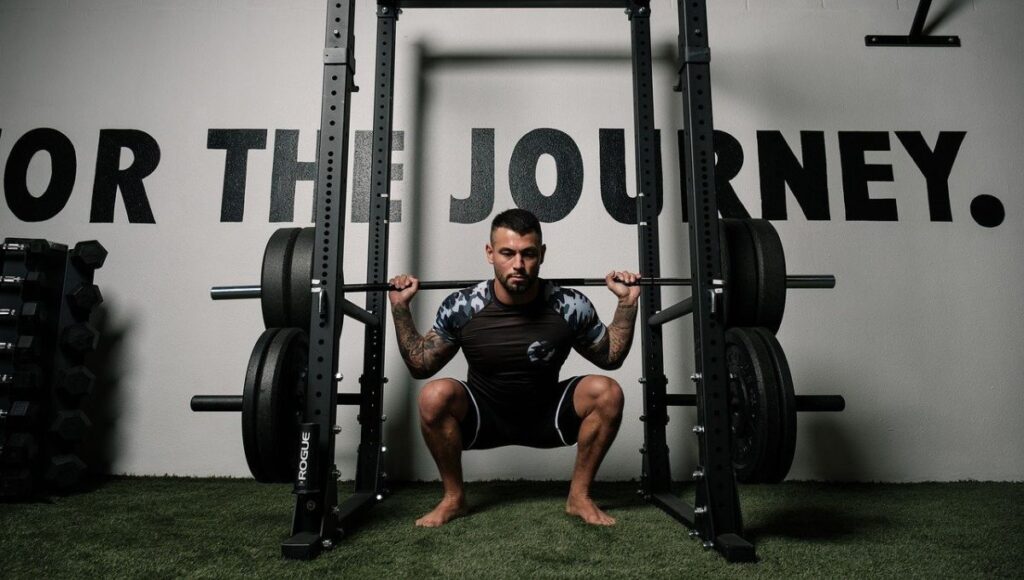
- Begin standing tall with your feet approximately shoulder width apart.
- Initiate the movement by bending at the hips and knees simultaneously.
- Lower until your thighs are at least parallel to the floor if your mobility allows.
- Keep your heels flat on the ground.
- Maintain a neutral spine throughout the movement.
- Drive evenly through both feet to return to standing.
Poor technique not only reduces the value of the assessment but may also increase injury risk over time.
Common Mistakes That Limit Performance
Many people stop their squat test because technique deteriorates rather than because their muscles are completely fatigued. The most common errors include allowing the knees to collapse inward, lifting the heels from the floor, rounding the lower back, shortening the range of motion, or losing balance. Improving ankle mobility, hip mobility, and core stability often increases squat performance without any additional strength training.
Does Age Affect Squat Performance?
Absolutely. Muscle mass naturally declines with age through a process known as sarcopenia. Strength and muscular endurance gradually decrease, particularly after the age of 50. However, regular resistance training dramatically slows these changes.
Research consistently shows that older adults who perform strength training maintain significantly better lower body function than inactive individuals of the same age. Healthy adults in their sixties and seventies who train regularly often outperform sedentary people decades younger.
Rather than comparing yourself to elite athletes, compare yourself to your previous performance. Maintaining or improving your squat numbers over time is a strong indicator of healthy aging.
Why Strong Legs Matter for Long Term Health
Lower body strength is one of the strongest predictors of future health outcomes. Numerous studies have linked stronger leg muscles with lower mortality risk, improved metabolic health, reduced fall risk, and greater independence during aging.
Large muscles such as the quadriceps and glutes also play an important role in glucose regulation because they store significant amounts of glycogen and improve insulin sensitivity following exercise. Regular squat training therefore benefits far more than athletic performance.
Bodyweight Squats and Cardiovascular Fitness
Although squats primarily assess muscular endurance, performing high repetitions also challenges the cardiovascular system. Heart rate rises rapidly during continuous squatting because multiple large muscle groups require oxygen simultaneously.
Research shows that circuit based resistance exercise can improve both muscular endurance and cardiovascular fitness, particularly in beginners and intermediate exercisers. If you find yourself breathing heavily after fifty squats, your heart and lungs are contributing just as much as your leg muscles.
When More Repetitions Stop Being Useful
There comes a point where chasing ever higher repetition numbers provides diminishing returns. If you can already perform one hundred quality squats, additional endurance offers relatively little practical benefit for most people.
At that stage, increasing strength through loaded squats may provide greater improvements in athletic performance, bone density, muscle growth, and functional capacity. Elite endurance remains impressive, but balanced fitness includes strength, power, mobility, flexibility, and cardiovascular conditioning.
The Bottom Line
Most healthy adults should aim to perform at least thirty consecutive bodyweight squats with excellent technique. Reaching fifty repetitions indicates good lower body endurance, while seventy five or more demonstrates excellent conditioning.
Remember that quality always outweighs quantity. Controlled repetitions performed through a full range of motion provide a much more meaningful assessment than rushed partial squats.
Bodyweight squats are simple, free, and highly effective as a measure of lower body fitness. Whether your goal is improving athletic performance, staying independent as you age, or simply becoming healthier, regularly testing and improving your squat endurance is a worthwhile investment.
Key Takeaways
| Topic | Key Takeaway |
|---|---|
| Minimum goal | Most healthy adults should aim for at least 30 consecutive bodyweight squats with proper form. |
| Good fitness | Completing 50 repetitions demonstrates solid lower body muscular endurance. |
| Excellent fitness | Performing 75 to 100 repetitions indicates excellent conditioning. |
| Elite level | More than 100 quality repetitions reflects exceptional muscular endurance. |
| Technique | Full depth, controlled movement, and proper alignment matter more than repetition count. |
| Health benefits | Strong legs support mobility, metabolic health, independence, and athletic performance. |
| Improvement | Combine strength training with higher repetition squat practice for the fastest progress. |
| Testing frequency | Retest every four to six weeks under similar conditions to monitor improvement. |
References
- American College of Sports Medicine. (2021). ACSM’s Guidelines for Exercise Testing and Prescription. 11th ed. Philadelphia: Wolters Kluwer.
- Aagaard, P., Suetta, C., Caserotti, P., Magnusson, S.P. and Kjaer, M. (2010). Role of the nervous system in sarcopenia and muscle atrophy with aging. Journal of Gerontology Series A: Biological Sciences and Medical Sciences, 65(10), pp.1001 to 1008.
- Fragala, M.S., Cadore, E.L., Dorgo, S., Izquierdo, M., Kraemer, W.J., Peterson, M.D. and Ryan, E.D. (2019). Resistance training for older adults. Journal of Strength and Conditioning Research, 33(8), pp.2019 to 2052.
- Garber, C.E., Blissmer, B., Deschenes, M.R., Franklin, B.A., Lamonte, M.J., Lee, I.M., Nieman, D.C. and Swain, D.P. (2011). American College of Sports Medicine position stand. Quantity and quality of exercise for developing and maintaining cardiorespiratory, musculoskeletal, and neuromotor fitness. Medicine and Science in Sports and Exercise, 43(7), pp.1334 to 1359.
- McLeod, J.C., Stokes, T. and Phillips, S.M. (2019). Resistance exercise training as a primary countermeasure to age related chronic disease. Frontiers in Physiology, 10, Article 645.
- Peterson, M.D., Rhea, M.R. and Sen, A. (2010). Resistance exercise for muscular strength in older adults. Ageing Research Reviews, 9(3), pp.226 to 237.