

Fitness is not only about lifting heavy weights, running fast, or having visible muscle definition. It is also about how easily you move through daily life. The ability to walk with purpose, climb stairs, carry bags, rise from the floor, and balance on one leg reflects a mix of strength, endurance, coordination, mobility, and confidence.
These everyday tasks are not medical tests, and no single task can diagnose your health or determine your fitness level. Age, height, body size, injury history, chronic conditions, and physical activity experience all affect performance. Still, researchers often use simple functional tasks to assess physical capacity because they reflect abilities people need outside the gym.


The best sign of fitness is not whether you can match somebody else’s performance. It is whether you can complete normal tasks comfortably, safely, and with enough physical reserve that they do not leave you exhausted or worried about your body.
Here are five everyday tasks that can reveal a surprising amount about your general fitness.
1. Walking Briskly Without Becoming Overly Breathless
Walking is one of the most basic forms of human movement, but a brisk walk can reveal a lot about aerobic fitness, leg strength, balance, coordination, and overall physical function. Gait speed is commonly used in research because it is strongly associated with health outcomes and survival in older adults.
A brisk walk does not mean sprinting down the sidewalk. It means moving at a purposeful pace where you feel your heart rate rise and your breathing become deeper, but you can still speak in short sentences. If you can maintain that pace for a meaningful amount of time without severe breathlessness, leg pain, or loss of balance, it is generally a positive sign of functional capacity.

Walking requires more than cardiovascular fitness. Your hips, legs, feet, and trunk must absorb force repeatedly. Your nervous system must coordinate each step, while your balance system keeps you upright as your body moves forward.
Research has found that faster habitual walking speed is associated with better survival in older adults. This does not mean walking fast guarantees a longer life. It means walking speed is a useful marker because it reflects several important physical systems working together.
What to Notice During a Brisk Walk
Pay attention to how your body feels after ten to twenty minutes of purposeful walking. You should expect some increase in breathing and body temperature. However, severe shortness of breath, chest pain, dizziness, or symptoms that feel unusual should be assessed by a qualified health professional.
A good sign of fitness is being able to walk at a steady pace while keeping an upright posture and even stride. You should not need to stop frequently because your legs feel heavy or your breathing becomes overwhelming.
If brisk walking feels difficult, begin with shorter walks at a comfortable pace. Adding only a few minutes each week can improve aerobic capacity and make daily movement feel easier.
2. Climbing Several Flights of Stairs With Control
Stair climbing is a demanding daily task because it requires you to lift your bodyweight upward with every step. Your quadriceps, glutes, calves, and trunk muscles all contribute, while your heart and lungs must deliver energy to working muscles.
Climbing stairs is more demanding than level walking because each step requires more force from the lower body. It challenges leg strength, balance, coordination, and cardiovascular fitness at the same time. This is why stair climbing ability is often used as a functional test in clinical and exercise settings.
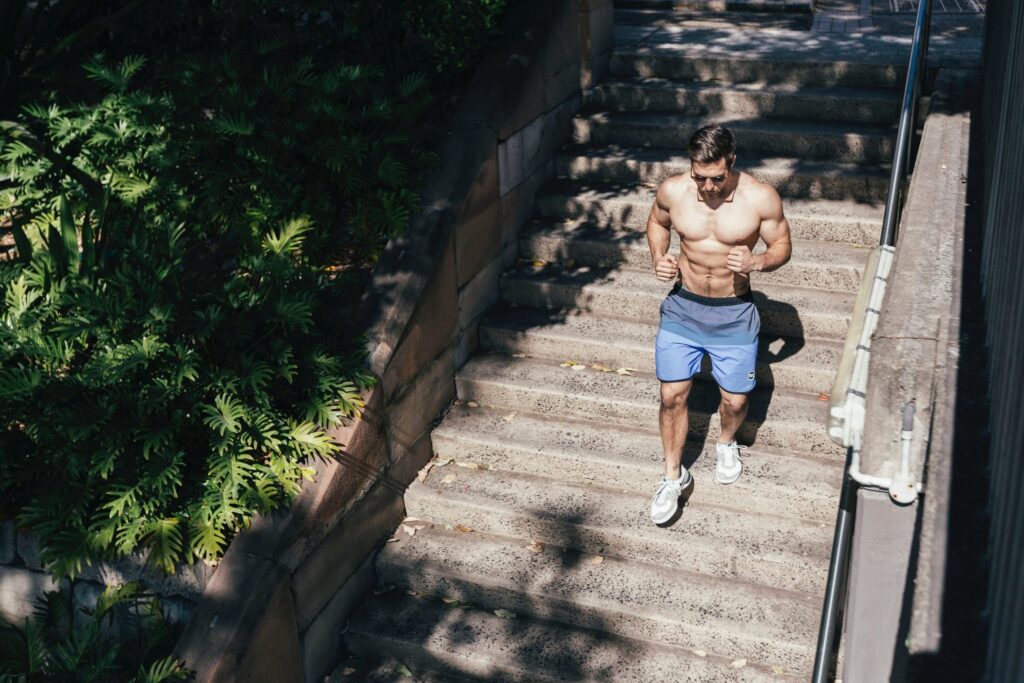
A good sign of fitness is being able to climb a few flights of stairs at a steady pace without needing a long recovery afterward. You may breathe harder, especially if you climb quickly, but you should regain comfortable breathing within a reasonable period after reaching the top.
Research using stair climbing tests has shown that stair climbing performance reflects lower body power and functional mobility. Power is the ability to produce force quickly. It matters because many real life movements require you to create force rapidly, such as stepping onto a curb, catching your balance, or climbing stairs when carrying something.
How to Use Stairs as a Fitness Check
Do not turn every staircase into a maximum effort test. Instead, notice whether stairs feel manageable during normal life. Can you climb without gripping the rail tightly for support? Can you maintain a steady rhythm? Can you continue walking normally once you reach the top?
If stairs are challenging, strength training can help. Squats, stepups, split squats, lunges, and calf raises train many of the muscles needed for stair climbing. Regular walking and cycling can also improve your ability to tolerate the cardiovascular demand.
3. Rising From a Chair Without Using Your Hands
Standing up from a chair looks simple, but it requires useful lower body strength. Your quadriceps and glutes must produce enough force to lift your bodyweight, while your trunk and feet keep you balanced.
The sit to stand movement is often used in research and clinical practice to assess lower body function. The ability to rise repeatedly from a chair is associated with leg strength and general functional capacity, especially as people age.
A good sign of fitness is being able to rise from a standard chair without pushing off the armrests or using your hands on your thighs. You should also be able to control the descent when sitting back down. Lowering yourself slowly requires eccentric strength, which means the leg muscles create force while lengthening.
3 Best Beginner Exercises for Wider and More Attractive Shoulders
This task becomes more demanding when the chair is low, soft, or deep. It also becomes harder if your hips, knees, or ankles are stiff. That is why comparing your own performance over time is more useful than judging yourself against someone with different body proportions or mobility.
How to Improve Chair Rise Strength
If standing from a chair feels difficult, practice the movement directly. Begin from a higher chair or use your hands lightly for assistance. Over time, use less assistance and move toward a lower surface.
Squats, box squats, split squats, and stepups are also excellent exercises for building the strength needed to rise from a chair. Start with a range of motion that feels comfortable and progress gradually.
A strong chair rise is a practical sign that your legs can handle one of the most common daily tasks with less effort.
4. Carrying Groceries Without Losing Posture
Carrying grocery bags, luggage, laundry, or a child requires grip strength, shoulder strength, trunk stability, and walking control. It may not look like a fitness test, but it combines several qualities that matter in real life.

Your grip must hold the load securely. Your shoulders and upper back must keep the arms in position. Your trunk muscles must resist leaning, twisting, or collapsing toward one side. Your legs must continue producing stable walking steps while the load changes your balance.
Research has shown that grip strength is associated with important health outcomes and physical function. Grip strength is not the only quality that matters, and it does not directly cause better health. It is useful because it often reflects broader muscular strength and the ability to perform physical tasks.
A good sign of fitness is being able to carry moderately heavy bags for a reasonable distance without your hands failing, your shoulders rising toward your ears, or your torso leaning dramatically. Carrying an uneven load can be especially revealing because it challenges the trunk to stay stable against side to side forces.
How to Improve Carrying Capacity
Loaded carries are one of the most direct ways to improve this ability. Hold a kettlebell, dumbbell, or other safe object in one or both hands, then walk slowly with good posture. Farmer carries use a load in each hand. Suitcase carries use a load on one side.
Start with a weight that allows you to walk normally for twenty to forty seconds. Keep your shoulders level, breathe steadily, and avoid leaning away from the load. Increase weight or distance only when you can maintain a controlled posture.
Rows, deadlifts, pullups, and grip exercises can also support stronger carrying performance by building the upper back, forearms, and hands.
5. Getting Up From the Floor With Control
The ability to get down to the floor and stand back up is a remarkably useful sign of whole body fitness. This task requires leg strength, hip mobility, balance, trunk control, coordination, and confidence moving through different positions.
Many adults rarely sit on the floor, kneel, crawl, or practice standing up from the ground. As a result, the movement can feel awkward even when they are otherwise active. That does not automatically mean they are unfit, but it can reveal a gap in mobility, strength, or movement skill.
Research using the sitting rising test has found that the ability to sit on the floor and rise with minimal support is associated with survival in middle aged and older adults. Again, this is an association, not a promise. The test reflects several physical qualities at once, which makes it useful as a broad marker of function.
A good sign of fitness is being able to lower yourself to the floor and return to standing without needing furniture or another person for assistance. Using one hand or knee for support is completely normal for many people. The goal is not perfection. The goal is to maintain and improve your personal ability over time.
How to Improve Floor Mobility
Practice getting down to and up from the floor in a safe space. Start near a sturdy chair, couch, or wall if you need support. Use a half kneeling position, where one knee is down and one foot is planted, before standing up.
Split squats, stepups, lunges, hip bridges, and balance exercises can all help improve the strength and control needed for floor transitions. The most specific practice, however, is simply practicing the movement itself.
Do not rush. The floor rise should be controlled and steady, not explosive. If you experience dizziness, pain, or loss of balance, use support and seek individual guidance if the issue continues.
Why Everyday Fitness Matters
Gym performance is useful, but it is only one expression of physical capacity. Everyday tasks show whether you can apply strength, balance, endurance, and coordination in practical situations.
The ability to walk briskly, climb stairs, rise from a chair, carry loads, and stand up from the floor can help you stay independent and active throughout life. These tasks also provide clear feedback. If one begins to feel harder than it used to, that is a useful signal to become more active or return to structured strength and conditioning work.
Research supports regular physical activity and resistance training for improving strength, function, and health. You do not need an extreme program. Consistent walking, strength training, and practice with basic movement patterns can produce meaningful improvements.
Final Thoughts
Everyday tasks can reveal more about your fitness than you might expect. Walking briskly, climbing stairs, rising from a chair, carrying groceries, and getting up from the floor all require the body to combine strength, balance, endurance, and coordination.
They are not pass or fail tests. They are practical indicators that can help you notice your current strengths and the areas that deserve more attention. Train consistently, move often, and focus on becoming more capable in the tasks that matter most in your everyday life.
Key Takeaways
| Everyday task | Fitness qualities involved | Positive sign | Useful training options |
|---|---|---|---|
| Brisk walking | Aerobic fitness, leg endurance, balance | You can maintain a purposeful pace without excessive breathlessness | Walking, cycling, and gradual aerobic training |
| Stair climbing | Leg strength, power, aerobic capacity | You can climb several flights with control and recover comfortably | Stepups, squats, split squats, and walking |
| Rising from a chair | Quadriceps and glute strength, balance | You can stand and sit with control without using your hands | Squats, box squats, and stepups |
| Carrying groceries | Grip, upper back, trunk stability, walking control | You can carry loads without major leaning or grip failure | Farmer carries, suitcase carries, rows, and deadlifts |
| Standing from the floor | Leg strength, mobility, balance, coordination | You can return to standing with minimal support | Lunges, split squats, balance work, and floor transition practice |
References
- Araujo, C.G.S., Ribeiro, A.L.P., Miranda, V.A., Rocha, N.Z., Silva Dias, L. and Ribeiro, L.S. (2012) ‘Ability to sit and rise from the floor as a predictor of all cause mortality’, European Journal of Preventive Cardiology, 19(5), pp. 892 to 898.
- Araujo, C.G.S., de Souza e Silva, C.G. and Laukkanen, J.A. (2022) ‘Successful 10 second one leg stance performance predicts survival in middle aged and older individuals’, British Journal of Sports Medicine, 56(17), pp. 975 to 980.
- Bean, J.F., Kiely, D.K., LaRose, S., Alian, J. and Frontera, W.R. (2002) ‘Is stair climb power a clinically relevant measure of leg power impairments in at risk older adults?’, Archives of Physical Medicine and Rehabilitation, 83(5), pp. 604 to 609.
- Jones, C.J., Rikli, R.E. and Beam, W.C. (1999) ‘A 30 second chair stand test as a measure of lower body strength in community residing older adults’, Research Quarterly for Exercise and Sport, 70(2), pp. 113 to 119.
- Leong, D.P., Teo, K.K., Rangarajan, S., Lopez Jaramillo, P., Avezum, A., Orlandini, A., Seron, P., Ahmed, S.H., Rosengren, A., Kelishadi, R. and others (2015) ‘Prognostic value of grip strength: Findings from the Prospective Urban Rural Epidemiology study’, The Lancet, 386(9990), pp. 266 to 273.
- Studenski, S., Perera, S., Patel, K., Rosano, C., Faulkner, K., Inzitari, M., Brach, J., Chandler, J., Cawthon, P., Connor, E.B. and others (2011) ‘Gait speed and survival in older adults’, JAMA, 305(1), pp. 50 to 58.
- Westcott, W.L. (2012) ‘Resistance training is medicine: Effects of strength training on health’, Current Sports Medicine Reports, 11(4), pp. 209 to 216.