

Strong quads make a major difference to how your legs look and perform. The quadriceps are the large muscles on the front of the thigh. They help straighten the knee, control lowering movements, and produce force during squats, lunges, stair climbing, jumping, and running.
For beginners, building muscular quads does not require a complicated leg day. You need a few exercises that train the quads through a controlled range of motion, enough challenging sets each week, and gradual progression over time.


The three exercises below are the goblet squat, reverse lunge, and leg extension. They provide a useful combination of bilateral strength, single leg control, and direct quadriceps work. Together, they are a simple foundation for bigger, stronger legs.
Research on resistance training shows that muscle growth is supported by progressive overload, sufficient training effort, and enough weekly volume. You do not need to start with heavy weights. Bodyweight, dumbbells, kettlebells, and machines can all build muscle when you use them consistently and make the work gradually more challenging.
What the Quads Do
The quadriceps consist of four muscles on the front of the thigh. The rectus femoris crosses both the hip and knee joints. The vastus lateralis, vastus medialis, and vastus intermedius mainly work across the knee joint.
Their primary job is knee extension, which means straightening the knee. They also help control knee bending during movements such as squatting down, walking downstairs, landing from a jump, and sitting into a chair. You cannot fully isolate one quadriceps muscle with a special foot position or a single exercise. However, you can train the whole group effectively with movements that involve knee flexion and extension under resistance.
3 Best Exercises for Ripped Oblique Six Pack Abs Without Using Machines
For muscular legs, focus on exercises that you can perform through a comfortable range of motion with consistent technique. Chasing complicated variations before mastering basic movements usually slows progress.
1. Goblet Squat
The goblet squat is one of the best beginner quad exercises because it teaches the squat pattern while allowing you to hold the load close to your body. Holding a dumbbell or kettlebell at chest height can make it easier to stay upright and control the movement.
Stand with your feet around shoulder width apart and hold the weight close to your chest. Keep your whole foot in contact with the floor. Lower yourself by bending your knees and hips together. Let your knees travel in the same direction as your toes, then press through the floor to stand up.
The goblet squat trains the quadriceps, glutes, adductors, calves, and trunk. The quads work hard as the knees bend during the descent and extend during the ascent. Research supports squat training as an effective way to improve lower body strength and muscle development.
Your squat depth should be based on control and comfort. Descend as far as you can while keeping your feet stable and your torso organized. You do not need to force a deeper position if your heels rise, your knees hurt, or your back loses control.
How to Progress the Goblet Squat
Start with two or three sets of eight to twelve repetitions. Use a load that makes the final few repetitions challenging while allowing you to keep your knees and feet controlled.
When you can perform all sets for twelve repetitions, increase the load slightly. If heavier weights are unavailable, slow the lowering phase, pause briefly near the bottom, or add another set.
Common Goblet Squat Errors
A common error is allowing the knees to collapse inward. Keep the knees tracking with the toes throughout the repetition. Another mistake is rising onto the toes. Keep pressure through the heel, the base of the big toe, and the outside of the foot.
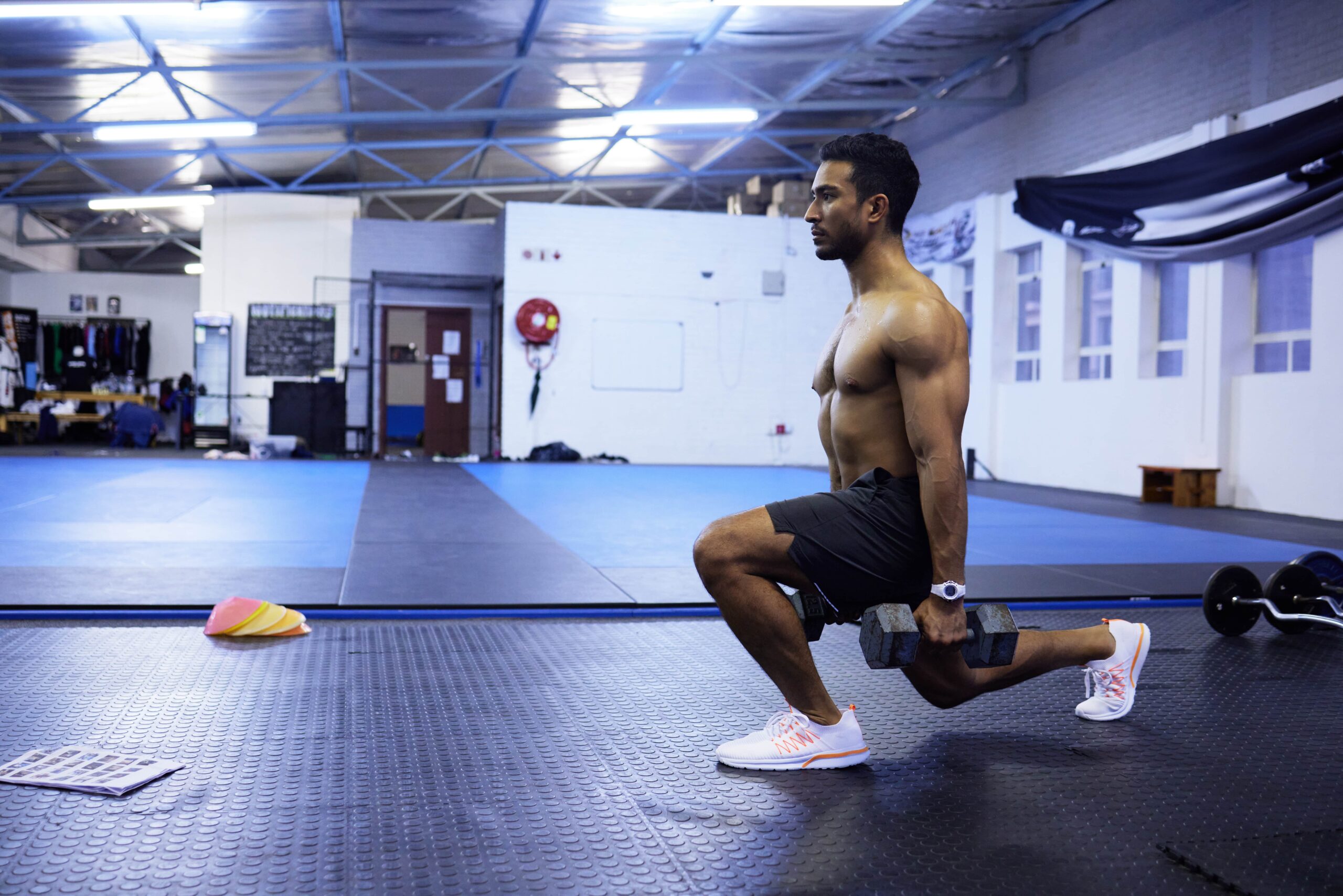
2. Reverse Lunge
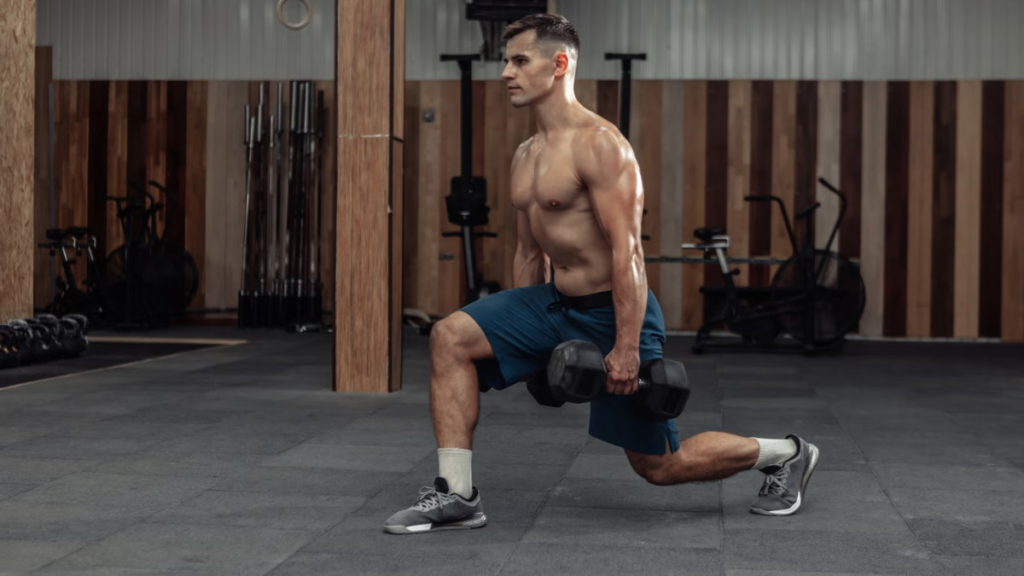
The reverse lunge is a highly effective single leg exercise for beginners. It trains the quadriceps, glutes, hamstrings, calves, and hip stabilizers while improving balance and coordination.
Stand tall, then step one foot backward. Lower your body until both knees are bent to a comfortable depth. Keep your front foot flat and your front knee tracking with the toes. Press through the front foot to return to standing.
The front leg performs most of the work, especially when you use a controlled step and avoid pushing hard from the back foot. The reverse lunge is often easier for beginners to control than a forward lunge because stepping backward can reduce the need to decelerate the body as aggressively.
Single leg training is useful because it can reveal differences in strength and balance between sides. You do not need identical performance on both legs immediately. Start with the weaker side, then match its repetitions on the stronger side.
How to Progress the Reverse Lunge
Begin with two or three sets of six to ten repetitions per leg. Use bodyweight first if balance is the limiting factor. Once you can perform stable repetitions, hold a dumbbell or kettlebell close to your chest.
Increase the range of motion and load gradually. A deeper lunge is not automatically better if you lose control of the front knee or pelvis. Use the deepest position you can manage smoothly.
Common Reverse Lunge Errors
A short backward step can make the movement feel unstable and force the front knee into an uncomfortable position. Take a moderate step backward that allows both knees to bend naturally.
Avoid rushing out of the bottom. Pause briefly, then push through the front foot. This keeps the movement controlled and gives the quads more useful work.
3. Leg Extension
The leg extension is a machine exercise that directly trains knee extension. It is one of the simplest ways for beginners to add focused quadriceps work after squats and lunges. Adjust the machine so that your knees align with the pivot point. Place the pad above your ankles, sit tall against the backrest, and hold the handles. Straighten your knees under control, pause briefly near the top, then lower the weight slowly.
The leg extension does not train balance or hip control like a squat or lunge. Its value is direct quadriceps loading. This can make it useful for adding training volume without placing a large technical demand on the lower back or hips.
Research on resistance training shows that muscle hypertrophy can occur with a range of exercise types and loads when training is sufficiently challenging. The leg extension can complement compound exercises by adding more direct work for the front of the thighs.
How to Progress the Leg Extension
Start with two or three sets of ten to fifteen repetitions. Use a load that allows you to move smoothly without kicking the weight upward or locking out aggressively.
When you can perform fifteen controlled repetitions, add a small amount of weight. You can also slow the lowering phase to increase the challenge before increasing load.
Common Leg Extension Errors
The most common mistake is moving too quickly. Lift and lower the weight with control so the quadriceps do the work. Another mistake is selecting a load that forces your hips to lift from the seat. Reduce the resistance until you can keep your body stable.
How to Build Quad Muscle Over Time
Train your quads two or three times per week, leaving at least one day between demanding leg sessions. A simple beginner workout can include three sets of goblet squats, two sets of reverse lunges, and two sets of leg extensions.
Research suggests that weekly resistance training volume contributes to muscle growth. Beginners can start with a modest amount of direct quad work and build gradually as their strength and recovery improve.
Most sets should end with one to three good repetitions still available. This helps you train hard enough to stimulate adaptation while keeping technique consistent. Going to complete failure is not required for beginners to build muscular legs.
Nutrition and recovery also matter. Eating enough protein supports muscle growth and repair, while sleep helps you recover from demanding training. The strongest leg program is one you can perform consistently for months.
Final Thoughts
The goblet squat, reverse lunge, and leg extension are three excellent beginner quad exercises for building jacked and muscular legs. The goblet squat develops basic leg strength. The reverse lunge builds single leg control and strength. The leg extension adds direct quadriceps volume.
Use controlled repetitions, select manageable loads, and make small progress over time. That approach builds quads that are not only more muscular, but stronger and more useful in everyday movement.
Key Takeaways
| Exercise | Main role | Starting recommendation | Main technique priority |
|---|---|---|---|
| Goblet squat | Builds overall leg strength and quad size | Two or three sets of eight to twelve repetitions | Keep the feet stable and knees tracking with the toes |
| Reverse lunge | Builds single leg quad strength and balance | Two or three sets of six to ten repetitions per leg | Step back with control and push through the front foot |
| Leg extension | Adds direct quadriceps training volume | Two or three sets of ten to fifteen repetitions | Lift and lower the weight slowly |
| Weekly structure | Supports quad muscle growth | Train quads two or three times weekly | Add load or repetitions gradually |
References
- American College of Sports Medicine (2009) ‘American College of Sports Medicine position stand: Progression models in resistance training for healthy adults’, Medicine and Science in Sports and Exercise, 41(3), pp. 687 to 708.
- Schoenfeld, B.J., Ogborn, D. and Krieger, J.W. (2017) ‘Dose response relationship between weekly resistance training volume and increases in muscle mass: A systematic review and meta analysis’, Journal of Sports Sciences, 35(11), pp. 1073 to 1082.
- Schoenfeld, B.J., Grgic, J., Ogborn, D. and Krieger, J.W. (2017) ‘Strength and hypertrophy adaptations between low versus high load resistance training: A systematic review and meta analysis’, Journal of Strength and Conditioning Research, 31(12), pp. 3508 to 3523.
- Wirth, K., Keiner, M., Hartmann, H., Sander, A. and Mickel, C. (2016) ‘Effect of 8 weeks of free weight squat training on strength, sprint performance, and jump power in recreationally trained men and women’, Journal of Strength and Conditioning Research, 30(10), pp. 2762 to 2769.