Big biceps are easy to notice, but judging whether they are big for your bodyweight is much harder than it appears. A 16 inch arm can look extraordinary on a lean 150 pound lifter and far less dramatic on a heavier lifter with more body fat, a larger frame, or longer arms. Your scale weight also includes far more than muscle. It reflects fat mass, bone mass, body water, organs, and the muscle in your entire body.
That means there is no scientifically validated equation that can tell you whether your biceps are “big” simply by dividing arm circumference by bodyweight. Still, you can make a much more useful assessment by combining arm measurements, body composition, proportionality, strength, and training history.


Why Bodyweight Is an Imperfect Comparison
Bodyweight matters because larger people generally carry more lean tissue and have larger limb dimensions. However, it is not a direct measure of biceps size. Two people at the same bodyweight can have very different muscularity because one may have more fat mass, while the other has more muscle mass.
Upper arm circumference is also not a direct measure of biceps muscle size. A tape measure records everything around the arm, including the biceps, triceps, brachialis, fat tissue, skin, and bone. This matters because the triceps make up a larger share of upper arm muscle mass than the biceps. Someone can have an impressive arm measurement while possessing relatively average biceps if their triceps are especially developed.
Research using imaging methods shows that muscle size is more accurately assessed with techniques such as magnetic resonance imaging, ultrasound, or computed tomography. These methods can distinguish between muscle, fat, and other tissues, whereas a tape measure cannot. In practical settings, though, a standardized circumference measurement is still useful for tracking your own progress over time.
The most meaningful question is not whether your arms reach a universal number. It is whether your arms are muscular, lean, proportionate to your frame, and improving in response to training.
How to Measure Your Arms Properly
A consistent measurement is more useful than an impressive but random one. Measure your upper arm under the same conditions each time, ideally when you are well hydrated and have not trained your arms immediately beforehand.
Measure Both Relaxed and Flexed
Measure the midpoint between the bony point at the top of your shoulder and the point of your elbow. Record both a relaxed measurement and a flexed measurement, using the same arm position and tape tension each time.
The relaxed measurement is often better for tracking actual tissue changes because it is less affected by how hard you flex. The flexed measurement can still be motivating, but it can change slightly depending on your pose, recent training, and muscle pump.
A post workout arm pump can temporarily increase circumference because resistance exercise increases blood flow and fluid in the working muscles. For a reliable record, measure at a consistent time, preferably before training.
Include Waist and Body Fat Context
A biceps measurement is much more informative when you also know your waist measurement and approximate body fat level. A 15 inch arm at a low body fat level will usually look far more muscular than the same measurement at a much higher body fat level.

Body fat assessment methods vary in accuracy. Dual energy X ray absorptiometry, underwater weighing, air displacement plethysmography, skinfold measurements, and bioelectrical impedance can all provide estimates, but each has limitations. Even without a precise percentage, regular waist measurements, progress photos, strength records, and bodyweight trends can create a practical picture of whether new arm size is likely muscle, fat, or both.
What Counts as Big?
There is no research based cutoff that defines a big biceps measurement for every adult. Genetics, height, sex, ethnicity, bone structure, training age, body fat, and the size of your triceps all influence the number on the tape.
For an adult male who lifts regularly and stays reasonably lean, a flexed upper arm circumference around 15 inches can look noticeably muscular on an average sized frame. A measurement around 16 inches is often impressive when body fat is moderate or low. Arms above 17 inches at a lean condition are uncommon outside of people with excellent genetics, long training histories, larger frames, or performance enhancing drug use.
Cardio vs Strength Training – Which Is More Important After 40?
These are visual and practical observations, not medical or scientific thresholds. They should not be treated as standards that determine success. A shorter lifter with 15 inch arms may look very muscular, while a very tall lifter may need a substantially larger arm measurement to create the same visual effect.
Women should use an even more individualized approach. Average arm circumference differs by sex and population, and female lifters typically begin with less upper body lean mass because of biological differences in muscle mass distribution. Progress relative to your own baseline is usually more valuable than comparing yourself with male bodybuilding standards or social media images.
Proportion Matters More Than a Single Number
Your biceps can be large in absolute terms but still look small if your shoulders, chest, forearms, or torso are much larger. Conversely, moderate arm size can look exceptional when paired with a narrow waist, developed deltoids, and low body fat.
Your arm length also affects appearance. A long upper arm spreads the same amount of muscle over a greater distance, which can make the biceps appear less full. Muscle insertion points, tendon length, and the shape of the muscle belly are largely genetic. Training can increase muscle size, but it cannot change where your biceps attach.
This is why comparing photos to someone with a different frame is rarely productive. Use your own arm circumference, waist measurement, bodyweight, and photographs under the same lighting to assess change. If your arms are growing while your waist remains stable or decreases, that is usually a much stronger sign of improved muscularity than bodyweight alone.
Strength Can Offer Useful Clues
Biceps strength is not a perfect proxy for biceps size, but it can provide supporting evidence. Larger muscles generally have greater potential to produce force because muscle cross sectional area is strongly related to strength. Skill, technique, leverage, tendon structure, and nervous system adaptations also influence performance, so strength gains do not prove that the biceps have grown.
Still, if your strict curl performance improves over months while your arm measurement also rises under consistent measuring conditions, it is reasonable to conclude that productive adaptation is occurring. The key word is strict. Swinging the torso or using the lower back turns a curl into a much less specific test of elbow flexor strength.
A controlled curl through a comfortable full range of motion is more useful than chasing a number with loose form. If your elbows, wrists, or shoulders hurt, reducing load and improving technique is more valuable than forcing progression.
How to Build Bigger Biceps for Your Frame
Biceps growth requires progressive resistance training, sufficient effort, adequate recovery, and enough energy and protein to support adaptation. Resistance training reliably increases skeletal muscle size, although the rate of growth varies widely between individuals.
Train the Biceps Directly
Rows, pulldowns, chin ups, and other pulling exercises train the elbow flexors, but direct curls provide additional biceps focused work. Research indicates that higher weekly training volumes tend to produce greater hypertrophy, up to a point, although individual recovery capacity matters.
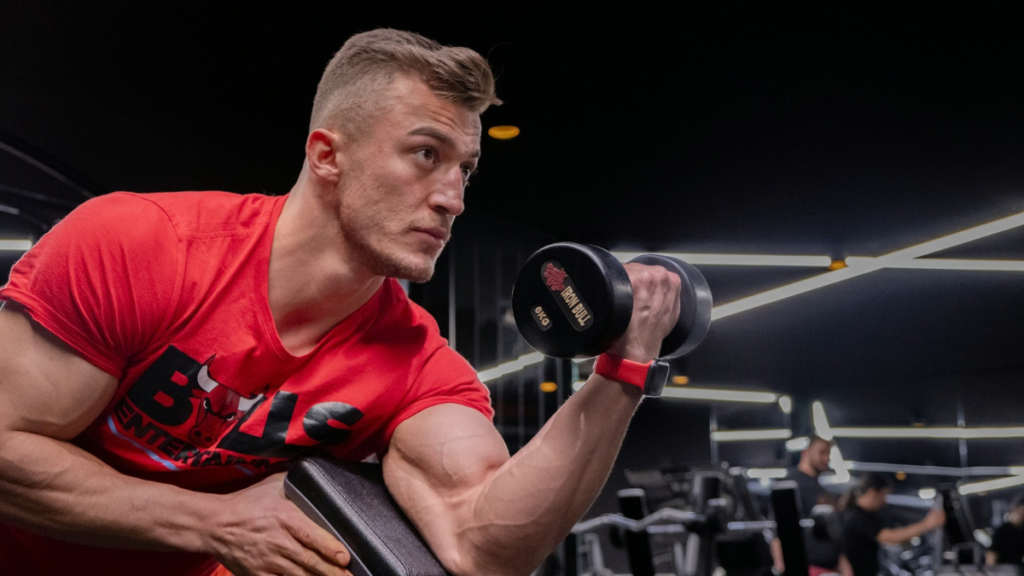
A practical starting point is to include several challenging sets of direct biceps work each week and increase volume only when you are recovering well and progressing. Curls can be performed with dumbbells, cables, barbells, machines, or resistance bands. Different tools can be useful because they change stability demands and resistance through the range of motion.
Both lighter and heavier loads can build muscle when sets are performed with sufficient effort. Very light loads may require more repetitions and may be less time efficient, while moderately heavy loads often make it easier to train hard with good control. The best choice is usually the load that lets you train near muscular fatigue without losing form or irritating your joints.
Use a Full, Controlled Range of Motion
A controlled full range of motion is generally a reliable default for hypertrophy training. Start with the elbow extended as far as is comfortable, then curl through the available range without swinging. Slow, intentional lowering phases can help maintain technique and make the target muscles do more of the work.
You do not need to reach absolute muscular failure on every set. Evidence suggests that training close to failure can stimulate hypertrophy, while repeated all out failure may add unnecessary fatigue for some people. Leaving a small number of repetitions in reserve is often a sustainable way to train hard while preserving quality.
Eat Enough Protein and Calories
Muscle growth is difficult when energy intake is consistently too low. If you are trying to add biceps size, a modest calorie surplus can make progress easier, although it may also add some body fat. If you prefer to stay lean, slower gains at maintenance calories can still occur, especially for beginners, people returning to training, and those with substantial room for improvement.

Protein intake supports the muscle building response to resistance training. A large meta analysis found that benefits for fat free mass tended to level off at an average intake of about 1.6 grams of protein per kilogram of bodyweight per day, although some people may benefit from somewhat higher intakes. Distributing protein across meals can also help make daily intake easier to achieve.
Sleep matters as well. Short sleep can impair recovery, training quality, appetite regulation, and the hormonal environment involved in adaptation. Consistent sleep supports the work you do in the gym.
A Better Way to Judge Your Biceps
Instead of asking whether your biceps are big enough for your bodyweight, track whether they are becoming more muscular for your body. Measure your relaxed and flexed arms every four to six weeks, record your waist and bodyweight, use consistent photos, and note changes in controlled curl performance.
If your arm circumference rises, your waist remains controlled, and your curls improve with sound technique, your biceps are likely moving in the right direction. If bodyweight rises quickly but your waist expands faster than your arms, the gain is less likely to be mostly muscle.
The most useful benchmark is not another person’s arm size. It is steady, measurable improvement that fits your frame, your goals, and your health.
Key Takeaways
| Factor | What it tells you | Practical use |
|---|---|---|
| Flexed arm circumference | Total upper arm size, including muscle and fat | Measure consistently and compare with your own previous measurements |
| Relaxed arm circumference | A less pose dependent measure of upper arm size | Use it to track long term tissue change |
| Waist measurement | Whether weight gain may be accompanied by fat gain | Track it alongside bodyweight and arm circumference |
| Body fat level | How visible your arm musculature will be | Use photos and repeated measurements rather than relying on one estimate |
| Curl performance | A supporting sign of biceps and elbow flexor progress | Track strict repetitions and load with controlled technique |
| Training history | How much development is realistic in the short term | Expect slower gains as training experience increases |
References
- American College of Sports Medicine (2009) ‘American College of Sports Medicine position stand: Progression models in resistance training for healthy adults’, Medicine & Science in Sports & Exercise, 41(3), pp. 687-708.
- Dankel, S.J., Mattocks, K.T., Jessee, M.B., Buckner, S.L., Mouser, J.G., Counts, B.R. and Loenneke, J.P. (2017) ‘Frequency: The overlooked resistance training variable for inducing muscle hypertrophy?’, Sports Medicine, 47(5), pp. 799-805.
- Fukunaga, T., Miyatani, M., Tachi, M., Kouzaki, M., Kawakami, Y. and Kanehisa, H. (2001) ‘Muscle volume is a major determinant of joint torque in humans’, Acta Physiologica Scandinavica, 172(4), pp. 249-255.
- Grgic, J., Schoenfeld, B.J., Orazem, J., Sabol, F., Bishop, D.J. and Pedisic, Z. (2022) ‘Effects of resistance training performed to repetition failure or non failure on muscular strength and hypertrophy: A systematic review and meta analysis’, Journal of Sport and Health Science, 11(2), pp. 202-211.
- Haun, C.T., Vann, C.G., Roberts, B.M., Vigotsky, A.D., Schoenfeld, B.J. and Roberts, M.D. (2019) ‘A critical evaluation of the biological construct skeletal muscle hypertrophy: Size matters but so does the measurement’, Frontiers in Physiology, 10, 247.
- Lasevicius, T., Ugrinowitsch, C., Schoenfeld, B.J., Roschel, H., Tavares, L.D., De Souza, E.O., Tricoli, V. and Teixeira, E.L. (2018) ‘Effects of different intensities of resistance training with equated volume load on muscle strength and hypertrophy’, European Journal of Sport Science, 18(6), pp. 772-780.
- Morton, R.W., Murphy, K.T., McKellar, S.R., Schoenfeld, B.J., Henselmans, M., Helms, E., Aragon, A.A., Devries, M.C., Banfield, L., Krieger, J.W. and Phillips, S.M. (2018) ‘A systematic review, meta analysis and meta regression of the effect of protein supplementation on resistance training induced gains in muscle mass and strength in healthy adults’, British Journal of Sports Medicine, 52(6), pp. 376-384.
- Schoenfeld, B.J., Ogborn, D. and Krieger, J.W. (2017) ‘Dose response relationship between weekly resistance training volume and increases in muscle mass: A systematic review and meta analysis’, Journal of Sports Sciences, 35(11), pp. 1073-1082.
- Schoenfeld, B.J., Grgic, J., Ogborn, D. and Krieger, J.W. (2017) ‘Strength and hypertrophy adaptations between low versus high load resistance training: A systematic review and meta analysis’, Journal of Strength and Conditioning Research, 31(12), pp. 3508-3523.