The reverse crunch is one of the most useful abdominal exercises for people who want stronger, more defined abs without turning every workout into a complicated core circuit. It is simple, needs no equipment, and can be progressed when basic repetitions become easy. It also asks you to move your pelvis toward your rib cage, which is an important difference from a standard crunch, where the rib cage moves toward the pelvis.
That does not mean the reverse crunch is automatically the perfect six pack exercise for everyone. It is a strong option, especially if you can control the movement well, but it cannot create visible abs by itself. The best exercise is the one that fits your current strength, body composition goals, injury history, and ability to train with consistent technique.


What a Reverse Crunch Actually Trains
The reverse crunch mainly challenges the rectus abdominis, the long muscle running down the front of your torso that creates the familiar segmented six pack appearance. It also involves the external obliques, which sit along the sides of the abdomen and help control trunk and pelvic movement.
A proper reverse crunch starts lying on your back with the hips and knees bent. You then use your abs to curl your pelvis off the floor and draw your knees slightly toward your chest. The important action is the pelvic curl, not simply lifting the knees. If the hips never leave the floor, the movement becomes more like a hip flexor exercise than a true reverse crunch.

Research using electromyography, which measures electrical activity associated with muscle contraction, has found that reverse curl variations produce high activity in the lower portion of the rectus abdominis. In one study of healthy adults, the reverse curl produced greater lower rectus abdominis activity than the trunk curl, twisted trunk curl, and V sit during both static and dynamic testing. The same study found that reverse curls also created substantial external oblique activity.
These findings support the reverse crunch as a useful exercise for training the abdominal wall. They do not prove that it is the only movement needed for complete core development. Electromyography can show which muscles are active during an exercise, but muscle activity alone does not guarantee greater long term muscle growth. Training effort, range of motion, progressive overload, recovery, nutrition, and total program design still matter.
Why People Call It a Lower Ab Exercise
The Lower Abs Are Not a Separate Muscle
The phrase lower abs is useful for describing the area below the navel, but it can be misleading. The rectus abdominis is one continuous paired muscle rather than a completely separate upper and lower muscle. You cannot isolate fat loss from the lower stomach with a specific exercise, and you cannot transform only one section of your rectus abdominis while leaving the rest unchanged.
However, different exercises can change how hard different regions of the rectus abdominis work. The reverse crunch may place more demand on the lower area because it emphasizes posterior pelvic tilt and pelvic movement. In practical terms, that means many lifters feel the exercise strongly in the region below the navel, even though the whole rectus abdominis is involved.
The important distinction is between regional muscle activation and local fat loss. Training your abs can strengthen and build the muscles in your midsection. It does not selectively burn the fat covering the muscles being trained.
Visible Abs Require More Than Ab Training
A six pack is partly a muscle development goal and partly a body composition goal. The rectus abdominis needs enough size to show, but it also needs to be visible beneath the layer of subcutaneous body fat. A controlled trial examining six weeks of abdominal exercise found improvements in abdominal endurance but no meaningful reduction in abdominal fat, body weight, body mass index, or abdominal circumference.
This does not make direct ab training pointless. It means you should treat reverse crunches as one part of the plan. Regular resistance training can help maintain or increase lean mass, while aerobic activity and dietary habits can help create the energy balance needed for fat loss when that is your goal. Your genetics, sex, total muscle mass, and fat distribution also influence how lean you need to become before abdominal definition is noticeable.
How to Perform the Reverse Crunch Well
Start on your back with your arms by your sides or lightly holding a stable bench behind your head. Bend your knees to roughly 90 degrees and lift your feet so your thighs are close to vertical. Keep your lower back gently in contact with the floor before each repetition.
Exhale as you tighten your abs and curl your pelvis upward. Your knees should travel toward your chest only a small amount. Think about bringing your belt buckle toward your rib cage rather than throwing your legs overhead. The lift may be short, but it should feel deliberate and controlled.
Pause briefly when your hips are just off the floor, then lower slowly until your pelvis returns to the ground. Avoid letting your feet swing down or using momentum to start the next repetition. A slow lowering phase makes it easier to keep tension on the abs and easier to identify whether you are actually controlling the movement.
Keep your neck relaxed and your shoulders heavy on the floor. You do not need to lift your head to make the exercise harder. Raising your head and shoulders can encourage neck tension and turn the movement into an awkward combination of a crunch and reverse crunch.
Common Mistakes That Limit Results
Swinging the Legs Instead of Curling the Pelvis
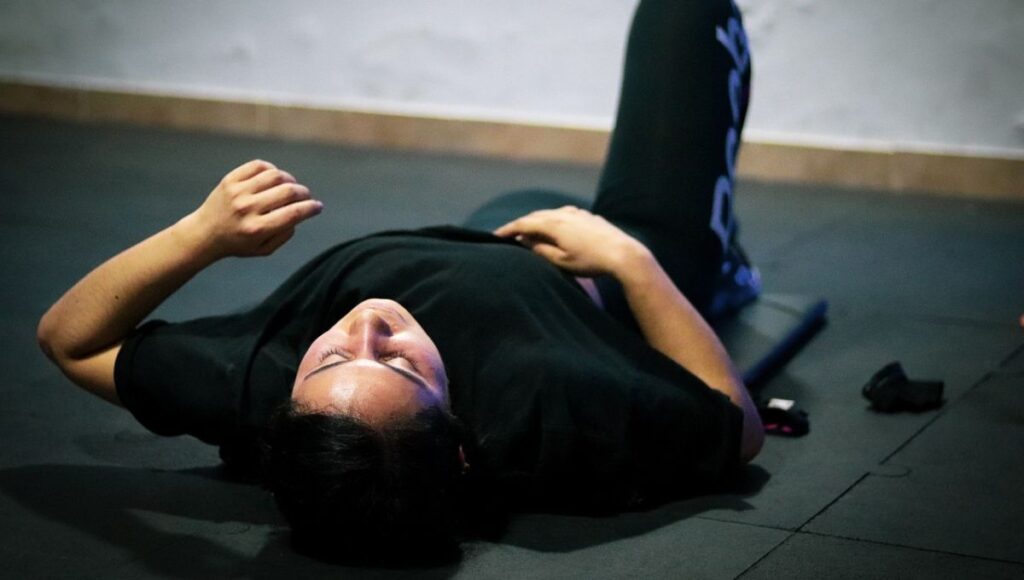
The most common error is using the legs to create momentum. When the legs swing toward the chest but the pelvis stays on the ground, the hip flexors do much of the work. Hip flexors are not bad muscles, but this version misses the main benefit of the reverse crunch.
Use a smaller range of motion if necessary. A controlled pelvic curl of a few inches is more productive than a large leg swing with little abdominal control.
Letting the Lower Back Arch
An excessive lower back arch can reduce the quality of the exercise and make it harder to feel the abs. Set your pelvis by gently flattening your lower back before you start each repetition. Maintain that position as you curl upward, then reset it at the bottom.
This cue is especially valuable for people who feel reverse crunches mostly in the front of the hips. A smaller movement with better pelvic control is usually the right answer.
Chasing High Repetitions Too Soon
Many people perform reverse crunches for very high repetitions because bodyweight ab exercises appear easy. Yet muscle and strength adaptations depend on sufficiently challenging effort, not on a magic rep count. If you can perform many repetitions without loss of control, slow the tempo, add a pause at the top, extend your arms overhead, or progress to a more demanding variation.
Good technique should set the limit. Stop the set when you can no longer curl the pelvis smoothly without swinging, arching, or holding your breath.
Who Should Use Reverse Crunches
The reverse crunch is a good choice for beginners who can get down to and up from the floor comfortably. It has a shorter learning curve than hanging leg raises, requires no gym equipment, and provides a clear way to practice pelvic control. It is also useful for experienced lifters who want direct rectus abdominis work after heavier compound movements.
It can be particularly valuable if standard crunches feel uncomfortable in your neck or if you want an exercise that keeps the upper body relatively still. Because the head and shoulders remain on the floor, many people find it easier to focus on the abdomen rather than straining through the neck.
People with current low back pain, recent abdominal surgery, pregnancy related concerns, hip pain, or other medical conditions should seek individual guidance from a qualified health professional before adding or progressing abdominal exercises. Research on stabilization exercise for persistent nonspecific low back pain suggests that exercise can be beneficial, but the best approach depends on the person and should not be reduced to one universal movement.
How to Make the Reverse Crunch Harder
Once you can perform controlled sets, progress the reverse crunch gradually. Begin by slowing the lowering phase to about three seconds. Then add a brief pause at the top while keeping the ribs down and the pelvis curled. Both changes increase difficulty without needing extra equipment.
Cardio vs Strength Training – Which Is More Important After 40?
You can also extend your arms overhead, which increases the challenge to the trunk by moving more of your body mass farther from the hips. Another option is to hold a light object between your knees, although the added load should never cause you to swing or lose pelvic control.
A hanging knee raise or hanging leg raise may be a useful later progression, but these movements require more grip strength, shoulder control, and hip flexor contribution. They are not automatically superior. The reverse crunch often remains the better choice when your goal is focused abdominal training with a controlled range of motion.
Is It the Perfect Six Pack Exercise?
The reverse crunch is not perfect because no single exercise can handle every part of abdominal development or body composition. It does not replace overall resistance training, dietary consistency, physical activity, sleep, or a sensible fat loss strategy when visible abs are the goal.
Still, it is one of the better bodyweight choices for direct abdominal training. It is accessible, easy to scale, and supported by evidence showing high activity in the lower region of the rectus abdominis and the external obliques. When you perform it with a true pelvic curl instead of a leg swing, it can earn a regular place in an effective core routine.
Use it two or three times per week after your main training. Perform controlled sets that bring you close to technical fatigue, then progress only when every repetition remains smooth. Pair it with whole body strength work and the nutrition habits that support your body composition goal. That is a much more reliable path to stronger, more visible abs than searching for one magic exercise.
Key Takeaways
| Topic | Key takeaway |
|---|---|
| Main muscles | Reverse crunches train the rectus abdominis and external obliques, with strong activity in the lower rectus abdominis region. |
| Best technique cue | Curl the pelvis toward the rib cage instead of swinging the knees toward the chest. |
| Lower abs | The lower abs are part of the continuous rectus abdominis, although reverse crunches can emphasize the lower region. |
| Six pack visibility | Ab exercises build and strengthen muscle, but visible abs also require sufficiently low body fat for the individual. |
| Progression | Increase control, range of motion, pauses, and load only when you can maintain a smooth pelvic curl. |
| Overall verdict | The reverse crunch is an excellent abs exercise, but it works best as part of a complete training and nutrition plan. |
References
- Axler, C.T. and McGill, S.M. (1997) ‘Low back loads over a variety of abdominal exercises: Searching for the safest abdominal challenge’, Medicine & Science in Sports & Exercise, 29(6), pp. 804–811.
- Escamilla, R.F., McTaggart, M.S., Fricklas, E.J., DeWitt, R., Kelleher, P., Taylor, M.K., Hreljac, A. and Moorman, C.T. (2006) ‘An electromyographic analysis of commercial and noncommercial abdominal exercises: Implications for rehabilitation and training’, Journal of Orthopaedic & Sports Physical Therapy, 36(2), pp. 45–57.
- Saragiotto, B.T., Maher, C.G., Yamato, T.P., Costa, L.O.P., Menezes Costa, L.C., Ostelo, R.W.J.G. and Macedo, L.G. (2020) ‘Motor control exercise for chronic non specific low back pain’, Cochrane Database of Systematic Reviews, 1, CD012004.
- Vigotsky, A.D., Halperin, I., Lehman, G.J., Trajano, G.S. and Vieira, T.M. (2018) ‘Interpreting signal amplitudes in surface electromyography studies in sport and rehabilitation sciences’, Frontiers in Physiology, 8, 985.
- Vispute, S.S., Smith, J.D., LeCheminant, J.D. and Hurley, K.S. (2011) ‘The effect of abdominal exercise on abdominal fat’, Journal of Strength and Conditioning Research, 25(9), pp. 2559–2564.
- Willett, G.M., Hyde, J.E., Uhrlaub, M.B., Wendel, C.L. and Karst, G.M. (2001) ‘Relative activity of abdominal muscles during commonly prescribed strengthening exercises’, Journal of Strength and Conditioning Research, 15(4), pp. 480–485.