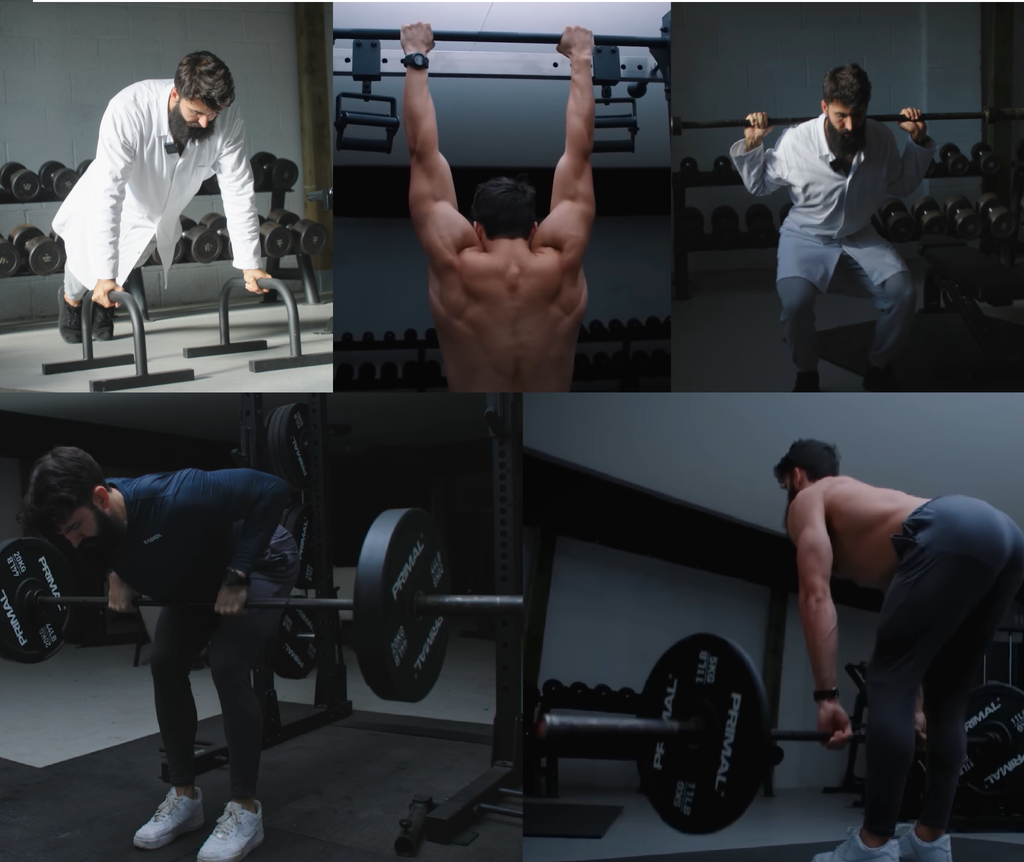


A muscular, strong body does not require an endless exercise list. It requires consistent effort on movements that let you train a lot of muscle mass, add load over time, and practice the positions where strength matters most.
For most men, three barbell compound exercises provide an exceptionally effective foundation: the back squat, bench press, and deadlift. Together, they train the legs, glutes, chest, shoulders, triceps, back, trunk, and grip. They also give you simple performance markers. If your technique is sound and your working weights gradually rise, you are likely building both strength and muscle.


That does not mean these are the only useful exercises. Rows, pull ups, lunges, overhead presses, curls, and direct abdominal work all have value. However, if you need to strip training back to the most productive essentials, these three movements cover a huge amount of ground.
Research consistently shows that progressive resistance training improves muscular strength and muscle size. The strongest results come from training hard, using a full comfortable range of motion, accumulating sufficient weekly work, and repeating the process for months rather than searching for a perfect routine.
Why Compound Exercises Matter
A compound exercise uses multiple joints and muscle groups in one movement. In a squat, your hips, knees, and ankles work together while your trunk resists spinal movement. In a bench press, the shoulders and elbows move while the upper back and trunk create a stable base. In a deadlift, the hips and knees extend while the back, trunk, and hands transfer force into the bar.
This makes compound training efficient. You can challenge several large muscle groups with one lift, build coordination under load, and complete meaningful training in less time than a routine made entirely of isolation exercises.
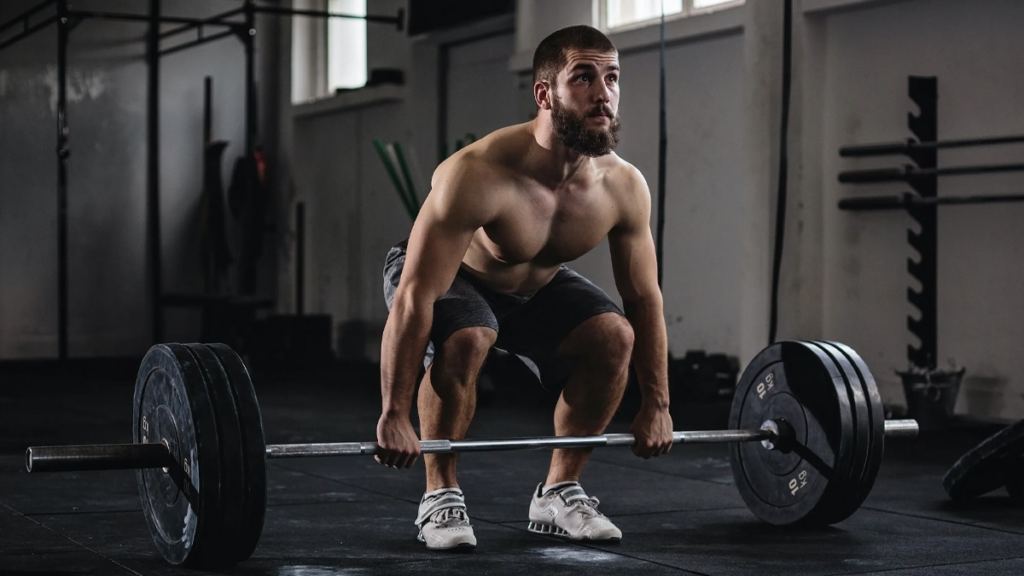
Compound lifts are especially valuable because they allow progressive overload. This means gradually asking more of your body through added weight, more repetitions, more sets, better technique, or a greater range of motion. Muscles adapt when training creates enough tension and effort to challenge their current capacity. The barbell gives you a practical way to track that challenge.
You do not need to lift maximal weight to grow. Both lighter and heavier loads can build muscle when sets are performed with adequate effort. Heavier loads tend to produce greater improvements in maximal strength, which makes them particularly useful when your goal is to look strong and become genuinely strong.
Exercise One: The Back Squat
The back squat is the first essential lift because powerful legs and glutes change the look and performance of your whole body. It develops the quadriceps, glutes, adductors, calves, trunk, and spinal erectors while demanding control from the upper back.
What the Back Squat Builds
Your quads extend the knees as you stand, while your glutes and adductors help extend the hips. The muscles around your trunk must work hard to keep your torso controlled as the bar travels over the middle of your foot. Your upper back also supports the barbell and helps maintain a stable position.
That combination makes the squat a high value movement for overall lower body size and strength. It is not just an exercise for athletes or powerlifters. Stronger legs and hips improve your capacity for almost every other gym movement, from lunges and sled pushes to deadlifts and carries.
Squatting through a comfortable, controlled depth is important. A full range of motion generally produces better strength and hypertrophy outcomes than consistently using shallow partial repetitions. The correct depth is individual. Your goal is to move as deeply as you can while keeping control, avoiding pain, and maintaining a stable foot position.
How to Perform It Well
Set the bar on a secure rack at roughly upper chest height. Position it across your upper back, either high on the traps or slightly lower across the rear shoulders, depending on which position feels stable. Grip the bar firmly and pull your elbows down toward your ribs to create upper back tension.
Walk the bar out with two or three deliberate steps. Place your feet around shoulder width apart, although a slightly wider stance may suit some lifters better. Take a deep breath into your abdomen and brace as if preparing to absorb a punch.
Sit down between your hips and bend your knees in a controlled manner. Keep your feet planted, allow your knees to travel in the same direction as your toes, and keep the bar balanced over the middle of your foot. Drive upward by pushing the floor away and maintaining pressure through the whole foot.
Start with a load that lets you repeat the movement confidently. For muscle and strength, three to five sets of five to ten repetitions works well for many lifters. Stop a repetition or two before technical breakdown rather than allowing every set to become a grinding fight.
Exercise Two: The Barbell Bench Press
The bench press is the cornerstone upper body pushing exercise. It trains the chest, triceps, and front shoulders, while the upper back and shoulder blade muscles provide the stable platform that lets you press effectively.
What the Bench Press Builds
The primary muscles in the bench press are the pectoralis major, anterior deltoids, and triceps. The chest helps move the upper arm across the body, the triceps straighten the elbows, and the shoulders contribute to pressing the bar away from the chest.
A bigger bench does not automatically equal a complete upper body, but a strong, well performed bench press can add substantial mass to the chest, shoulders, and triceps. It is also easy to progress. Adding a small amount of weight, completing one extra repetition, or improving control at the bottom of the lift are all meaningful signs of development.
The bench press should not be treated as a chest only exercise. Your upper back matters. A stable upper back gives you a consistent pressing surface, helps keep the shoulders in a stronger position, and makes every repetition more repeatable.
How to Perform It Well
Lie on the bench with your eyes under the bar. Set your feet firmly on the floor and create tension through your legs. Pull your shoulder blades back and down gently, then keep them stable against the bench throughout the set.
Use a grip that allows your forearms to be close to vertical when the bar reaches your chest. Lift the bar out of the rack with straight arms, then lower it with control to the lower portion of your chest. Your elbows should not flare directly out to the sides, but they also do not need to be forced tightly against your ribs.
Press the bar upward and slightly back toward the starting position. Keep your wrists stacked above your forearms and drive your feet into the floor without allowing your hips to rise from the bench.
For most people, three to five sets of six to twelve repetitions provide a productive combination of practice, strength work, and muscle building volume. A spotter or safety arms are sensible when you are approaching challenging weights.
Exercise Three: The Deadlift
The deadlift teaches you to create force from the floor and stand with a heavy object in your hands. It is one of the best tests of total body strength because the movement requires the legs, glutes, hamstrings, back, trunk, grip, and upper body to work together.
What the Deadlift Builds
The deadlift heavily trains the glutes, hamstrings, spinal erectors, upper back, forearms, and hands. Your quads also contribute as the bar leaves the floor. It is not a movement that isolates any one area, which is exactly why it has such a strong return on effort.
A well trained deadlift can help build the dense look many men want through the back, glutes, hamstrings, and forearms. It also develops the ability to maintain body position while producing force, an important quality in sport, work, and everyday life.
Because deadlifts are demanding, they do not always need high repetitions or huge amounts of weekly volume. High quality sets performed with solid technique usually beat exhausting yourself with endless sloppy reps.
How to Perform It Well
Stand with the bar over the middle of your feet. Bend down and grip the bar with your hands just outside your legs. Bring your shins close to the bar, then pull your chest long and tighten your upper back.
Take the slack out of the bar before it leaves the floor. You should feel your body create tension rather than jerking the bar upward. Push the floor away while keeping the bar close to your legs. Let your hips and shoulders rise together until you reach standing.
At the top, stand tall with your glutes squeezed, but do not lean backward or force your lower back into an exaggerated arch. Return the bar to the floor by pushing your hips back and keeping the bar close to your legs.
Two to four sets of three to eight repetitions are enough for many lifters. Beginners can benefit from practicing more repetitions with lighter loads, while experienced lifters may need fewer hard sets because the absolute loads are higher.
How to Train the Three Lifts for Results
Train each movement at least once per week. Many lifters progress well by squatting and bench pressing two times per week, while deadlifting once per week and using a lighter hinge movement on another day. The exact schedule matters less than consistency and recovery.
Aim to add a small amount of weight when you can complete all prescribed repetitions with strong technique. If you cannot add weight, try to complete an extra repetition within your target range before increasing the load. This slow, measured progression is more sustainable than constantly testing maximum lifts.
For muscle growth, sufficient weekly training volume matters. A useful long term target is around ten or more challenging sets per muscle group each week, although your personal needs depend on training experience, recovery, exercise selection, and effort. The squat, bench press, and deadlift contribute greatly to that total, but accessories can help provide additional volume where needed.
Do not ignore recovery. Muscle growth happens after training, not during it. Eat enough protein, consume enough total calories to support your goal, sleep consistently, and keep your technique strict enough that you can train again productively.
The Bottom Line
The squat, bench press, and deadlift are not magic, but they are remarkably effective tools. They train almost every major muscle group, reward disciplined progression, and give you a direct route toward a more muscular and capable body.
Master the technique, train them consistently, and make small improvements over time. Add supporting exercises when needed, but build your program around these three lifts and you will never lack a productive foundation.
Key Takeaways
| Focus | What to do | Why it matters |
|---|---|---|
| Back squat | Train three to five controlled sets of five to ten repetitions | Builds the quads, glutes, trunk, and lower body strength |
| Bench press | Train three to five controlled sets of six to twelve repetitions | Develops the chest, triceps, front shoulders, and pressing strength |
| Deadlift | Train two to four high quality sets of three to eight repetitions | Builds the glutes, hamstrings, back, grip, and total body strength |
| Progression | Add load or repetitions gradually while maintaining technique | Progressive overload drives long term strength and muscle gains |
| Weekly training | Practice each lift at least once weekly and recover well | Consistency, sufficient volume, and recovery support adaptation |
References
- Currier, B.S., D’Souza, A.C., Fiatarone Singh, M.A., Lowisz, C.V., Rawson, E.S., Schoenfeld, B.J., Smith Ryan, A.E., Steen, J., Thomas, G.A., Triplett, N.T., Washington, T.A., Werner, T.J. and Phillips, S.M. (2026) ‘American College of Sports Medicine position stand: Resistance training prescription for muscle function, hypertrophy, and physical performance in healthy adults: An overview of reviews’, Medicine and Science in Sports and Exercise, 58(4), pp. 851–872.
- Grgic, J., Schoenfeld, B.J., Orazem, J. and Sabol, F. (2022) ‘Effects of resistance training performed to repetition failure or non failure on muscular strength and hypertrophy: A systematic review and meta analysis’, Journal of Sport and Health Science, 11(2), pp. 202–211.
- Krzysztofik, M., Wilk, M., Wojdała, G. and Gołaś, A. (2019) ‘Maximizing muscle hypertrophy: A systematic review of advanced resistance training techniques and methods’, International Journal of Environmental Research and Public Health, 16(24), 4897.
- Schoenfeld, B.J., Grgic, J., Ogborn, D. and Krieger, J.W. (2017) ‘Strength and hypertrophy adaptations between low versus high load resistance training: A systematic review and meta analysis’, Journal of Strength and Conditioning Research, 31(12), pp. 3508–3523.
- Schoenfeld, B.J., Ogborn, D. and Krieger, J.W. (2017) ‘Dose response relationship between weekly resistance training volume and increases in muscle mass: A systematic review and meta analysis’, Journal of Sports Sciences, 35(11), pp. 1073–1082.
- Schoenfeld, B.J., Peterson, M.D., Ogborn, D., Contreras, B. and Sonmez, G.T. (2015) ‘Effects of low versus high load resistance training on muscle strength and hypertrophy in well trained men’, Journal of Strength and Conditioning Research, 29(10), pp. 2954–2963.
- Schoenfeld, B.J., Ratamess, N.A., Peterson, M.D., Contreras, B., Tiryaki Sonmez, G. and Alvar, B.A. (2015) ‘Effects of different volume equated resistance training loading strategies on muscular adaptations in well trained men’, Journal of Strength and Conditioning Research, 29(10), pp. 2909–2918.
- Simao, R., de Salles, B.F., Figueiredo, T., Dias, I. and Willardson, J.M. (2012) ‘Exercise order in resistance training’, Sports Medicine, 42(3), pp. 251–265.
- Vuk, S., Vukovic, M., Stojanovic, E., Trajkovic, N. and Milanovic, Z. (2021) ‘The effects of full versus partial range of motion resistance training on muscular strength and hypertrophy: A systematic review and meta analysis’, Journal of Sports Sciences, 39(16), pp. 1840–1851.