

Getting bigger arms takes consistent training, not a secret exercise or an overnight transformation. The good news is that beginners can make noticeable progress by learning a few reliable movements, using a weight they can control, and gradually doing more over time. A bigger arm workout does not need to be complicated, either.
It needs to train the muscles that bend and straighten your elbows and give them enough challenging work to grow.


The three exercises below give you a practical place to start: the incline dumbbell curl, the overhead triceps extension, and the close-grip pushup. Together, they train the biceps and triceps with beginner friendly equipment and simple technique. Research also suggests that exercise position can affect how muscles respond, although no single exercise guarantees faster growth for everyone.
What beginners need to know about arm growth
The biceps bend the elbow, while the triceps straighten it. Both matter if you want your arms to look fuller. That is why an arm routine should include both a curl and an extension. The triceps also have three heads, including a long head that crosses the shoulder joint. Training with your arm raised overhead lengthens that head, and one controlled study found greater triceps growth from overhead elbow extensions than from extensions with the arm beside the body.
Muscle growth comes from repeating challenging resistance training and recovering from it. Beginners do not need to use very heavy weights or train until they cannot complete another repetition. A systematic review found no clear hypertrophy advantage to reaching momentary failure on every set. Instead, choose a load that lets you use good form and finish most sets with about one to three good repetitions still possible. That effort level is challenging without making every set a grind.
The number of sets matters too, but adding more work is not automatically better. A meta-analysis found a general relationship between weekly resistance training volume and muscle growth, while also showing that responses vary. Start with a manageable amount, then add repetitions or a small amount of weight when your technique stays consistent. Beginners can make progress without turning every workout into a marathon.
1. Incline dumbbell curl
The incline dumbbell curl is a useful choice for training the biceps through a controlled range of motion. Sit against an incline bench with a dumbbell in each hand and let your arms hang naturally. Keep your shoulders relaxed and your upper arms close to your sides as you bend your elbows to lift the dumbbells. Lower them slowly until your elbows are nearly straight, without letting the weights pull your shoulders forward.
The bench position places your upper arms slightly behind your torso. That lengthens the biceps compared with a curl performed with the arms held in front of the body. A recent study comparing incline curls with preacher curls found differences in where the elbow flexor muscles grew, with the incline curl producing greater growth in the proximal region measured by the researchers. That does not prove incline curls are best for every person, but it gives a reasonable basis for including them in a beginner program.
Start light. The stretched position can feel unfamiliar, and using too much weight often leads to swinging, shrugging, or letting the elbows drift forward. Keep the movement smooth and stop the set if you cannot control the lowering phase. Aim for two or three sets of 8 to 12 repetitions. Rest long enough to regain control and repeat the set with similar technique.
If you do not have an incline bench, perform standing dumbbell curls with your arms at your sides. The most important thing is to bend and straighten the elbows under control. You do not need to force a deep stretch or use a position that feels uncomfortable in your shoulders.
2. Overhead triceps extension
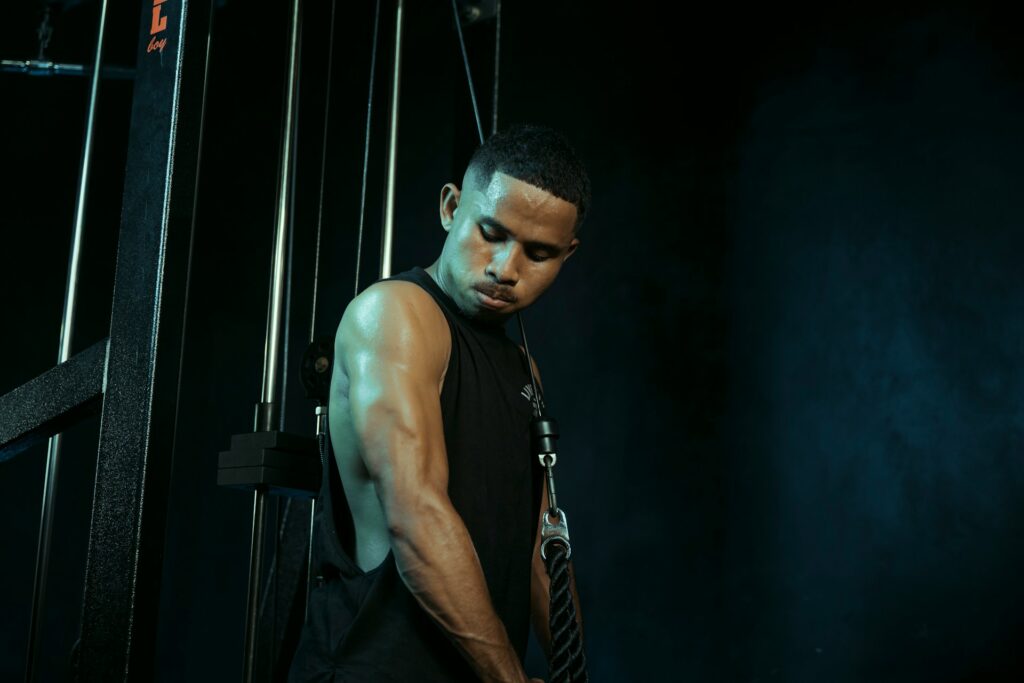
The overhead triceps extension targets the back of the upper arm. You can perform it with one dumbbell held in both hands or with a cable and rope attachment. For the dumbbell version, sit or stand tall, hold the weight above your head, and bend your elbows to lower it behind you. Then straighten your elbows to return the weight overhead. Keep your upper arms pointing upward and avoid arching your lower back to move a heavier load.
This exercise earns its place because of the arm position. The triceps long head crosses the shoulder, so raising the arm overhead puts it at a longer muscle length. In a training study, overhead cable elbow extensions produced greater triceps growth than extensions performed with the upper arm in a neutral position. The study supports the exercise position, but it does not mean you must use a cable or that every beginner will respond identically.
Use a light enough weight to keep your elbows steady and your shoulders comfortable. Lower the dumbbell only as far as you can while maintaining control. If the movement causes joint pain, use a cable, try a lighter load, or choose a more comfortable elbow extension variation. Muscle effort is expected; sharp pain is not a useful training target.
Perform two or three sets of 8 to 12 repetitions. Let the elbows bend as you lower the weight, then straighten them without snapping into lockout. Control each repetition rather than dropping the weight quickly. As you get stronger, you can gradually add repetitions before increasing the load.
3. Close-grip pushup
The close-grip pushup trains the triceps while also working the chest and shoulders. Begin in a high plank with your hands under your shoulders or slightly closer together. Keep your body in a straight line from your head to your heels, bend your elbows to lower your chest, then press the floor away to return to the start. Keep your elbows angled back rather than flaring out to the sides.
Pushups are convenient because they require no gym equipment, and you can adjust their difficulty. If a floor pushup is too difficult to perform with control, place your hands on a sturdy bench or counter. The more upright position reduces the amount of body weight you need to press. As you build strength, lower the hand position until you can perform floor repetitions with steady form.
The close hand position makes the triceps work hard to straighten the elbows, but the pushup is still a compound exercise that involves other upper body muscles. It complements the more direct arm work in the first two exercises. If your wrists feel uncomfortable, try placing your hands on dumbbells or pushup handles so your wrists stay more neutral, or use an elevated surface.
Start with two or three sets, stopping when you still have one or two clean repetitions left. If you can do more than 15 repetitions easily, use a lower hand position or a harder variation. If your hips sag or your shoulders take over, make the movement easier and keep the repetitions controlled.
How to put the exercises together
Train these movements two times per week, with at least a day between sessions. For example, you could perform them on Monday and Thursday. Do two sets of each exercise during the first couple of weeks. If you recover well and your technique stays solid, build toward three sets per exercise. This gives you a simple starting amount of direct arm work without demanding a high level of training experience.
The 3 Exercises that Make Your Shoulders Look Wider
For each exercise, use a load or variation that lets you complete about 8 to 12 controlled repetitions. The exact repetition number is less important than choosing a challenging resistance and keeping your form consistent. Research comparing different resistance training loads suggests that muscle growth can occur across a range of loads when sets are sufficiently challenging. The moderate repetition range is practical for many beginners because it balances a manageable load with enough practice to learn the movement.
Keep a simple training record. Write down the weight, repetitions, and sets you complete. When you can perform the top end of your target repetition range for every set with good technique, increase the weight slightly next time. If you are doing pushups, make the variation a little harder when the current version is no longer challenging. This gradual progression gives your muscles a reason to adapt.
You do not need to train your arms every day. Your muscles need time to recover between hard sessions, and arm exercises also involve joints and connective tissues that adapt over time. If soreness is affecting your next workout or technique is slipping, keep the same weight or reduce a set rather than forcing extra work.
Support your training with recovery and nutrition
Eating enough protein helps support gains from resistance training, but protein powder is not required. A meta-analysis of protein supplementation and resistance training found that supplementation can add a modest benefit to muscle and strength gains, particularly when total daily protein intake would otherwise be low. Build meals around protein rich foods such as eggs, dairy, fish, poultry, tofu, beans, or lentils. Supplements are simply a convenient option when food does not meet your needs.
Sleep and consistency matter because muscle growth takes repeated training over time. Do not judge progress from a single workout or chase rapid changes with daily arm sessions. Track your performance over several weeks, use the same technique, and increase the challenge gradually. Beginners often improve quickly at first, but the pace varies from person to person.
“Quickly” should mean making steady, measurable progress while staying healthy enough to keep training. These three movements can help beginners build a foundation for stronger, fuller arms, but results depend on consistent effort, progressive training, recovery, and nutrition. Focus on adding a repetition or a little resistance when you can do so with good form, and give the process enough time to work.
Key takeaways
| Focus | What to do |
|---|---|
| Exercise selection | Pair incline dumbbell curls and overhead triceps extensions with close-grip pushups. |
| Starting volume | Begin with two sets per exercise, twice per week, and add sets gradually if recovery is good. |
| Repetition target | Use a challenging load or variation that allows about 8 to 12 controlled repetitions. |
| Progression | Add repetitions first, then increase the weight or difficulty when your form remains consistent. |
| Effort | Finish most sets with about one to three good repetitions still possible. |
| Recovery | Leave at least a day between arm sessions and eat enough protein rich foods to support training. |
References
- American College of Sports Medicine (2009) ‘American College of Sports Medicine position stand. Progression models in resistance training for healthy adults’, Medicine & Science in Sports & Exercise, 41(3), pp. 687–708.
- Maeo, S. et al. (2023) ‘Triceps brachii hypertrophy is substantially greater after elbow extension training performed in the overhead versus neutral arm position’, European Journal of Sport Science, 23(7), pp. 1240–1250.
- Morton, R.W. et al. (2018) ‘A systematic review, meta-analysis and meta-regression of the effect of protein supplementation on resistance training-induced gains in muscle mass and strength in healthy adults’, British Journal of Sports Medicine, 52(6), pp. 376–384.
- Refalo, M.C. et al. (2023) ‘Influence of resistance training proximity-to-failure on skeletal muscle hypertrophy: a systematic review with meta-analysis’, Sports Medicine, 53(3), pp. 649–665.
- Schoenfeld, B.J., Ogborn, D. and Krieger, J.W. (2017) ‘Dose-response relationship between weekly resistance training volume and increases in muscle mass: a systematic review and meta-analysis’, Journal of Sports Sciences, 35(11), pp. 1073–1082.
- Tavares, L.D. et al. (2025) ‘Distinct muscle growth and strength adaptations after preacher and incline biceps curls’, International Journal of Sports Medicine, 46(5), pp. 334–343.
- López, P. et al. (2021) ‘Resistance training load effects on muscle hypertrophy and strength gain: systematic review and network meta-analysis’, Medicine & Science in Sports & Exercise, 53(6), pp. 1206–1216.